“Babe in the woods” is an English expression used to describe someone who is innocent, inexperienced, or unfamiliar with a particular situation. It often refers to a person who does not understand how things work and may be easily confused, misled, or taken advantage of. The expression is commonly used when someone enters an unfamiliar environment without enough knowledge or experience to handle it confidently.
For example, if someone starts their first job and does not understand workplace rules, office politics, or professional expectations, you might describe them as a “babe in the woods.” The phrase does not necessarily mean that the person is unintelligent. Instead, it suggests that they are new to a situation and have not yet learned how to navigate it. Understanding this idiom will help you recognize it in conversations, books, movies, and everyday English.
Quick Answer: What Does Babe in the Woods Mean?
“Babe in the woods” means an innocent or inexperienced person who is unfamiliar with a situation and may not know how to handle it. The expression often describes someone who is new to a place, activity, or social environment. It can be playful, sympathetic, or mildly critical, depending on the context.
Why Do People Confuse Babe in the Woods?
People may misunderstand this expression because its literal meaning sounds unusual. A “babe” can mean a baby or a young child, while “woods” refers to a wooded area or forest.
However, the phrase is an idiom, so its meaning is not simply about a baby in a forest. It describes a person who lacks experience or knowledge in a particular situation.
For example:
- Literal meaning: A baby is in the woods.
- Idiomatic meaning: An inexperienced person is facing an unfamiliar situation.
If someone says, “I was a babe in the woods during my first business meeting,” they mean they were inexperienced and did not fully understand what was happening.
What Does Babe in the Woods Mean?
“Babe in the woods” is an idiomatic expression that describes someone who is naive, inexperienced, or unprepared for an unfamiliar situation.
The word “babe” suggests innocence or vulnerability, while “in the woods” creates an image of someone being somewhere unfamiliar without knowing the way around.
The expression can apply to many situations, including work, education, travel, relationships, and technology.
Examples of Babe in the Woods
- I was a babe in the woods when I started my first job.
- Without any experience in business, he felt like a babe in the woods.
- She was a babe in the woods during her first international trip.
- The new employee felt like a babe in the woods at the company meeting.
- I was a babe in the woods when I first started using this software.
In each example, the person lacks experience in a particular environment or activity.
Where Does the Expression Babe in the Woods Come From?
The expression draws on the image of an inexperienced or vulnerable person entering a forest without knowing the surroundings or how to find their way.
The woods can be unfamiliar, confusing, or difficult to navigate. Someone without experience in that environment might feel lost or unprepared. Over time, this image became a figurative way to describe people who are inexperienced in unfamiliar situations.
The phrase is associated with the broader idea of innocence and vulnerability. Although its imagery may suggest a child in a forest, its everyday meaning applies to people of different ages.
Babe in the Woods vs Similar Expressions
| Expression | Meaning | Example |
|---|---|---|
| Babe in the woods | An innocent or inexperienced person | I was a babe in the woods at my first interview. |
| Fish out of water | Someone uncomfortable in an unfamiliar environment | He felt like a fish out of water at the formal dinner. |
| Green | Inexperienced or new at something | She is still green when it comes to managing a team. |
| Wet behind the ears | Very inexperienced or immature | He is still wet behind the ears in the industry. |
| Naive | Lacking experience or judgment about how people or situations work | It was naive to trust the stranger immediately. |
| Novice | A beginner in a particular activity | As a novice, she needed extra guidance. |
| Out of one’s depth | Involved in something too difficult for one’s current ability | I was out of my depth during the advanced training. |
These expressions overlap, but their emphasis differs. “Babe in the woods” often suggests innocence and unfamiliarity, while “fish out of water” emphasizes discomfort in an unfamiliar environment.
When Should You Use Babe in the Woods?
Use “babe in the woods” when describing someone who is new to a situation and does not yet understand its expectations, rules, or challenges.
1. At Work
A new employee may not understand company procedures or workplace culture.
Example: “During my first week at the firm, I was a babe in the woods.”
2. In Education
A student may feel inexperienced when entering a new academic environment.
Example: “As a first year university student, I felt like a babe in the woods.”
3. While Traveling
Someone visiting a country for the first time may not understand local customs or transportation systems.
Example: “Without a map or a local guide, we were babes in the woods.”
4. With Technology
A person who has never used a particular device or program may struggle at first.
Example: “I was a babe in the woods when I bought my first computer.”
5. In Business
A beginner may lack the knowledge needed to negotiate, manage money, or understand industry practices.
Example: “He was a babe in the woods when he entered the competitive real estate market.”
12 Examples of Babe in the Woods in Sentences
Here are 12 examples showing how the expression is used in everyday English.
- I felt like a babe in the woods on my first day at university.
- She was a babe in the woods when she started her own business.
- Without any travel experience, he was a babe in the woods at the airport.
- The new manager felt like a babe in the woods during the negotiations.
- I was a babe in the woods when I first tried online banking.
- They were babes in the woods when they moved to a country where they did not speak the language.
- My older brother helped me because I was a babe in the woods when it came to buying a car.
- The young athlete was a babe in the woods during his first professional competition.
- She admitted that she had been a babe in the woods about investing.
- The new students were babes in the woods during orientation week.
- He felt like a babe in the woods when everyone started discussing unfamiliar technical terms.
- With no experience in public speaking, I was a babe in the woods before my first presentation.
Notice that the expression often appears with “feel like,” “was,” or “were.” These structures make it easy to use naturally.
Common Mistakes to Avoid
Mistake 1: Taking the Phrase Literally
Incorrect understanding: The expression always refers to a baby who is physically in a forest.
Correct understanding: It usually describes someone who is inexperienced or unfamiliar with a situation.
Example: “I was a babe in the woods during my first job interview.”
Mistake 2: Using It to Mean Someone Is Stupid
The expression does not automatically mean that someone lacks intelligence. It usually highlights a lack of experience or familiarity.
Example: “She was a babe in the woods when it came to investing, but she learned quickly.”
Mistake 3: Forgetting the Article in Common Sentence Patterns
The usual singular expression is “a babe in the woods.”
Correct: “He was a babe in the woods.”
The plural form is “babes in the woods.”
Correct: “They were babes in the woods.”
Mistake 4: Using It When Someone Is Experienced
The phrase is generally unsuitable for someone who already understands the situation well.
Awkward: “The experienced lawyer was a babe in the woods during a case she had handled many times.”
Better: “The inexperienced trainee was a babe in the woods during the hearing.”
Mistake 5: Assuming It Is Always an Insult
The expression can be affectionate, humorous, sympathetic, or mildly critical. Its tone depends on the speaker and situation.
Example: “Don’t worry. We were all babes in the woods when we started.”
Here, the phrase is reassuring rather than insulting.
Memory Trick: How to Remember Babe in the Woods
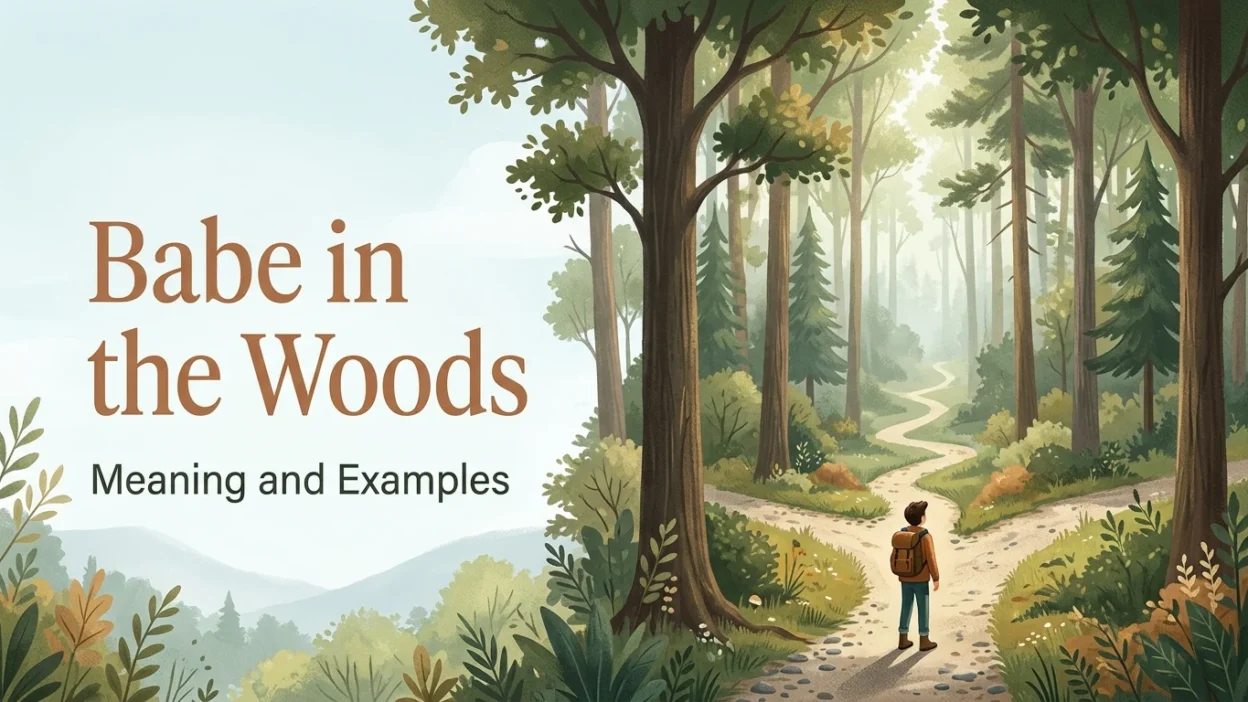
Imagine someone walking into a forest for the first time. They do not know which path to take, where to go, or what to expect.
That person represents someone who is new to an unfamiliar situation.
Remember this simple formula:
Babe in the woods = innocent and inexperienced in an unfamiliar situation.
For example, a person who has never attended a formal business meeting might feel like a babe in the woods because they do not understand the procedures or expectations yet.
American vs British English
“Babe in the woods” is understood in both American and British English. It is not restricted to one variety, although the expression may sound more familiar to some speakers than others.
In both varieties, it can describe a person who is naive or inexperienced in a particular situation.
American English example: “I was a babe in the woods when I started working in finance.”
British English example: “He felt like a babe in the woods on his first day at the new school.”
In either variety, the expression is conversational and figurative rather than a formal technical term.
Similar Words and Expressions
1. Fish Out of Water
This expression describes someone who feels uncomfortable or out of place in an unfamiliar environment.
Example: “I felt like a fish out of water at the fancy restaurant.”
2. Green
“Green” means inexperienced, especially in a job or activity.
Example: “The new assistant is still green, but she is learning quickly.”
3. Wet Behind the Ears
This informal expression describes someone who is very young or inexperienced.
Example: “He is still wet behind the ears when it comes to managing people.”
4. Naive
“Naive” describes someone who lacks experience or does not recognize the risks or complexities of a situation.
Example: “It was naive to believe that every online offer was genuine.”
5. Novice
A “novice” is a beginner who has little experience in a particular field or activity.
Example: “As a novice photographer, I am still learning how to use the camera.”
6. Out of One’s Depth
This phrase describes a situation that is too difficult for someone’s current knowledge or ability.
Example: “I was out of my depth in the advanced mathematics class.”
7. Inexperienced
“Inexperienced” is a direct and neutral word for someone who has not yet gained much practical knowledge.
Example: “The inexperienced driver needed more practice.”
Final Verdict: What Does Babe in the Woods Mean?
“Babe in the woods” is an idiom that describes someone who is innocent, inexperienced, or unfamiliar with a situation. It often suggests that the person does not yet know how to handle the challenges or expectations around them.
The expression is useful in conversations about starting a new job, entering an unfamiliar environment, learning a skill, or facing a situation for the first time. It can be humorous or sympathetic, depending on the context.
Remember that the phrase does not necessarily suggest a lack of intelligence. It usually means that a person has not yet gained the experience needed to feel comfortable or confident in a particular situation.
Frequently Asked Questions
1. What does babe in the woods mean in simple English?
It means a person who is inexperienced, innocent, or unfamiliar with a situation. Such a person may not know what to do because they have not encountered that situation before.
2. Is babe in the woods an idiom?
Yes. “Babe in the woods” is an idiom because its figurative meaning differs from the literal meaning of its individual words. It describes an inexperienced person rather than necessarily referring to a child in a forest.
3. Is babe in the woods positive or negative?
It can be either, depending on the context. It may sound affectionate or sympathetic when describing a beginner, but it can sound mildly critical if it suggests that someone is too naive to recognize risks.
4. What is an example of babe in the woods?
“I was a babe in the woods when I started my first job” means that the speaker was inexperienced and unfamiliar with the workplace.
5. What is the plural of babe in the woods?
The plural is “babes in the woods.” For example, “The new employees were babes in the woods during their first week.”
6. Is babe in the woods formal or informal?
It is mainly a conversational and figurative expression. It can appear in informal writing, stories, articles, and general discussion, but a more direct word such as “inexperienced” may be preferable in formal reports.
7. Is babe in the woods the same as fish out of water?
Not exactly. “Babe in the woods” emphasizes innocence or inexperience, while “fish out of water” emphasizes feeling uncomfortable or out of place in an unfamiliar environment. A person can be both.
8. Can you use babe in the woods for adults?
Yes. The expression can describe adults who are inexperienced in a particular situation, profession, or activity. It does not have to refer to a child.
Remember This
- “Babe in the woods” is an idiom.
- It means an innocent or inexperienced person.
- It often describes someone facing an unfamiliar situation.
- It does not automatically mean someone is unintelligent.
- Its tone can be humorous, sympathetic, or mildly critical.
- “Fish out of water” is similar but focuses more on feeling out of place.
- Use “inexperienced” if you need a more formal alternative.
Conclusion
“Babe in the woods” is a useful English idiom for describing someone who is new to a situation and lacks the experience to understand it fully. It can apply to a first job, a new school, unfamiliar technology, travel, or business negotiations. The phrase creates an image of someone entering unfamiliar surroundings without knowing how to find their way.
When you encounter this expression, remember that it generally refers to inexperience rather than intelligence. You can use it naturally in conversation when describing yourself or another person who is learning the ropes. Understanding its meaning and tone will help you recognize the expression and use it appropriately in everyday English.

Charles Kevin is a passionate language writer and researcher at SimileHive, creating clear, engaging content about similes, idioms, metaphors, and figurative language to help readers improve English communication confidently every day.