Have you ever wondered whether to write “suffice it to say” or “suffice to say”? Both expressions appear in English writing, but one is the established and widely accepted idiom. Understanding the difference can help you write more clearly, avoid common grammar mistakes, and choose the right expression for formal and informal situations.
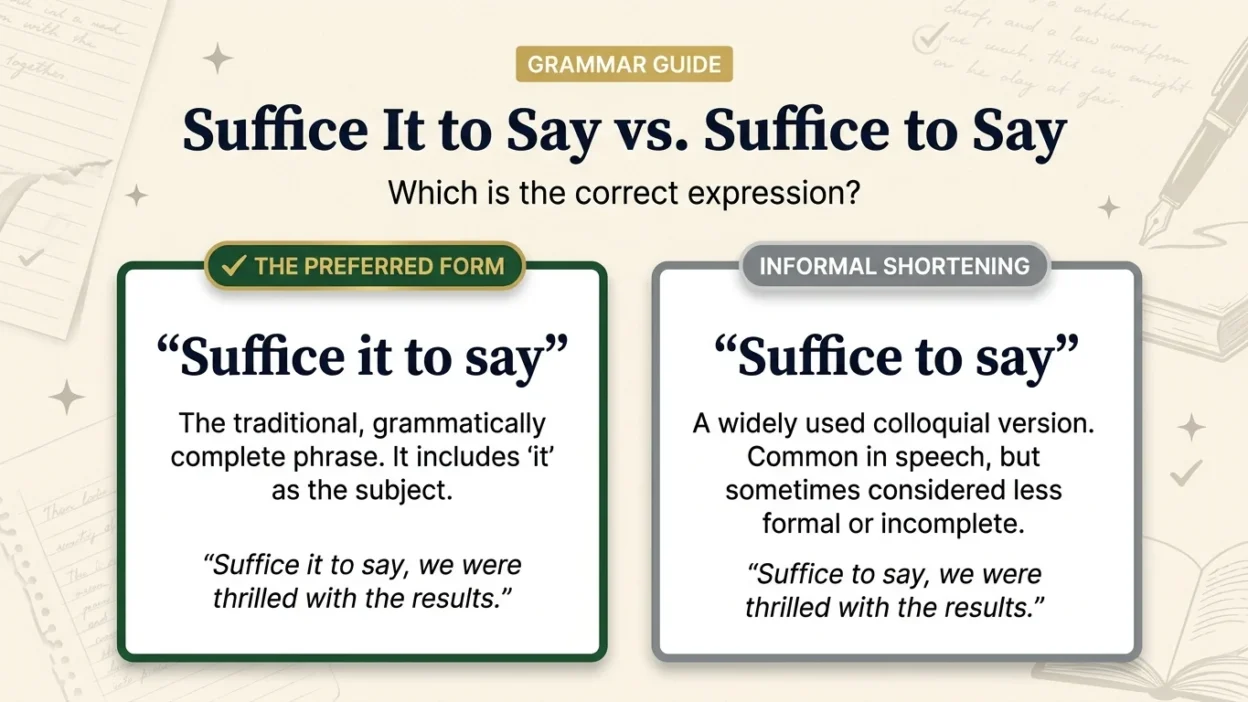
The standard expression is “suffice it to say.” It means that something can be stated briefly without explaining every detail. Writers and speakers often use it when they want to summarize a situation, emphasize a point, or avoid a lengthy explanation.
Although “suffice to say” is also used by some speakers and writers, it is generally considered a shortened or less established version of the traditional phrase. If you want the safest choice for academic writing, professional communication, or everyday English, use “suffice it to say.”
This guide explains both expressions, provides practical examples, and shows you how to remember the correct form.
Quick Answer: Suffice It to Say or Suffice to Say?
“Suffice it to say” is the standard and preferred expression in English. It means that a brief statement is enough to communicate the main point. “Suffice to say” is also used, but it is less established in traditional usage. When writing an essay, email, article, or professional document, choose “suffice it to say” for the most widely accepted form.
Why Do People Confuse These Expressions?
People confuse “suffice it to say” and “suffice to say” because their meanings are nearly identical. Both introduce a brief statement that summarizes a situation or communicates an important point without providing every detail.
The confusion also comes from the word “suffice,” which means to be enough or adequate. Since “suffice” can stand on its own in other grammatical constructions, some people assume that removing “it” from the idiom does not change anything.
However, established idiomatic expressions do not always follow the patterns people expect. “Suffice it to say” has a long history of use and remains the preferred form in standard written English.
1. Suffice It to Say: Meaning and Usage
“Suffice it to say” is an established English expression meaning that what follows is enough to explain or summarize a situation.
The word “it” acts as a formal or anticipatory subject in this construction. The expression is commonly used before a statement that conveys the main point without giving a complete account.
Examples of “Suffice It to Say”
- Suffice it to say, we were disappointed with the results.
- Suffice it to say that the meeting lasted much longer than expected.
- Suffice it to say, the new restaurant exceeded our expectations.
- Suffice it to say that she was not pleased with the decision.
- Suffice it to say, the journey was anything but comfortable.
In each example, the phrase signals that the following information is enough to give the reader or listener a general understanding of the situation.
Is “Suffice It to Say” Formal?
The expression is suitable for formal, professional, and informal contexts. However, it can sound slightly literary or rhetorical in everyday conversation.
For example:
- Formal: Suffice it to say that the proposed changes require further review.
- Informal: Suffice it to say, our vacation did not go as planned.
The phrase is especially useful when you want to summarize something without explaining every detail.
2. Suffice to Say: Meaning and Usage
“Suffice to say” is a shortened version of the established expression “suffice it to say.” Some English speakers use it naturally, and readers will generally understand what it means.
However, it is less established in traditional standard usage. For that reason, it may be considered less conventional in edited writing, academic work, or formal communication.
Examples of “Suffice to Say”
- Suffice to say, the project was more complicated than we expected.
- Suffice to say that everyone was surprised by the announcement.
- Suffice to say, we will not be returning to that hotel.
- Suffice to say that the experience taught me a valuable lesson.
- Suffice to say, the final decision disappointed several employees.
These sentences are understandable, but the traditional form, “suffice it to say,” is the safer choice when you want to follow established idiomatic usage.
Should You Use “Suffice to Say”?
You may encounter “suffice to say” in articles, online discussions, and everyday communication. Its use does not usually prevent readers from understanding the intended meaning.
Nevertheless, if you are unsure which version to choose, use “suffice it to say.” It is the more established form and is appropriate across a wide range of writing situations.
Suffice It to Say vs. Suffice to Say: Comparison Table
| Feature | Suffice it to say | Suffice to say |
|---|---|---|
| Meaning | A brief statement is enough | A brief statement is enough |
| Standard usage | Established and preferred | Less established variant |
| Grammar and idiom | Traditional idiomatic form | Shortened construction |
| Formal writing | Recommended | Better avoided when a conventional form is desired |
| Everyday speech | Acceptable | Also encountered |
| Best choice | Essays, reports, emails, and articles | Understandable, but less conventional |
The main difference is not the intended meaning. It is the level of conventional acceptance. “Suffice it to say” is the more reliable choice in standard English.
When Should You Use Each Expression?
Use “Suffice It to Say” in Formal Writing
Choose “suffice it to say” when writing essays, reports, business emails, professional articles, or other edited material.
Examples:
- Suffice it to say that the evidence supports our conclusion.
- Suffice it to say, the company must reconsider its current strategy.
- Suffice it to say that the results were below expectations.
Use “Suffice It to Say” in Everyday Communication
The expression also works in casual conversations when you want to make a point without giving a long explanation.
Examples:
- Suffice it to say, we had a difficult day.
- Suffice it to say, the movie was not worth the ticket price.
- Suffice it to say, I learned my lesson.
What About “Suffice to Say”?
You may see or hear “suffice to say,” particularly in informal writing or speech. You can understand it as a shortened variant, but using the traditional form is generally preferable in carefully edited text.
12 Examples of “Suffice It to Say” and “Suffice to Say”
The following examples show how the expressions appear in context.
- Preferred: Suffice it to say, the interview went very well.
- Less conventional: Suffice to say, the interview went very well.
- Preferred: Suffice it to say that the deadline was difficult to meet.
- Less conventional: Suffice to say that the deadline was difficult to meet.
- Preferred: Suffice it to say, everyone was relieved when the storm passed.
- Less conventional: Suffice to say, everyone was relieved when the storm passed.
- Preferred: Suffice it to say that the new policy changed the way we work.
- Less conventional: Suffice to say that the new policy changed the way we work.
- Preferred: Suffice it to say, the results surprised the entire team.
- Less conventional: Suffice to say, the results surprised the entire team.
- Preferred: Suffice it to say that the experience was unforgettable.
- Less conventional: Suffice to say that the experience was unforgettable.
These pairs illustrate the same intended meaning. The preferred form includes “it,” following the established idiom.
Common Mistakes to Avoid
1. Omitting “It” in Formal Writing
Less conventional: Suffice to say, we were pleased with the outcome.
Preferred: Suffice it to say, we were pleased with the outcome.
Use the complete idiom when conventional standard usage matters.
2. Treating the Phrase as a Complete Explanation
“Suffice it to say” introduces a statement. It does not automatically explain every detail of a situation.
Example: Suffice it to say, the negotiations were challenging.
This sentence summarizes the situation, but it does not describe exactly what made the negotiations challenging.
3. Using the Phrase Too Often
Repeating “suffice it to say” throughout an article can make the writing sound repetitive. Use it when a concise summary adds value, and choose alternatives when appropriate.
Alternatives include:
- In short
- Simply put
- To put it briefly
- In summary
- It is enough to say that
4. Assuming “Suffice” Means “Explain Fully”
“Suffice” means “be enough,” not “provide every detail.” The expression usually signals that the speaker or writer is deliberately keeping the explanation brief.
Memory Trick: How to Remember the Correct Expression
Use this simple memory trick: “Suffice it to say” is the complete, conventional phrase.
Remember the word “it” as part of the expression rather than treating it as an optional extra.
You can also connect the meaning to this sentence:
“Suffice it to say” means “it is enough to say.”
For example:
“Suffice it to say, the trip was unforgettable.”
In other words, saying that the trip was unforgettable is enough to communicate the main point.
American vs. British English
There is no major difference between American and British English in the preferred expression. “Suffice it to say” is established in both varieties.
You may encounter “suffice to say” in writing or speech in either variety, but it is less conventional than the complete idiom.
| Variety | Preferred expression |
|---|---|
| American English | Suffice it to say |
| British English | Suffice it to say |
| International English | Suffice it to say |
If you are writing for an international audience, “suffice it to say” is a dependable choice.
Similar Words and Expressions
Several expressions communicate the same general idea as “suffice it to say.”
| Expression | Meaning | Example |
|---|---|---|
| In short | Briefly stated | In short, the plan worked. |
| Simply put | Explained in simple terms | Simply put, we need more time. |
| In summary | Giving the main points | In summary, the results were positive. |
| To put it briefly | Using few words | To put it briefly, the project failed. |
| Needless to say | Introducing something considered obvious or expected | Needless to say, we were relieved. |
| Long story short | Giving only the essential details | Long story short, we missed the train. |
These expressions are not always interchangeable. For example, “needless to say” often suggests that something should already be obvious, while “suffice it to say” emphasizes that a brief statement is enough.
Final Verdict: Suffice It to Say or Suffice to Say?
“Suffice it to say” is the preferred expression in standard English. It means that a brief statement is enough to communicate the main point without explaining every detail.
“Suffice to say” is also used and is generally understandable, but it is less established as the traditional idiom. For essays, professional emails, academic writing, articles, and other carefully edited content, choose “suffice it to say.”
When in doubt, include “it.” This small word helps you use the conventional expression confidently.
Frequently Asked Questions
1. Is “suffice it to say” grammatically correct?
Yes. “Suffice it to say” is a standard English idiom used to introduce a concise statement or summary.
2. Is “suffice to say” incorrect?
It is a less established variant of the traditional expression. People use it and generally understand it, but “suffice it to say” is the safer choice in formal and edited writing.
3. What does “suffice it to say” mean?
It means that a short statement is enough to communicate the main point without explaining every detail.
4. Should I use “suffice it to say” in an essay?
Yes. It is appropriate in essays when you want to summarize a situation or introduce a concise conclusion. Use it only when it fits the context.
5. Can I use “suffice it to say” at the beginning of a sentence?
Yes. For example: “Suffice it to say, the results were unexpected.” You can also write, “Suffice it to say that the results were unexpected.”
6. Is “suffice it to say” formal or informal?
It works in both formal and informal contexts, although it can sound somewhat literary or rhetorical. It is suitable for professional writing and many everyday situations.
7. Is “suffice it to say” the same in American and British English?
Yes. The expression is established in both American and British English, and neither variety requires a different form.
8. What is another way to say “suffice it to say”?
You can use “in short,” “simply put,” “in summary,” or “to put it briefly.” The best alternative depends on the sentence and the meaning you want to convey.
Remember This
- Suffice it to say is the established and preferred idiom.
- Suffice to say is a less conventional variant.
- Both expressions generally communicate the same idea.
- Use “suffice it to say” in formal, academic, professional, and carefully edited writing.
- The phrase introduces a concise statement rather than a complete explanation.
Conclusion
The difference between “suffice it to say” and “suffice to say” is mainly a matter of established usage. Both expressions are understandable, but “suffice it to say” is the traditional and widely accepted form. It communicates that a brief statement is enough to explain the main point without discussing every detail.
To write clearly and confidently, choose “suffice it to say” in essays, articles, professional emails, and other formal contexts. Remembering the complete expression will help you avoid uncertainty and use this common English idiom naturally.

Charles Kevin is a passionate language writer and researcher at SimileHive, creating clear, engaging content about similes, idioms, metaphors, and figurative language to help readers improve English communication confidently every day.