Do you use “pending” or “impending” when talking about something that has not happened yet? Although these two words look similar and can both refer to situations connected with the future, they have different meanings. Choosing the correct word helps you communicate clearly, especially when writing emails, reports, news articles, or everyday messages.
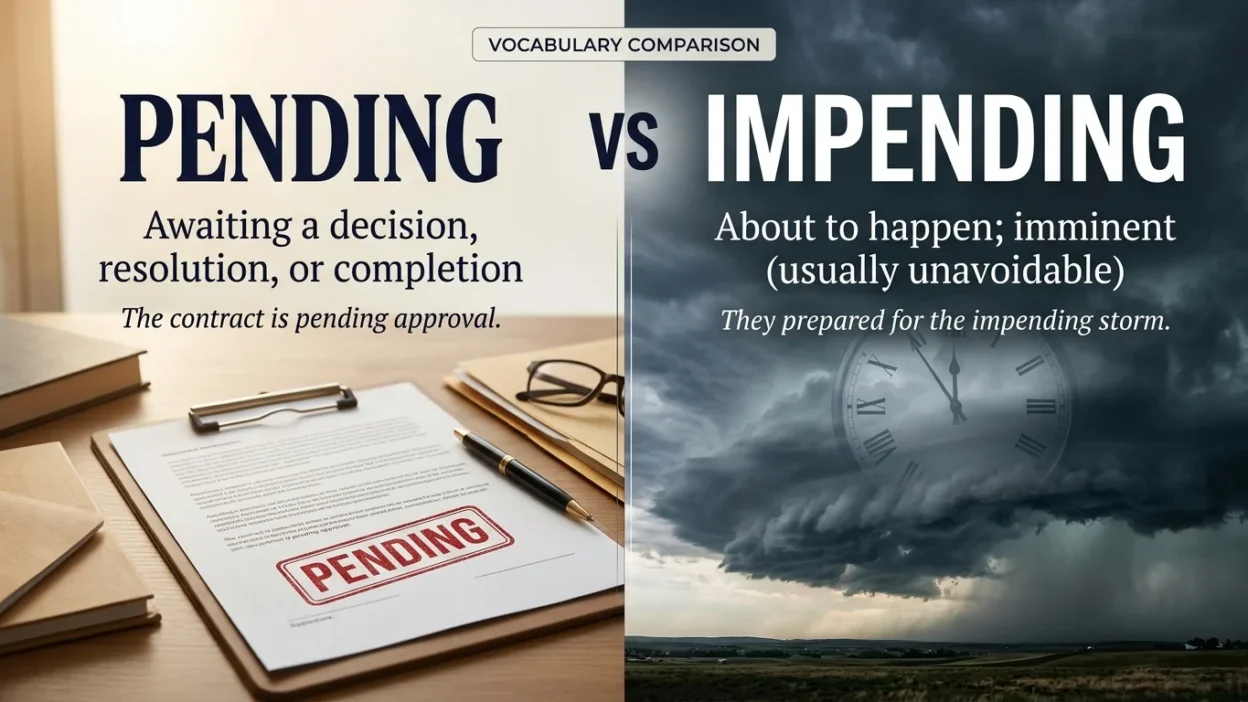
The main difference is that “pending” means waiting for a decision, completion, or resolution, while “impending” means about to happen soon. For example, a pending application is still awaiting a decision, whereas an impending storm is expected to arrive soon.
Understanding this distinction will help you avoid common vocabulary mistakes and choose the right word for the situation. This guide explains the definitions, grammatical uses, differences, and practical examples of “pending” and “impending.”
Quick Answer: Pending vs. Impending
Pending describes something that is awaiting a decision, action, or resolution. Impending describes something that is expected to happen soon. A pending request has not yet been resolved, while an impending event is approaching. Use “pending” for unfinished matters and “impending” for upcoming events, especially when they may bring important consequences or difficulties.
Why Do People Confuse Pending and Impending?
People often confuse “pending” and “impending” because both words relate to situations that are not fully completed or have not yet occurred. Their similar spelling also makes them easy to mix up.
However, the words emphasize different things. “Pending” focuses on a matter that remains unresolved or awaits an action. “Impending” focuses on an event that is approaching.
Consider these examples:
- Pending approval: Approval has not been granted yet.
- Impending deadline: The deadline is approaching soon.
The first phrase describes an unresolved process. The second describes an upcoming event. Recognizing this difference makes it easier to choose the correct word.
1. Pending: Meaning and Usage
Pending means awaiting a decision, action, completion, or resolution. It can also mean that something will happen or take effect only after a particular condition has been met.
The word is commonly used in business, law, administration, education, finance, and everyday communication.
Examples of Pending
- My application is pending approval.
- The court case is still pending.
- Your payment is pending confirmation.
- The company has a pending request for additional funding.
- The project remains pending until the manager makes a decision.
In these examples, something is unfinished or waiting for the next step.
Pending as an Adjective
“Pending” often functions as an adjective that describes a matter awaiting action or resolution.
Examples:
- The pending application will be reviewed tomorrow.
- We discussed the pending changes during the meeting.
- Several pending orders need attention.
- The pending decision has delayed the project.
Pending in Legal and Business Contexts
In legal and business settings, “pending” often refers to a case, application, transaction, or decision that has not been finalized.
Examples:
- The lawsuit is pending before the court.
- The transaction is pending verification.
- The job offer is pending approval from the department.
- The employee’s promotion remains pending.
Remember: If something is waiting to be completed or decided, “pending” is usually the right choice.
2. Impending: Meaning and Usage
Impending means about to happen or approaching soon. It commonly describes an event, change, or situation that is expected in the near future.
The word is often associated with events that may have significant consequences, such as a storm, crisis, deadline, departure, or major change. However, it can also describe neutral or positive events.
Examples of Impending
- Dark clouds warned us of an impending storm.
- She was worried about the impending deadline.
- The company is preparing for an impending merger.
- Everyone discussed the impending changes.
- The residents prepared for the impending arrival of winter.
In each example, the event is approaching rather than waiting for a decision.
Impending as an Adjective
“Impending” is primarily used as an adjective before a noun.
Examples:
- The impending election has attracted public attention.
- We need to prepare for the impending launch.
- The impending deadline has made everyone more focused.
- They discussed the impending arrival of their guests.
Does Impending Always Mean Something Bad?
No. Although “impending” frequently appears in descriptions of unpleasant or serious events, it does not always have a negative meaning.
For example:
- The impending wedding filled the family with excitement.
- The children looked forward to the impending holiday.
- The team prepared for the impending championship.
The word simply means that something is expected to happen soon. The context determines whether the event is positive, negative, or neutral.
Remember: If an event is approaching soon, “impending” is usually the right choice.
Pending vs. Impending: Comparison Table
| Feature | Pending | Impending |
|---|---|---|
| Meaning | Awaiting action, a decision, or resolution | About to happen soon |
| Main focus | An unfinished or unresolved matter | An approaching event |
| Common nouns | Application, payment, case, approval | Storm, deadline, crisis, event |
| Typical context | Administrative, legal, business | Events, changes, situations |
| Example | The application is pending review. | An impending storm is approaching. |
| Does it imply a decision is needed? | Often, but not always | No |
| Does it imply an event is near? | Not necessarily | Yes |
The easiest way to distinguish them is to ask whether something is waiting for a decision or approaching in time.
When Should You Use Pending or Impending?
When to Use Pending
Use “pending” when a process, decision, request, or matter has not been completed or resolved.
Examples:
- The payment is pending confirmation.
- Her admission is pending review.
- The case remains pending.
- The final decision is pending approval.
You can often replace “pending” with “awaiting” or “not yet resolved,” depending on the sentence.
When to Use Impending
Use “impending” when an event is expected to occur soon.
Examples:
- The impending storm forced the organizers to cancel the event.
- We are preparing for the impending deadline.
- The impending changes will affect the whole department.
- Everyone was nervous about the impending announcement.
You can often replace “impending” with “approaching” or “about to happen.”
12 Examples of Pending vs. Impending
These examples show how the two words work in different contexts.
- Pending: My job application is pending review.
- Impending: The impending interview made me nervous.
- Pending: The payment is pending confirmation.
- Impending: The impending storm forced us indoors.
- Pending: The court case is still pending.
- Impending: The impending deadline requires immediate attention.
- Pending: The manager has several pending requests.
- Impending: The impending launch has kept the team busy.
- Pending: The refund is pending approval.
- Impending: The impending wedding has excited both families.
- Pending: The decision remains pending until Friday.
- Impending: The impending arrival of winter means we must prepare.
Notice that “pending” describes something unfinished, while “impending” describes something expected soon.
Common Mistakes to Avoid
1. Using Impending for an Unresolved Application
Incorrect: My university application is impending.
Correct: My university application is pending.
An application is pending when it is waiting for review or a decision. “Impending” would suggest that the application itself is about to happen, which is usually not the intended meaning.
2. Using Pending for an Approaching Storm
Incorrect: An impending storm is pending over the city.
Better: An impending storm is approaching the city.
Use “impending” to describe the approaching storm. “Pending” would suggest an unresolved matter rather than an approaching weather event.
3. Assuming Pending Means Something Will Happen Soon
A pending decision may take hours, days, or months. The word does not necessarily indicate that the outcome is imminent.
Example: The court case has been pending for several years.
4. Assuming Impending Always Means Something Negative
“Impending” often appears in serious contexts, but it can also describe positive events.
Example: The impending graduation ceremony filled the students with joy.
5. Confusing Impending With Immediate
“Impending” means approaching or expected soon, but it does not necessarily mean that something will happen in the next few seconds.
Example: The impending election is scheduled for next month.
Memory Trick: How to Remember the Difference
Use this simple memory trick:
- Pending = waiting.
- Impending = approaching.
Think of a pending application sitting in a queue, waiting for approval. Then picture an impending storm moving toward your town.
You can also remember the words through these questions:
- Is it waiting for a decision or completion? Use pending.
- Is it expected to happen soon? Use impending.
These two questions will help you choose the correct word in most everyday situations.
American vs. British English
There is no significant difference between American and British English in the meanings of “pending” and “impending.” Both varieties use the words in the same general way.
| English variety | Pending | Impending |
|---|---|---|
| American English | Awaiting a decision or resolution | About to happen soon |
| British English | Awaiting a decision or resolution | About to happen soon |
| International English | Unfinished or unresolved | Approaching or expected soon |
For example, both American and British writers can say “pending approval” and “impending storm.” The choice depends on the meaning, not the variety of English.
Similar Words and Expressions
Several words are related to “pending” or “impending,” but their meanings are not identical.
| Word | Meaning | Example |
|---|---|---|
| Awaiting | Waiting for something | The application is awaiting approval. |
| Unresolved | Not settled or decided | The issue remains unresolved. |
| Upcoming | Scheduled or expected in the future | The upcoming meeting is important. |
| Approaching | Getting nearer in time or distance | The approaching storm looks severe. |
| Imminent | Likely to happen very soon | An imminent departure requires preparation. |
| Forthcoming | Expected or planned to happen or appear | The forthcoming announcement may clarify the issue. |
“Imminent” is particularly close to “impending.” Both describe something likely to happen soon, although “imminent” can emphasize that it is very near.
“Upcoming” is generally more neutral, while “impending” often carries a stronger sense of anticipation or consequence.
Final Verdict: Pending or Impending?
Use “pending” for something awaiting a decision, action, or resolution. Use “impending” for something expected to happen soon.
For example, a pending application is waiting for approval, while an impending deadline is approaching. Although both words relate to situations that are not yet complete, they are not interchangeable.
When choosing between them, focus on the main idea. If the situation is waiting, choose “pending.” If an event is approaching, choose “impending.”
Frequently Asked Questions
1. What is the main difference between pending and impending?
“Pending” means awaiting a decision, action, or resolution. “Impending” means about to happen soon. A pending application awaits review, while an impending event is approaching.
2. Is pending the same as impending?
No. They can both relate to future situations, but they emphasize different things. “Pending” focuses on something unfinished or unresolved, while “impending” focuses on an approaching event.
3. Does pending mean something will happen soon?
Not necessarily. A pending matter is awaiting a decision, action, or resolution, but there is no guarantee that it will be completed soon.
4. Does impending always mean something bad?
No. “Impending” is often used for serious or unpleasant events, such as a crisis or storm, but it can also describe positive events, such as an impending wedding or holiday.
5. Can I say “pending approval”?
Yes. “Pending approval” is a common and correct expression meaning that approval has not yet been granted.
6. Can I say “impending deadline”?
Yes. An “impending deadline” is a deadline that is approaching soon. The phrase is commonly used in professional and academic contexts.
7. What is another word for impending?
Depending on the context, alternatives include “approaching,” “imminent,” “forthcoming,” and “upcoming.” “Imminent” is especially close when an event is expected very soon.
8. What is another word for pending?
Depending on the sentence, alternatives include “awaiting,” “unresolved,” “undecided,” and “in progress.” These words are not always interchangeable, so choose one that fits the context.
Remember This
- Pending means waiting for a decision, action, or resolution.
- Impending means about to happen soon.
- A pending application is awaiting a decision.
- An impending storm is approaching.
- Pending does not guarantee that something will happen soon.
- Impending can describe positive, negative, or neutral events.
Conclusion
The difference between “pending” and “impending” becomes clear when you focus on what each word describes. “Pending” refers to an unfinished matter that is waiting for action or resolution. “Impending” refers to an event that is approaching and expected to happen soon. Both words are useful, but they serve different purposes.
To remember the distinction, think of a pending request waiting in a queue and an impending event moving closer in time. This simple comparison will help you use both words accurately in everyday conversations, academic assignments, and professional writing.

Adam Aaron is a language enthusiast and content writer at SimileHive, creating clear, engaging guides on similes, idioms, metaphors, and figurative language to help readers improve English confidently every day.