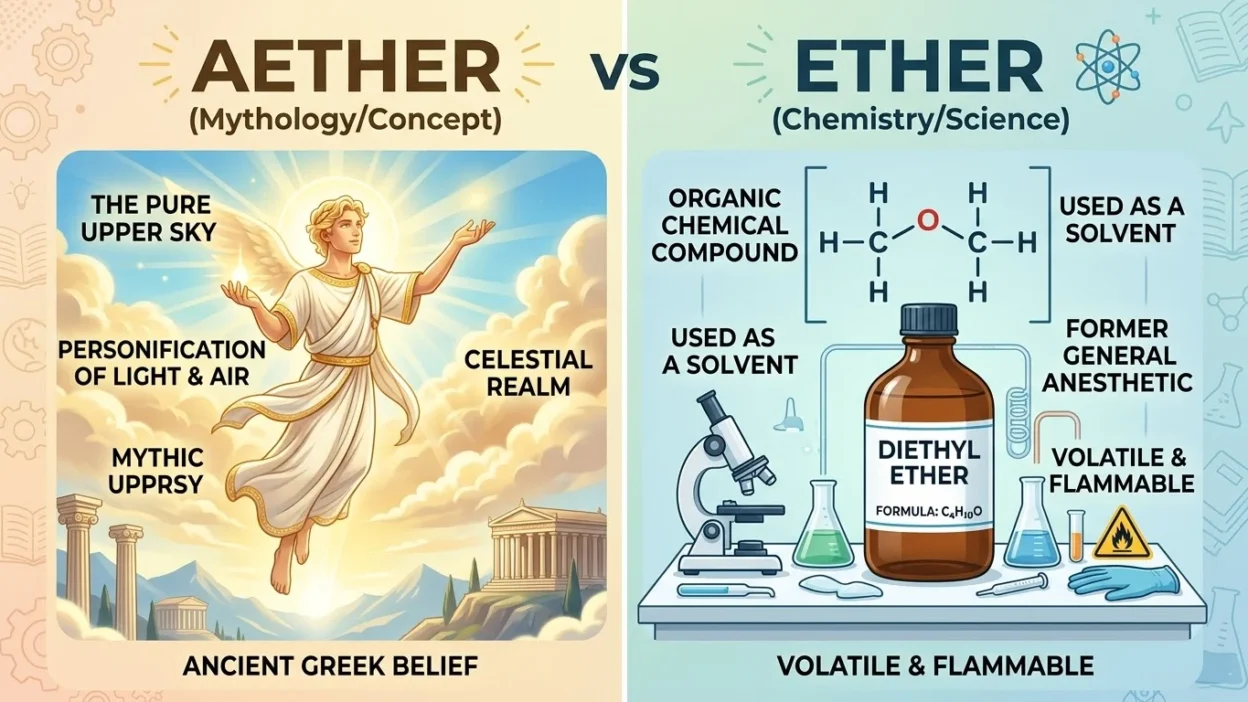
Aether and ether are closely related words with a long history, and their meanings depend heavily on context. Aether is mainly the traditional or literary spelling associated with the ancient Greek concept of the upper heavens, the classical element believed to fill the region above the ordinary atmosphere, and the old scientific idea of a medium through which light was thought to travel.
Ether, on the other hand, is the more common modern spelling and has several meanings, including a chemical compound, the old hypothetical medium in physics, and the figurative or literary sense of the heavens or upper air.
The two spellings are historically connected, but they are not always interchangeable in modern English. Aether is more likely to appear in mythology, fantasy, philosophy, literature, or historical discussions, while ether is the standard spelling in chemistry and is also widely used for the historical scientific concept. Knowing the context is therefore the best way to choose the correct word.
Quick Answer
Aether is mainly a literary, philosophical, or historical spelling referring to the upper heavens or the classical element associated with the sky. Ether is the standard modern spelling for the chemical term and is also used for the old scientific concept of an invisible medium. The words share the same historical origin but differ in modern usage.
Why Do People Confuse “Aether” and “Ether”?
The confusion comes from their shared history.
Both words ultimately trace back to the Greek word aithēr, associated with the bright upper air or heavens.
Over time, English developed both aether and ether as spellings. Different fields then developed their own conventions.
For example:
The ancient Greeks believed in aether as a heavenly substance.
But in chemistry:
Ether is a class of organic compounds.
And in the history of physics:
Scientists once proposed an ether as a medium through which light traveled.
So although the words are related, modern context determines which spelling is appropriate.
First Word: Aether
Aether is a traditional spelling with strong connections to ancient Greek thought, mythology, philosophy, literature, and fantasy.
In ancient Greek thought, Aether was associated with the bright, upper air or the heavenly region above the ordinary atmosphere.
In classical mythology, Aether was also personified as a divine figure representing the upper sky or bright air.
The spelling aether is often chosen when writers want to emphasize the classical, poetic, or mythological sense.
For example:
The gods were said to dwell in the aether.
In fantasy and speculative fiction, aether may also be used for an imagined mystical substance or energy.
Second Word: Ether
Ether is the more common modern spelling and has several important meanings.
1. Ether in chemistry
In chemistry, ether refers to a class of organic compounds containing an oxygen atom bonded to two carbon-containing groups.
A familiar example is diethyl ether, a chemical compound historically used as a solvent and anesthetic.
For example:
The laboratory stored the ether in a properly labeled container.
2. Ether in historical physics
Ether was also the name given to a hypothetical medium that nineteenth-century physicists proposed as a way for light to travel through space.
This idea was eventually abandoned as modern physics developed.
For example:
Nineteenth-century scientists debated whether the luminiferous ether existed.
3. Ether in literary usage
Ether can also be used figuratively to mean the heavens, upper air, or an intangible realm.
For example:
Her voice seemed to float into the ether.
This use is literary or figurative.
Aether vs Ether: The Main Difference
| Word | Main Use | Example |
|---|---|---|
| Aether | Classical heavens, mythology, philosophy, literary or fantasy contexts | The gods lived in the aether. |
| Ether | Chemistry | Ether is an organic compound class. |
| Ether | Historical physics | Scientists once proposed a luminiferous ether. |
| Ether | Literary/figurative “upper air” or intangible realm | The signal disappeared into the ether. |
The simplest distinction is:
Aether = classical, mythological, poetic, or fantasy use
Ether = modern scientific or general literary use
When Should You Use “Aether”?
Use aether when you are discussing the classical Greek concept, mythology, or a deliberately archaic, poetic, or fantasy setting.
Examples:
The ancient gods were believed to inhabit the aether.
The hero rose into the aether.
In Greek mythology, Aether represented the bright upper air.
The fantasy novel describes a magical force called aether.
The spelling can give a word a distinctly classical or otherworldly feeling.
When Should You Use “Ether”?
Use ether in modern scientific contexts, especially chemistry.
For example:
Diethyl ether is a volatile organic compound.
Use ether when discussing the historical scientific theory of a medium through which light was thought to travel:
The luminiferous ether was once proposed as a medium for light.
You can also use ether figuratively:
Her message vanished into the ether.
Aether vs Ether in Chemistry
In chemistry, the standard spelling is ether, not aether.
An ether is a type of organic compound characterized by an oxygen atom bonded to two carbon-containing groups.
A simplified structural representation is:
R–O–R′
where R and R′ represent carbon-containing groups.
One well-known example is diethyl ether.
Therefore, in a chemistry article or laboratory report, write:
ether
not:
❌ aether
Aether vs Ether in Physics
The historical scientific concept is normally spelled ether in English.
The luminiferous ether, sometimes called the aether in historical or variant spelling, was a hypothetical medium that scientists once believed might carry light waves through space.
The idea became unnecessary as modern theories of electromagnetism and relativity developed.
So in modern discussions of the history of physics, ether is generally the expected spelling.
Aether vs Ether in Mythology
When referring specifically to the ancient Greek personification or concept of the upper heavenly air, Aether is a common spelling.
For example:
Aether was associated with the bright upper air in Greek mythology.
The word is often capitalized when it refers to the mythological personification.
In a literary translation or classical discussion, you may also encounter Aither or Aithēr, reflecting transliteration from Greek.
15 Examples of “Aether”
- The ancient gods were said to dwell in the aether.
- The hero disappeared into the aether.
- Greek mythology associated Aether with the bright upper air.
- The poet described the stars as shining through the aether.
- The fantasy world was filled with magical aether.
- The wizard drew energy from the aether.
- The story describes a realm beyond the aether.
- The ancient philosopher wrote about the nature of the aether.
- The character gazed into the endless aether.
- The celestial beings moved through the aether.
- The novel uses aether as a source of magical energy.
- The poet imagined music traveling through the aether.
- The gods were believed to breathe the aether.
- The fantasy kingdom was surrounded by glowing aether.
- The writer deliberately chose aether to create an archaic atmosphere.
15 Examples of “Ether”
- The laboratory used ether as a solvent.
- Diethyl ether is a well-known organic compound.
- The researchers discussed the history of the ether theory.
- Scientists once proposed a luminiferous ether.
- The old theory suggested that light traveled through the ether.
- The message seemed to disappear into the ether.
- Her words floated into the ether.
- The radio signal seemed to vanish into the ether.
- The book discusses the nineteenth-century theory of ether.
- The chemist carefully handled the ether.
- The concept of luminiferous ether is now historically important.
- The writer used ether to suggest an invisible space.
- The chemical reaction involved an ether compound.
- The old physics textbook describes the proposed ether.
- The sound seemed to dissolve into the ether.
Aether vs Ether: Are They the Same Word?
Historically, aether and ether are closely related and can sometimes represent different spellings of the same underlying word.
However, modern English has developed distinct conventions.
Aether tends to signal:
- classical ideas
- mythology
- philosophy
- poetry
- fantasy
- an archaic atmosphere
Ether tends to signal:
- chemistry
- historical physics
- general literary usage
- the figurative idea of an intangible space
Therefore, they should not simply be treated as interchangeable spellings in every context.
Common Mistakes
1. Using “aether” in chemistry
In modern chemistry, use:
ether
For example:
Diethyl ether is a chemical compound.
2. Assuming “ether” is always a chemical
It is not.
Ether can also refer to the historical physics concept or be used figuratively.
3. Assuming “aether” is the only historical spelling
Historical texts may use several forms, including aether, ether, and transliterations such as aithēr or aither.
4. Confusing “ether” with “either”
These words sound different in careful pronunciation and have completely different meanings.
ether = a chemical class, historical medium, or figurative realm
either = one or the other of two choices
5. Treating “aether” and “ether” as completely unrelated words
They have a shared historical origin. Their modern uses have simply developed in different directions.
Comparison Table: Aether, Ether, and Related Words
| Word | Meaning | Common Context |
|---|---|---|
| Aether | Upper heavens or classical element | Mythology, philosophy, fantasy |
| Ether | Organic compound class | Chemistry |
| Ether | Hypothetical medium for light | History of physics |
| Ether | Intangible or undefined realm | Literary/figurative |
| Aither | Greek-derived transliteration | Classical studies |
| Either | One or the other | General English |
Aether vs Ether in Literature
Both spellings can appear in literature, but aether often creates a more archaic or mythological feeling.
Compare:
The message disappeared into the ether.
This sounds like a modern figurative expression.
Now compare:
The gods watched from the aether.
This sounds more classical, mythological, or poetic.
Writers sometimes choose aether deliberately because the spelling evokes ancient Greek ideas or fantasy worlds.
Aether vs Ether in Fantasy
In fantasy writing, aether is often used as the name of a fictional energy, substance, or magical force.
For example:
The wizard gathered aether in his hands.
This is not necessarily a reference to historical Greek thought or old physics. The writer may simply be using aether because it has a mystical or ancient sound.
Ether can also be used in fantasy, but aether often feels more deliberately archaic or magical.
Memory Trick
Use this simple trick:
AETHER = ANCIENT
Think:
Aether → Ancient heavens
ETHER = EVERYDAY SCIENTIFIC
Think:
Ether → chemistry and historical physics
So remember:
Aether → ancient, mythological, fantasy
Ether → chemistry, physics, figurative usage
This is not an absolute rule, but it is a useful guide.
American vs British English
The basic distinction between aether and ether is not primarily an American-versus-British spelling difference.
Both American and British English use ether in modern scientific terminology.
For example:
diethyl ether
Both varieties also recognize aether as a historical, literary, or classical spelling.
The main difference is therefore context and tradition, rather than national variety.
Similar Words
Aither
Aither is a transliteration of the ancient Greek term often rendered in English as aether.
Air
Air is the mixture of gases surrounding Earth.
Fresh air entered through the window.
Atmosphere
The atmosphere is the layer of gases surrounding a planet.
Earth’s atmosphere contains several gases.
Heavens
Heavens can refer to the sky or celestial realm, especially in religious or literary language.
The stars filled the heavens.
Void
Void refers to an empty or seemingly empty space.
The spacecraft traveled through the void.
Vapor
Vapor is a gaseous form of a substance that is normally liquid or solid under ordinary conditions.
Water vapor rose from the surface.
Final Verdict
Aether and ether share a historical origin but have developed different conventions in modern English.
Use aether when discussing ancient Greek concepts, mythology, classical philosophy, poetry, or fantasy, especially when you want an archaic or mystical tone.
Use ether for chemistry, the historical scientific concept of a medium for light, and common figurative expressions such as “into the ether.”
If you are writing a chemistry article, choose ether. If you are writing about Greek mythology or a fantasy world, aether may be the more appropriate choice.
Frequently Asked Questions
What is the difference between aether and ether?
Aether is commonly associated with ancient Greek ideas of the upper heavens, classical philosophy, mythology, and fantasy. Ether is the standard modern spelling for the chemical term and is also used for the historical physics concept and some figurative expressions.
Is aether the same as ether?
They are historically related and can sometimes be variant spellings, but modern English often uses them in different contexts. Aether tends to have a classical or literary sense, while ether is standard in chemistry and historical physics.
Is it ether or aether in chemistry?
The standard spelling in chemistry is ether.
Diethyl ether is an organic compound.
What does aether mean in Greek mythology?
In Greek mythology, Aether is associated with the bright upper air or heavenly region above the ordinary atmosphere. It can also refer to the personification of that realm.
What was the ether theory in physics?
The historical ether theory proposed that an invisible medium, often called the luminiferous ether, filled space and provided a medium through which light could travel. The concept was later abandoned.
Is aether used in fantasy?
Yes. Aether is frequently used in fantasy and speculative fiction to describe a magical energy, mystical substance, or supernatural realm.
Is ether still used as a chemical term?
Yes. Ether remains an important chemical term for a class of organic compounds containing an oxygen atom bonded to two carbon-containing groups.
Which spelling should I use?
Choose according to context. Use ether for modern chemistry and the historical physics concept. Use aether for classical, mythological, poetic, or fantasy contexts when that spelling fits the intended tone.
Remember This
Aether = ancient and heavenly
The gods lived in the aether.
Ether = scientific or figurative
The chemist used ether.
The message disappeared into the ether.
The easiest memory trick is:
Aether sounds ancient; ether sounds scientific.
Conclusion
Aether and ether are two closely related words whose meanings have developed in different directions. Aether is strongly associated with ancient Greek ideas, mythology, philosophy, poetry, and fantasy. It can refer to the bright upper air or a mystical substance in imaginative writing. The spelling often gives a word a classical or otherworldly feeling.
Ether is the preferred modern spelling in scientific contexts, particularly chemistry, where it refers to a class of organic compounds. It is also used when discussing the historical ether theory of physics and in figurative expressions such as “disappear into the ether.”
When choosing between the two, focus on context: aether for classical or mystical meanings, ether for modern scientific and general figurative meanings.

Lucas Luke is a passionate language writer and content creator at SimileHive, specializing in similes, idioms, metaphors, and figurative language. He enjoys making complex English expressions simple, engaging, and easy to understand for students, writers, and language enthusiasts through well-researched, practical content.