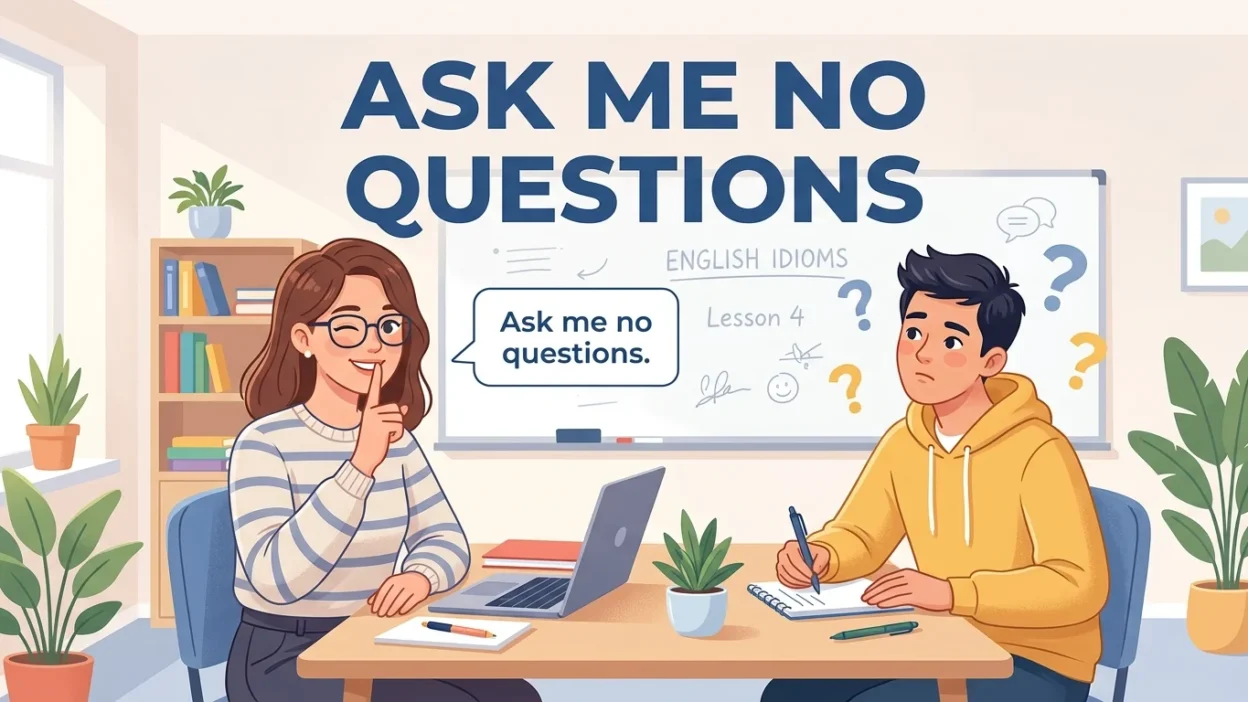
“Ask me no questions” is an expression used to tell someone not to ask for an explanation, details, or information about something. It is often followed by “and I’ll tell you no lies,” creating the familiar phrase “Ask me no questions, and I’ll tell you no lies.”
The expression can be serious, humorous, secretive, or playful depending on the situation. For example, if someone says, “Ask me no questions about how I got this ticket,” they are suggesting that they do not want to explain what happened.
The expression can also imply that the speaker has something they would rather keep private. Sometimes it is used jokingly when the circumstances are embarrassing, unusual, complicated, or difficult to explain.
Although the phrase may sound old fashioned because of its traditional wording, it remains understandable in modern English. Its exact meaning depends on context, but the central idea is simple: “Don’t ask me to explain this.”
Quick Answer
“Ask me no questions” means “Do not ask me for an explanation or details.” It is often used when someone wants to keep something private or avoid explaining an unusual situation. The longer expression “Ask me no questions, and I’ll tell you no lies” means that if you do not ask, the speaker will not have to explain or reveal anything.
Why Do People Say “Ask Me No Questions”?
People use this expression when they want to avoid discussing something.
It can suggest:
- secrecy
- privacy
- embarrassment
- humor
- mystery
- reluctance to explain
- a complicated situation
For example:
I came home with a new bicycle. Ask me no questions.
The speaker may be jokingly suggesting that the story behind the bicycle is complicated or embarrassing.
The expression does not necessarily mean that something illegal or dishonest happened. Context matters.
First Word: “Ask”
The verb ask means to request information, an answer, or an explanation.
For example:
I asked him where he had been.
She asked me why I was late.
In “Ask me no questions,” the word ask is an imperative verb.
It is essentially a command:
Do not ask me questions.
The unusual-sounding word order comes from the traditional style of the expression.
Second Word: “Questions”
A question is something someone asks to obtain information, clarification, or an answer.
In this expression, questions means requests for information or explanations.
So:
Ask me no questions
literally means:
Do not ask me any questions.
The figurative meaning can be stronger:
Do not ask me to explain what happened.
“Ask Me No Questions” vs “Ask Me No Questions, and I’ll Tell You No Lies”
The shorter expression can stand on its own:
Ask me no questions.
But the longer version is more recognizable:
Ask me no questions, and I’ll tell you no lies.
The second part adds a humorous or mysterious idea: if you do not ask for information, the speaker does not have to provide an explanation.
The phrase can therefore be understood as:
Don’t ask, and I won’t have to explain.
What Does “Ask Me No Questions, and I’ll Tell You No Lies” Mean?
The expression means:
If you don’t ask me for information, I won’t have to tell you anything about it.
It is often used humorously.
For example:
“Where did you get all that money?”
“Ask me no questions, and I’ll tell you no lies.”
The speaker is jokingly refusing to explain where the money came from.
The phrase can create a sense of mystery without necessarily indicating that the speaker has actually done anything wrong.
When Should You Use “Ask Me No Questions”?
Use the expression when you want to suggest that you do not want to explain something.
It works particularly well in informal conversation.
For example:
I somehow ended up owning three dogs. Ask me no questions.
I bought another pair of shoes. Ask me no questions.
I know I said I wouldn’t order dessert, but here we are. Ask me no questions.
The expression can make a statement sound humorous or mysterious.
15 Examples of “Ask Me No Questions”
- I bought another pair of shoes. Ask me no questions.
- I have no idea how I ended up at that party. Ask me no questions.
- I came home with a new television. Ask me no questions.
- I spent far too much money this weekend. Ask me no questions.
- I somehow adopted another cat. Ask me no questions.
- There is a strange package in my room. Ask me no questions.
- I got home at three in the morning. Ask me no questions.
- I ordered dessert even though I said I wouldn’t. Ask me no questions.
- I don’t want to explain how I found it. Ask me no questions.
- I have a ticket to the concert now. Ask me no questions.
- I accidentally bought five notebooks. Ask me no questions.
- My weekend was complicated. Ask me no questions.
- I somehow ended up with a second phone. Ask me no questions.
- I know what happened, but ask me no questions.
- Ask me no questions, and everything will be fine.
“Ask Me No Questions” in a Conversation
The expression is usually informal and works best in conversational English.
For example:
Tom: Why are you carrying a suitcase?
Sam: Ask me no questions.
Sam is telling Tom not to ask for an explanation.
Another example:
Maria: Why did you buy another computer?
John: Ask me no questions, please.
Here, John is jokingly avoiding the subject.
Is “Ask Me No Questions” Rude?
It can sound rude depending on the tone.
If someone says:
Ask me no questions.
in a serious or angry tone, it may mean:
Stop asking me about this.
But if someone says it with a smile, it may simply be humorous.
For example:
I bought another cake. Ask me no questions!
This sounds playful.
Therefore, tone and context are important.
“Ask Me No Questions” vs “Don’t Ask Me Questions”
These expressions have similar meanings, but they have different tones.
Don’t ask me questions
This is direct and ordinary.
Don’t ask me questions about my personal life.
Ask me no questions
This sounds more dramatic, humorous, literary, or old-fashioned.
Ask me no questions about what happened last night.
The second expression can make a situation sound mysterious or playful.
Comparison Table: Similar Expressions
| Expression | Meaning | Tone |
|---|---|---|
| Ask me no questions | Don’t ask me for details | Dramatic, humorous, or secretive |
| Don’t ask me questions | Stop asking me | Direct |
| Don’t ask | Don’t request an explanation | Informal |
| It’s a long story | The explanation is complicated | Casual |
| I’d rather not say | I don’t want to reveal it | Polite |
| That’s private | I don’t want to discuss it | Direct |
Common Mistakes
1. Thinking the expression always implies dishonesty
It does not.
Someone may say:
Ask me no questions.
simply because they do not want to explain something embarrassing or complicated.
2. Using it in highly formal writing
The expression is conversational and often humorous.
In formal writing, alternatives such as:
I would prefer not to discuss the matter.
may be more appropriate.
3. Assuming it always sounds serious
It is often used jokingly.
For example:
I bought another dessert. Ask me no questions.
This is clearly playful.
4. Confusing it with “ask me any questions”
These have opposite meanings.
Ask me any questions.
means:
Feel free to ask questions.
But:
Ask me no questions.
means:
Do not ask questions.
Is “Ask Me No Questions” an Idiom?
It can function as a fixed expression or idiomatic phrase.
Its meaning is not complicated once you understand the context, but the phrase has a distinctive conventional style.
The longer form:
Ask me no questions, and I’ll tell you no lies.
is especially recognizable as a traditional expression.
Origin of “Ask Me No Questions”
The phrase “Ask me no questions, and I’ll tell you no lies” is an old English saying.
It has been used in literature and popular culture for a long time. Its wording has a deliberately formal or old-fashioned structure, which is one reason it can sound more dramatic than the simple:
Don’t ask me questions.
The saying expresses the idea that avoiding questions also avoids the need to reveal information.
Because the expression has appeared in different contexts over time, it is best understood as a traditional saying rather than a phrase with one universally agreed single origin.
Memory Trick
Remember:
Ask me no questions = Don’t ask me to explain.
Think of it as:
NO QUESTIONS → NO EXPLANATION
For the longer expression:
Ask me no questions, and I’ll tell you no lies.
Remember:
Don’t ask → I don’t explain.
American vs British English
“Ask me no questions” is understandable in both American and British English.
However, it can sound somewhat old-fashioned, dramatic, or literary compared with the simple:
Don’t ask me.
The expression can still be used humorously in modern conversation in both varieties of English.
Similar Expressions
Don’t ask me
A short way of refusing to explain something.
Don’t ask me how I did it.
It’s a long story
Used when an explanation would take a long time.
Why are you late? It’s a long story.
I’d rather not say
A polite way to avoid giving information.
I’d rather not say where I got it.
That’s private
Used when information is personal.
That’s private, so I’d rather not discuss it.
Don’t pry
Means do not ask intrusive questions.
Please don’t pry into my personal affairs.
Leave it at that
Means do not continue discussing the subject.
We made our decision, so let’s leave it at that.
Final Verdict
“Ask me no questions” means “Do not ask me for an explanation or details.” It can be serious, secretive, humorous, or playful depending on the speaker’s tone and the situation.
The longer expression “Ask me no questions, and I’ll tell you no lies” adds a traditional, slightly mysterious tone. It suggests that if someone does not ask for information, the speaker will not have to reveal anything.
In everyday modern English, “Don’t ask me” is usually more natural and direct. However, “Ask me no questions” is useful when you want your sentence to sound humorous, dramatic, mysterious, or deliberately old-fashioned.
Frequently Asked Questions
What does “ask me no questions” mean?
“Ask me no questions” means “Do not ask me for an explanation or details.” It is often used when someone wants to avoid discussing something.
What does “ask me no questions, and I’ll tell you no lies” mean?
It means “If you don’t ask me about something, I won’t have to explain or reveal anything about it.” It is often used humorously or mysteriously.
Is “ask me no questions” rude?
It can be rude if said angrily, but it is often humorous or playful. The meaning depends heavily on the speaker’s tone and context.
Is “ask me no questions” an idiom?
It is commonly treated as a fixed expression or traditional saying. Its longer form, “Ask me no questions, and I’ll tell you no lies,” is particularly well known.
Is “ask me no questions” old-fashioned?
It can sound somewhat old-fashioned or dramatic because of its wording. However, people still use it humorously in modern informal English.
What is another way to say “ask me no questions”?
Depending on the situation, you can say “Don’t ask me,” “I’d rather not say,” “It’s a long story,” or “I’d rather not discuss it.”
Does “ask me no questions” mean someone is hiding something?
Not necessarily. It can suggest secrecy, but it is also frequently used as a joke when someone simply does not want to explain something embarrassing, complicated, or amusing.
Can I use “ask me no questions” in formal writing?
It is better suited to informal or creative contexts. In formal writing, a phrase such as “I would prefer not to discuss the matter” is usually more appropriate.
Remember This
“Ask me no questions” = “Don’t ask me for an explanation.”
It can suggest:
- privacy
- secrecy
- humor
- embarrassment
- mystery
- reluctance to explain
And the familiar longer form is:
Ask me no questions, and I’ll tell you no lies.
The easiest meaning to remember is:
Don’t ask → no explanation.
Conclusion
“Ask me no questions” is a traditional English expression meaning “Do not ask me for details or an explanation.” It is often used when someone wants to keep something private, avoid an awkward explanation, or create a humorous sense of mystery. The phrase can be serious, but in modern conversation it is frequently used playfully.
The longer expression “Ask me no questions, and I’ll tell you no lies” has a more traditional and dramatic tone. Although “Don’t ask me” is more common in ordinary conversation, “ask me no questions” remains useful when you want a statement to sound humorous, secretive, literary, or deliberately dramatic. As always, the speaker’s tone and the surrounding context determine exactly how the expression is understood.

Charles Kevin is a passionate language writer and researcher at SimileHive, creating clear, engaging content about similes, idioms, metaphors, and figurative language to help readers improve English communication confidently every day.