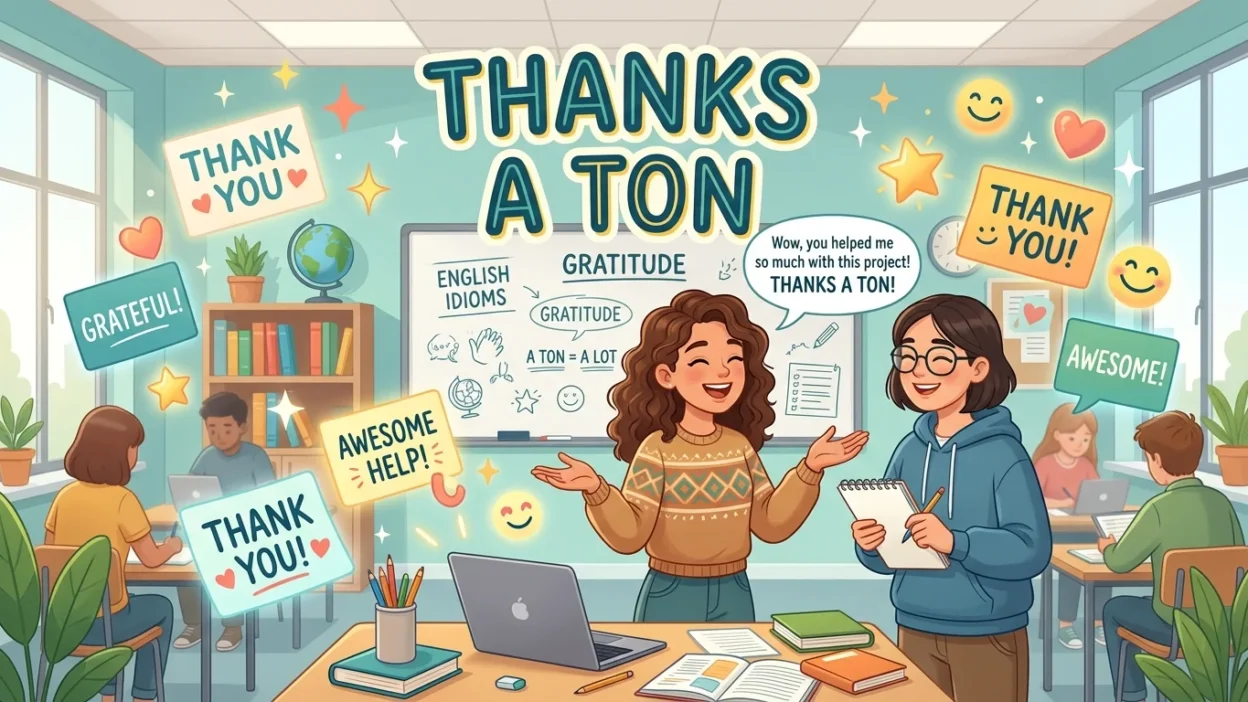
“Thanks a ton” is an informal expression used to say “thank you very much” or “thank you a lot.” It shows strong appreciation and is often used when someone has done something helpful, kind, or thoughtful. For example, if a friend helps you move, you might say, “Thanks a ton for helping me!” The phrase is warm, friendly, and common in everyday English.
The word “ton” is not meant literally in this expression. A ton is a unit of weight, but in “thanks a ton,” it is used figuratively to emphasize the amount of gratitude you feel. The expression is similar to “thanks a lot,” “thanks so much,” and “many thanks.” However, “thanks a ton” tends to sound especially casual and enthusiastic. It works well in conversations, text messages, emails to people you know, and friendly social communication.
Quick Answer
“Thanks a ton” means “thank you very much” or “thank you a lot.” It is an informal and friendly way to express strong gratitude. The word “ton” is used figuratively to emphasize how much you appreciate someone’s help, kindness, or effort. For example: “Thanks a ton for your help!”
Why Do People Say “Thanks a Ton”?
People use “thanks a ton” to make their gratitude sound stronger and warmer than a simple “thanks.”
Compare:
Thanks.
This is polite but simple.
Thanks a ton!
This sounds more enthusiastic.
The expression is especially natural when someone has done something useful or gone out of their way to help you.
For example:
You picked me up from the airport? Thanks a ton!
The speaker is showing genuine appreciation.
First Word: Thanks
Thanks is a common informal way of expressing gratitude.
It is related to thank you, but it sounds more conversational.
For example:
Thanks for your help.
Thanks for calling.
Thanks for the advice.
The word thanks can be followed by expressions that strengthen the gratitude:
Thanks so much.
Thanks a lot.
Thanks a ton.
Second Word: Ton
A ton is normally a unit of weight.
For example:
The truck can carry several tons.
But in “thanks a ton,” the word ton is not being used literally.
It means:
a great deal
or:
a very large amount
So:
Thanks a ton.
literally sounds like “thank you a very large amount,” but the natural meaning is:
Thank you very much.
What Does “Thanks a Ton” Really Mean?
The expression means:
- Thank you very much.
- Thank you so much.
- I really appreciate it.
- I appreciate your help a lot.
For example:
Thanks a ton for helping me with my homework.
This means:
Thank you very much for helping me with my homework.
It expresses strong appreciation in a friendly way.
When Should You Use “Thanks a Ton”?
Use “thanks a ton” in informal or friendly situations.
It works well when:
- a friend helps you
- someone gives you useful advice
- someone does you a favor
- someone provides information
- someone goes out of their way for you
- you want to sound warm and appreciative
For example:
Thanks a ton for picking me up.
Thanks a ton for sending the information.
Thanks a ton for your support.
15 Examples of “Thanks a Ton”
- Thanks a ton for helping me with my project.
- Thanks a ton for your advice.
- Thanks a ton for picking me up from the airport.
- Thanks a ton for sending me the information.
- Thanks a ton for your help.
- Thanks a ton for explaining everything.
- Thanks a ton for waiting for me.
- Thanks a ton for the wonderful gift.
- Thanks a ton for covering my shift.
- Thanks a ton for recommending that restaurant.
- Thanks a ton for checking this for me.
- Thanks a ton for being so helpful.
- Thanks a ton for your quick response.
- Thanks a ton for helping me solve the problem.
- Thanks a ton for everything you’ve done.
“Thanks a Ton” vs “Thank You Very Much”
Both expressions communicate strong gratitude.
Thanks a ton
Thanks a ton for your help!
This sounds:
- informal
- friendly
- warm
- conversational
Thank you very much
Thank you very much for your help.
This sounds:
- more neutral
- polite
- slightly more formal
If you are speaking to a close friend, “thanks a ton” sounds natural.
If you are writing a formal business letter, “thank you very much” may be a better choice.
Comparison Table: Ways to Say Thank You
| Expression | Meaning | Tone |
|---|---|---|
| Thanks | Thank you | Informal |
| Thanks a lot | Thank you very much | Informal |
| Thanks a ton | Thank you very much | Friendly and enthusiastic |
| Thanks so much | Thank you very much | Warm and friendly |
| Thank you very much | Strong gratitude | Neutral to formal |
| Many thanks | Thank you very much | Polite and somewhat formal |
| I really appreciate it | I am very grateful | Warm and sincere |
Is “Thanks a Ton” Formal or Informal?
“Thanks a ton” is informal.
It is perfectly natural in:
- conversations
- text messages
- social media
- friendly emails
- messages to people you know
For example:
Hey, thanks a ton for helping me yesterday!
However, in a highly formal letter or professional document, you may prefer:
Thank you very much for your assistance.
or:
I greatly appreciate your assistance.
Can You Say “Thanks a Ton” in an Email?
Yes.
It is appropriate for a friendly or moderately casual email.
For example:
Hi Sarah,
Thanks a ton for sending those documents. They were exactly what I needed.
Best,
Alex
For a formal business email, however, a more neutral expression may be better.
“Thanks a Ton” vs “Thanks a Lot”
These expressions are very similar.
Thanks a lot!
Thanks a ton!
Both mean thank you very much.
However, thanks a ton can sound slightly more enthusiastic or playful.
There is also an important context issue with thanks a lot.
Depending on tone, “Thanks a lot” can sometimes be sarcastic:
You deleted the entire file? Thanks a lot!
“Thanks a ton” can also be sarcastic, but it is more often understood as genuinely enthusiastic when the context is positive.
“Thanks a Ton” vs “Thanks So Much”
Both are warm and informal.
Thanks so much for your help!
Thanks a ton for your help!
They have almost the same meaning.
Thanks so much is perhaps slightly more broadly natural, while thanks a ton has a casual, enthusiastic feel.
Can “Thanks a Ton” Be Sarcastic?
Yes.
Tone and context can change the meaning.
For example:
You broke my phone. Thanks a ton.
Here, the speaker is probably not genuinely grateful.
They are being sarcastic.
But:
You found my lost wallet? Thanks a ton!
is clearly sincere.
So the phrase can express either genuine gratitude or sarcasm depending on context.
Common Mistakes
1. Taking “ton” literally
The expression does not mean that you are giving or receiving a physical ton of thanks.
It simply means:
Thank you very much.
2. Using it in extremely formal writing
It is not wrong English, but it may sound too casual for a formal letter, legal document, or highly professional communication.
3. Thinking it means “thanks for a ton”
These are different structures.
Thanks a ton.
means:
Thank you very much.
But:
Thanks for a ton of help.
means:
Thank you for a large amount of help.
4. Forgetting that tone matters
Like many expressions of gratitude, “thanks a ton” can be sincere or sarcastic.
Context determines the intended meaning.
“Thanks a Ton” in American vs British English
“Thanks a ton” is understood in both American and British English.
It is informal in both varieties.
There is no major difference in meaning between American and British usage.
The expression is simply a casual way of emphasizing gratitude.
Similar Expressions
Thanks a lot
Thanks a lot for your help.
Means thank you very much.
Thanks so much
Thanks so much for your kindness.
A warm and friendly expression of gratitude.
Many thanks
Many thanks for your assistance.
A polite expression that can sound more formal.
Thanks a million
Thanks a million for helping me.
An enthusiastic way to say thank you very much.
I really appreciate it
I really appreciate your help.
A sincere and natural expression of gratitude.
I can’t thank you enough
I can’t thank you enough for everything you’ve done.
A strong way to express deep gratitude.
Memory Trick
Think:
TON = A LOT
So:
Thanks a ton = Thanks a lot
And:
Thanks a lot = Thank you very much
The word ton is simply being used to make the expression stronger.
Final Verdict
“Thanks a ton” means “thank you very much.” It is a friendly, informal expression used to show strong appreciation for someone’s help, kindness, advice, effort, or generosity.
The phrase is natural in everyday conversation, messages, social media, and friendly emails. It is less suitable for highly formal communication, where “thank you very much” or “I greatly appreciate it” may sound more appropriate.
The easiest way to remember it is:
Thanks a ton = Thanks a lot = Thank you very much.
Frequently Asked Questions
What does “thanks a ton” mean?
“Thanks a ton” means “thank you very much” or “thank you a lot.” It is an informal way to express strong gratitude.
Is “thanks a ton” formal or informal?
It is informal and friendly. It is common in conversations, text messages, social media, and casual emails.
Is “thanks a ton” the same as “thanks a lot”?
Yes. Both generally mean thank you very much. “Thanks a ton” can sound slightly more enthusiastic or playful.
Can I use “thanks a ton” in a professional email?
Yes, if the email is friendly or informal. In a highly formal business email, “thank you very much” or “I greatly appreciate your assistance” may be more appropriate.
Can “thanks a ton” be sarcastic?
Yes. Depending on tone and context, it can be used sarcastically.
You lost my keys? Thanks a ton.
Here, the speaker probably does not mean genuine gratitude.
Is “thanks a ton” grammatically correct?
Yes. “Thanks a ton” is a standard informal expression of gratitude.
What is another way to say “thanks a ton”?
You can say “thanks a lot,” “thanks so much,” “thanks a million,” “thank you very much,” or “I really appreciate it.”
Why does “ton” mean “a lot” in this expression?
Ton is being used figuratively to suggest a very large amount. Therefore, “thanks a ton” means giving a very large amount of thanks, or simply thanking someone very much.
Remember This
Thanks a ton = Thank you very much.
It is:
- informal
- friendly
- enthusiastic
- common in everyday English
For example:
Thanks a ton for your help!
For formal situations, consider:
Thank you very much for your assistance.
The simplest rule is:
Casual → Thanks a ton
Formal → Thank you very much
Conclusion
“Thanks a ton” is a common informal expression that means “thank you very much.” It uses ton figuratively to suggest a large amount of gratitude. The phrase is especially useful when you want to sound warm, friendly, and enthusiastic after someone has helped you or done something kind.
The expression works naturally in everyday conversations, text messages, social media, and friendly emails. It can also be used sarcastically when the context or tone suggests the opposite of genuine gratitude.
For formal situations, expressions such as “thank you very much” or “I greatly appreciate your assistance” are usually better choices. In simple terms, whenever you want to say “thank you very much” in a casual and friendly way, “thanks a ton” is a natural option.

Charles Kevin is a passionate language writer and researcher at SimileHive, creating clear, engaging content about similes, idioms, metaphors, and figurative language to help readers improve English communication confidently every day.