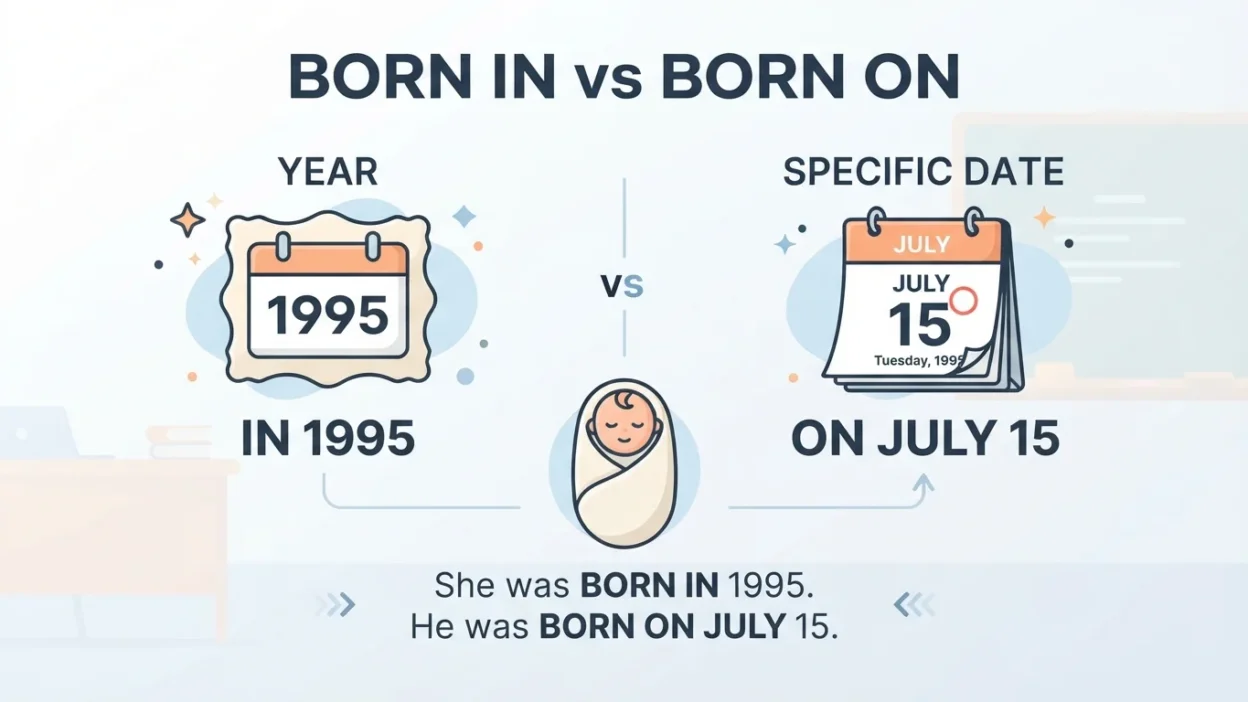
“Born in” and “born on” are both correct, but they are used for different types of time expressions. Use born in with a year, month, season, or general period: “I was born in 1995,” “She was born in July,” or “He was born in winter.” Use born on with a specific day or date: “I was born on Monday” or “She was born on July 15.”
The same basic rule applies to many other expressions involving time. In is generally used for a broader period, while on is used for a particular day or date. This makes the choice easy once you know what kind of time you are mentioning.
You can also use born in with places, such as “She was born in London,” because in can indicate the place where someone was born. Understanding these patterns will help you avoid common mistakes such as saying “I was born on 1995” or “I was born in Monday.”
Quick Answer
Use born in for a year, month, season, or place: “I was born in 2000,” “I was born in June,” or “I was born in Canada.” Use born on for a specific day or date: “I was born on Monday” or “I was born on June 10.” The choice depends on what follows born.
Why Do People Confuse “Born In” and “Born On”?
People often confuse these expressions because both in and on can be used when talking about someone’s birth.
For example:
I was born in 1998.
I was born on August 12.
Both sentences are correct, but they refer to different kinds of time.
The easiest rule is:
IN = a longer or broader period
ON = a specific day or date
There is another important use:
I was born in Pakistan.
Here, in refers to a place rather than a time.
First Expression: Born In
Born in is used when talking about:
- years
- months
- seasons
- centuries
- general periods
- places
Examples:
I was born in 1990.
She was born in March.
He was born in summer.
My grandfather was born in the twentieth century.
She was born in Canada.
Born In + Year
Use in with a year.
I was born in 1995.
She was born in 2001.
He was born in 1987.
Do not say:
I was born on 1995. ❌
The correct form is:
I was born in 1995. ✅
Born In + Month
Use in with a month when you do not give a specific date.
I was born in January.
She was born in September.
They were born in December.
If you give a specific date, however, use on:
I was born on September 12.
Second Expression: Born On
Use born on when referring to a specific day or date.
Examples:
I was born on Monday.
She was born on July 10.
He was born on December 25.
My daughter was born on a Sunday.
The important idea is specificity.
On points to a particular day on the calendar.
Born On + Day of the Week
Use on with days of the week.
I was born on Monday.
She was born on Friday.
He was born on Sunday.
Born On + Specific Date
Use on when you give a complete date.
I was born on May 15, 1998.
She was born on October 2, 2004.
He was born on January 1, 2000.
Notice that even though the year is included, the expression uses on because the entire expression identifies one specific date.
Born In vs Born On: The Main Difference
| Expression | Use It With | Example |
|---|---|---|
| Born in | Year | I was born in 1995. |
| Born in | Month | She was born in July. |
| Born in | Season | He was born in winter. |
| Born in | Century | She was born in the 19th century. |
| Born in | Place | He was born in England. |
| Born on | Day | I was born on Monday. |
| Born on | Specific date | She was born on July 15. |
| Born on | Specific calendar day | He was born on Christmas Day. |
When Should You Use “Born In”?
Use born in when the information is broad or general.
With a year
She was born in 1999.
With a month
He was born in April.
With a season
I was born in spring.
With a century
The author was born in the nineteenth century.
With a place
She was born in Lahore.
He was born in Pakistan.
When Should You Use “Born On”?
Use born on when referring to a particular day.
With a day of the week
She was born on Tuesday.
With a specific date
He was born on March 8.
With a special day
She was born on Christmas Day.
With a particular calendar day
I was born on the first day of the month.
15 Examples of “Born In”
- I was born in 1995.
- She was born in July.
- He was born in Canada.
- They were born in winter.
- My father was born in 1970.
- She was born in London.
- The actor was born in April.
- My grandmother was born in the twentieth century.
- He was born in Pakistan.
- She was born in 2003.
- My brother was born in November.
- The writer was born in France.
- He was born in spring.
- She was born in the 1980s.
- My grandfather was born in a small village.
15 Examples of “Born On”
- I was born on Monday.
- She was born on July 10.
- He was born on December 25.
- My sister was born on a Friday.
- She was born on March 15, 2001.
- He was born on January 1.
- I was born on Sunday.
- The baby was born on Tuesday morning.
- She was born on her mother’s birthday.
- He was born on the first day of spring.
- My son was born on June 5.
- She was born on October 31.
- He was born on Christmas Day.
- They were born on the same day.
- I was born on a rainy Monday.
What About “Born in 1990” vs “Born on July 15, 1990”?
Both are correct.
The difference is how specific you are.
I was born in 1990.
This gives only the year.
I was born on July 15, 1990.
This gives the exact date.
You can think of it as:
in + broader period
on + exact day/date
Comparison Table: Common Birth Expressions
| Expression | Correct? | Why? |
|---|---|---|
| I was born in 1990. | ✅ | Year |
| I was born on 1990. | ❌ | A year takes in |
| I was born in July. | ✅ | Month |
| I was born on July. | ❌ | A month alone takes in |
| I was born on July 15. | ✅ | Specific date |
| I was born in Monday. | ❌ | A day takes on |
| I was born on Monday. | ✅ | Day of the week |
| I was born in Pakistan. | ✅ | Place |
| I was born on Pakistan. | ❌ | A country takes in |
Born In vs Born On With Full Dates
One common question is whether to use in or on when a year and exact date appear together.
Use on:
I was born on June 14, 1998.
Although 1998 normally takes in, the complete expression refers to one specific date, so on is correct.
Compare:
I was born in 1998.
I was born on June 14, 1998.
Both are correct.
The first gives the year.
The second gives the exact date.
Born In vs Born On With Months
Use in when mentioning only a month:
I was born in May.
Use on when mentioning a specific date:
I was born on May 20.
This is one of the easiest rules to remember.
Month only → in
Specific date → on
Born In vs Born On With Days
Days take on.
I was born on Monday.
She was born on Friday.
He was born on Christmas Day.
Do not use in with a specific day:
I was born in Monday. ❌
Born In for Places
Born in is also used to identify where someone was born.
For example:
She was born in New York.
He was born in India.
I was born in Lahore.
They were born in a small town.
This is different from born on, which normally refers to a specific date or day.
Common Mistakes
1. “I was born on 1995”
Incorrect:
I was born on 1995. ❌
Correct:
I was born in 1995. ✅
A year takes in.
2. “I was born in Monday”
Incorrect:
I was born in Monday. ❌
Correct:
I was born on Monday. ✅
A day takes on.
3. “I was born on July”
Incorrect when July is given by itself:
I was born on July. ❌
Correct:
I was born in July. ✅
But:
I was born on July 15. ✅
4. “I was born in July 15”
Incorrect:
I was born in July 15. ❌
Correct:
I was born on July 15. ✅
5. Using “on” for a country
Incorrect:
I was born on Pakistan. ❌
Correct:
I was born in Pakistan. ✅
Memory Trick
Use this simple rule:
IN = big or broad
ON = specific day
Think of a calendar:
IN 1995
IN July
ON Monday
ON July 15
For places:
IN Pakistan
IN Lahore
A very easy formula is:
Year / month / season → IN
Day / exact date → ON
American vs British English
The basic rule is the same in American and British English.
Both varieties use:
I was born in 1990.
I was born in July.
I was born on July 15.
I was born on Monday.
However, date formatting can differ.
American English commonly writes:
July 15, 1990
British English commonly writes:
15 July 1990
But the preposition remains on in both:
I was born on July 15, 1990.
I was born on 15 July 1990.
Similar Time Expressions
The same in / on rule appears with many other expressions.
In + year
The company was founded in 2005.
In + month
We moved in August.
In + season
Flowers bloom in spring.
On + day
The meeting is on Monday.
On + date
The appointment is on June 10.
Understanding these patterns makes born in and born on much easier.
Final Verdict
Use born in for a year, month, season, century, general period, or place:
I was born in 1995.
I was born in July.
I was born in Pakistan.
Use born on for a specific day or date:
I was born on Monday.
I was born on July 15.
The easiest rule is:
IN = broader period or place
ON = specific day or date
So, if you are talking about an exact birthday, use on. If you are talking about only the year or month, use in.
Frequently Asked Questions
Is it “born in” or “born on”?
Both are correct, depending on what follows. Use born in for years, months, seasons, and places. Use born on for specific days and dates.
Do you say “born in 1990” or “born on 1990”?
The correct expression is “born in 1990.” Years use the preposition in.
Do you say “born in July” or “born on July”?
Say “born in July” when you mention the month by itself. If you give a specific date, say “born on July 15.”
Do you say “born in Monday” or “born on Monday”?
The correct expression is “born on Monday.” Days of the week use on.
Do you say “born in June 10” or “born on June 10”?
The correct expression is “born on June 10.” A specific calendar date takes on.
Is “I was born in Pakistan” correct?
Yes. Use in for countries, cities, towns, and other general places.
Is “I was born on December 25” correct?
Yes. December 25 is a specific date, so on is correct.
What is the easiest way to remember “born in” and “born on”?
Remember:
IN → year, month, season, place
ON → day, exact date
For example:
I was born in 1998.
I was born on May 12.
Remember This
The rule is simple:
Born in:
- in 1995
- in July
- in winter
- in the 1990s
- in Pakistan
- in Lahore
Born on:
- on Monday
- on Friday
- on July 15
- on December 25
- on my birthday
Remember:
IN = broad
ON = specific day
Conclusion
“Born in” and “born on” are both correct expressions, but they are used with different kinds of information. Use born in for a year, month, season, century, general period, or place. For example, “I was born in 1995” and “She was born in Canada” are correct. Use born on when you give a particular day or exact date, such as “I was born on Monday” or “She was born on July 15.”
The easiest way to remember the difference is to think about how specific the information is. In is generally used for a broader period or location, while on is used for a specific day or date. So, say “born in June” but “born on June 15.” Once you learn this simple pattern, choosing between in and on when talking about birth becomes much easier.

Adam Aaron is a language enthusiast and content writer at SimileHive, creating clear, engaging guides on similes, idioms, metaphors, and figurative language to help readers improve English confidently every day.