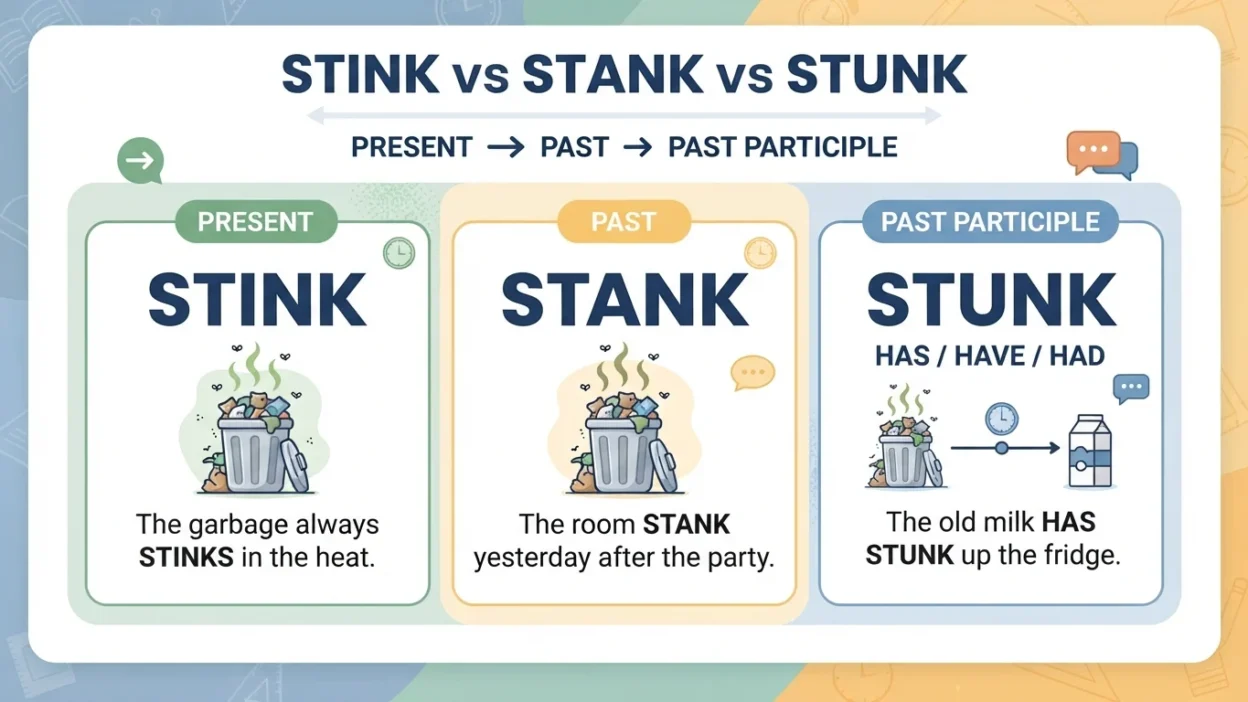
“Stink,” “stank,” and “stunk” all come from the same verb, but they are used in different ways. The verb stink means to smell very bad or unpleasant. Stank is traditionally the simple past form, especially in informal American English, while stunk is the past participle and is normally used with helping verbs such as has, have, had, or was in certain constructions. For example, you can say, “The garbage stank yesterday” and “The garbage has stunk for days.”
The confusion happens because stink has irregular forms and because both stank and stunk can sometimes appear in past contexts. In everyday English, you may hear stank as a simple past verb and stunk in perfect constructions. The safest pattern to remember is stink → stank → stunk. Once you understand the difference between a simple past form and a past participle, choosing the right word becomes much easier.
Quick Answer
Stink is the base form, stank is the traditional simple past form, and stunk is the past participle. Say “It stinks” for the present, “It stank yesterday” for the simple past, and “It has stunk for days” for the present perfect. The basic pattern is stink → stank → stunk.
Why Do People Confuse “Stink,” “Stank,” and “Stunk”?
These three words are confusing because stink is an irregular verb.
Regular verbs usually form the past by adding -ed:
walk → walked
clean → cleaned
But stink changes its vowel:
stink → stank → stunk
The three forms are not interchangeable in standard usage.
For example:
The fish stinks.
The fish stank yesterday.
The fish has stunk for three days.
Each sentence uses a different verb form.
First Word: Stink
Stink is the base form of the verb.
It means to smell very bad or unpleasant.
Examples:
These shoes stink.
The garbage stinks.
This room will stink if we leave the food here.
It can also be used after helping verbs:
It might stink.
They could stink.
The kitchen will stink if we do not clean it.
Stink in the Present Tense
For present simple:
I stink.
You stink.
We stink.
They stink.
With he, she, or it, add -s:
He stinks.
She stinks.
It stinks.
Second Word: Stank
Stank is the simple past form of stink.
Use it when you are talking about something that smelled bad at a particular time in the past.
Examples:
The garbage stank yesterday.
The room stank after the food was left out.
His shoes stank after the game.
You do not normally need a helping verb with stank because it already expresses the past tense.
For example:
The fish stank.
Not:
The fish did stank. ❌
After did, use the base form:
The fish did stink. ✅
Third Word: Stunk
Stunk is the past participle of stink.
It is normally used with a helping verb such as has, have, or had.
Examples:
The garbage has stunk for days.
The room had stunk before we opened the windows.
Those shoes have stunk since yesterday.
The important pattern is:
has/have/had + stunk
Do not normally use stunk by itself as the simple past in standard English.
For example:
The room stunk yesterday. ✅
The room stunk yesterday. ❌
The second sentence would be wrong only if you intended stunk to be the simple past form; the standard simple past is stank.
Stink vs Stank vs Stunk: The Main Difference
| Word | Verb Form | Main Use | Example |
|---|---|---|---|
| Stink | Base form | Present, infinitive, after modals | It may stink. |
| Stinks | Present, third person singular | Present | It stinks. |
| Stank | Simple past | Completed past action | It stank yesterday. |
| Stunk | Past participle | Perfect constructions | It has stunk for days. |
The basic pattern is:
Stink → present/base form
Stank → simple past
Stunk → past participle
When Should You Use “Stink”?
Use stink when you are using the base form of the verb.
After “to”
I don’t want to stink.
After modal verbs
It might stink.
The room could stink later.
With “do” or “did”
It does stink.
It did stink yesterday.
In general statements
Some foods stink when they are fermented.
Remember that stink changes to stinks with a singular third-person subject in the simple present:
The cheese stinks.
When Should You Use “Stank”?
Use stank as the simple past form.
For example:
The garbage stank yesterday.
The bathroom stank after the pipe broke.
His clothes stank after the workout.
If you are describing a completed past situation, stank is usually the correct form.
When Should You Use “Stunk”?
Use stunk as the past participle.
It commonly follows:
- has
- have
- had
- may have
- might have
- could have
- would have
Examples:
The room has stunk all morning.
The shoes have stunk since Monday.
The kitchen had stunk before we cleaned it.
The garbage might have stunk because it was left outside.
15 Examples of “Stink”
- These socks stink.
- The garbage stinks.
- Those shoes really stink.
- This cheese stinks.
- The bathroom might stink later.
- The room will stink if we leave the trash there.
- I don’t want to stink.
- The fish can stink if it is not refrigerated.
- The old carpet stinks.
- Some chemicals stink terribly.
- The kitchen may stink after cooking.
- His clothes stink after working outside.
- The drain stinks.
- Wet towels can stink.
- The trash will stink in the heat.
15 Examples of “Stank”
- The garbage stank yesterday.
- The room stank after the party.
- His shoes stank after the game.
- The kitchen stank because of the spoiled food.
- The drain stank all morning.
- The fish stank when we opened the container.
- The bathroom stank after the pipe broke.
- The old carpet stank badly.
- The trash stank in the summer heat.
- His clothes stank after the workout.
- The basement stank of mold.
- The refrigerator stank after the power went out.
- The alley stank after the garbage was left there.
- The room stank when we walked in.
- The wet towels stank after being left in the basket.
15 Examples of “Stunk”
- The garbage has stunk for days.
- The room has stunk since yesterday.
- His shoes have stunk since the game.
- The kitchen has stunk all morning.
- The bathroom had stunk before we cleaned it.
- The fish has stunk since we opened the package.
- The basement has stunk for weeks.
- The drain has stunk since Monday.
- The refrigerator had stunk before we discovered the problem.
- The towels have stunk because they stayed wet.
- The carpet has stunk since it got wet.
- The room had stunk before the windows were opened.
- The garbage has stunk badly in the heat.
- His clothes have stunk after every workout.
- The kitchen had stunk for hours before anyone noticed.
Comparison: Simple Past vs Past Participle
This is the most important distinction.
Simple past
Use stank:
The room stank yesterday.
Present perfect
Use has/have stunk:
The room has stunk all day.
Past perfect
Use had stunk:
The room had stunk before we cleaned it.
The difference is grammatical rather than a difference in the basic meaning of the smell.
Comparison Table: Which Form Should You Choose?
| What You Mean | Correct Form | Example |
|---|---|---|
| Present | stink / stinks | The room stinks. |
| Past | stank | The room stank yesterday. |
| Present perfect | has/have stunk | The room has stunk all day. |
| Past perfect | had stunk | The room had stunk for hours. |
| After “to” | stink | I don’t want to stink. |
| After “did” | stink | It did stink. |
| After “might have” | stunk | It might have stunk. |
Can “Stunk” Be Used as the Simple Past?
In standard modern English, stank is the traditional simple past form:
The garbage stank yesterday.
Stunk is normally the past participle:
The garbage has stunk for days.
However, usage can vary in some dialects and informal speech. You may hear stunk used as a simple past form, but if you want a safe standard-English choice, use stank for the simple past.
Can “Stank” Be Used With “Have”?
No, not in standard English.
Incorrect:
It has stank for days. ❌
Correct:
It has stunk for days. ✅
Likewise:
It had stunk before we arrived. ✅
Not:
It had stank before we arrived. ❌
What About “Stinks”?
Do not forget stinks.
Stinks is the simple present form used with he, she, it, or another singular subject.
The garbage stinks.
This cheese stinks.
The room stinks.
Compare:
These shoes stink.
This shoe stinks.
Common Mistakes
1. “It stunk” vs “It stank”
For standard English simple past, use:
It stank yesterday. ✅
Stunk is normally the past participle.
2. “It has stank”
Incorrect:
It has stank for days. ❌
Correct:
It has stunk for days. ✅
3. “It did stank”
Incorrect:
It did stank. ❌
Correct:
It did stink. ✅
After did, use the base form.
4. “It stinks yesterday”
Incorrect:
It stinks yesterday. ❌
Correct:
It stank yesterday. ✅
The past time marker yesterday requires the past form.
5. Confusing “stink” with the noun “stink”
Stink can also be a noun.
There was a terrible stink in the kitchen.
Here, stink means a very unpleasant smell.
Stink as a Noun
Although this article focuses on the verb forms, stink can also be a noun.
As a noun, it means a very unpleasant smell.
Examples:
There was a terrible stink coming from the drain.
The stink of garbage filled the room.
I couldn’t stand the stink.
It can also be used informally to describe a fuss or controversy:
The decision caused quite a stink.
This use is different from the verb forms stink, stank, and stunk.
Stink vs Smell
Stink is stronger than the neutral verb smell.
The flowers smell nice.
The garbage stinks.
Smell can be positive, neutral, or negative.
Stink normally suggests a very unpleasant smell.
Memory Trick
Use this three-step pattern:
STINK → STANK → STUNK
Think:
Now → Before → Has/Had
It stinks now.
It stank yesterday.
It has stunk all day.
Another easy rule:
No helping verb + past → STANK
Has / have / had + past participle → STUNK
American vs British English
Stink, stank, and stunk are used in both American and British English.
The standard pattern is generally:
stink → stank → stunk
However, informal and dialectal usage can vary, particularly with the past forms. You may occasionally hear stunk used as a simple past form in some varieties of English.
For standard written English, the safest pattern is:
stank = simple past
stunk = past participle
Similar Words
Smell
A general word for noticing or producing an odor.
The flowers smell wonderful.
Reek
Means to smell very strongly and unpleasantly.
The garbage reeks.
Odor
A noun meaning a smell, often used for an unpleasant smell.
There was a strange odor in the room.
Foul-smelling
Describes something that has a very unpleasant smell.
The water was foul-smelling.
Fragrant
Describes something with a pleasant smell.
The flowers were fragrant.
Final Verdict
The easiest way to remember the three forms is:
Stink → base form
Stank → simple past
Stunk → past participle
Examples:
The garbage stinks.
The garbage stank yesterday.
The garbage has stunk for days.
If you are writing in standard English, use stank for the simple past and stunk after has, have, or had.
Frequently Asked Questions
Is “stank” or “stunk” the past tense of “stink”?
Stank is the standard simple past form, while stunk is the past participle.
It stank yesterday.
It has stunk for days.
Is “stunk” grammatically correct?
Yes. Stunk is the past participle of stink and is normally used with helping verbs.
The room has stunk all day.
Can I say “it stunk”?
Yes. “It stunk” is the standard simple past form.
The garbage stunk yesterday.
Can I say “it stunk yesterday”?
Yes. This is correct standard English.
Can I say “it has stank”?
No, not in standard English.
The correct form is:
It has stunk.
What is the difference between “stank” and “stunk”?
Stank is the simple past form. Stunk is the past participle.
The room stank yesterday.
The room has stunk for days.
Is “stinks” the present tense?
Yes. Stinks is the third-person singular present form of stink.
The garbage stinks.
Is “stink” a verb or a noun?
It can be both. As a verb, it means to smell very badly. As a noun, it means a very unpleasant smell.
Remember This
Keep this pattern in mind:
STINK → STANK → STUNK
- Stink = base/present form
- Stank = simple past
- Stunk = past participle
Examples:
It stinks now.
It stank yesterday.
It has stunk for days.
The key rule is:
Stank = past
Stunk = has/have/had + past participle
Conclusion
Stink, stank, and stunk are three forms of the same irregular verb. The verb stink means to smell very badly or unpleasantly. Stank is the standard simple past form, while stunk is the past participle. This gives us the basic pattern stink → stank → stunk. For example, “The garbage stinks” describes the present, “The garbage stank yesterday” describes the simple past, and “The garbage has stunk for days” uses the past participle.
The most important thing to remember is the difference between stank and stunk. Use stank when you are simply talking about something that smelled bad in the past. Use stunk after helping verbs such as has, have, and had. Although informal and dialectal usage can vary, stink → stank → stunk is the safest pattern for standard English. Once you memorize these three forms, using them correctly becomes straightforward.

Charles Kevin is a passionate language writer and researcher at SimileHive, creating clear, engaging content about similes, idioms, metaphors, and figurative language to help readers improve English communication confidently every day.