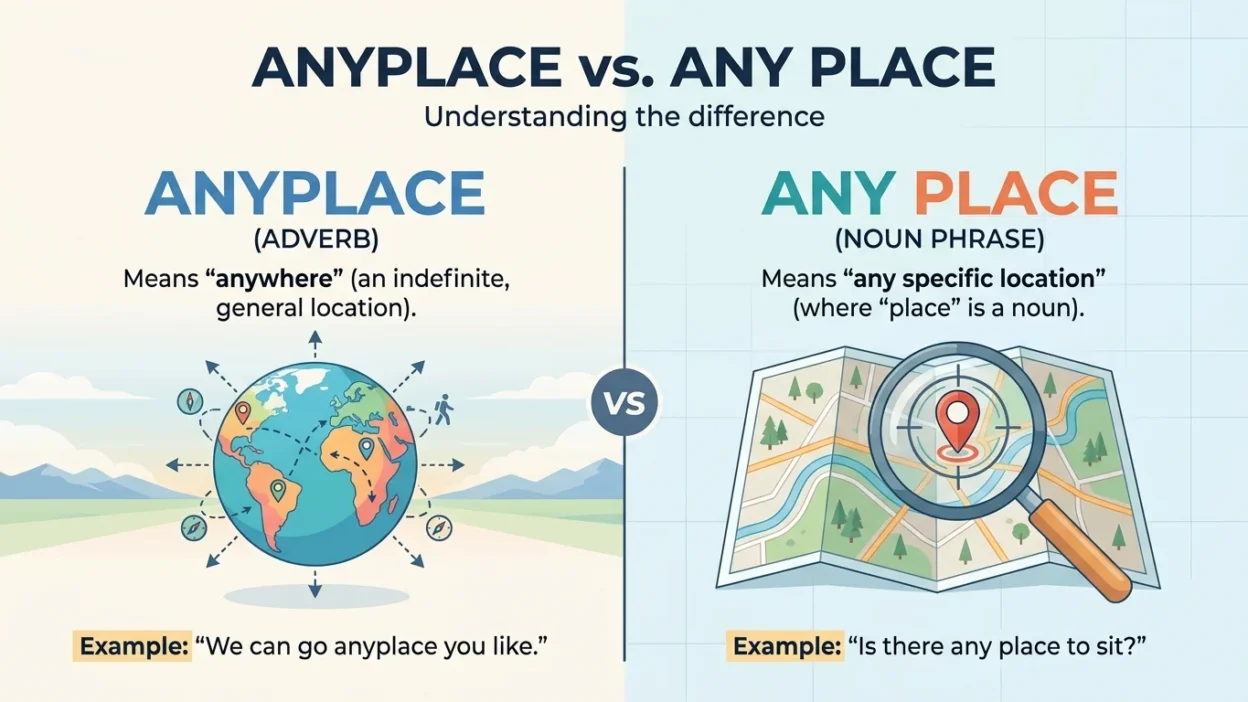
“Anyplace” and “any place” can both be correct, but they are used differently. Anyplace is a one word adverb meaning “anywhere” or “in, at, or to any place.” For example, “You can sit anyplace you like” means “You can sit anywhere you like.” Any place, written as two words, is a determiner and noun combination meaning “any particular place” or “any location.” For example, “You can choose any place you like” means you can choose any location you prefer.
The easiest way to tell them apart is to look at what the phrase is doing in the sentence. If it means “anywhere,” use anyplace. If any describes the noun place, use any place. Both forms are standard, but anyplace is more common in American English and can sound less natural in some varieties of British English. Learning this small distinction will help you choose the right form without relying on guesswork.
Quick Answer
Anyplace is an adverb meaning “anywhere,” while any place is the phrase any + place, meaning “any location.” Say “You can go anyplace” when you mean “anywhere,” but say “Choose any place you like” when place is a noun that can be modified by other words.
Why Do People Confuse “Anyplace” and “Any Place”?
The confusion happens because the two forms look almost identical and often appear in sentences with similar meanings.
Compare:
You can sit anyplace.
Here, anyplace means anywhere.
Now compare:
You can sit in any place you choose.
Here, any describes the noun place.
Both sentences are correct, but their grammatical structures are different.
A useful question to ask is:
Can I replace it with “anywhere”?
If yes, anyplace may be the right choice.
First Word: Anyplace
Anyplace is an adverb.
It means:
- anywhere
- in any place
- at any place
- to any place
Examples:
You can go anyplace you want.
I can’t find my keys anyplace.
We can meet anyplace.
In these examples, anyplace describes location or direction.
Anyplace = Anywhere
In many sentences, you can replace anyplace with anywhere without changing the basic meaning.
We can meet anyplace.
We can meet anywhere.
Both mean that there is no particular location requirement.
Second Expression: Any Place
Any place consists of the determiner any and the noun place.
Here, place remains a normal noun.
For example:
Choose any place you like.
The word any tells us that there is no restriction on which place can be chosen.
You can also modify place:
Choose any quiet place you like.
We need any suitable place for the meeting.
Is there any safe place nearby?
Because place is functioning as a noun, the two word form is required in these structures.
Anyplace vs Any Place: The Main Difference
| Form | Part of Speech | Meaning | Example |
|---|---|---|---|
| Anyplace | Adverb | Anywhere | You can sit anyplace. |
| Any place | Determiner + noun | Any location | Choose any place you like. |
| Anyplace | Adverb | In/at/to anywhere | I can’t find it anyplace. |
| Any place | Noun phrase | Any particular location | Is there any place nearby? |
The simplest rule is:
Anyplace = anywhere
Any place = any + noun “place”
When Should You Use “Anyplace”?
Use anyplace when it functions as an adverb and means anywhere.
For example:
You can park anyplace.
I can’t find my phone anyplace.
We can meet anyplace.
You can put the box anyplace.
In each case, anyplace describes where something can happen, exist, or be located.
Anyplace After a Verb
You will often see anyplace after a verb:
Let’s go anyplace.
You can sit anyplace.
I looked anyplace I could think of.
Anyplace in Negative Sentences
Anyplace can also appear in negative sentences:
I couldn’t find the document anyplace.
She doesn’t want to go anyplace today.
However, anywhere is often more natural and more widely used.
When Should You Use “Any Place”?
Use any place when place is functioning as a noun.
For example:
Choose any place you like.
Here, you could add an adjective:
Choose any quiet place you like.
That makes it clear that place is a noun.
You can also use any place after prepositions:
We didn’t see any place to park.
Is there any place nearby?
I don’t want to go to any place crowded.
In these structures, keeping place as a separate noun is often necessary.
15 Examples of “Anyplace”
- You can sit anyplace you want.
- We can meet anyplace.
- I couldn’t find my phone anyplace.
- You can park anyplace along this street.
- Let’s go anyplace you choose.
- I looked anyplace I could think of.
- She doesn’t want to go anyplace today.
- You can put the bag anyplace.
- We can travel anyplace this summer.
- He couldn’t find a taxi anyplace nearby.
- You can work anyplace with an internet connection.
- I searched anyplace that seemed likely.
- They can meet anyplace after lunch.
- You won’t find a better deal anyplace else.
- We can have the meeting anyplace that is convenient.
15 Examples of “Any Place”
- You can choose any place you like.
- Is there any place nearby?
- We need any place with enough seats.
- Choose any place on the map.
- I don’t want any place too expensive.
- We can meet at any place you prefer.
- Is there any place where we can sit?
- She looked for any place that offered parking.
- Pick any place on the list.
- They need any place large enough for the event.
- We couldn’t find any place suitable for the meeting.
- He wants to live in any place with a warm climate.
- Is there any place open this late?
- You may select any place in the room.
- We were willing to consider any place within our budget.
How Can You Tell Which One to Use?
Try replacing the expression with anywhere.
If “anywhere” works naturally
Use anyplace:
You can sit anyplace.
You can sit anywhere.
Both work.
If “place” is being described
Use any place:
Choose any quiet place.
You cannot replace any quiet place with anywhere without changing the structure.
This is one of the easiest ways to identify the difference.
Comparison Table: Anyplace vs Any Place
| Sentence | Correct Form | Why? |
|---|---|---|
| You can go ___ you want. | anyplace | Means anywhere |
| Choose ___ you like. | any place | Place is a noun |
| I couldn’t find it ___. | anyplace | Means anywhere |
| Is there ___ nearby? | any place | Place is a noun |
| You can sit ___. | anyplace | Adverb |
| Choose ___ with good lighting. | any place | Place is modified by a phrase |
| We can meet ___. | anyplace | Means anywhere |
| We need ___ suitable for children. | any place | Place is a noun |
Anyplace vs Anywhere
Anyplace and anywhere can often mean exactly the same thing.
You can go anyplace.
You can go anywhere.
Both mean you can go to any location.
However, anywhere is generally more common and widely accepted in both American and British English.
If you want the most universally natural choice, anywhere is usually the safest option.
Is “Anyplace” One Word?
Yes.
When anyplace is being used as an adverb meaning anywhere, it is written as one word.
You can sit anyplace.
Do not write:
You can sit any place.
if you intend anyplace as the adverb meaning “anywhere.”
However, any place is correct when place is being used as a noun:
Choose any place you like.
Can “Any Place” Be One Word?
Sometimes, but not in every sentence.
If the intended meaning is “anywhere,” anyplace can be written as one word.
If place is a noun modified by any, keep the words separate.
Compare:
We can meet anyplace.
We can meet at any place that you prefer.
The first means anywhere. The second refers to any particular location that the listener can choose.
Common Mistakes
1. Writing “any place” when you mean “anywhere”
If you mean:
anywhere
you can use:
anyplace
For example:
You can go anyplace.
2. Writing “anyplace” when “place” has a modifier
Incorrect:
Choose anyplace quiet. ❌
Better:
Choose any quiet place. ✅
Here, place is a noun modified by quiet.
3. Assuming the two forms are always interchangeable
They can have similar meanings, but their grammatical roles differ.
You can sit anyplace.
Choose any place you like.
4. Forgetting that “anyplace” is less common than “anywhere”
Anyplace is correct, but anywhere is often the more natural choice.
Memory Trick
Remember:
Anyplace = anywhere
If you can replace it with anywhere, the one word form is likely correct.
For example:
We can meet anyplace.
We can meet anywhere.
But if place has an adjective or another phrase describing it, keep the words separate:
Choose any quiet place.
A simple rule:
Anyplace = location adverb
Any place = any + noun
American vs British English
Anyplace is especially common in American English.
It is also understood in British English, but anywhere is generally more common in British usage.
The two word phrase any place is available in both varieties when place is functioning as a noun.
For example:
You can go anyplace you want.
You can go anywhere you want.
Both are understandable, but anywhere is often the more natural choice, particularly in British English.
Similar Words
Anywhere
Means in, at, or to any place.
You can sit anywhere.
Somewhere
Means in, at, or to an unspecified place.
I left it somewhere.
Everywhere
Means in or to all places.
We looked everywhere.
Any location
A more formal alternative to any place.
You can choose any location.
Wherever
Means in or to any place that.
Go wherever you want.
Anywhere else
Means any other place.
Is there anywhere else we can go?
Final Verdict
“Anyplace” and “any place” are both correct, but they have different grammatical functions.
Use anyplace as an adverb when it means anywhere:
You can sit anyplace.
Use any place when place is a noun:
Choose any place you like.
The easiest test is to ask whether you can replace the expression with anywhere. If you can, anyplace may work. If place is being modified by an adjective or another phrase, use any place.
In many situations, anywhere is the most natural alternative to anyplace.
Frequently Asked Questions
Is “anyplace” one word or two?
Anyplace is one word when it is used as an adverb meaning anywhere.
You can go anyplace.
But any place is two words when place is functioning as a noun.
Choose any place you like.
Is “anyplace” grammatically correct?
Yes. Anyplace is a standard English word meaning anywhere, especially common in American English.
What is the difference between “anyplace” and “any place”?
Anyplace is an adverb meaning anywhere. Any place is the combination of any + noun place.
Is “anyplace” the same as “anywhere”?
Usually, yes. Both can mean in, at, or to any place.
We can meet anyplace.
We can meet anywhere.
Which is more common, “anyplace” or “anywhere”?
Anywhere is generally more common and widely used. Anyplace is especially common in American English.
Should I write “anyplace you want” or “any place you want”?
When the meaning is “anywhere you want,” anyplace you want is natural. However, any place you want can also be correct when place is functioning as a noun.
Is “any place” always wrong?
No. Any place is completely correct when place is a noun.
Is there any place to sit?
Can “anyplace” be used in formal writing?
Yes, but anywhere is often a more natural and widely preferred choice in formal writing.
Remember This
Keep this simple rule in mind:
Anyplace = anywhere
Any place = any + place
Examples:
You can go anyplace.
Choose any place you like.
If place has a modifier:
any quiet place
any safe place
any convenient place
use two words.
Conclusion
“Anyplace” and “any place” look almost identical, but they serve different grammatical purposes. Anyplace is a one word adverb meaning “anywhere.” It is especially common in American English and works naturally in sentences such as “You can sit anyplace you want.” Any place, on the other hand, consists of the determiner any and the noun place, as in “Choose any place you like.”
The simplest way to remember the difference is to check whether place is acting as a noun. If the whole expression simply means “anywhere,” anyplace can be used. If place is being described by an adjective or another phrase, use any place. When in doubt, anywhere is usually the safest and most widely natural alternative to anyplace.

Lucas Luke is a passionate language writer and content creator at SimileHive, specializing in similes, idioms, metaphors, and figurative language. He enjoys making complex English expressions simple, engaging, and easy to understand for students, writers, and language enthusiasts through well-researched, practical content.