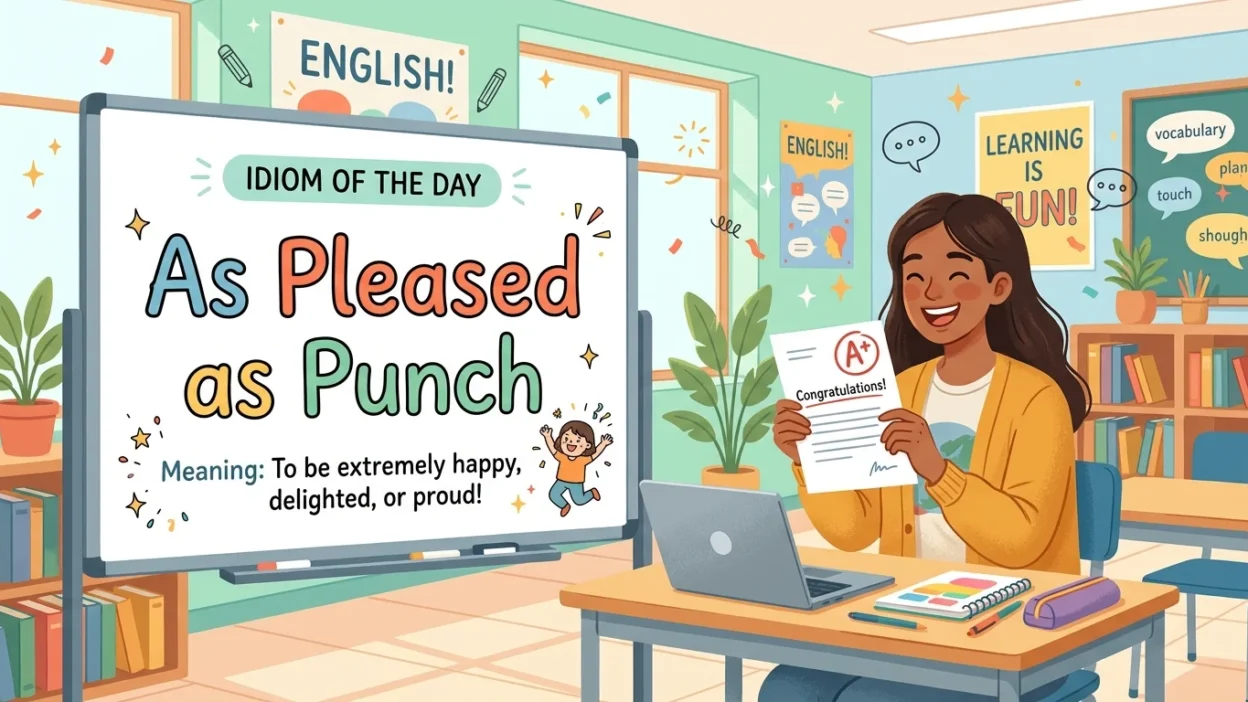
“As pleased as punch” is a common English idiom used to describe someone who is very happy, delighted, or proud about something. If someone is as pleased as punch, they are extremely satisfied with a situation or achievement and often show their happiness clearly.
For example, if your friend wins a school competition and cannot stop smiling, you could say, “She was as pleased as punch when she received the award.” The expression is informal, friendly, and often used when someone is especially proud or excited about good news. It can describe happiness about an achievement, compliment, success, gift, or pleasant surprise.
Quick Answer
“As pleased as punch” means extremely happy, delighted, or satisfied. It is an informal idiom often used when someone is very proud or pleased about something that has happened. For example: “He was as pleased as punch when his team won the final.”
Why Do People Say “As Pleased as Punch”?
The phrase uses punch in an unusual way. Here, “punch” does not mean hitting someone or the fruit drink.
The expression is generally associated with Mr. Punch, the cheerful and often mischievous puppet character from the traditional Punch and Judy shows. The character was known for his exaggerated expressions and confident behavior.
Over time, “pleased as Punch” came to describe someone who looked extremely pleased with themselves.
Today, most speakers simply understand the phrase as meaning very pleased or delighted, without thinking about its historical background.
What Does “As Pleased as Punch” Mean?
“As pleased as punch” means:
- Very happy
- Extremely pleased
- Delighted
- Very satisfied
- Proud of an achievement
- Excited about good news
It is usually used in a positive and informal situation.
Example
“Dad was as pleased as punch when I got my first job.”
This means Dad was extremely happy and proud when he learned about the job.
How to Use “As Pleased as Punch” in a Sentence
The expression is normally used after a form of be.
Common patterns include:
Subject + be + as pleased as punch
Examples:
- “She was as pleased as punch.”
- “He is as pleased as punch with the results.”
- “They were as pleased as punch when they heard the news.”
You can also add the reason for the happiness:
“Maria was as pleased as punch about her promotion.”
“Pleased” vs. “As Pleased as Punch”
| Expression | Meaning | Strength |
|---|---|---|
| Pleased | Happy or satisfied | Normal |
| Very pleased | Quite happy or satisfied | Strong |
| As pleased as punch | Extremely happy, delighted, or proud | Very strong |
“As pleased as punch” is more colorful and expressive than simply saying “pleased.”
Examples of “As Pleased as Punch”
Here are natural examples showing how the idiom is used.
- She was as pleased as punch when she passed her driving test.
- Tom was as pleased as punch with his new bicycle.
- My parents were as pleased as punch when I graduated.
- He looked as pleased as punch after winning the competition.
- Sarah was as pleased as punch when her teacher praised her work.
- The children were as pleased as punch with their surprise gifts.
- James was as pleased as punch about his promotion.
- She was as pleased as punch when her painting was displayed in the gallery.
- The coach was as pleased as punch with the team’s performance.
- I was as pleased as punch when my friend remembered my birthday.
- He looked as pleased as punch after receiving the award.
- Grandmother was as pleased as punch to see all her grandchildren together.
- The students were as pleased as punch when their project won first prize.
- David was as pleased as punch with the results of his exam.
- She was as pleased as punch when she heard that her article had been published.
Is “As Pleased as Punch” Positive or Negative?
The idiom is normally positive.
It describes genuine or obvious happiness and satisfaction.
For example:
“She was as pleased as punch with her new job.”
This clearly means she was very happy about her new job.
However, depending on the context and tone of voice, it can sometimes sound playful or slightly teasing, especially when someone is very proud of themselves.
“He was as pleased as punch with himself after fixing the broken computer.”
Here, the speaker may be genuinely pleased, or they may be gently teasing him about how proud he looks.
Can “As Pleased as Punch” Describe a Person?
Yes. In fact, it is most commonly used to describe how happy or satisfied a person is.
For example:
“The little girl was as pleased as punch with her birthday cake.”
It can also describe someone’s reaction or appearance:
“He looked as pleased as punch.”
Can You Use It for Things?
Usually, the expression describes a person’s emotional state, rather than an object.
Natural:
“She was as pleased as punch with her new car.”
Less natural:
“The car was as pleased as punch.”
The idiom refers to the person’s happiness about the car, not the car itself.
Common Mistakes
1. Saying “pleased like punch”
The standard expression is:
as pleased as punch
Not:
as pleased like punch
The structure follows the familiar pattern as + adjective + as.
2. Thinking “punch” Means a Hit
In this idiom, “punch” does not refer to hitting someone.
The phrase has a historical connection with Punch, the traditional puppet character.
3. Using It for Sad Situations
“As pleased as punch” expresses happiness or satisfaction, so it should not normally be used for negative emotions.
Incorrect meaning:
“She was as pleased as punch when she lost her wallet.”
Unless the sentence is intentionally sarcastic, this does not make sense.
4. Confusing It With “Pleased With”
“As pleased as punch” is an idiom.
“Pleased with” is a normal adjective phrase.
Compare:
“I am pleased with the results.”
“I am as pleased as punch with the results.”
Both express happiness, but the second is more colorful and emphatic.
Memory Trick
Think:
Pleased + Punch = Very Happy
Imagine someone named Punch standing there with a huge smile because something wonderful happened.
So when someone is as pleased as punch, imagine them being extremely happy and proud.
American vs. British English
“As pleased as punch” is understood in both British and American English.
However, the expression can have a slightly more traditional or British feel in some contexts. American speakers also use it, especially in informal or playful writing and conversation.
More common everyday alternatives include:
- Very happy
- Really pleased
- Delighted
- Thrilled
- Overjoyed
- Absolutely delighted
For example:
“She was as pleased as punch.”
could also be expressed as:
“She was absolutely delighted.”
Similar Expressions
Several English expressions have a similar meaning.
| Expression | Meaning |
|---|---|
| As pleased as punch | Extremely pleased or happy |
| Over the moon | Extremely happy |
| On cloud nine | Very happy |
| Thrilled to bits | Extremely excited or pleased |
| Walking on air | Feeling extremely happy |
| On top of the world | Feeling wonderful or extremely happy |
Although these expressions are similar, “as pleased as punch” often suggests that someone is particularly pleased or proud about a specific achievement or event.
Final Verdict
“As pleased as punch” means extremely happy, delighted, satisfied, or proud. It is an informal English idiom and is especially useful when you want to describe someone’s obvious happiness.
For example:
“She was as pleased as punch when she got the job.”
This means:
“She was extremely happy when she got the job.”
It is a colorful alternative to simply saying “very pleased.”
Frequently Asked Questions
What does “as pleased as punch” mean?
“As pleased as punch” means extremely happy, delighted, or satisfied, often because something good has happened.
Is “as pleased as punch” an idiom?
Yes. “As pleased as punch” is a common English idiom.
Is “as pleased as punch” positive?
Yes. It normally expresses a strong feeling of happiness, satisfaction, or pride.
What is another way to say “as pleased as punch”?
You can say very happy, delighted, thrilled, overjoyed, over the moon, or extremely pleased.
Can I use “as pleased as punch” in formal writing?
You can, but it is more suitable for informal, conversational, or lively writing. In formal writing, “extremely pleased” or “delighted” may be more appropriate.
What does “punch” mean in the idiom?
“Punch” is generally connected with Mr. Punch, the traditional puppet character from Punch and Judy shows. It does not mean a physical punch in this expression.
Is “pleased as punch” the same as “very pleased”?
Yes, they have essentially the same meaning, but “pleased as punch” is more colorful, expressive, and idiomatic.
What is the opposite of “as pleased as punch”?
Possible opposites include disappointed, unhappy, upset, dissatisfied, or miserable, depending on the context.
Remember This
As pleased as punch = extremely happy, delighted, or proud.
If someone is smiling from ear to ear because something wonderful happened, you can say:
“They are as pleased as punch.”
It is an informal and expressive way to say that someone is very pleased.
Conclusion
“As pleased as punch” is a useful English idiom for describing someone who is extremely happy, satisfied, or proud. It is especially natural when a person has received good news, achieved something important, or has a reason to feel proud. The expression is informal and adds personality to everyday English.
Although the phrase has an interesting historical connection with the character Punch, modern speakers generally use it simply to mean very pleased. If you want your English to sound more colorful than simply saying “very happy” or “very pleased,” “as pleased as punch” is a great expression to know.

Lucas Luke is a passionate language writer and content creator at SimileHive, specializing in similes, idioms, metaphors, and figurative language. He enjoys making complex English expressions simple, engaging, and easy to understand for students, writers, and language enthusiasts through well-researched, practical content.