Dashes are small punctuation marks, but they can cause big confusion. English uses different marks for different purposes, and knowing when to use each one can make your writing clearer and more polished. The three marks people often confuse are the em dash (—), the en dash (–), and the hyphen (-).
The em dash is mainly used to create a strong break in a sentence, add an interruption, or emphasize extra information. The en dash is commonly used for ranges and connections, while the hyphen joins words or parts of words. Although these marks look similar, they are not interchangeable. Learning a few simple rules will help you use them confidently in essays, emails, articles, and everyday writing.
Quick Answer
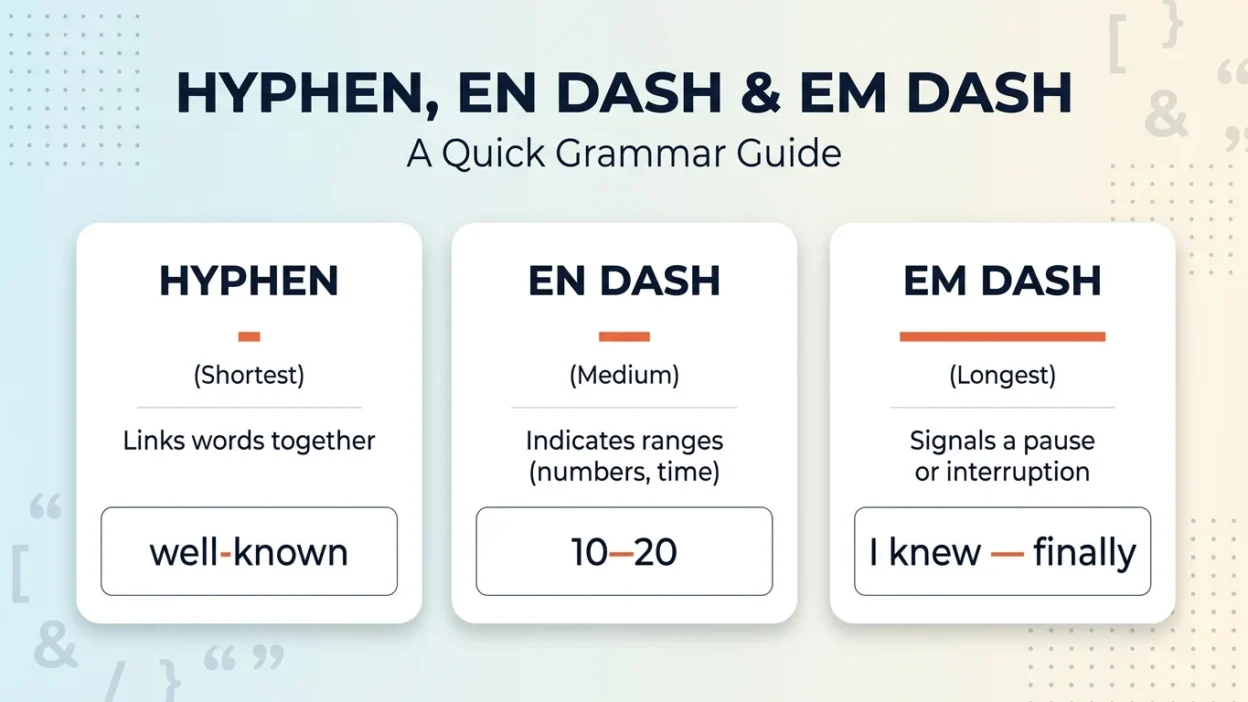
Use an em dash (—) to show a strong break, interruption, or emphasis. Use an en dash (–) mainly for ranges or connections, such as “pages 10–20” or “the London–Paris flight.” Use a hyphen (-) to join words, such as “well-known” or “part-time.”
Why Do People Confuse Dashes?
The confusion comes from the fact that the three marks look similar:
| Mark | Name | Main Use |
|---|---|---|
| – | Hyphen | Joins words |
| – | En dash | Shows ranges or connections |
| — | Em dash | Shows a strong break or interruption |
Their names are also confusing because hyphen, en dash, and em dash sound like variations of the same punctuation mark.
They are different marks with different jobs.
1. What Is an Em Dash?
An em dash (—) is a long dash used to create a strong break in a sentence.
It can replace a comma, colon, parentheses, or sometimes a semicolon when you want a stronger or more dramatic pause.
Examples
- She finally arrived — two hours late.
- I knew the answer — but I was too nervous to speak.
- There was only one thing left to do — apologize.
- My brother — who rarely complains — was furious.
The em dash often draws attention to the information that follows or comes between the dashes.
Em Dash Rule 1: Use It for an Abrupt Break
An em dash can show that a sentence suddenly changes direction.
I was going to call you — but then I changed my mind.
The dash creates a stronger pause than a normal comma.
Another example:
She opened the door — and screamed.
The dash adds emphasis to what happens next.
Em Dash Rule 2: Use It to Add Extra Information
An em dash can surround information that interrupts the main sentence.
John — my oldest friend — lives in Canada.
The words “my oldest friend” are extra information.
You could also write:
John, my oldest friend, lives in Canada.
The commas are more neutral. The dashes make the inserted information stand out more strongly.
Em Dash Rule 3: Use It Instead of a Colon for Emphasis
An em dash can introduce an explanation, result, or important detail.
She had one goal — to win.
I knew exactly what I wanted — a fresh start.
A colon would also be possible:
She had one goal: to win.
The em dash usually feels more conversational or dramatic.
Em Dash Rule 4: Use It to Show an Interruption
An em dash can show that someone suddenly stops speaking.
“I was just trying to —”
“Wait — what are you doing?”
In dialogue, an em dash can make an interruption or sudden change especially clear.
Em Dash Rule 5: Use Two Em Dashes Around an Interruption
When extra information interrupts a sentence, you can use an em dash on both sides.
The new manager — who started last week — has already changed several policies.
The information between the dashes is an interruption in the main sentence.
However, don’t overuse this structure. If the information is not important enough to emphasize, commas or parentheses may be better.
Should There Be Spaces Around an Em Dash?
This depends on the style guide and publishing convention.
In American English, em dashes are commonly written without spaces:
The meeting was canceled — no, wait, it has been rescheduled.
Actually, many American publishers prefer:
The meeting was canceled—no, wait, it has been rescheduled.
In British English, spaced em dashes are also common:
The meeting was canceled — no, wait, it has been rescheduled.
The important point is to follow one style consistently.
For general online writing, either convention can be acceptable depending on the publication’s style.
2. What Is an En Dash?
An en dash (–) is shorter than an em dash and longer than a hyphen.
Its most common use is to show a range.
Examples
- pages 10–20
- Monday–Friday
- 1990–2000
- 8:00–10:00 a.m.
- Chapters 3–6
The en dash essentially means “to” or “through.”
pages 10–20
means:
pages 10 to 20
En Dash Rule 1: Use It for Number Ranges
Use an en dash between numbers when indicating a range.
The course runs from June 5–20.
Read pages 25–40.
The temperature will be 20–25°C.
However, when using from, many style guides prefer from X to Y rather than from X–Y:
The course runs from June 5 to June 20.
This is clearer and avoids mixing two range structures.
En Dash Rule 2: Use It for Time Ranges
The en dash can show a period of time.
The office is open 9:00–5:00.
The meeting is scheduled for 2:00–3:30 p.m.
En Dash Rule 3: Use It for Geographic Connections
An en dash can connect places when showing a relationship or route.
The London–Paris train is very popular.
The New York–Boston route is busy.
Here, the dash means something like “between” or “from … to.”
En Dash Rule 4: Use It for Relationships or Comparisons
An en dash can connect two names or concepts that have a relationship.
The teacher–student relationship is important.
The doctor–patient relationship requires trust.
The cost–benefit analysis was useful.
In these cases, the en dash shows a relationship between the two elements.
3. What Is a Hyphen?
A hyphen (-) is the shortest of the three marks.
It is mainly used to join words or parts of words.
Examples
- well-known
- part-time
- high-speed
- twenty-one
- mother-in-law
- self-confidence
The hyphen helps readers understand that two or more words function together.
Hyphen Rule 1: Use Hyphens in Some Compound Adjectives
When two or more words work together as an adjective before a noun, a hyphen may be needed.
a well-known author
a five-year-old child
a high-speed train
a full-time employee
Compare:
She works full time.
Here, “full time” comes after the verb, so the hyphen is normally unnecessary.
But:
She is a full-time employee.
Here, “full-time” comes before the noun and works as a compound adjective.
Hyphen Rule 2: Use Hyphens in Some Compound Nouns
Some compound nouns contain hyphens.
Examples include:
- mother-in-law
- editor-in-chief
- check-in
- self-esteem
- runner-up
However, compound-word spelling can change over time, so not every compound noun needs a hyphen.
Hyphen Rule 3: Use Hyphens in Spelled-Out Numbers
Use hyphens in compound numbers from twenty-one through ninety-nine.
Examples:
- twenty-one
- thirty-five
- sixty-seven
- ninety-nine
But do not use a hyphen between the tens and hundreds:
one hundred twenty-five
not:
one hundred-twenty-five
Hyphen Rule 4: Use Hyphens to Avoid Confusion
Sometimes a hyphen makes the meaning clearer.
Compare:
re-cover the sofa
with:
recover from an illness
The hyphen can help distinguish different meanings.
Another example:
re-sign the contract
means sign the contract again.
resign from the position
means leave the position.
Dash vs Hyphen: The Easy Difference
The simplest way to remember the difference is:
Hyphen = joins
En dash = ranges or connects
Em dash = breaks
| Mark | Think | Example |
|---|---|---|
| Hyphen (-) | Join | well-known |
| En dash (–) | Range or connection | 10–20 |
| Em dash (—) | Break or interruption | She was ready—but nervous. |
Common Dash Mistakes
Mistake 1: Using a Hyphen for a Range
Incorrect:
Pages 10-20
This is often typed this way informally, but typographically an en dash is preferred:
Pages 10–20
Mistake 2: Using an En Dash in a Compound Word
Incorrect:
well–known writer
Correct:
well-known writer
The compound adjective uses a hyphen.
Mistake 3: Using a Hyphen Instead of an Em Dash
Incorrect when you intend a strong break:
I knew what I wanted – a new job.
Better:
I knew what I wanted — a new job.
Mistake 4: Using Too Many Dashes
Dashes are powerful punctuation. If every sentence contains one, the writing can become difficult to read.
Use them when they genuinely improve emphasis, clarity, or flow.
Mistake 5: Mixing Spacing Styles
Choose a consistent style for em dashes.
For example, do not randomly alternate between:
word—word
and
word — word
unless a specific style requires it.
When to Use Each Mark
Here is a quick guide:
Use a Hyphen (-) When:
- Joining compound words
- Writing some compound adjectives
- Writing certain compound nouns
- Connecting parts of a word
- Writing numbers such as twenty-five
Use an En Dash (–) When:
- Showing a range
- Connecting dates
- Connecting page numbers
- Showing a time range
- Connecting places in a route
- Showing a relationship between two things
Use an Em Dash (—) When:
- Creating a strong break
- Adding emphasis
- Showing an interruption
- Setting off extra information
- Introducing an important explanation
American vs British English
The basic functions of the hyphen, en dash, and em dash are broadly similar in American and British English.
The biggest visible difference is often spacing around the em dash.
American publishing commonly uses an unspaced em dash:
She knew the answer—but she said nothing.
British writing often uses spaced dashes:
She knew the answer — but she said nothing.
However, style varies among publishers and publications in both varieties of English. The safest approach is to follow the style guide required for your work and remain consistent.
Similar Punctuation Marks
Dashes are not the only punctuation marks used to separate or connect ideas.
| Punctuation | Main Function | Example |
|---|---|---|
| Hyphen (-) | Joins words | well-known |
| En dash (–) | Shows ranges or connections | 10–20 |
| Em dash (—) | Shows a strong break | I agreed — eventually. |
| Comma (,) | Separates parts of a sentence | After dinner, we left. |
| Colon (:) | Introduces an explanation or list | I need three things: time, money, and help. |
| Parentheses ( ) | Adds extra information | John (my neighbor) called. |
Frequently Asked Questions
What are the three types of dashes?
The three commonly discussed marks are the hyphen (-), en dash (–), and em dash (—). The hyphen joins words, the en dash commonly shows ranges or connections, and the em dash creates a strong break or interruption.
What is the difference between an em dash and an en dash?
An em dash (—) is mainly used for breaks, interruptions, and emphasis. An en dash (–) is mainly used for ranges and connections.
Should there be spaces around an em dash?
It depends on the style being followed. American publishing often uses an em dash without spaces, while British writing frequently uses spaced em dashes. Consistency is important.
Is a dash the same as a hyphen?
No. A hyphen (-) is shorter and normally joins words. A dash, such as an en dash or em dash, has different punctuation functions.
When should I use an en dash?
Use an en dash for ranges such as pages 10–20, 1990–2000, or 9:00–11:00. It can also connect related places or concepts.
Can an em dash replace a comma?
Yes. An em dash can sometimes replace a comma when you want a stronger break or greater emphasis.
Can I use an em dash instead of a colon?
Yes. In some sentences, an em dash can introduce an explanation or important detail in a more emphatic way than a colon.
Is it okay to use dashes in formal writing?
Yes. Dashes are acceptable in formal writing when they are used correctly and appropriately. However, excessive use can make writing feel informal or cluttered.
Remember This
The easiest rule is:
Hyphen = join
En dash = range or connection
Em dash = break or emphasis
Remember the three marks:
– → joins words
– → shows a range or connection
— → creates a strong break
For example:
a well-known writer
pages 10–20
She had one goal — to succeed.
Final Verdict
The three marks may look similar, but each has a different purpose.
Use the hyphen (-) to join words, the en dash (–) to show ranges or connections, and the em dash (—) to create a strong break, interruption, or emphasis.
Once you remember join, range, break, most dash questions become much easier.
Conclusion
Correct dash usage can make your writing clearer and more professional. The key is not to memorize dozens of complicated rules but to understand the main job of each mark. A hyphen connects parts of words, an en dash commonly connects numbers or related items, and an em dash creates a noticeable break in a sentence.
When in doubt, look at what you are trying to do. If you are joining words, think hyphen. If you are showing a range or relationship, think en dash. If you want a strong pause or interruption, think em dash. With these three basic rules, you can handle most common dash situations confidently.

Charles Kevin is a passionate language writer and researcher at SimileHive, creating clear, engaging content about similes, idioms, metaphors, and figurative language to help readers improve English communication confidently every day.