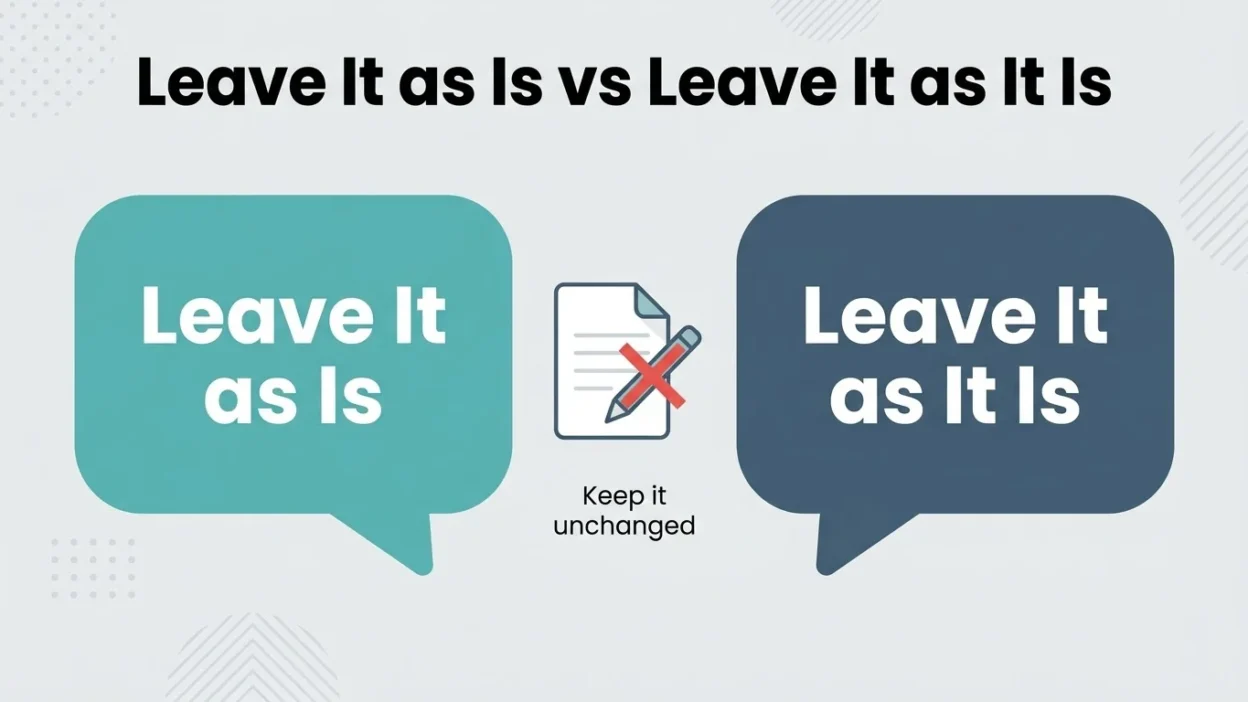
“Leave it as is” and “leave it as it is” are both correct English expressions. They mean to keep something in its current condition without changing, fixing, or altering it. The main difference is that “leave it as is” is shorter and more concise, while “leave it as it is” uses the complete phrase “as it is” and can sound slightly more emphatic in some contexts.
You can use either expression when talking about a document, a design, a plan, a room, or any other thing that does not need to be changed. For example, if someone asks you to edit a report, you can say, “Leave it as is” or “Leave it as it is.” Both communicate that the report should remain unchanged.
Although the two expressions are interchangeable in many situations, understanding their structure can help you choose the most natural option. In this guide, you will learn what each phrase means, how to use it correctly, how the expressions differ, and which one is better for everyday conversations and formal writing.
Quick Answer
“Leave it as is” and “leave it as it is” are both grammatically acceptable. Both mean to keep something in its current state without making changes. “Leave it as is” is shorter and direct, while “leave it as it is” is a fuller version that may add emphasis. Choose either expression according to your sentence and preferred style.
Why Do People Confuse “Leave It as Is” and “Leave It as It Is”?
People often confuse these expressions because they have almost the same meaning and can be used in the same situations.
The confusion usually comes from the extra word “it” in the longer expression. In “leave it as is,” the phrase “as is” describes the condition in which something should remain. In “leave it as it is,” the words “as it is” express the same idea using a fuller construction.
Both are natural in modern English. Neither is automatically incorrect, and the choice often depends on style, rhythm, and context.
1. What Does “Leave It as Is” Mean?
“Leave it as is” means to keep something in its current condition without making any changes.
It is a concise expression commonly used in everyday conversation, instructions, workplace communication, and editing.
Examples of “Leave It as Is”
- The design looks perfect, so leave it as is.
- I do not want to change the report. Leave it as is.
- The painting looks beautiful without any adjustments, so leave it as is.
- The customer approved the draft and asked us to leave it as is.
- If the machine is working properly, leave it as is.
- The room looks fine. You can leave it as is.
- I like the original version, so please leave it as is.
- The manager told us to leave the schedule as is.
- This paragraph is clear enough. Leave it as is.
- The old building has historical value, so we should leave it as is.
- The recipe tastes great, so I would leave it as is.
- The settings are correct. There is no need to change anything, so leave them as is.
When Should You Use “Leave It as Is”?
Use this expression when you want to give a direct, simple instruction or explain that something does not need to be changed.
For example:
“Your presentation looks good. Leave it as is.”
This sentence is short, clear, and natural.
2. What Does “Leave It as It Is” Mean?
“Leave it as it is” also means to keep something in its current condition without changing it.
The phrase uses the fuller expression “as it is.” It is common in spoken and written English and can sound slightly more deliberate or emphatic, depending on the sentence.
Examples of “Leave It as It Is”
- The room is comfortable, so leave it as it is.
- I like the original design. Please leave it as it is.
- The report is accurate, so we should leave it as it is.
- If the arrangement works for everyone, leave it as it is.
- The garden looks natural. I would leave it as it is.
- The teacher said to leave the sentence as it is.
- The painting has a unique character, so leave it as it is.
- The current plan is working well. Let us leave it as it is.
- I do not want any more changes. Leave it as it is.
- The old photograph is valuable, so leave it as it is.
- The document has already been approved. Please leave it as it is.
- The situation is manageable, so we can leave it as it is for now.
When Should You Use “Leave It as It Is”?
Use this version when you prefer the fuller wording or want the sentence to sound more deliberate.
For example:
“The original painting is beautiful. Leave it as it is.”
The sentence emphasizes preserving the painting in its existing condition, although the shorter version could express the same idea.
Comparison Table 1: “Leave It as Is” vs “Leave It as It Is”
| Feature | Leave It as Is | Leave It as It Is |
|---|---|---|
| Meaning | Keep something unchanged | Keep something unchanged |
| Grammar | Correct | Correct |
| Length | Shorter | Longer |
| Style | Concise and direct | Fuller and sometimes more emphatic |
| Common use | Instructions and everyday speech | Conversation and writing |
| Formality | Suitable for most contexts | Suitable for most contexts |
| Main difference | Uses the shorter phrase “as is” | Uses the fuller phrase “as it is” |
The two expressions have the same basic meaning. Neither is universally more formal or more correct than the other.
3. What Is the Difference Between “As Is” and “As It Is”?
The difference lies mainly in their structure.
“As is” is a concise expression meaning “in its current condition” or “without changes.” It is also commonly used in sales, contracts, and product descriptions to indicate that something is offered in its existing condition.
Example: “The car is being sold as is.”
“As it is” is a fuller phrase that can mean “in its current condition.” Depending on the context, it can also mean “considering the situation that already exists.”
Examples:
- “Leave the room as it is.” This means do not change the room.
- “As it is, we have very little time.” Here, “as it is” means that the situation is already difficult or limited.
This second use is important because “as it is” does not always mean “without changing something.” Its meaning depends on how it is used in the sentence.
Comparison Table 2: “As Is” vs “As It Is”
| Example | Meaning |
|---|---|
| Leave the document as is. | Keep the document unchanged. |
| Leave the document as it is. | Keep the document unchanged. |
| The sofa is sold as is. | The sofa is sold in its existing condition. |
| As it is, the project is already expensive. | The project is already expensive under the current circumstances. |
| The room looks fine as is. | The room looks fine in its current condition. |
4. When Should You Use Each Expression?
The best choice depends on the sentence and the effect you want.
Use “Leave It as Is” for Concise Instructions
This version works well when you want to be brief and direct.
Examples:
- Leave the file as is.
- The colors look good. Leave them as is.
- We do not need to adjust the settings. Leave them as is.
Use “Leave It as It Is” for a Fuller Expression
This version is equally appropriate when you prefer a more complete-sounding phrase.
Examples:
- Leave the arrangement as it is.
- I like the original version. Leave it as it is.
- The building has historical importance, so leave it as it is.
Use Either in Most Everyday Situations
In ordinary conversation, you can generally choose either version without changing the main message.
For example:
- “Please leave the design as is.”
- “Please leave the design as it is.”
Both sentences ask someone not to change the design.
5. More Examples in Everyday English
Here are additional examples showing how both expressions work in different situations.
Workplace Examples
- The client approved the proposal, so leave it as is.
- The manager wants us to leave the schedule as it is.
- Please leave the original figures as is until we receive confirmation.
- The policy is working well, so we should leave it as it is.
- The formatting looks correct. Leave it as is.
Home and Daily Life Examples
- The furniture looks good here, so leave it as it is.
- Do not move the table. Leave it as is.
- The soup tastes great, so leave it as it is.
- The room is comfortable. You can leave it as is.
- I like the way you arranged the flowers. Leave them as they are.
Writing and Editing Examples
- The paragraph is clear, so leave it as is.
- The author wants us to leave the final sentence as it is.
- The original wording is effective. Do not change it.
- The editor suggested leaving the introduction as it is.
- The title is strong enough. Leave it as is.
Grammar note: When the subject changes from “it” to a plural noun, the wording may change too. For example, “Leave them as they are” is a natural choice for plural objects. “Leave them as is” also occurs in some usage contexts, especially as a fixed or informal construction, but “leave them as they are” is often the clearer choice.
6. Common Mistakes to Avoid
Mistake 1: Thinking One Expression Is Incorrect
Incorrect assumption: “Leave it as is” is wrong because it leaves out the second “it.”
Correction: Both “leave it as is” and “leave it as it is” are acceptable.
Mistake 2: Using “As It Is” with the Wrong Meaning
Consider these sentences:
- “Leave it as it is.” This means keep it unchanged.
- “As it is, I am already busy.” This means I am already busy under the present circumstances.
The same phrase can have different meanings depending on its role in the sentence.
Mistake 3: Adding Unnecessary Words
Avoid awkward wording such as:
“Leave it as it is currently being right now.”
A more natural version is:
“Leave it as it is.”
Simple wording is usually clearer.
Mistake 4: Ignoring the Context
In a product listing, “sold as is” may communicate that an item is being sold in its existing condition. In a sentence such as “As it is, we cannot afford another expense,” the phrase has a different meaning. Always consider the surrounding words.
7. A Simple Memory Trick
Remember this rule:
- As is = in its current condition.
- As it is = in its current condition, or already in the present situation, depending on context.
If you are telling someone not to change something, both “leave it as is” and “leave it as it is” usually work.
Think of the shorter expression as the concise option and the longer expression as the fuller option.
8. American vs British English
Both “leave it as is” and “leave it as it is” are used in American and British English.
There is no strict rule that limits one expression to American English and the other to British English. Preferences can vary by speaker, publication, and context.
“As is” is particularly familiar in phrases such as “sold as is,” especially in commercial and contractual contexts. “As it is” is also widely used in everyday speech and writing.
If you are writing for an international audience, either expression is understandable. Choose the one that sounds most natural in your sentence.
9. Similar Words and Expressions
Here are some alternatives that express a similar idea:
| Expression | Meaning |
|---|---|
| Leave it unchanged | Do not make any changes. |
| Keep it as it is | Preserve its current condition. |
| Leave it alone | Do not interfere with it. |
| Keep it the same | Do not alter it. |
| Leave it untouched | Do not handle or change it. |
| Keep things as they are | Maintain the existing situation. |
| Do not change a thing | Make no changes at all. |
| Let it be | Do not interfere or try to change it. |
These expressions are related, but they are not always interchangeable. For example, “leave it alone” can mean not to interfere with a person or matter, while “leave it untouched” may suggest that something should not be physically handled.
10. Frequently Asked Questions
Is “Leave It as Is” grammatically correct?
Yes. “Leave it as is” is a correct and natural expression meaning to keep something in its current condition without making changes.
Is “Leave It as It Is” also correct?
Yes. “Leave it as it is” is also correct. It uses a fuller version of the phrase and has the same basic meaning when referring to keeping something unchanged.
Which is better: “Leave It as Is” or “Leave It as It Is”?
Neither is universally better. “Leave it as is” is concise, while “leave it as it is” is a fuller alternative. Both work in most situations where you want something to remain unchanged.
Is “As Is” formal or informal?
“As is” can be used in both formal and informal contexts. It is especially common in commercial descriptions, such as “sold as is,” and also appears in everyday instructions.
Does “As It Is” Always Mean “Without Changes”?
No. It can mean “in its current condition,” as in “Leave it as it is.” It can also mean “already” or “under the present circumstances,” as in “As it is, we have enough work to do.”
Can I Say “Leave Them as Is”?
This wording is used, particularly in some informal or fixed-expression contexts, but “leave them as they are” is often the clearest and most widely suitable option when referring to plural things.
Can I Use “Leave It as Is” in Professional Writing?
Yes. It is suitable for professional emails, editing instructions, project discussions, and other workplace communication. For example, “The client has approved the design, so please leave it as is.”
Remember This
“Leave it as is” and “leave it as it is” are both correct expressions that usually mean to keep something unchanged.
Use “leave it as is” when you want a concise, direct expression. Use “leave it as it is” when you prefer the fuller wording. The choice is generally stylistic, not a matter of right versus wrong.
Conclusion
The difference between “leave it as is” and “leave it as it is” is small. Both expressions tell someone to keep something in its current condition without making changes. The shorter version is concise and direct, while the longer version provides a fuller construction and may sound more emphatic in certain contexts.
For everyday conversations, professional messages, and most writing situations, you can use either expression. Just remember that “as it is” can have another meaning when it refers to the current circumstances, as in “As it is, we are already running late.” Understanding the context will help you choose the most natural wording.

Adam Aaron is a language enthusiast and content writer at SimileHive, creating clear, engaging guides on similes, idioms, metaphors, and figurative language to help readers improve English confidently every day.