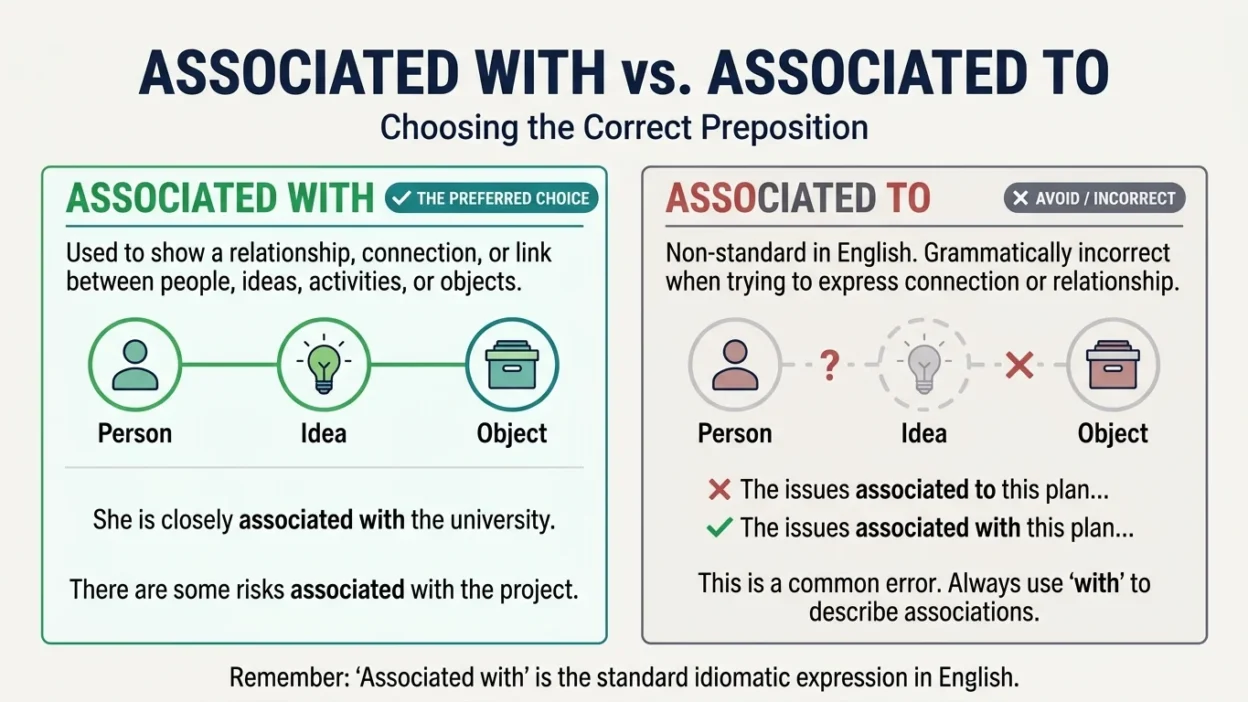
“Associated with” and “associated to” may look similar, but they are not equally common in standard English. “Associated with” is the usual and generally preferred expression when describing a connection, relationship, idea, person, or thing. For example, “Smoking is associated with several health risks” means that smoking is linked to those risks.
“Associated to” is also found in English, especially in certain technical contexts and some regional varieties, but it is less common in general usage. In most everyday and professional sentences, “associated with” is the safer choice.
Understanding the difference can help you write more naturally in emails, essays, reports, academic papers, and everyday conversations. The right preposition depends partly on what kind of relationship you want to describe, so it is useful to look at common sentence patterns rather than memorize a single rule.
In this guide, you will learn the meanings of both expressions, when to use each one, common mistakes to avoid, and examples that show how to choose the most natural wording.
Quick Answer
Use “associated with” in most situations when you mean connected or related to something. For example, “This symptom is associated with stress.” “Associated to” occurs in some specialized or regional usage, but it is not the usual choice in standard general English. When in doubt, choose “associated with.”
Why Do People Confuse “Associated With” and “Associated To”?
People confuse these expressions because both prepositions can express relationships in English. Words such as connected, linked, related, and associated all describe connections, but they do not always take the same preposition.
For example, English speakers commonly say:
- associated with a company
- connected to a network
- related to a problem
- linked with a condition
Because these patterns overlap, it may seem logical to use “associated to” in the same way as “connected to.” However, common English usage generally favors “associated with.”
1. What Does “Associated With” Mean?
“Associated with” means connected to, related to, linked with, or connected in people’s minds to a person, thing, idea, activity, or event.
It is the standard, natural choice in most contexts.
Examples of “Associated With”
- Regular exercise is associated with better overall health.
- The color white is often associated with peace.
- She is associated with a well-known research organization.
- This smell is associated with my childhood.
- The company is associated with several successful brands.
- High stress levels are sometimes associated with poor sleep.
- His name is associated with honesty and hard work.
- The festival is associated with local traditions.
- This painting is associated with the artist’s early career.
- The problem is associated with outdated software.
- The charity is associated with several community projects.
- Certain risks are associated with the procedure.
When Should You Use “Associated With”?
Use “associated with” when describing a relationship, connection, reputation, possible cause, or shared feature.
For example:
- Ideas: The color red is associated with passion.
- People: She is associated with the organization.
- Health: The condition is associated with several symptoms.
- Business: The brand is associated with quality.
- Events: The tradition is associated with the holiday.
This expression works well in everyday English, business writing, academic writing, and formal reports.
2. What Does “Associated To” Mean?
“Associated to” is a less common alternative that appears in some varieties of English and specialized contexts. In general writing, it is often considered less idiomatic than “associated with.”
Writers sometimes use “associated to” by analogy with expressions such as “connected to,” “linked to,” or “related to.” However, those expressions do not automatically make “associated to” the best choice.
Examples You May Encounter
- The data associated to each record is stored separately.
- Each account is associated to a specific identifier.
- The code is associated to a particular function.
- The values associated to the entries are displayed below.
- The device is associated to the user’s profile.
These constructions may occur in technical documentation or regional usage. However, in general standard English, the following alternatives will usually sound more natural:
- The data associated with each record is stored separately.
- Each account is associated with a specific identifier.
- The code is associated with a particular function.
- The values associated with the entries are displayed below.
- The device is associated with the user’s profile.
In technical writing, follow the terminology and style conventions of the relevant field or organization. If there is no established convention, “associated with” is usually the better choice.
Comparison Table 1: Associated With vs Associated To
| Feature | Associated With | Associated To |
|---|---|---|
| General usage | Standard and very common | Less common |
| Meaning | Connected or related to something | Intended to express a connection |
| Naturalness in general English | Usually natural | Often less idiomatic |
| Formal writing | Recommended in most cases | Use only when supported by established usage |
| Academic writing | Commonly preferred | Usually avoid unless context requires it |
| Everyday conversation | Natural | Less usual |
The main practical rule is simple: prefer “associated with” unless you have a specific reason to use “associated to.”
3. What Is the Difference Between “Associated With” and “Associated To”?
The key difference is conventional usage rather than a major difference in meaning.
“Associated With” Is the Usual Choice
Use it to describe a general relationship or connection.
Example:
“Lack of sleep is associated with difficulty concentrating.”
This is a natural construction because it expresses a relationship between lack of sleep and difficulty concentrating.
“Associated To” Is Less Common
Some writers use “associated to” when describing data, identifiers, or technical relationships. However, “associated with” is usually equally clear and more idiomatic in general English.
Less preferred in general English: “The file is associated to the account.”
Preferred: “The file is associated with the account.”
Does the Preposition Change the Meaning?
Usually, the intended meaning remains the same. The main difference is that “associated with” is the established and more widely accepted pattern in standard English.
If you need to express a direct technical connection, you may sometimes find that another phrase is clearer:
- connected to a network
- linked to an account
- assigned to a user
- related to a particular topic
- associated with a particular category
Choose the expression that accurately describes the relationship.
Comparison Table 2: Which Preposition Sounds Most Natural?
| Sentence | Recommendation |
|---|---|
| This disease is associated ___ smoking. | associated with |
| She is associated ___ the organization. | associated with |
| The file is associated ___ the account. | associated with |
| The problem is related ___ the software. | related to |
| The computer is connected ___ the network. | connected to |
| The task was assigned ___ the employee. | assigned to |
| The brand is closely linked ___ quality. | linked to or linked with, depending on context |
Remember that prepositions depend on the expression being used. You cannot always replace with with to simply because both can describe a connection.
4. When Should You Use Each Expression?
Use “Associated With” in Everyday English
This is the best option for ordinary conversation, emails, essays, and general writing.
Examples:
- His name is associated with success.
- The smell is associated with fresh bread.
- This problem is associated with poor planning.
Use “Associated With” in Academic and Professional Writing
It is especially common when describing relationships between variables, outcomes, concepts, and conditions.
Examples:
- The study found that the behavior was associated with higher stress levels.
- The result is associated with several contributing factors.
- The company is associated with a number of international projects.
Be careful not to imply causation when you only have evidence of an association. For example, two factors being associated does not automatically mean that one causes the other.
Use “Associated To” Only When Context Justifies It
If a technical standard, established regional convention, or specific organization consistently uses “associated to,” follow that convention where appropriate. Otherwise, use “associated with” for clarity and naturalness.
5. More Examples of Correct Usage
Here are examples of “associated with” across different contexts.
Education and Research
- The theory is associated with the work of several researchers.
- The results were associated with changes in temperature.
- This concept is associated with critical thinking.
- The behavior is associated with several environmental factors.
Business and Technology
- The account is associated with your email address.
- The brand is associated with reliability.
- The error is associated with an outdated application.
- Each transaction is associated with a unique reference number.
Everyday Life
- The song is associated with happy memories.
- The holiday is associated with family gatherings.
- That restaurant is associated with excellent service.
- The color blue is often associated with calmness.
Health and Society
- The condition is associated with several symptoms.
- The habit may be associated with increased stress.
- The tradition is associated with the area’s history.
- The issue is associated with a broader social change.
6. Common Mistakes to Avoid
Mistake 1: Assuming “Associated To” Is Always the Best Choice
Less natural in general English: “The problem is associated to the delay.”
Better: “The problem is associated with the delay.”
Mistake 2: Confusing Similar Expressions
Different expressions take different prepositions:
- associated with a person
- connected to a network
- related to a subject
- assigned to a worker
Learn each expression as a phrase rather than choosing a preposition based only on its meaning.
Mistake 3: Using “Associated With” to Claim Cause and Effect
“Associated with” can describe a relationship without proving that one factor causes another.
For example, “The habit is associated with poor sleep” does not necessarily mean the habit directly causes poor sleep.
Mistake 4: Replacing “With” and “To” Everywhere
The prepositions are not interchangeable in all contexts.
For example, “assigned to the manager” is natural, while “assigned with the manager” usually expresses a different or unclear meaning.
7. A Simple Memory Trick
Remember this rule:
Associated with = the standard choice for a connection or relationship.
Examples:
- associated with a person
- associated with a problem
- associated with an idea
- associated with a company
For other phrases, learn their usual prepositions separately:
- connected to
- related to
- assigned to
- associated with
If you are unsure, “associated with” will be the most suitable choice in most general English sentences.
8. American vs British English
“Associated with” is standard in both American and British English.
There is no major American-versus-British distinction that requires one variety to use “associated with” and the other to use “associated to.” The less common form “associated to” may appear in regional or specialized contexts, but “associated with” remains the safer general choice in both varieties.
For international communication, academic writing, and professional documents, use “associated with” unless a relevant style guide or technical convention recommends otherwise.
9. Similar Words and Expressions
| Expression | Example |
|---|---|
| Connected with | The issue is connected with the recent changes. |
| Connected to | The device is connected to the network. |
| Related to | The article is related to climate change. |
| Linked to | The problem is linked to an earlier decision. |
| Linked with | The brand is linked with high quality. |
| Connected with | She is connected with several local organizations. |
| Tied to | The payment is tied to the completion of the project. |
| Affiliated with | He is affiliated with a research institute. |
These expressions have overlapping meanings, but their best uses differ. For instance, “affiliated with” often describes a formal relationship with an organization, while “linked to” can describe a connection between events, factors, or ideas.
10. Frequently Asked Questions
Is “Associated With” Correct?
Yes. “Associated with” is the standard and most widely suitable expression for describing a connection or relationship.
Is “Associated To” Grammatically Wrong?
Not in every possible context, but it is less common and often less idiomatic in general English. In most cases, “associated with” is the preferred alternative.
Should I Write “Associated With” in Formal Writing?
Yes. “Associated with” is appropriate for academic papers, business reports, professional emails, and other formal documents.
What Is the Difference Between “Associated With” and “Related To”?
Both describe connections. “Associated with” often highlights a connection or relationship between things, while “related to” can mean connected by subject, relevance, or relationship. Their meanings overlap, but they are not interchangeable in every sentence.
Is “Closely Associated With” Correct?
Yes. “Closely associated with” is a natural expression meaning strongly connected or closely linked.
Example: “The author is closely associated with the literary movement.”
Can I Say “Associated With a Company”?
Yes. This is a common and correct construction.
Example: “She is associated with an international company.”
Is “Associated To” Used in Technical English?
It does appear in some technical documents and specialized or regional usage. However, “associated with” is usually the more natural general-English choice. In a specific technical field, follow its established terminology.
Remember This
Use “associated with” when describing a connection, relationship, idea, person, organization, or condition. It is the standard choice in most forms of English.
“Associated to” occurs in some contexts, but it is less common in general usage. Unless a technical convention or established style requires it, choose “associated with.”
Conclusion
The difference between “associated with” and “associated to” is mainly a matter of standard usage. Both are intended to express a connection, but “associated with” is much more common and generally preferred in standard English.
For everyday conversations, academic writing, business communication, and most technical explanations, “associated with” is the safest choice. Remember that similar expressions may use different prepositions, so learning common combinations will help you write more clearly and naturally.

Charles Kevin is a passionate language writer and researcher at SimileHive, creating clear, engaging content about similes, idioms, metaphors, and figurative language to help readers improve English communication confidently every day.