Have you ever wondered If to say “appreciative of” or “appreciative for”? Both expressions may appear in English, but they are not used in exactly the same way. Choosing the right preposition can make your sentences sound more natural and clear.
In standard English, “appreciative of” is the usual and most widely accepted expression. We use it to show that we recognize the value of something, feel grateful for someone’s kindness, or admire a quality or effort.
For example, “I am appreciative of your support” is a natural way to thank someone. The phrase “appreciative for” is less common and may sound awkward to many English speakers, especially when expressing gratitude directly.
In this guide, you will learn the difference between appreciative of and appreciative for, when to use each expression, and how to avoid common mistakes. You will also find practical examples, comparison tables, and simple memory tips to help you choose the right phrase in everyday conversations, emails, and formal writing.
Quick Answer
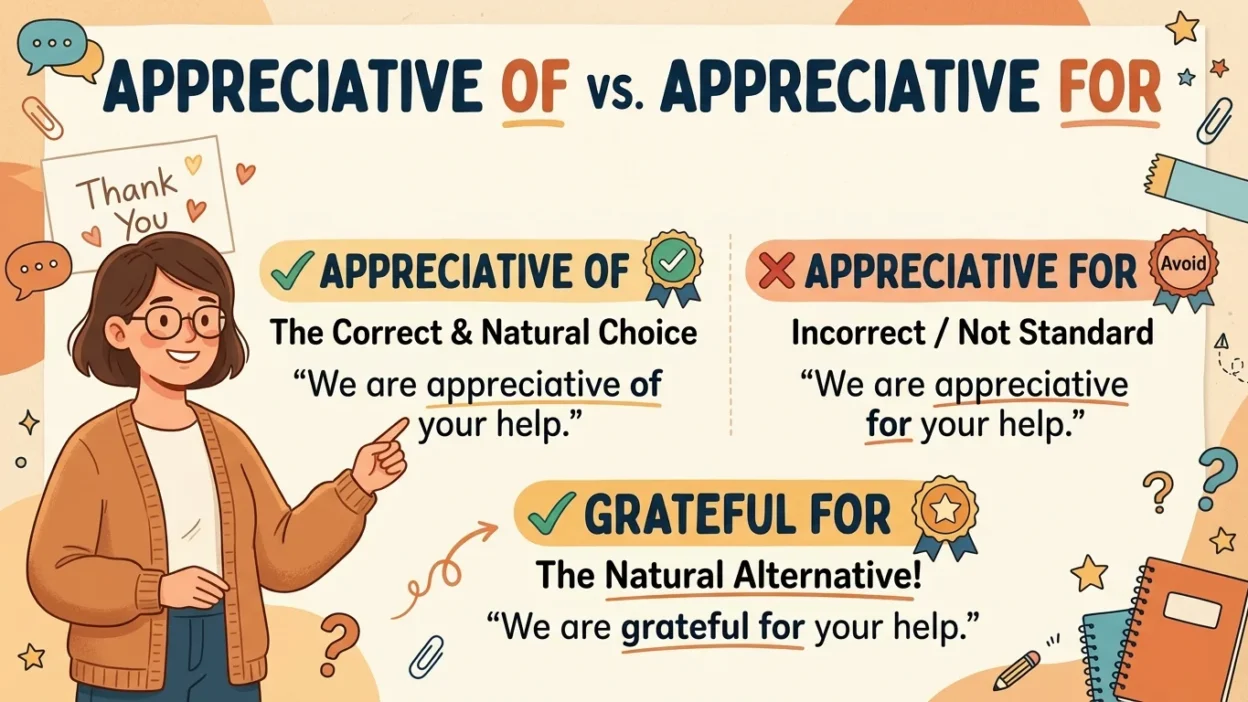
“Appreciative of” is the standard choice when expressing gratitude, recognition, or admiration. For example, “I am appreciative of your help.” The phrase “appreciative for” is less idiomatic in general English. When you want to emphasize the reason for your gratitude, you can also say “grateful for your help.”
Why Do People Confuse Appreciative Of and Appreciative For?
People often confuse these expressions because the word appreciative describes a feeling of gratitude, and gratitude is commonly expressed with the preposition for.
For example, we naturally say:
- I am grateful for your kindness.
- I am thankful for your advice.
- I am appreciative of your kindness.
The confusion happens because grateful for and appreciative of have similar meanings. However, English uses different prepositions with these adjectives.
A helpful way to remember the difference is that appreciative usually goes with of, while grateful and thankful commonly go with for.
1. What Does Appreciative Of Mean?
Appreciative of means feeling or showing gratitude for something, recognizing its value, or being aware of someone’s effort or kindness.
It is the most natural and standard choice in most situations.
Examples of Appreciative Of
- I am appreciative of your continued support.
- She was appreciative of the thoughtful gift.
- We are very appreciative of your time and effort.
- He seemed appreciative of the team’s hard work.
- I am appreciative of everything you have done for me.
- The manager was appreciative of her employees’ dedication.
- They were appreciative of the opportunity to learn.
- I hope you know how appreciative I am of your kindness.
- The students were appreciative of their teacher’s patience.
- We are deeply appreciative of your generosity.
When Should You Use Appreciative Of?
Use appreciative of when you want to:
- Thank someone for their help or kindness.
- Recognize someone’s effort or contribution.
- Show that you value an opportunity.
- Express admiration for a quality or action.
- Sound polite and professional in an email or conversation.
For example, in a professional email, you could write, “I am appreciative of your time and consideration.”
2. What Does Appreciative For Mean?
Appreciative for is less common than appreciative of and is generally not the preferred expression in standard English when directly describing gratitude toward something.
Some speakers may use it by analogy with phrases such as grateful for or thankful for. However, it can sound unnatural to many readers and listeners.
Instead of writing:
- I am appreciative for your help.
Prefer:
- I am appreciative of your help.
- I am grateful for your help.
- I am thankful for your help.
These alternatives communicate the intended meaning clearly and naturally.
Is Appreciative For Ever Correct?
The phrase may occur in informal, regional, or nonstandard usage, but it is not the usual choice in edited English. If you are writing an essay, business email, application, report, or formal message, it is best to use appreciative of or replace appreciative with grateful or thankful.
Appreciative Of vs Appreciative For: Key Differences
| Feature | Appreciative of | Appreciative for |
|---|---|---|
| Standard usage | Common and natural | Less common |
| General acceptance | Widely accepted | Often sounds awkward |
| Expressing gratitude | Yes | Usually better replaced |
| Professional writing | Recommended | Generally avoid |
| Natural alternative | Appreciative of your help | Grateful for your help |
When to Use Each Expression
Use Appreciative Of for Gratitude and Recognition
Choose appreciative of when you want to acknowledge something valuable or express thanks for someone’s actions.
Examples:
- I am appreciative of your honest feedback.
- She is appreciative of the support she received.
- The director was appreciative of the staff’s dedication.
- We are appreciative of your understanding during this difficult time.
Use Grateful For When You Want to Use For
If the sentence sounds more natural with for, you probably want grateful for rather than appreciative for.
Examples:
- I am grateful for your advice.
- We are grateful for this opportunity.
- She was grateful for the kindness shown to her.
- I will always be grateful for your friendship.
Use Thankful For in Everyday Conversations
Thankful for is another natural alternative, especially in personal messages and casual conversation.
Examples:
- I am thankful for my family.
- We are thankful for your help.
- He was thankful for the second chance.
- I am thankful for everything you have taught me.
10 Example Sentences: Appreciative Of vs Appreciative For
Here are examples that show how to choose the more natural expression.
| Less natural or incorrect for standard usage | Better expression |
|---|---|
| I am appreciative for your support. | I am appreciative of your support. |
| She is appreciative for the gift. | She is appreciative of the gift. |
| We are appreciative for your patience. | We are appreciative of your patience. |
| He was appreciative for their kindness. | He was appreciative of their kindness. |
| I am appreciative for the opportunity. | I am appreciative of the opportunity. |
| They were appreciative for our efforts. | They were appreciative of our efforts. |
| I am appreciative for your advice. | I am grateful for your advice. |
| She is appreciative for everything. | She is thankful for everything. |
| We are appreciative for your consideration. | We are appreciative of your consideration. |
| I feel appreciative for your time. | I appreciate you taking the time. |
Notice that appreciative of works well when the adjective describes your feeling. If you want to use for, changing the adjective to grateful or thankful often makes the sentence more natural.
Common Mistakes to Avoid
Mistake 1: Using Appreciative For in Formal Writing
Incorrect or less natural: “I am appreciative for your assistance.”
Better: “I am appreciative of your assistance.”
You can also say, “I am grateful for your assistance.”
Mistake 2: Confusing Appreciative Of With Appreciate For
The verb appreciate is normally used without a preposition before its object.
Less natural: “I appreciate for your help.”
Correct: “I appreciate your help.”
You can also say, “I am appreciative of your help.”
Mistake 3: Using Appreciative When Grateful Sounds Better
Although both words express gratitude, grateful often sounds more direct and personal.
For example:
- Natural: I am grateful for your friendship.
- Natural: I am appreciative of your friendship.
Both are correct, but the preposition changes with the adjective.
Mistake 4: Assuming Every Expression Uses The Same Preposition
English adjectives often take particular prepositions. Learn them as complete phrases:
- appreciative of
- grateful for
- thankful for
- aware of
- interested in
- proud of
Learning these combinations helps you avoid common grammar errors.
A Simple Memory Trick
Remember this easy rule:
Appreciative of, grateful for, thankful for.
Think of of as the usual partner of appreciative, while for is the usual partner of grateful and thankful.
Examples:
- I am appreciative of your help.
- I am grateful for your help.
- I am thankful for your help.
If you remember these three combinations, you can choose the right phrase with confidence.
American English vs British English
The distinction between appreciative of and appreciative for is broadly the same in American and British English.
In both varieties, appreciative of is the usual standard expression.
Examples in American English:
- I am appreciative of your support.
- We are grateful for the opportunity.
Examples in British English:
- I am appreciative of your help.
- We are thankful for your kindness.
Regional speakers may occasionally use appreciative for, but it is not a preferred standard alternative in either variety.
Similar Expressions You Should Know
| Expression | Meaning | Example |
|---|---|---|
| Appreciative of | Recognizing value or feeling gratitude | I am appreciative of your effort. |
| Grateful for | Feeling thankful for something | I am grateful for your help. |
| Thankful for | Feeling pleased and grateful | She is thankful for the opportunity. |
| Appreciate something | Recognize its value or be grateful for it | I appreciate your honesty. |
| Show appreciation for | Express gratitude or recognition | We showed appreciation for their work. |
These expressions are related, but their grammatical patterns differ. Learning each one as a phrase will make your English sound more natural.
Frequently Asked Questions
1. Is it appreciative of or appreciative for?
Appreciative of is the usual and standard expression. For example, “I am appreciative of your help.” If you prefer to use for, say “I am grateful for your help.”
2. Can I say “I am appreciative for your help”?
People may understand what you mean, but the phrase sounds unnatural to many English speakers. A better sentence is “I am appreciative of your help” or “I am grateful for your help.”
3. Is appreciative of grammatically correct?
Yes. Appreciative of is grammatically correct and widely used in both everyday and formal English.
4. What is the difference between appreciative of and grateful for?
Both expressions communicate gratitude. However, appreciative is normally followed by of, while grateful is normally followed by for.
Examples: “I am appreciative of your kindness” and “I am grateful for your kindness.”
5. Is appreciative of formal?
It can be used in both formal and informal contexts. It is particularly suitable for professional emails, thank-you messages, reports, and situations where you want to acknowledge someone’s effort politely.
6. Can I say “I appreciate for your help”?
No, not in standard English. The verb appreciate usually takes a direct object without for. Say “I appreciate your help” or “I am grateful for your help.”
7. What is another way to say “I am appreciative of you”?
Depending on your intended meaning, you can say “I appreciate you,” “I am grateful to you,” or “I appreciate everything you do for me.” The last option is especially natural when acknowledging someone’s actions.
Remember This
- Appreciative of is the preferred standard expression.
- Grateful for is a natural way to express gratitude using for.
- Thankful for is another common alternative.
- Say “I appreciate your help,” not “I appreciate for your help.”
- In formal writing, choose the expression that sounds natural and follows standard grammar.
Conclusion
The main difference between appreciative of and appreciative for is their level of acceptance in standard English. Although both may appear in use, appreciative of is the natural and widely accepted choice for expressing gratitude, recognition, or admiration.
When you want to use for, choose grateful for or thankful for instead. By remembering these common word combinations and using them in your conversations and writing, you can express appreciation clearly, politely, and confidently.

Adam Aaron is a language enthusiast and content writer at SimileHive, creating clear, engaging guides on similes, idioms, metaphors, and figurative language to help readers improve English confidently every day.