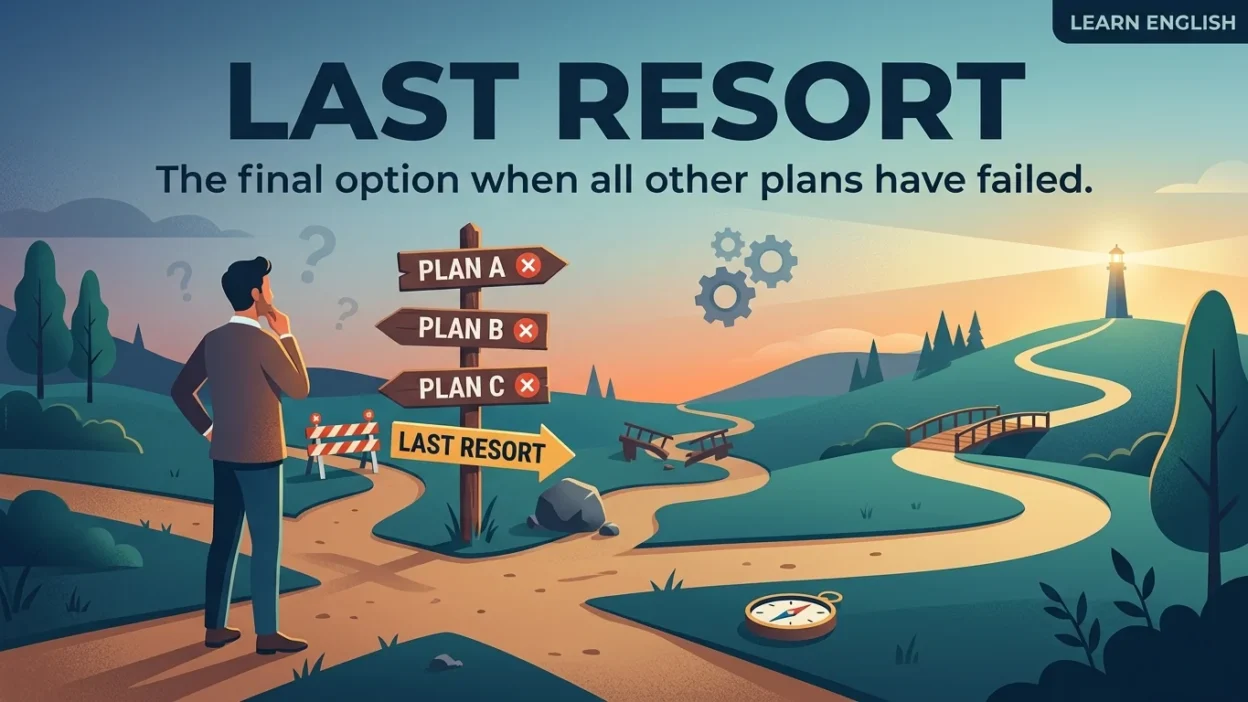
Have you ever faced a difficult situation where you tried everything but nothing worked? In such moments, you might have to choose a final option. This is where the phrase “last resort” comes in.
The expression last resort means the final option you consider when all other choices have failed, are unavailable, or seem unsuitable. It is often used when someone must take an action they would prefer to avoid but has no better alternative.
For example, “Calling the police was our last resort” means the person tried other ways to solve the problem before deciding to contact the police.
This phrase is common in everyday conversations, professional settings, news reports, and formal writing. You can use it when discussing difficult decisions, problem solving, emergencies, or situations with limited choices. In this article, you will learn the meaning of last resort, discover its origin, explore useful examples, and understand how to use it naturally in sentences.
Quick Answer
Last resort means the final possible choice or action taken when other options have failed or are not available. For example, “We will ask for a refund as a last resort.” The phrase often suggests that someone prefers another solution but will use this option if nothing else works.
What Does Last Resort Mean?
The phrase last resort refers to the final option available to someone in a difficult situation. It is usually used when other solutions have been tried, rejected, or considered unsuitable.
A last resort is not necessarily a bad choice. It simply means that the option is saved for the end, often because it is less desirable, more serious, or more difficult than the alternatives.
For example:
- “Selling the car was our last resort.”
This means the person did not want to sell the car but decided to do so because other solutions were not successful.
Simple Definition
Last resort: The final action or choice used when no better alternative remains.
Last Resort in Everyday English
People use this expression in many situations, such as:
- Asking for help after trying to solve a problem alone.
- Contacting a manager after ordinary customer service fails.
- Selling something to cover unexpected expenses.
- Seeking legal action after other attempts to settle a dispute.
- Taking emergency measures when other solutions do not work.
What Is the Origin of Last Resort?
The expression last resort comes from the idea of turning to a final source of help or support when other possibilities have been exhausted.
The word resort can mean a place or person one turns to for assistance, but it can also mean a course of action adopted in a particular situation. In the expression last resort, it refers to the final option someone turns to.
Over time, the phrase became a common way to describe a final measure taken after other choices have failed or become impractical.
15 Examples of Last Resort in Sentences
Here are 15 natural examples showing how to use last resort in different situations.
- Calling a lawyer was my last resort.
I tried other ways to solve the problem before seeking legal help. - We may have to cancel the trip as a last resort.
Cancelling the trip is the final option if nothing else works. - The teacher contacted the parents as a last resort.
The teacher tried other ways to address the problem first. - Selling our old furniture was a last resort.
We sold it only because other financial solutions were unavailable. - The company considered layoffs as a last resort.
It wanted to avoid reducing its workforce if possible. - I will ask my brother for help as a last resort.
I would prefer to handle the problem myself. - The police used force only as a last resort.
They treated force as a final measure rather than a first response. - We tried restarting the computer, and reinstalling the software was our last resort.
Reinstalling the software was the final troubleshooting step. - Taking a taxi was our last resort after we missed the bus.
We used a taxi because our preferred travel option was no longer available. - She contacted customer support as a last resort.
She tried other ways to fix the issue before asking for help. - The family sold their house as a last resort.
They made this difficult decision because other options had failed. - Going to court should be a last resort when a dispute can be settled peacefully.
Legal action should be considered after other reasonable solutions. - He borrowed money from a friend as a last resort.
He asked for financial help only after exhausting other options. - If negotiations fail, a strike may become the workers’ last resort.
The workers may take this action if no agreement is reached. - We kept the emergency generator as a last resort.
The generator was intended for use only if the normal power supply failed.
How to Use Last Resort Correctly
The expression last resort commonly appears in two patterns:
1. As a Last Resort
Use this form when describing an action taken only when other options are unavailable or unsuccessful.
Examples:
- I will borrow money as a last resort.
- We should contact the authorities as a last resort.
- She used her savings as a last resort.
2. Someone’s Last Resort
Use this form to identify the final option available to a person, group, or organization.
Examples:
- This is our last resort.
- Asking her parents was his last resort.
- Negotiation remains the company’s last resort.
You can also use the phrase with the verb become:
- “An appeal may become our last resort.”
This means an appeal may be the only remaining option if other approaches fail.
Last Resort vs. First Choice
The phrase last resort is often contrasted with first choice. These expressions describe opposite ends of a decision-making process.
| Last Resort | First Choice |
|---|---|
| The final option | The preferred option |
| Used when other choices fail | Chosen before other options |
| Often suggests reluctance | Often suggests preference |
| “Moving was our last resort.” | “Staying was our first choice.” |
Example: “We prefer to repair the roof, but replacing it may be our last resort.”
This sentence shows that repairing the roof is the preferred solution, while replacement is the final option.
Last Resort vs. Final Option
These expressions are similar, but their tone can differ.
| Expression | Meaning | Example |
|---|---|---|
| Last resort | The final measure, often after other choices fail | Calling a lawyer was our last resort. |
| Final option | The last choice in a list or decision | The final option on the form is marked in blue. |
| Last choice | The option someone prefers least | That restaurant would be my last choice. |
| Only option | The sole available choice | Taking the train was our only option. |
| Emergency measure | An action taken in response to an urgent problem | The hospital introduced an emergency measure. |
A last resort often carries the idea that someone tried other solutions first. A final option can simply mean the last item in a sequence.
Common Mistakes to Avoid
Mistake 1: Using Last Resort for the First Solution
Incorrect: “We called a repair technician as our last resort before trying anything else.”
Better: “We called a repair technician as our first step.”
If it is the first action you take, last resort is not the right expression.
Mistake 2: Confusing Last Resort With Last Choice
The phrases are related, but they do not always mean exactly the same thing.
- Last resort: The final measure used when other solutions fail.
- Last choice: The option you like or prefer the least.
Example: “Moving abroad was our last resort” suggests that other solutions were unsuccessful. “Moving abroad was my last choice” means it was the option I preferred least.
Mistake 3: Writing Last Resorts When You Mean One Final Option
If you are describing one final measure, use the singular form.
Correct: “Negotiation is our last resort.”
Use the plural last resorts when talking about several final options or measures.
Mistake 4: Assuming a Last Resort Must Be Harmful
A last resort is not always dangerous or negative. It can be a sensible and necessary action.
Example: “Calling an ambulance was our last resort after the situation worsened.”
The expression describes when the option is used, not whether the option is good or bad.
A Simple Memory Trick
Remember this phrase:
Last resort = the option you save for last.
Imagine trying several ways to solve a problem. If none of them works, you turn to your last resort.
For example:
- First, I tried fixing the problem myself.
- Next, I asked a friend for advice.
- Finally, I hired a professional as a last resort.
This simple sequence helps you remember the meaning.
American English vs. British English
The expression last resort is widely used in both American and British English. Its meaning and general usage are essentially the same.
American English example: “We may have to sell the house as a last resort.”
British English example: “Taking legal action should be a last resort.”
Both versions are natural and correct. The phrase is also common in other varieties of English.
Similar Idioms and Expressions
If you understand last resort, these related expressions may also be useful.
| Expression | Meaning | Example |
|---|---|---|
| Plan B | An alternative plan | If the train is cancelled, Plan B is to take a bus. |
| Final straw | The last problem that makes a situation unbearable | The latest delay was the final straw. |
| In desperation | Doing something because you feel you have no other choice | In desperation, he called an old friend. |
| At the end of one’s rope | Having no patience or resources left | I was at the end of my rope after weeks of delays. |
| Last-ditch effort | A final attempt to succeed | They made a last-ditch effort to save the project. |
| Resort to | To turn to a particular action, often an undesirable one | He resorted to asking for a loan. |
These expressions have different meanings, so choose the one that best matches your situation.
Frequently Asked Questions
1. What does last resort mean in simple words?
Last resort means the final thing you try when nothing else works. For example, asking for financial help may be your last resort if you cannot solve a money problem another way.
2. Is last resort a positive or negative phrase?
It is generally neutral, although it can suggest difficulty or reluctance. A last resort may be necessary, practical, or helpful, even if it is not the preferred option.
3. What does “as a last resort” mean?
“As a last resort” means doing something only after other options have failed or are unavailable.
Example: “I will contact the manager as a last resort.”
4. What is another word for last resort?
Depending on the context, alternatives include final option, last measure, final step, and last-ditch effort. These phrases are similar but not always interchangeable.
5. Can I use last resort in a sentence?
Yes. You can use it in everyday speech and formal writing.
Example: “We will seek legal advice as a last resort if negotiation fails.”
6. What is the difference between last resort and last choice?
A last resort is a final action taken when other options fail. A last choice is the option someone likes or prefers the least.
7. Is it correct to say “my last resort”?
Yes. “My last resort” is a natural expression referring to your final available option.
Example: “Asking my parents for money was my last resort.”
Remember This
- Last resort means the final option when other solutions fail or are unavailable.
- As a last resort describes an action taken only when necessary.
- The phrase often suggests that someone would prefer another solution.
- It can be used in casual conversations, professional writing, and formal discussions.
- A last resort is not always bad; it may be the most practical option remaining.
Conclusion
The phrase last resort is a useful expression for describing a final action or choice when other possibilities have failed or are no longer available. It often suggests that the person would prefer a different solution but is prepared to take this step if necessary.
You can use it in situations involving work, money, relationships, travel, problem solving, and difficult decisions. Remember that a last resort is the option you turn to last, not necessarily the option you like least. Once you understand this distinction, you can use the expression naturally and confidently.

Charles Kevin is a passionate language writer and researcher at SimileHive, creating clear, engaging content about similes, idioms, metaphors, and figurative language to help readers improve English communication confidently every day.