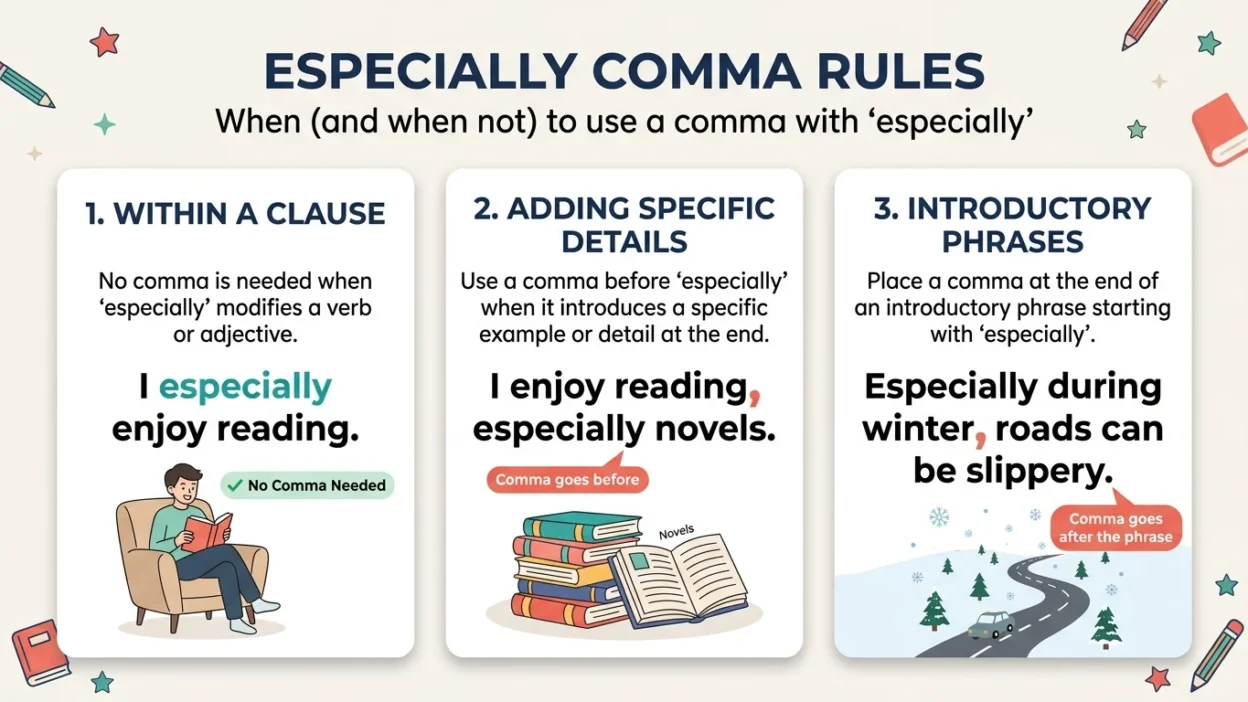
Knowing when to use a comma with “especially” can make your writing clearer and more natural. Some writers place a comma before especially whenever it appears in a sentence, while others avoid commas altogether. The correct choice depends on how the word functions in the sentence.
In general, you do not need a comma before or after “especially” when it directly emphasizes a word, phrase, or example. For instance, “I enjoy outdoor activities, especially hiking” uses a comma before especially because it introduces a specific example at the end of the sentence. However, “I especially enjoy hiking” does not need a comma because especially directly modifies the verb enjoy.
A comma may also appear when especially introduces an explanatory or parenthetical phrase, particularly when that phrase adds extra information rather than essential meaning. Understanding these patterns will help you avoid unnecessary punctuation and use commas confidently in essays, emails, articles, and everyday writing.
Quick Answer
Use a comma with especially when it introduces an additional example or follows a phrase that benefits from separation, as in “I enjoy sports, especially tennis.” Do not automatically place commas around especially. In “I especially enjoy tennis,” no comma is needed. The punctuation depends on the sentence structure and intended meaning.
Why Do People Get Especially Comma Rules Wrong?
The confusion arises because especially can perform different roles in a sentence. It can emphasize an action, highlight a particular person or thing, or introduce a specific example.
Compare these sentences:
- No comma: I especially like chocolate.
- Comma before especially: I like many desserts, especially chocolate.
- Commas around especially: The event, especially the final performance, was impressive.
All three sentences are correct, but the punctuation differs because the word functions differently in each example.
The key is to examine the entire sentence rather than automatically adding a comma whenever you see especially.
1. Do You Put a Comma Before Especially?
A comma before especially is often appropriate when the word introduces a specific example or highlights one item from a broader category.
Rule 1: Use a Comma Before Especially When Introducing an Example
When especially introduces a particular example at the end of a sentence, a comma often separates the general statement from the example.
Examples:
- I enjoy outdoor activities, especially hiking.
- She loves Italian food, especially pasta.
- Many students struggle with grammar, especially punctuation.
- We visited several beautiful places, especially the mountains.
- He enjoys reading, especially historical novels.
- The garden attracts wildlife, especially butterflies.
- I like warm drinks, especially green tea.
- The city is famous for its museums, especially the national museum.
In these sentences, the first part introduces a general category, and the phrase after especially highlights a particular example.
Rule 2: Do Not Add a Comma Before Especially When It Directly Modifies a Verb
When especially directly emphasizes a verb or another part of the sentence, a comma is generally unnecessary.
Examples:
- I especially enjoy reading.
- She especially likes classical music.
- We especially appreciate your support.
- He especially wanted to meet the author.
- I especially remember that conversation.
- They especially value honesty.
- She especially enjoys working with children.
- I especially admire her patience.
In each sentence, especially is integrated into the sentence rather than introducing a separate example.
Compare the Two Patterns
| Sentence | Comma Rule | Why |
|---|---|---|
| I especially like tea. | No comma | Especially modifies like. |
| I like drinks, especially tea. | Comma before especially | Especially introduces an example. |
| She especially enjoys painting. | No comma | Especially modifies enjoys. |
| She enjoys creative hobbies, especially painting. | Comma before especially | Painting is a specific example. |
2. Do You Put a Comma After Especially?
In most ordinary sentences, you do not need a comma immediately after “especially.” However, a comma may be necessary if the sentence structure calls for one.
Rule 1: Do Not Add a Comma After Especially When It Is Followed by a Noun or Phrase
Examples:
- I especially enjoy summer mornings.
- She especially likes her new teacher.
- He especially appreciates your honesty.
- We especially enjoyed the final performance.
- The restaurant is especially popular with tourists.
These sentences do not need a comma after especially because the word is closely connected to the phrase that follows it.
Rule 2: Use a Comma After an Introductory Especially Phrase When Needed
When a sentence begins with especially followed by a longer introductory phrase, a comma may help separate that phrase from the main clause.
Examples:
- Especially during the winter months, roads can become dangerous.
- Especially for beginners, this exercise may seem difficult.
- Especially in large cities, public transport can save time.
- Especially when deadlines are approaching, good planning matters.
In these sentences, the comma marks the end of the introductory phrase. The comma is not required simply because the word especially appears at the beginning.
Rule 3: Use Commas Around a Parenthetical Phrase When Appropriate
If especially appears in a phrase that adds nonessential information, commas may be needed around the entire phrase.
Example:
“The final performance, especially the closing song, impressed the audience.”
Here, especially the closing song adds specific information about the performance. The phrase is enclosed in commas because it functions as an inserted explanation.
Another example:
“My sister, especially when she is tired, prefers quiet evenings.”
The phrase especially when she is tired adds extra information about when the preference applies.
3. Should You Put a Comma Before Especially at the Beginning of a Sentence?
Usually, no comma is needed immediately after especially just because it begins the sentence. Instead, punctuation depends on the length and structure of the introductory phrase.
Examples:
- Especially today, we need to be careful.
- Especially for young learners, clear instructions are important.
- Especially during exam season, students need enough rest.
- Especially when the weather is hot, drink enough water.
These examples use commas after the introductory phrases, not automatically after the word especially.
Compare:
- Incorrect punctuation: Especially, I like the blue one.
- Better: I especially like the blue one.
- Also natural: I like the blue one especially.
The first sentence is awkward because especially does not need to be separated from the sentence in that way.
4. Especially in the Middle of a Sentence
When especially appears in the middle of a sentence, it usually does not require commas if it directly modifies a verb, adjective, or phrase.
Examples:
- I especially enjoy spending time outdoors.
- The book is especially useful for beginners.
- She was especially happy about the results.
- We especially need your help today.
- This rule is especially important in formal writing.
- He especially admired the author’s writing style.
However, if the word introduces an inserted phrase, commas may be appropriate.
Example:
“The trip, especially the final day, was unforgettable.”
The phrase especially the final day identifies the part of the trip being highlighted and is set off with commas.
5. Especially vs. Particularly: Are the Comma Rules Different?
Especially and particularly have similar meanings, and their comma rules are also similar. Both words can emphasize something or introduce a specific example.
| Especially | Particularly |
|---|---|
| I especially like apples. | I particularly like apples. |
| I enjoy fruit, especially apples. | I enjoy fruit, particularly apples. |
| The course, especially the final lesson, was useful. | The course, particularly the final lesson, was useful. |
Neither word automatically requires a comma. In both cases, punctuation depends on sentence structure and whether the word introduces an example or an inserted phrase.
6. Especially vs. Specially: Comma Rules and Usage
Although especially and specially can overlap in meaning, they are not always interchangeable.
- Especially often means particularly or more than others.
- Specially often means for a particular purpose, though usage can overlap.
Examples:
- I especially like this song.
- This cake was specially made for your birthday.
Neither word automatically needs a comma. The same general punctuation principles apply.
7. Common Especially Comma Mistakes
Mistake 1: Always Putting a Comma Before Especially
Incorrect: “I especially, enjoy reading.”
Correct: “I especially enjoy reading.”
The comma interrupts the connection between especially and the verb.
Mistake 2: Always Putting a Comma After Especially
Incorrect: “She especially, likes summer.”
Correct: “She especially likes summer.”
There is no reason to separate especially from likes.
Mistake 3: Forgetting the Comma Before an Example
Less clear: “I enjoy many sports especially tennis.”
Clearer: “I enjoy many sports, especially tennis.”
The comma helps separate the general category from the example.
Mistake 4: Adding Commas Around Every Use of Especially
Incorrect: “We, especially, enjoyed the concert.”
Better: “We especially enjoyed the concert.”
Use commas around especially only when the sentence structure supports an inserted or parenthetical phrase.
Mistake 5: Using a Comma Without Considering Meaning
Compare:
- “I especially like the ending.” This emphasizes how much the speaker likes the ending.
- “I like the story, especially the ending.” This highlights the ending as a specific part of the story.
Both are correct, but the comma changes the structure and helps the reader understand how the idea is organized.
8. A Simple Memory Trick for Especially Comma Rules
Remember these three patterns:
1. Especially + verb: usually no comma.
“I especially enjoy music.”
2. General category + especially + example: often use a comma before especially.
“I enjoy music, especially jazz.”
3. Inserted explanatory phrase: commas may surround the whole phrase.
“The concert, especially the final song, was wonderful.”
This simple guide will help you make the right punctuation choice in most everyday sentences.
9. American English vs. British English
The basic comma rules for especially are the same in American and British English. Both varieties commonly use a comma when especially introduces a specific example after a general statement.
Examples:
- American English: “I enjoy sports, especially basketball.”
- British English: “I enjoy sports, especially cricket.”
Differences in comma style may occur between individual writers, publishers, or style guides, particularly when deciding whether a phrase is parenthetical. However, there is no major American versus British rule that requires a comma every time especially appears.
10. Frequently Asked Questions
1. Do you put a comma before especially?
Sometimes. Use a comma when especially introduces a specific example after a general statement, as in “I enjoy fruit, especially apples.” Do not use one automatically when especially directly modifies a verb.
2. Do you put a comma after especially?
Not usually. For example, “I especially like this book” needs no comma after especially. A comma may appear after a longer introductory phrase, as in “Especially during winter, roads can be slippery.”
3. Is there a comma before especially in the middle of a sentence?
It depends on the sentence. “I especially enjoy reading” needs no comma, while “I enjoy reading, especially novels” usually uses a comma to introduce an example.
4. Should especially be surrounded by commas?
Only when it appears in a parenthetical or inserted phrase that is appropriately set off by commas. For example, “The event, especially the final performance, was excellent.”
5. Is “especially” followed by a comma grammatically correct?
It can be, particularly after an introductory phrase. For example, “Especially for beginners, this lesson is useful.” However, a comma immediately after especially is not generally needed when the word directly modifies the next word.
6. Can a sentence start with especially?
Yes. For example, “Especially during busy periods, employees need clear instructions.” A comma may follow the introductory phrase, depending on its structure.
7. Is “especially” a conjunction?
No. Especially is generally an adverb. It adds emphasis or highlights a particular person, thing, or example. Its punctuation depends on how it is used in the sentence.
Remember This
- Do not automatically put commas around especially.
- Use a comma before especially when it introduces an example after a general statement.
- Do not use a comma after especially when it directly modifies a verb or another word.
- Use commas around an inserted phrase when the sentence structure calls for them.
- The same basic rules apply in American and British English.
Conclusion
The comma rules for especially depend on how the word functions in a sentence. When it directly modifies a verb or adjective, you generally do not need a comma. When it introduces a specific example after a broader statement, a comma before it is often appropriate. When it appears in an introductory or parenthetical phrase, punctuation depends on the structure of that phrase.
The most useful examples to remember are “I especially enjoy reading” and “I enjoy reading, especially novels.” By learning the difference between these patterns, you can use especially naturally and avoid unnecessary commas in your writing.

Lucas Luke is a passionate language writer and content creator at SimileHive, specializing in similes, idioms, metaphors, and figurative language. He enjoys making complex English expressions simple, engaging, and easy to understand for students, writers, and language enthusiasts through well-researched, practical content.