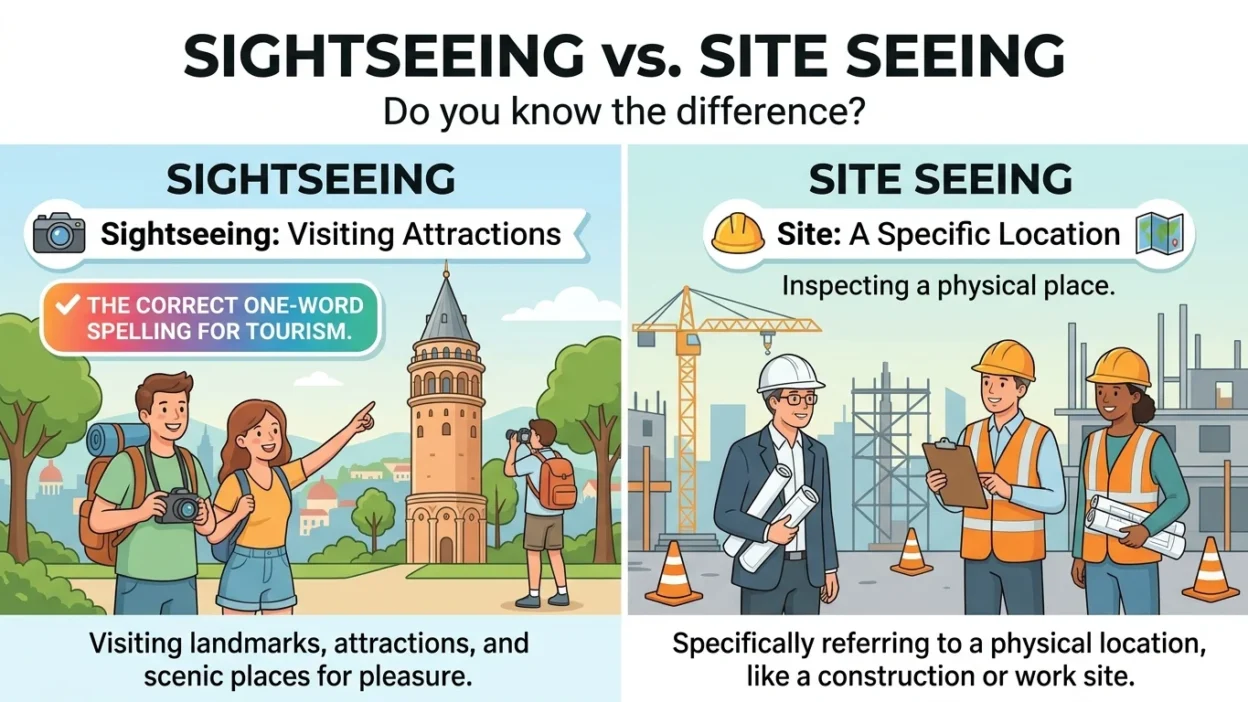
Is it sightseeing or site seeing? If you are writing about visiting famous places, exploring a new city, or enjoying tourist attractions, the correct spelling is sightseeing, written as one word.
Sightseeing means visiting or looking at interesting places, landmarks, and attractions, usually while traveling. For example, you might go sightseeing in London, visit historical monuments in Rome, or explore famous landmarks in New York City.
The phrase site seeing is not the standard spelling for this activity. However, the two words can appear together in a different context when someone is literally seeing or inspecting a site, such as a construction site or a proposed location for a new building.
In this guide, you will learn the difference between sightseeing and site seeing, discover how to use each expression, and explore practical examples to help you choose the correct wording in everyday English.
Quick Answer: Sightseeing vs Site Seeing
Sightseeing is the correct one-word spelling when you mean visiting tourist attractions or interesting places. For example, “We went sightseeing in Paris.” The phrase site seeing is not the standard spelling for tourism, but it may be used literally when someone is looking at or inspecting a particular site.
Why Do People Confuse Sightseeing and Site Seeing?
People confuse these expressions because sightseeing contains the word sight, while site sounds almost the same.
Here is why the difference matters:
- Sight means the ability to see or something that can be seen.
- Site means a particular place or location.
- Seeing means looking at or observing something.
When combined, sightseeing has a special, established meaning related to tourism. Writing site seeing instead may change the meaning or make the sentence look like a spelling mistake.
What Does Sightseeing Mean?
Sightseeing is the activity of visiting or looking at places of interest, especially when traveling for pleasure.
These places may include famous buildings, museums, historical landmarks, natural wonders, monuments, and scenic locations.
Sightseeing is commonly associated with holidays, vacations, guided tours, and trips to unfamiliar places.
Examples of Sightseeing
- Visiting the Eiffel Tower in Paris.
- Exploring historical sites in Rome.
- Taking a guided tour of Washington, D.C.
- Visiting famous temples in Thailand.
- Exploring natural attractions in New Zealand.
- Walking around a city to see its landmarks.
Example Sentences With Sightseeing
- We spent the afternoon sightseeing in London.
- Our family went sightseeing during our summer vacation.
- The tour guide took us sightseeing around the old city.
- I enjoy sightseeing whenever I visit a new country.
- They planned a sightseeing trip to see the city’s famous monuments.
- We hired a bus for sightseeing around the capital.
- After breakfast, we went sightseeing near the harbor.
- The tourists spent the day sightseeing and taking photographs.
- She packed comfortable shoes for a full day of sightseeing.
- Our sightseeing tour included museums, parks, and historical buildings.
What Does Site Seeing Mean?
Site seeing is not the standard expression for visiting tourist attractions. However, the words site and seeing can appear together when someone is literally looking at, visiting, or inspecting a specific location.
A site may be a construction area, a proposed building location, an archaeological location, or another particular place.
In most ordinary writing, a clearer expression is usually available, such as visiting the site, viewing the site, or inspecting the site.
Examples of Site Seeing in a Literal Context
- The architect was seeing the site for the first time.
- We spent the morning viewing the construction site.
- The engineer visited the site before approving the plans.
- The team inspected the site where the new school will be built.
- The project manager wanted to see the site before the meeting.
Notice that these examples use natural expressions such as seeing the site, viewing the site, and inspected the site. They do not use site seeing as a tourism term.
Sightseeing vs Site Seeing: Key Differences
| Feature | Sightseeing | Site seeing |
|---|---|---|
| Standard tourism spelling | Yes | No |
| Meaning | Visiting places of interest | Literally seeing or looking at a particular site |
| Grammar | Established noun and activity term | A possible combination of separate words in a sentence |
| Common context | Tourism, holidays, and travel | Construction, architecture, research, and site visits |
| Example | We went sightseeing in Rome. | We are seeing the site tomorrow. |
| Best alternative | Sightseeing tour | Visiting or inspecting the site |
When Should You Use Sightseeing or Site Seeing?
Use Sightseeing for Tourism
Choose sightseeing when you mean exploring tourist attractions or visiting interesting places.
Examples:
- We went sightseeing in Istanbul.
- Sightseeing is one of my favorite activities when traveling.
- The hotel offers a sightseeing tour of the city.
- They spent two days sightseeing in Pakistan’s northern areas.
- Our guide recommended several sightseeing spots near the beach.
Use Site and Seeing Separately for a Specific Location
Use site when referring to a particular location. If you want to describe looking at that location, use a natural sentence with the words separated.
Examples:
- We are seeing the site tomorrow.
- The architect is visiting the site this afternoon.
- The workers are inspecting the site before construction begins.
- She wants to see the proposed site before making a decision.
- The researchers spent the day examining the archaeological site.
In these examples, seeing is a verb form and site is its object. They are not being used as the tourism term sightseeing.
Sightseeing vs Site Seeing: More Example Sentences
| Correct use of sightseeing | Correct use of site in a sentence |
|---|---|
| We went sightseeing after lunch. | We visited the site after lunch. |
| The sightseeing tour lasted three hours. | The site inspection lasted three hours. |
| I love sightseeing in historic cities. | I love seeing historic sites. |
| They booked a sightseeing bus. | They booked a visit to the construction site. |
| Our vacation included sightseeing and shopping. | Our work trip included seeing the new site. |
| The city offers excellent sightseeing opportunities. | The company is considering a new site. |
| We took photographs while sightseeing. | We took photographs while inspecting the site. |
| Sightseeing made our vacation memorable. | Seeing the site helped us understand the project. |
Common Mistakes to Avoid
1. Writing Site Seeing When You Mean Tourism
Incorrect: We went site seeing in Paris.
Correct: We went sightseeing in Paris.
2. Separating Sightseeing Into Two Words
Incorrect: We planned a sight seeing tour.
Correct: We planned a sightseeing tour.
3. Confusing Sight With Site
Remember that sight relates to seeing, views, or things you can look at. Site refers to a location.
For example:
- The mountain was a beautiful sight.
- The construction site was near the river.
4. Assuming Site Seeing Is Always Wrong in Every Context
The phrase site seeing is not the accepted spelling for tourism, but the words site and seeing can occur separately in a grammatically correct sentence.
For example: “We are seeing the site tomorrow.”
For clarity, however, visiting the site or inspecting the site may be more natural in formal writing.
Memory Trick: How to Remember the Difference
Use this simple trick:
- Sightseeing = Sights. Think of beautiful views, famous attractions, and tourist destinations.
- Site = Spot. Think of a specific location, such as a building site or a place selected for a project.
Remember this sentence:
“We went sightseeing to enjoy the sights, then visited the site where the new museum will be built.”
This example uses both terms correctly.
American vs British English
There is no major American versus British English spelling difference for this term.
Both American and British English use sightseeing as one word when referring to tourism.
Examples:
- American English: We went sightseeing in Chicago.
- British English: We went sightseeing in Edinburgh.
The same spelling applies in both varieties. Site seeing does not become the standard tourism spelling in either variety.
Sightseeing vs Site Seeing: Similar Words
| Word or phrase | Meaning |
|---|---|
| Sightseeing | Visiting places of interest |
| Sightseer | A person who visits attractions for pleasure |
| Sightseeing tour | An organized trip to see local attractions |
| Tourist attraction | A place that visitors commonly visit |
| Landmark | A recognizable or historically important place or structure |
| Site visit | A visit to a specific location, often for work or inspection |
| Site inspection | A careful examination of a particular location |
| Scenic tour | A trip focused on beautiful views or landscapes |
Frequently Asked Questions
1. Is sightseeing one word or two?
Sightseeing is one word when it means visiting tourist attractions or interesting places. For example, “We went sightseeing in Rome.”
2. Is site seeing ever correct?
The two words can appear separately in a sentence when site refers to a location and seeing means looking at it. However, site seeing is not the standard spelling for tourism.
3. What is the difference between sightseeing and site seeing?
Sightseeing means visiting places of interest, usually for pleasure. Site seeing, when used literally, refers to seeing a particular site, although phrases such as visiting the site are generally clearer.
4. Is sightseeing hyphenated?
No. The standard spelling is sightseeing, written as one word without a hyphen.
5. What is a sightseeing tour?
A sightseeing tour is an organized trip to visit or view popular attractions, landmarks, historical places, or scenic locations.
6. What is a person who goes sightseeing called?
A person who goes sightseeing is called a sightseer. Sightseers often visit famous landmarks, museums, monuments, and other attractions.
7. Is sightseeing a noun or a verb?
Sightseeing is commonly used as a noun for the activity of visiting attractions. It can also appear in progressive verb constructions, as in “We are sightseeing around the city.”
8. How do you use site in a sentence?
Use site to refer to a particular place or location. For example, “The builders inspected the site before starting work.”
Remember This
Sightseeing is the correct spelling for tourism. Use it when talking about visiting attractions, exploring cities, or enjoying interesting places.
Use site when referring to a specific location. If you mean looking at that location, write a natural phrase such as seeing the site, visiting the site, or inspecting the site.
Conclusion
The difference between sightseeing and site seeing comes down to spelling and meaning. Sightseeing is the established one-word term for visiting tourist attractions and places of interest. Site seeing is not the standard spelling for that activity, although the two words may appear separately when discussing a particular location.
When writing about holidays, city tours, landmarks, or travel experiences, always choose sightseeing. When discussing a construction area, project location, or other specific place, use site in a suitable phrase.

Lucas Luke is a passionate language writer and content creator at SimileHive, specializing in similes, idioms, metaphors, and figurative language. He enjoys making complex English expressions simple, engaging, and easy to understand for students, writers, and language enthusiasts through well-researched, practical content.