Are you confused about if to write too many or to many? Both combinations can appear in English, but they do not mean the same thing. “Too many” is the correct expression when you mean an excessive number of people or things. For example, “There are too many people in the room.”
The phrase to many can also be grammatically correct in certain sentences, but it usually appears when the preposition to connects a verb or another expression to the word many. For example, “The teacher spoke to many students.” Here, to means that the teacher spoke with or addressed a large number of students.
The confusion happens because to and too sound alike in many varieties of English. However, their meanings are different. Learning when to use each expression will help you avoid common spelling mistakes in emails, school assignments, conversations, and other forms of writing.
Quick Answer: Too Many vs To Many
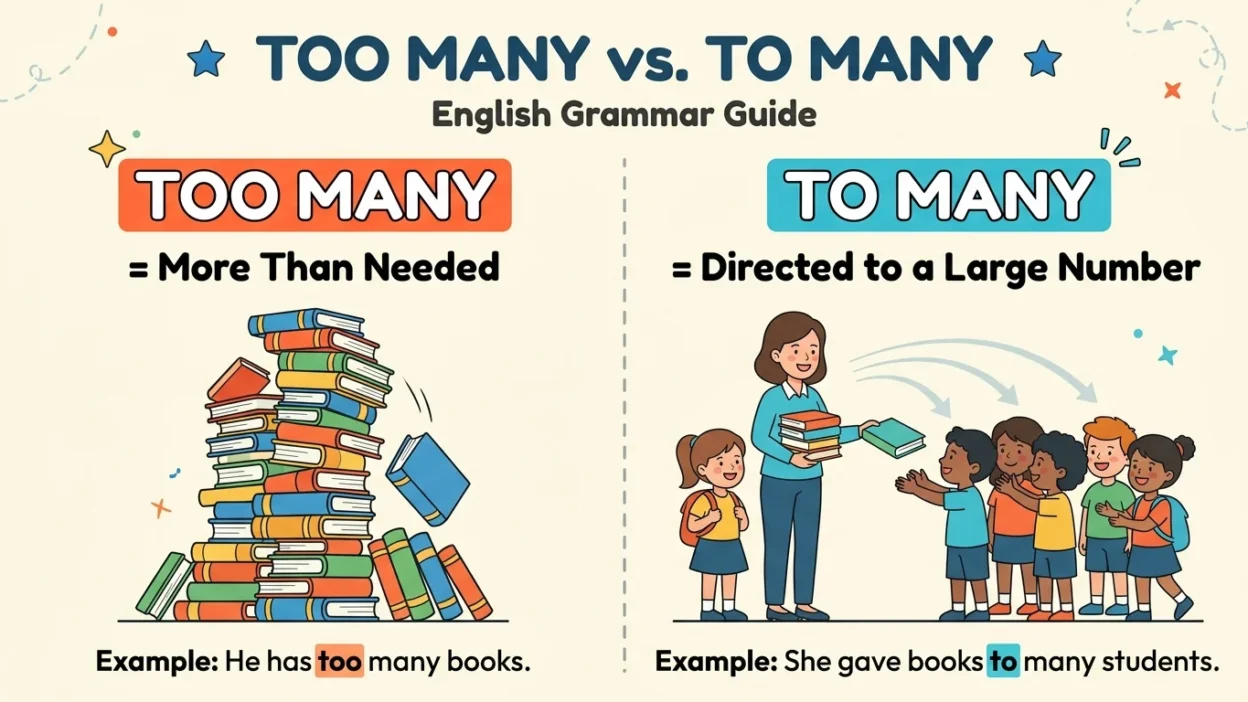
Too many means more people or things than are wanted, needed, or manageable. Example: “I have too many assignments.” To many is correct when to belongs to the sentence’s grammar and many refers to a large number of people or things. Example: “She gave instructions to many students.”
Why Do People Confuse Too Many and To Many?
People often confuse these expressions because to and too are homophones in most English accents. This means they sound the same but have different meanings and spellings.
Here is the main difference:
- Too means “more than necessary,” “excessively,” or “also.”
- To is commonly used as a preposition or as part of an infinitive verb.
- Many refers to a large number of countable people or things.
When too comes before many, it expresses an excessive quantity. When to comes before many, it usually connects the rest of the sentence to a large number of people or things.
What Does Too Many Mean?
Too many means more people or things than are necessary, acceptable, or desirable. It is used with countable nouns, such as books, people, questions, cars, and tasks.
The word too adds the idea of excess. It often suggests that the quantity creates a problem or is greater than someone wants.
Examples of Too Many
- Too many people
- Too many books
- Too many questions
- Too many mistakes
- Too many responsibilities
- Too many cars on the road
- Too many messages on my phone
Example Sentences With Too Many
- There are too many people waiting outside.
- I made too many mistakes on the test.
- She bought too many books for her small shelf.
- We have too many tasks to finish today.
- There were too many cars on the road this morning.
- He asks too many questions during the meeting.
- I received too many emails over the weekend.
- You added too many ingredients to the recipe.
- The teacher said that there were too many students in the classroom.
- I have too many things to do before my trip.
In each sentence, too many means that the number is excessive or more than is appropriate.
What Does To Many Mean?
To many is not usually a fixed expression with its own meaning. Instead, it is a combination of the preposition to and the determiner many.
It can be correct when the sentence requires to before a group of people or things.
For example:
- She spoke to many students.
- The company sent invitations to many customers.
- He explained the rules to many visitors.
- We gave directions to many tourists.
- The announcement came as a surprise to many people.
In these sentences, to shows the relationship between an action or expression and the people affected by it. The word many indicates a large number.
Example Sentences With To Many
- The principal spoke to many parents at the meeting.
- The charity distributed food to many families.
- She sent invitations to many friends.
- The guide gave directions to many tourists.
- The news came as a surprise to many people.
- The teacher explained the lesson to many students.
- The organization offered support to many communities.
- He introduced the new policy to many employees.
- The speaker presented the idea to many listeners.
- The program provides useful information to many readers.
Notice that to many does not mean “an excessive number.” It means that something is directed, given, explained, or communicated to a large number of people or things.
Too Many vs To Many: Key Differences
| Feature | Too Many | To Many |
|---|---|---|
| Main function | Expresses an excessive quantity | Connects an action or expression to a large number |
| Meaning | More than necessary or wanted | To a large number of people or things |
| Grammar | Quantity expression | Preposition followed by many |
| Common use | Complaints, limits, and excess | Speaking, giving, sending, or explaining something |
| Example | There are too many cars. | She spoke to many drivers. |
| Can they be interchangeable? | No | No |
When Should You Use Too Many or To Many?
Use Too Many When You Mean Excess
Choose too many when the number of people or things is greater than necessary, manageable, or desirable.
Examples:
- There are too many advertisements on this website.
- I have too many clothes in my closet.
- We made too many changes to the original plan.
- There were too many questions on the exam.
- He spends too much time worrying about too many things.
Remember that too many normally comes before a plural countable noun.
Use To Many When the Sentence Needs the Preposition To
Choose to many when to connects an action or expression to a large number of people or things.
Examples:
- She gave the instructions to many workers.
- The organization provides clean water to many villages.
- He explained the situation to many customers.
- The message was meaningful to many readers.
- The new rules apply to many businesses.
In these examples, to has a grammatical role in the sentence. It does not express excess.
Too Many vs To Many: More Example Sentences
| Too Many | To Many |
|---|---|
| There are too many people in the hall. | The host spoke to many people in the hall. |
| I bought too many groceries. | I gave the shopping list to many family members. |
| She made too many errors. | She explained the errors to many students. |
| We received too many complaints. | We responded to many complaints. |
| He has too many responsibilities. | He assigned responsibilities to many employees. |
| There are too many cars on this street. | The city sent notices to many drivers. |
| They asked too many questions. | The presenter answered questions from many students. |
| I have too many books to carry. | I donated books to many children. |
| The website displays too many pop-ups. | The company sent updates to many users. |
| We made too many changes. | We explained the changes to many team members. |
Common Mistakes to Avoid
1. Using To Many to Express Excess
Incorrect: There are to many people in the room.
Correct: There are too many people in the room.
Use too because the sentence means there are more people than desired.
2. Using Too Many When You Need the Preposition To
Incorrect: She gave the instructions too many students.
Correct: She gave the instructions to many students.
The preposition to connects the instructions with the students who received them.
3. Confusing Too Many With Too Much
Use too many with plural countable nouns and too much with uncountable nouns.
- Correct: There are too many chairs.
- Correct: There is too much furniture.
- Incorrect: There are too much chairs.
4. Assuming To Many Is Always Wrong
The phrase to many is perfectly acceptable when the sentence needs the preposition to.
For example: “This announcement was important to many people.”
The key is to look at the meaning and grammatical structure of the entire sentence.
Memory Trick: How to Remember the Difference
Use this simple trick:
- Too many = Too much or more than needed. Think of excess.
- To many = To a large number. Think of giving, speaking, sending, or explaining something to people.
Try these examples:
- “I have too many books.” This means I have more books than I need or want.
- “I gave books to many children.” This means I gave books to a large number of children.
If you can replace too with “more than necessary,” use too many. If the sentence needs the preposition to, use to many.
American vs British English
There is no difference between American and British English in the spelling or basic usage of these expressions.
Both varieties use too many to express an excessive number and to many when the grammar requires the preposition to.
Examples:
- American English: There are too many people at the event.
- British English: There are too many people at the event.
- American English: She explained the rules to many students.
- British English: She explained the rules to many students.
The distinction is based on meaning and grammar, not regional spelling.
Too Many vs To Many: Similar Expressions
| Expression | Meaning | Example |
|---|---|---|
| Too much | More than necessary of an uncountable thing | There is too much noise. |
| Too few | Fewer than needed | We have too few chairs. |
| Too little | Less than needed of an uncountable thing | There is too little time. |
| So many | A large number, often emphasizing the quantity | There are so many options. |
| Many too | Usually part of a different structure, such as “many too many” in emphatic usage, which is uncommon | The phrase is rarely needed in ordinary writing. |
| To several | Directed toward or intended for several people or things | She sent the letter to several offices. |
Frequently Asked Questions
1. Is it too many or to many?
Both can be correct in different contexts. Use too many to mean an excessive number. Use to many when to is a preposition connecting an action or expression to a large number of people or things.
2. Is “too many people” correct?
Yes. “Too many people” is correct when you mean that the number of people is excessive or greater than desired.
Example: “There were too many people at the concert.”
3. Is “to many people” grammatically correct?
Yes, when the sentence requires the preposition to.
Example: “She explained the rules to many people.”
4. What is the difference between too and to?
Too can mean “excessively” or “also.” To commonly shows direction, connection, or purpose and is also used before the base form of a verb, as in “to read.”
5. Can I write “there are to many problems”?
No. If you mean that the number of problems is excessive, write “There are too many problems.”
6. Is it too many or too much?
Use too many with plural countable nouns, such as books, people, and questions. Use too much with uncountable nouns, such as water, time, and noise.
Examples: “too many books” and “too much water.”
7. Why do people write “to many” instead of “too many”?
Because to and too sound alike in most English accents. Writers sometimes choose the wrong spelling, especially when typing quickly. Checking the meaning of the sentence helps prevent this mistake.
Remember This
Too many means more than necessary. To many is correct when to connects an action or expression to a large number of people or things.
For example, “There are too many students in the room” expresses excess, while “The teacher spoke to many students” describes who received the teacher’s words.
Conclusion
The difference between too many and to many is small in spelling but important in meaning. Use too many when you want to describe an excessive number of countable people or things. Use to many when the preposition to is needed by the sentence, as in “She gave the information to many people.”
The easiest way to remember the rule is to connect too with excess and to with a grammatical connection. By checking what you want to say, you can choose the correct expression in everyday conversation and formal writing.

Adam Aaron is a language enthusiast and content writer at SimileHive, creating clear, engaging guides on similes, idioms, metaphors, and figurative language to help readers improve English confidently every day.