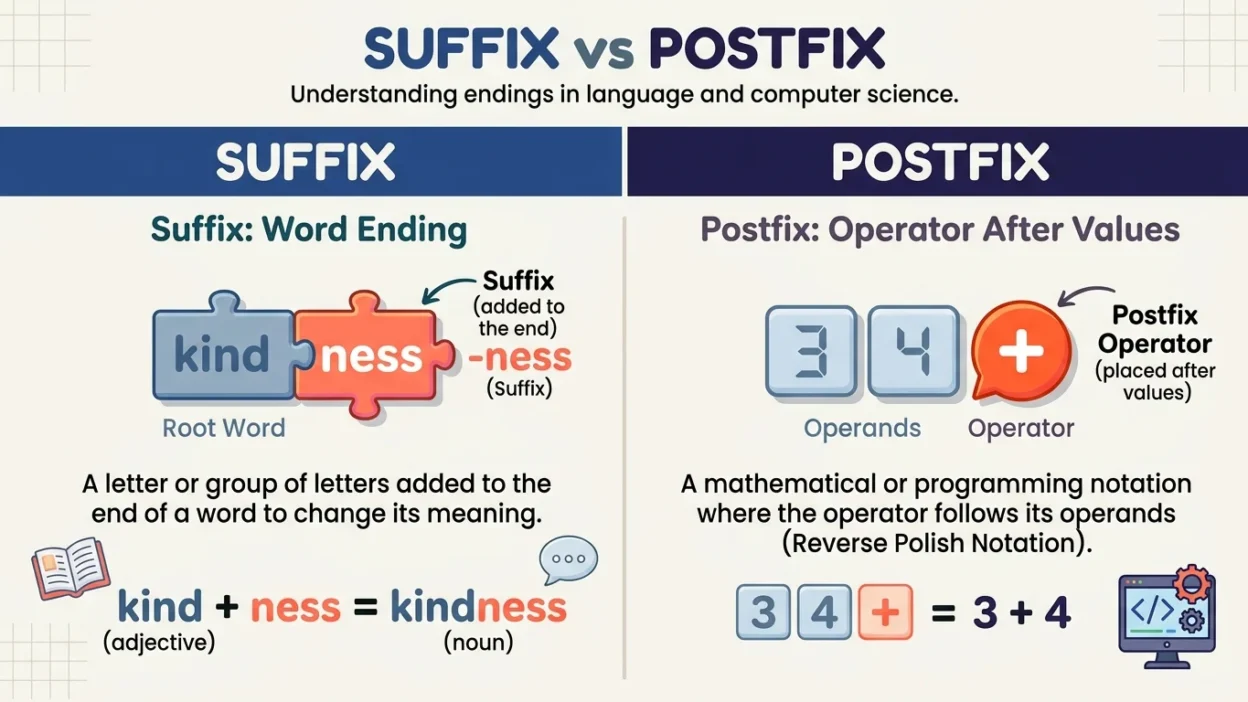
Are suffix and postfix the same thing? Both terms refer to something placed after another element, but their meanings and uses depend on the context. In English grammar, “suffix” is the standard term for a letter or group of letters added to the end of a word to change its meaning or grammatical form. For example, adding -ful to hope creates hopeful, while adding -ness to kind creates kindness.
The term postfix is more common in computer science, mathematics, and formal systems. In programming, a postfix operator appears after the value or expression it operates on, as in x++ in languages that support that notation. In computer science, postfix notation also places operators after their operands, as in 3 4 +.
Although both words share the idea of something coming after something else, they are not interchangeable in every situation. In this guide, you will learn their meanings, explore their differences, and discover when to use each term correctly.
Quick Answer: Suffix vs Postfix
A suffix is a word element added to the end of a word, such as -ness in happiness. A postfix is something placed after another element, especially in programming or mathematical notation. In everyday English grammar, suffix is the appropriate term for word endings, while postfix is generally used in technical contexts.
Why Do People Confuse Suffix and Postfix?
People confuse these terms because both contain the idea of something coming after another element.
The prefix post- means “after,” while subfix is not the standard term for an English word ending. The word suffix comes from a Latin root meaning “to attach underneath or after,” and it has become the established linguistic term for an ending added to a word.
The main difference is how the terms are conventionally used:
- Suffix: Commonly used in grammar and linguistics.
- Postfix: Commonly used in programming, mathematics, and formal notation.
For example, -ed in walked is a suffix. In postfix notation, the operator follows the values it acts on.
What Does Suffix Mean?
A suffix is a letter or group of letters added to the end of a word to change its meaning, grammatical function, or form.
Suffixes are important in English because they help create new words and show grammatical information.
Examples of Suffixes
| Root or Base Word | Suffix | New Word |
|---|---|---|
| Help | -ful | Helpful |
| Kind | -ness | Kindness |
| Teach | -er | Teacher |
| Quick | -ly | Quickly |
| Hope | -less | Hopeless |
| Walk | -ed | Walked |
| Cat | -s | Cats |
| Modern | -ize | Modernize |
| Happy | -ness | Happiness |
| Care | -ful | Careful |
Example Sentences With Suffixes
- The suffix -er turns teach into teacher.
- Adding -ness to kind creates kindness.
- The word quickly contains the suffix -ly.
- The suffix -ed often marks the past tense of regular verbs.
- Adding -s to book gives us books.
- The suffix -ful changes hope into hopeful.
- The word careless contains the suffix -less.
- The suffix -able helps form the adjective readable.
- The word modernization contains more than one suffix.
- Learning suffixes can help students understand unfamiliar words.
What Does Postfix Mean?
A postfix is an element placed after another element. The term is especially common in computing and mathematical notation, where the position of an operator or symbol matters.
Unlike suffix, which has a specific established role in word formation, postfix is a broader positional term in technical contexts.
Examples of Postfix
1. Postfix notation in mathematics
In postfix notation, also called Reverse Polish notation, operators appear after their operands.
For example:
- In ordinary infix notation:
3 + 4 - In postfix notation:
3 4 +
The plus sign comes after the two numbers.
2. Postfix operators in programming
In some programming languages, an operator appears after a variable.
For example, in C-like languages:
x++Here, ++ is a postfix increment operator. Its exact behavior depends on the language and the surrounding expression.
3. Postfix expressions
A computer program may use postfix expressions to evaluate calculations without requiring parentheses in the same way as ordinary infix notation.
For example:
5 2 *This represents (5 \times 2) in postfix notation.
Example Sentences With Postfix
- The calculator uses postfix notation to evaluate expressions.
- The programmer used a postfix increment operator.
- In postfix notation, the operator appears after its operands.
- The students learned how to convert infix expressions into postfix expressions.
- The compiler processes the expression according to the programming language’s rules.
- Postfix notation can simplify the evaluation of certain mathematical expressions.
- The
++operator is postfix when it appears after a variable. - The program converts an arithmetic expression into postfix notation.
- Postfix notation is also known as Reverse Polish notation.
- The placement of an operator determines whether it is prefix, infix, or postfix notation.
Suffix vs Postfix: Key Differences
| Feature | Suffix | Postfix |
|---|---|---|
| Basic meaning | An element added to the end of a word | An element placed after another element |
| Main field | Grammar and linguistics | Computing, mathematics, and formal notation |
| Typical example | -ness in kindness | 3 4 + in postfix notation |
| Purpose | Forms words or marks grammatical information | Specifies the position of an operator or other element |
| Everyday English | Common in word study | Less common outside technical contexts |
| Interchangeable? | No, not in ordinary grammar terminology | No, not in ordinary grammar terminology |
When Should You Use Suffix or Postfix?
Use Suffix When Discussing Words
Choose suffix when talking about a word ending that changes the word’s form or meaning.
Examples:
- The suffix -ly forms many adverbs.
- The word friendship ends with the suffix -ship.
- Adding the suffix -able creates readable.
- The suffix -s can mark plural nouns.
- Students learn prefixes and suffixes to expand their vocabulary.
Use Postfix in Technical Contexts
Choose postfix when describing something placed after another element, especially an operator or expression in a technical system.
Examples:
- The expression uses postfix notation.
- The language supports a postfix increment operator.
- The program converts the equation into postfix form.
- The calculator evaluates postfix expressions.
- The operator appears after its operand in this notation.
Suffix vs Postfix: More Example Sentences
| Suffix | Postfix |
|---|---|
| The suffix -ful appears in beautiful. | The calculator uses postfix notation. |
| The suffix -less appears in careless. | The operator appears after its operands. |
| The word happiness ends in -ness. | The expression 3 4 + is in postfix form. |
| The suffix -ed often marks the past tense. | The programmer used a postfix increment operator. |
| The suffix -er can refer to a person who performs an action. | The program evaluates the postfix expression. |
| Learning suffixes improves vocabulary skills. | Postfix notation can be useful for stack-based evaluation. |
| The suffix -able appears in comfortable. | The expression was converted from infix to postfix notation. |
| The suffix -s can mark plural nouns. | The operator follows the value in a postfix expression. |
Common Mistakes to Avoid
1. Calling an English Word Ending a Postfix
Incorrect: The word happiness contains the postfix -ness.
Better: The word happiness contains the suffix -ness.
In standard English grammar, suffix is the appropriate term.
2. Calling Postfix Notation a Suffix
Incorrect: The expression 3 4 + is a suffix.
Correct: The expression 3 4 + is written in postfix notation.
A suffix is a word element, while postfix notation describes the arrangement of operators and operands.
3. Assuming Postfix Is Used Only in Programming
Postfix is also used in mathematical and logical notation. The term is not limited to programming languages.
4. Assuming Every Word Ending Is a Suffix
Some words simply end with particular letters without those letters functioning as a suffix. For example, the final letters of cat do not represent a suffix.
A suffix is a meaningful word element, not merely the last few letters of a word.
Memory Trick: How to Remember the Difference
Use this simple trick:
- Suffix = Word stuff at the end. Think of kindness, hopeful, and quickly.
- Postfix = Position after something. Think of operators placed after values in a mathematical or programming expression.
Remember these examples:
- Happiness contains the suffix -ness.
3 4 +is an example of postfix notation.
If you are discussing English word formation, choose suffix. If you are discussing the position of an operator or expression in a technical system, postfix may be the correct term.
American vs British English
There is no meaningful American versus British English difference in the use of suffix and postfix.
Both varieties use suffix in grammar and linguistics. Both also use postfix in relevant technical contexts, such as programming and mathematical notation.
Examples:
- American English: The suffix -ness forms the noun kindness.
- British English: The suffix -ness forms the noun kindness.
- American English: The expression uses postfix notation.
- British English: The expression uses postfix notation.
The difference depends on the subject being discussed, not on regional spelling.
Suffix vs Postfix: Related Terms
| Term | Meaning | Example |
|---|---|---|
| Prefix | An element added to the beginning of a word or expression | Un- in unhappy |
| Suffix | An element added to the end of a word | -ness in kindness |
| Infix | An element inserted within another element, or an operator placed between operands in infix notation | 3 + 4 |
| Postfix notation | A notation in which operators follow their operands | 3 4 + |
| Prefix notation | A notation in which operators precede their operands | + 3 4 |
| Affix | A linguistic element attached to a base or root | Un-, -ful, or -ness |
| Morpheme | The smallest linguistic unit that carries meaning or grammatical function | Book, -s, or un- |
Frequently Asked Questions
1. What is the main difference between suffix and postfix?
A suffix is a word element added to the end of a word, such as -ness in kindness. A postfix is an element placed after another element, especially in technical notation and programming.
2. Is postfix a grammatical term?
Postfix can be used in linguistics in a broad or specialized sense, but suffix is the standard and more familiar term for an affix added to the end of a word in English grammar.
3. Is -ing a suffix or postfix?
In words such as walking and reading, -ing is a suffix. It can mark a verb form or help form a gerund or participle, depending on how the word is used.
4. What is an example of postfix notation?
The expression 3 4 + is an example of postfix notation. The operator + comes after the operands 3 and 4.
5. What is the difference between prefix and postfix?
A prefix appears before an element, while a postfix appears after it. For example, prefix notation writes addition as + 3 4, while postfix notation writes it as 3 4 +.
6. Can suffix and postfix be used interchangeably?
Usually not. Use suffix when discussing English word endings. Use postfix when discussing the position of an operator or another element in a technical system.
7. Is -ed a suffix?
Yes. In a regular past-tense verb such as walked, -ed is a suffix. It marks the past-tense form of the verb.
8. Why is postfix notation useful?
Postfix notation can make certain expressions easier for computers to evaluate, particularly when using a stack. It also avoids the need for parentheses to express operator precedence in the same way as ordinary infix notation.
Remember This
A suffix is a word ending; a postfix is something placed after another element, especially in technical notation.
Use suffix for endings such as -ness, -ful, and -ed. Use postfix when discussing expressions such as 3 4 + or operators such as x++.
Conclusion
Suffix and postfix both involve the idea of something coming after another element, but they serve different purposes. A suffix is a standard linguistic term for a word element added to the end of a word. A postfix is a broader positional term commonly used in programming and mathematical notation.
To choose the correct word, consider the context. If you are studying English vocabulary or grammar, suffix is usually the right choice. If you are discussing operators or formal expressions that place an element after another, postfix is often appropriate.

Adam Aaron is a language enthusiast and content writer at SimileHive, creating clear, engaging guides on similes, idioms, metaphors, and figurative language to help readers improve English confidently every day.