Have you ever wondered whether to say “a couple of days,” “a few days,” “some days,” “several days,” or “many days”? These expressions all refer to quantities, but they do not communicate exactly the same idea. Choosing the right word can make your English sound more natural and help you express quantities more clearly.
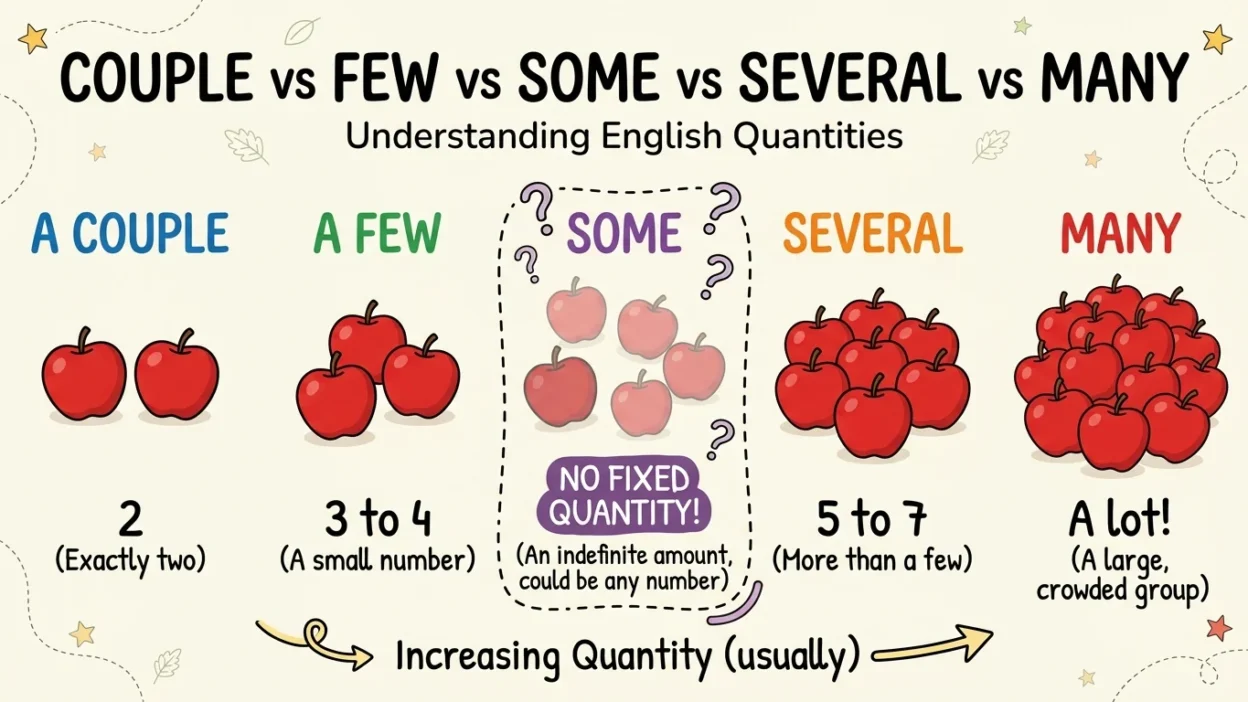
The main difference is that a couple usually means two, a few means a small number, some refers to an unspecified amount or number, several means more than a few but not a large number, and many refers to a large number. However, these meanings can overlap depending on the situation. For example, “a few people” and “several people” may describe similar groups, while “many people” usually suggests a noticeably larger group.
In this guide, you will learn the meanings of couple, few, some, several, and many, discover how to use them correctly, and explore practical examples, comparison tables, common mistakes, and frequently asked questions.
Quick Answer: What Is the Difference Between Couple, Few, Some, Several, and Many?
A couple usually means two, a few means a small number, some means an unspecified quantity, several means more than a few in many contexts, and many means a large number. These expressions are not exact measurements except for the usual meaning of “a couple.” Their meanings depend on context.
Why Do People Confuse These Words?
People often confuse these expressions because they all describe quantities without giving an exact number. They are especially common when talking about people, objects, days, questions, and other countable things.
For example:
- I have a couple of books.
- I have a few books.
- I have some books.
- I have several books.
- I have many books.
All five sentences are grammatically correct, but they give the reader different impressions of how many books the speaker has.
The challenge is that few, some, and several do not have universally fixed numerical boundaries. One person might use “a few” for three items, while another might use it for four or five. Context, expectations, and the size of the group all influence the meaning.
1. What Does Couple Mean?
A couple generally means two people or things considered together. In everyday English, the expression “a couple of” is commonly used before plural countable nouns.
Examples:
- I need a couple of minutes to finish this task.
- She bought a couple of notebooks.
- We invited a couple of friends to dinner.
- He asked me a couple of questions.
- I will call you in a couple of days.
- They stayed for a couple of hours.
- Can you give me a couple of examples?
- I have a couple of ideas for the project.
Does Couple Always Mean Exactly Two?
In its most precise sense, a couple means two. However, in informal conversation, “a couple of” can sometimes mean approximately two or a small number close to two.
For example, someone might say, “I will be there in a couple of minutes,” without promising to arrive exactly two minutes later.
In formal or technical writing, use an exact number when precision matters.
Couple vs A Couple Of
A couple can refer to two people in a relationship.
Example: The couple celebrated their anniversary.
“A couple of” can refer to two things or people.
Example: I bought a couple of apples.
Remember that “a couple of” is followed by a plural countable noun in standard English.
2. What Does Few Mean?
Few refers to a small number of people or things that can be counted. The expression “a few” usually has a positive meaning: there are some items, even if the number is small.
Examples:
- I have a few questions about the lesson.
- She invited a few friends to her birthday party.
- We need a few more chairs.
- He stayed for a few days.
- I have read a few books this month.
- A few students arrived early.
- Please wait a few minutes.
- There are a few mistakes in the report.
Few vs A Few
This is an important distinction.
A few means a small number, but enough for the purpose or situation.
Example: I have a few friends in this city.
This suggests that the speaker has some friends there.
Few, without “a,” often emphasizes that the number is surprisingly small or insufficient.
Example: Few people understood the instructions.
This suggests that not many people understood them.
Compare these sentences:
- I have a few opportunities to practice. This sounds positive.
- I have few opportunities to practice. This emphasizes a lack of opportunities.
The meaning depends on whether you use “a.”
3. What Does Some Mean?
Some refers to an unspecified number or amount. It is useful when the exact quantity is unknown, unimportant, or not being stated.
It can be used with plural countable nouns and uncountable nouns.
Examples with countable nouns:
- I bought some apples.
- Some students stayed after class.
- She sent me some photographs.
- We invited some friends.
- He asked some questions.
Examples with uncountable nouns:
- I need some water.
- She gave me some advice.
- We need some information.
- He spent some money.
- They showed some patience.
When Should You Use Some?
Use “some” when you want to mention a quantity without specifying whether it is small or large.
For example:
- I have some books to read.
- There is some milk in the fridge.
- We need some help with this project.
Unlike “a couple” or “a few,” “some” does not strongly indicate a particular numerical range. The amount could be small or substantial, depending on the noun and context.
4. What Does Several Mean?
Several means more than a small number in many everyday contexts, but not necessarily a large number. It usually refers to a number of separate people or things.
Examples:
- I have visited that city several times.
- Several students answered the question correctly.
- She bought several dresses for the event.
- We discussed the issue for several hours.
- He has written several articles.
- Several people attended the meeting.
- The company opened several new offices.
- I received several emails this morning.
How Many Is Several?
There is no universally agreed numerical definition of “several.” It often suggests more than two or three, but the exact number depends on the context.
For example, “several people attended the meeting” could describe four, six, or another modest number. If the exact number matters, state it directly.
Several vs A Few
Both expressions refer to relatively small numbers, and their meanings overlap.
- A few people came to the party.
- Several people came to the party.
The second sentence may suggest a somewhat larger group, but this is not a strict rule. The context determines how readers interpret the quantity.
5. What Does Many Mean?
Many refers to a large number of people or things. It is used with plural countable nouns.
Examples:
- Many people attended the concert.
- She has read many books.
- Many students passed the examination.
- We visited many places during our holiday.
- He has made many friends at university.
- Many customers prefer online shopping.
- There are many reasons to learn English.
- Many questions remain unanswered.
Can Many Be Used With Uncountable Nouns?
In ordinary affirmative statements, “many” is generally used with plural countable nouns, not directly with uncountable nouns.
Correct:
- Many students attended the lecture.
- Many problems need to be solved.
Incorrect in standard English:
- Many information is available.
- Many money was spent.
Use much or a lot of with uncountable nouns.
Correct:
- Much information is available.
- A lot of money was spent.
In questions and negative sentences, “many” is especially common:
- How many books do you have?
- I do not have many books.
Couple vs Few vs Some vs Several vs Many: Comparison Table
| Word or phrase | General meaning | Approximate quantity | Example |
|---|---|---|---|
| A couple of | Usually two | 2 | I bought a couple of pens. |
| A few | A small number | Often 3 or more, depending on context | I bought a few pens. |
| Some | An unspecified quantity | No fixed range | I bought some pens. |
| Several | More than a few in many contexts | A modest number, with no fixed limit | I bought several pens. |
| Many | A large number | Depends on context | I bought many pens. |
The numbers in this table are only rough illustrations. Except for the usual meaning of “a couple,” these expressions do not have fixed numerical limits.
Which Word Suggests the Smallest or Largest Quantity?
A useful general guide is:
A couple of → a few → several → many
This sequence suggests an increasing quantity in many everyday situations. However, “some” does not fit neatly into the sequence because it indicates an unspecified amount rather than a particular size.
For example:
- A couple of people came.
- A few people came.
- Several people came.
- Many people came.
Each sentence gives a different impression, but the actual quantities depend on context.
When Should You Use Each Word?
Use a Couple When You Mean Two
- I need a couple of minutes.
- We bought a couple of tickets.
- She has a couple of questions.
Choose this expression when two is the intended quantity or when an informal approximation is appropriate.
Use a Few When the Number Is Small
- I have a few tasks to finish.
- A few students need extra help.
- We stayed for a few days.
Use “a few” when the small quantity is worth mentioning and you want a generally positive or neutral tone.
Use Some When the Exact Number Is Not Important
- I bought some groceries.
- We need some information.
- Some people disagree with the decision.
Choose “some” when you do not need to describe the quantity as particularly small or large.
Use Several When You Want to Indicate a Modest Number
- Several employees attended the training.
- I have read several books on the topic.
- We received several applications.
Use “several” when you want to indicate more than just a couple, without suggesting a very large number.
Use Many When the Number Is Large
- Many people use smartphones.
- Many students enjoy reading.
- We received many applications.
Use “many” when the quantity is large in relation to the situation.
Examples: All Five Words in Similar Sentences
| Expression | Example sentence |
|---|---|
| A couple of | I have a couple of emails to answer. |
| A few | I have a few emails to answer. |
| Some | I have some emails to answer. |
| Several | I have several emails to answer. |
| Many | I have many emails to answer. |
The topic stays the same, but the implied quantity changes. “Some emails” leaves the number open, while “many emails” suggests a large workload.
Here are more examples:
- A couple of guests arrived early.
- A few guests arrived early.
- Some guests arrived early.
- Several guests arrived early.
- Many guests arrived early.
- I have a couple of ideas for our presentation.
- I have a few ideas for our presentation.
- I have several ideas for our presentation.
- Many people expressed interest in the event.
- Some people preferred to stay at home.
Common Mistakes to Avoid
Mistake 1: Using Couple When You Mean a Large Number
Incorrect or misleading: I have a couple of books to read, when you mean twenty books.
Better: I have many books to read.
“A couple of” usually means two, so it is not the best choice for a large quantity.
Mistake 2: Confusing Few With A Few
Compare:
- Few students completed the task.
- A few students completed the task.
The first emphasizes that the number was low, possibly disappointingly so. The second simply says that some students completed it.
Mistake 3: Using Many With an Uncountable Noun
Incorrect: She gave me many advice.
Correct: She gave me a lot of advice.
“Advice” is uncountable in standard English, so use “some advice,” “much advice,” or “a lot of advice.”
Mistake 4: Assuming Several Has an Exact Number
“Several” does not always mean five or more. It is a flexible quantity word, and its meaning changes with context.
If you need precision, say “four people,” “seven days,” or the exact number that applies.
Mistake 5: Treating Some as Always Meaning a Small Amount
“Some” can refer to a small, moderate, or substantial quantity.
For example, “Some countries have very large populations” does not suggest that those populations are small. It simply refers to an unspecified group of countries.
Memory Trick: How to Remember the Difference
Use this simple guide:
- Couple: Think of two.
- A few: Think of a small number.
- Some: Think of an unspecified quantity.
- Several: Think of a modest number, often more than a few.
- Many: Think of a large number.
Remember that “some” is different because it does not tell you how large or small the quantity is.
Frequently Asked Questions
1. Is a couple more or less than a few?
A couple usually means two, while “a few” generally means a small number that is often greater than two. However, informal usage can overlap, and “a few” does not have an exact numerical definition.
2. Does several mean five?
Not necessarily. Several often refers to a modest number, but it does not have a fixed numerical meaning. Depending on the context, it could mean four, five, six, or another number.
3. Is some more than a few?
Not always. “Some” means an unspecified quantity, while “a few” explicitly suggests a small number. Some could refer to fewer items than a few, the same number, or many more.
4. Is several more than many?
Usually, no. “Many” generally suggests a larger number than “several.” However, the exact interpretation depends on the noun and context.
5. Can I use a couple of for more than two?
In informal conversation, people sometimes use “a couple of” loosely to mean approximately two or a small number. If the exact quantity matters, use “two” or state the actual number.
6. Can couple, few, some, several, and many be used with uncountable nouns?
Not all of them. “A couple of,” “a few,” “several,” and “many” normally take plural countable nouns. “Some” can be used with both plural countable nouns and uncountable nouns.
Examples:
- A few books
- Several students
- Many questions
- Some books
- Some water
7. Which word should I use in formal writing?
Choose the word that accurately reflects your meaning. “Several” and “many” are common in formal writing, but “a few” and “some” are also perfectly appropriate. Use an exact number whenever precision is important.
Remember This
Couple, few, some, several, and many all describe quantities, but they communicate different ideas. A couple usually means two, a few means a small number, some leaves the quantity unspecified, several suggests a modest number, and many indicates a large number.
These words are useful because they let you describe quantities without always giving an exact figure. The key is to choose the word that best matches the quantity and the meaning you want to express.
Conclusion
Understanding the difference between couple, few, some, several, and many can improve your everyday English and writing. Although these expressions overlap, each gives the reader a different impression of quantity. “A couple of” usually points to two, “a few” suggests a small number, “some” leaves the amount open, “several” suggests a modest number, and “many” indicates a large number.
Remember that these expressions are not all exact numerical measurements. Context matters, especially when using “a few,” “several,” and “many.” If the exact number is important, use a precise figure. Otherwise, choose the expression that communicates your meaning naturally and clearly.

Lucas Luke is a passionate language writer and content creator at SimileHive, specializing in similes, idioms, metaphors, and figurative language. He enjoys making complex English expressions simple, engaging, and easy to understand for students, writers, and language enthusiasts through well-researched, practical content.