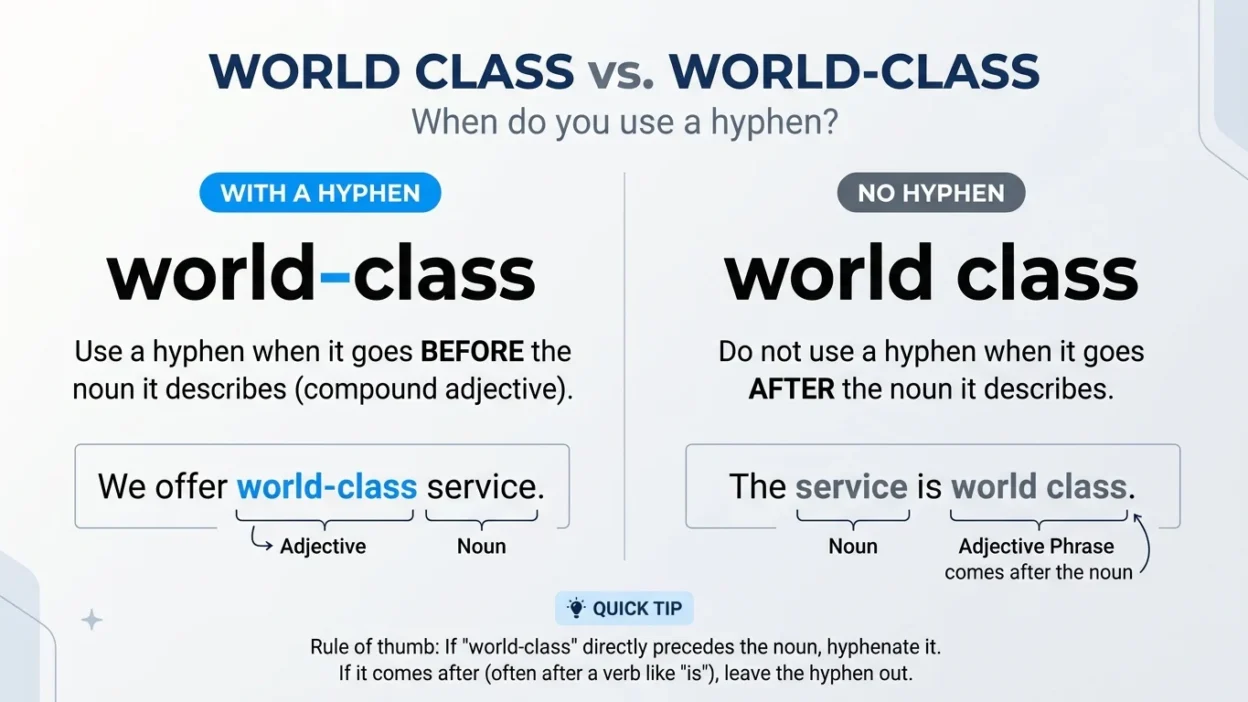
Should you write world class or world-class? The correct form depends on how you use the expression in a sentence. In standard English, world-class is usually hyphenated when it works as a compound adjective before a noun. For example, you would write “a world-class athlete,” “world-class education,” or “a world-class restaurant.”
However, when the expression comes after a linking verb such as is, was, or seems, it is often written without a hyphen: “The restaurant is world class.” This is a common style distinction, although some dictionaries and style guides hyphenate the expression more consistently.
Understanding the world-class hyphen rule helps you write more clearly and professionally. Whether you are writing an essay, a business report, a website, or a social media post, knowing when to use the hyphen can improve your grammar and consistency. Let’s look at the rules, examples, and common mistakes.
Quick Answer: Is World-Class Hyphenated?
World-class is generally hyphenated when it comes before a noun and describes something of exceptionally high quality. For example, “She received world-class training.” When the expression follows a linking verb, “The training was world class” is also common. Follow the style guide you are using and remain consistent.
Why Do People Confuse World Class and World-Class?
The confusion comes from the fact that English compound words and compound adjectives do not always follow one universal hyphen rule. Some expressions use a hyphen before a noun but not after a linking verb.
The meaning of world class and world-class is essentially the same. Both describe something that is among the best in the world or of an exceptionally high standard. The main difference is how the expression functions in the sentence and which style convention you follow.
What Does World-Class Mean?
World-class means exceptionally good, highly skilled, or of a quality that can compete with the best in the world.
It is often used to describe people, services, facilities, products, organizations, and achievements.
Examples:
- She is a world-class pianist.
- The hotel offers world-class service.
- Our city has world-class medical facilities.
- The company developed a world-class product.
In these examples, world-class describes a noun and functions as a compound adjective.
What Is the Correct World-Class Hyphen Rule?
1. Use a Hyphen Before a Noun
When world-class directly describes a noun, the hyphenated form is the usual choice.
Examples:
- The university has a world-class research center.
- He is a world-class football player.
- They built a world-class sports complex.
- We attended a world-class music festival.
- The company provides world-class customer support.
The hyphen connects world and class to show that they work together as one adjective describing the noun.
2. A Hyphen Is Often Optional After a Linking Verb
When the expression appears after a linking verb, such as is, was, seems, or became, it is often written as world class, without a hyphen.
Examples:
- The restaurant is world class.
- Her performance was world class.
- Their customer service seems world class.
- The hospital has become world class.
- The team’s standard of play is world class.
This is a common editorial convention, not an absolute rule. Some dictionaries and style guides retain the hyphen in both positions. If you are following a particular publication’s style guide, use its preferred form.
3. Keep the Hyphen When It Comes Before a Noun
When you use the expression directly before a noun, choose world-class in most formal writing.
| Correct | Less preferred in standard edited writing |
|---|---|
| world-class athlete | world class athlete |
| world-class education | world class education |
| world-class facilities | world class facilities |
| world-class performance | world class performance |
| world-class technology | world class technology |
The unhyphenated form is understandable, but the hyphen makes the compound adjective easier to read.
World Class vs. World-Class: Comparison Table
| Form | Typical use | Example |
|---|---|---|
| World-class | Before a noun | She is a world-class chef. |
| World class | After a linking verb in styles that omit the hyphen | The chef is world class. |
| World Class | Capitalized in a title or official name when appropriate | The event is called World Class Expo. |
Remember that capitalization depends on the sentence, title, or official name. Writing World Class in capital letters does not automatically make it the correct grammatical form.
When Should You Use World-Class?
Use the hyphenated form when the expression functions as an adjective immediately before a noun.
Examples:
- The country is known for its world-class universities.
- She received world-class medical care.
- The team hired a world-class coach.
- This company produces world-class equipment.
- We enjoyed a world-class dining experience.
- The city is building a world-class airport.
- He delivered a world-class performance.
- The school provides world-class education.
- The museum houses a world-class art collection.
- The organization has assembled a world-class research team.
In each sentence, world-class comes before the noun it describes.
When Can You Write World Class Without a Hyphen?
You can commonly write world class without a hyphen when it follows a linking verb and functions as a description.
Examples:
- The hotel is world class.
- Her singing was world class.
- The facilities are world class.
- Their performance seemed world class.
- The service has become world class.
- The team’s quality is world class.
- The restaurant looks world class.
- The standard of care was world class.
- The new stadium is world class.
- His work remains world class.
Some style guides prefer world-class in these sentences too. The most important thing is to follow the relevant style guide and apply it consistently.
Common Mistakes With World-Class
Mistake 1: Leaving Out the Hyphen Before a Noun
Incorrect or less preferred: The company offers world class services.
Preferred: The company offers world-class services.
Mistake 2: Assuming the Hyphen Is Always Required
Common alternative: The service is world class.
Also accepted by some style guides: The service is world-class.
The right choice depends on the style convention you follow.
Mistake 3: Capitalizing It in the Middle of a Sentence
Usually incorrect: We hired a World-Class trainer.
Preferred: We hired a world-class trainer.
Use lowercase unless capitalization is required by a proper name or title.
Mistake 4: Treating World-Class as a Noun
Awkward: She is a world-class.
Better: She is a world-class athlete.
Or: She performs at a world-class level.
World-class is normally an adjective, so it usually describes a noun rather than standing alone as a countable noun.
A Simple Memory Trick
Remember this guideline:
Before a noun, hyphenate it. After a linking verb, check your style guide.
- Before a noun: a world-class player
- After a linking verb: the player is world class in some style conventions
This shortcut works well for everyday writing, but always follow your organization’s or publisher’s rules if they specify a particular form.
Is World-Class Different in American and British English?
The expression world-class is widely understood in both American and British English. Both varieties commonly use the hyphen before a noun, as in “world-class facilities.”
Differences can arise between individual dictionaries, newspapers, publishers, and academic style guides. Therefore, the choice to keep or omit the hyphen after a linking verb is better understood as a matter of editorial style than a strict difference between American and British English.
Similar Words With Hyphen Rules
Here are a few expressions that follow a similar pattern in many styles:
| Expression | Before a noun | After a linking verb |
|---|---|---|
| first-class | a first-class ticket | The service is first class. |
| top-quality | top-quality materials | The materials are top quality. |
| high-quality | high-quality products | The products are high quality. |
| long-term | a long-term plan | The plan is long term. |
| full-time | a full-time job | She works full time. |
These are useful patterns, but hyphenation varies by expression and style guide. Check a dictionary or house style guide if you are unsure.
Frequently Asked Questions
1. Is world-class one word or two words?
It is written as two words joined by a hyphen: world-class. In styles that omit the hyphen after a linking verb, it appears as two separate words: world class.
2. Is world-class always hyphenated?
No. It is usually hyphenated before a noun, as in “world-class service.” After a linking verb, some styles omit the hyphen: “The service is world class.” Other styles retain it.
3. Is it world-class service or world class service?
World-class service is the preferred form in standard edited writing because the compound adjective comes before the noun service.
4. Is it a world-class player or a world class player?
A world-class player is the usual form. The hyphen joins the words into one compound adjective modifying player.
5. Should I write the service is world-class or the service is world class?
Both forms appear in published English. The service is world class follows the convention of omitting the hyphen after a linking verb. If your style guide requires consistent hyphenation, world-class may also be appropriate.
6. Does world-class need capital letters?
No. In the middle of a sentence, write world-class in lowercase unless it is part of a proper name or title. At the beginning of a sentence, capitalize the first letter.
7. What is a synonym for world-class?
Depending on the context, alternatives include outstanding, exceptional, excellent, top-tier, first-rate, and superb. These words may have slightly different shades of meaning.
Remember This
- Use world-class before a noun: “world-class facilities.”
- World class without a hyphen is common after a linking verb: “The facilities are world class.”
- Some style guides retain the hyphen in both positions.
- Use lowercase in ordinary sentences unless capitalization is required.
- Follow your chosen style guide and stay consistent.
Conclusion
The standard world-class hyphen rule is straightforward in most cases: use world-class when the expression comes before a noun, as in “world-class education,” “world-class athletes,” and “world-class service.” The hyphen shows that the two words work together as one adjective.
When the expression follows a linking verb, world class without a hyphen is common, although some style guides prefer world-class in every position. If you are writing for school, work, a website, or a publication, check the relevant style guide. Consistency and clarity are more important than treating one editorial convention as a universal rule.

Charles Kevin is a passionate language writer and researcher at SimileHive, creating clear, engaging content about similes, idioms, metaphors, and figurative language to help readers improve English communication confidently every day.