Is it correct to say “I have flew” or “I have flown”? Many English learners confuse flew vs flown because both words are forms of the verb fly. However, they are used in different grammatical situations. Knowing which form to choose will help you speak and write English more naturally.
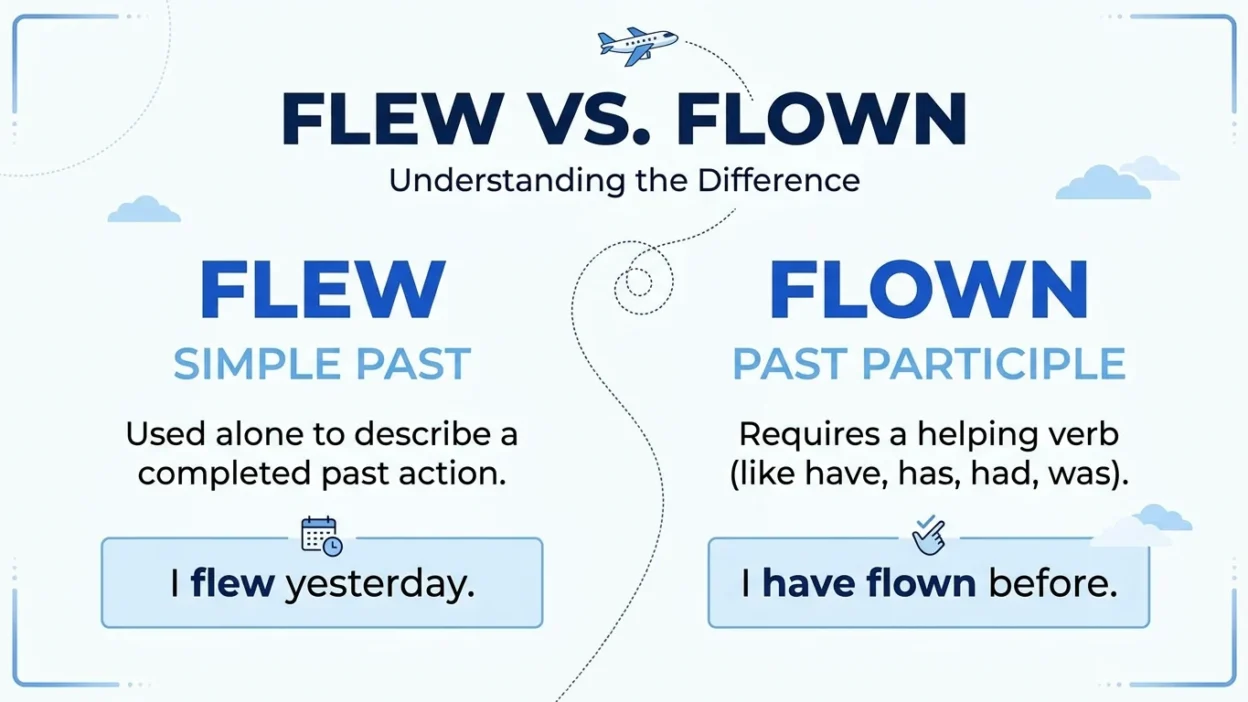
The main difference is simple: flew is the simple past tense of fly, while flown is its past participle. You use flew when describing a completed action in the past, such as “We flew to London yesterday.” You generally use flown with helping verbs such as have, has, and had, as in “We have flown to London before.”
These forms are also used when talking about birds, airplanes, travel, and things moving through the air. In this article, you will learn the meanings of flew and flown, their grammar rules, common mistakes, and practical examples to help you remember the difference.
Quick Answer: Flew or Flown?
Flew is the simple past tense of fly, while flown is the past participle. Use flew for a completed past action: “She flew home yesterday.” Use flown with a helping verb: “She has flown home.” In standard English, “She has flew” is incorrect.
Why Do People Confuse Flew and Flown?
People confuse these words because they are both past forms of the same irregular verb, fly. Unlike regular verbs, which usually form the past tense by adding -ed, irregular verbs change in different ways.
For example:
- Walk, walked, walked
- Play, played, played
- Fly, flew, flown
The first two verbs use the same form for the simple past tense and past participle. However, fly has different forms for these two grammatical functions.
The easiest way to avoid mistakes is to learn the three main forms of the verb together: fly, flew, flown.
What Does Flew Mean?
Flew is the simple past tense of fly. It describes an action that happened in the past.
You can use flew when talking about air travel, birds, insects, objects moving through the air, or time passing quickly.
Examples:
- We flew to Dubai last summer.
- The bird flew over the garden.
- She flew to New York for a business meeting.
- The ball flew across the field.
- Time flew during the holidays.
In each sentence, flew describes an action or event in the past.
When Should You Use Flew?
Use flew when you are talking about a completed past action without using have, has, or had as the auxiliary verb for a perfect tense.
Examples:
- I flew to Karachi yesterday.
- She flew to London last week.
- The bird flew out of its cage.
- They flew home after the conference.
- My parents flew to Turkey last year.
- The kite flew high above the trees.
- He flew across the country for work.
- The plane flew through thick clouds.
- We flew to Islamabad early in the morning.
- The little butterfly flew from flower to flower.
What Does Flown Mean?
Flown is the past participle of fly. It is commonly used with have, has, or had to form perfect tenses. It can also appear in passive constructions, such as “The flag has been flown.”
Examples:
- I have flown on that airline before.
- She has flown to Canada several times.
- They had flown home before the storm began.
- The flag has been flown outside the building.
- We have flown together many times.
In these examples, flown works with a helping verb to complete the grammatical structure.
When Should You Use Flown?
Use flown when the sentence requires the past participle, especially in perfect tenses.
Examples:
- I have flown to Dubai twice.
- She has flown across the Atlantic.
- We have flown with this airline before.
- He had flown home before I called.
- They have flown to several countries.
- The bird has flown away.
- My brother has flown alone for the first time.
- The plane had flown for six hours before landing.
- Have you ever flown in a helicopter?
- The flag had been flown at half-mast.
Flew vs Flown: Key Differences
| Feature | Flew | Flown |
|---|---|---|
| Verb form | Simple past tense | Past participle |
| Main use | Describes a past action | Forms perfect tenses and some passive constructions |
| Common structure | Subject + flew | Subject + have/has/had + flown |
| Example | She flew yesterday. | She has flown before. |
| Correct with “have” in standard English? | No | Yes |
| Example with “had” | She had flew. (Incorrect) | She had flown. (Correct) |
The key is to identify the grammatical structure of your sentence before choosing the verb form.
Flew vs Flown in Different Tenses
The verb fly changes depending on the tense you need.
| Tense | Correct form | Example |
|---|---|---|
| Simple present | Fly / flies | Birds fly south in winter. |
| Simple past | Flew | We flew yesterday. |
| Present perfect | Have/has flown | She has flown before. |
| Past perfect | Had flown | They had flown home. |
| Future | Will fly | We will fly tomorrow. |
| Future perfect | Will have flown | By noon, we will have flown for three hours. |
Notice that flew is used for the simple past, while flown appears in perfect tenses.
Can You Say “I Have Flew”?
No. In standard English, “I have flew” is incorrect because have requires the past participle in the present perfect tense.
Incorrect: I have flew to Paris.
Correct: I have flown to Paris.
Similarly:
- Incorrect: She has flew to London.
- Correct: She has flown to London.
- Incorrect: They had flew home.
- Correct: They had flown home.
Remember that have, has, and had are followed by flown, not flew, when forming these perfect tenses.
Flew vs Flown: More Example Sentences
Here are additional examples that show how to use both forms correctly.
Examples With Flew
- The plane flew over the mountains.
- We flew to another city for the wedding.
- The bird flew away when I opened the door.
- She flew home after finishing her exams.
- The paper airplane flew across the classroom.
- They flew to Europe during the summer break.
- The football flew into the crowd.
- He flew to work for an important meeting.
- The eagle flew above the valley.
- The days flew by during our vacation.
Examples With Flown
- I have flown on many different airplanes.
- She has flown to Australia three times.
- We had flown for hours before reaching our destination.
- Have you ever flown first class?
- He has never flown alone.
- The bird has flown away from the nest.
- They had flown to Singapore before moving there.
- The aircraft has flown thousands of miles.
- By the time we arrived, the others had flown home.
- The national flag has been flown outside the school.
Common Mistakes With Flew and Flown
Mistake 1: Using Flew After Have
Incorrect: I have flew to London.
Correct: I have flown to London.
Use the past participle flown after have when forming the present perfect tense.
Mistake 2: Using Flown Alone for a Simple Past Action
Incorrect in standard English: She flown to Paris yesterday.
Correct: She flew to Paris yesterday.
The simple past tense does not require a helping verb in this sentence.
Mistake 3: Using Flew After Had
Incorrect: They had flew home before sunset.
Correct: They had flown home before sunset.
The past perfect tense uses had plus the past participle.
Mistake 4: Confusing Flew With the Present Form Fly
Incorrect: Yesterday, we fly to Karachi.
Correct: Yesterday, we flew to Karachi.
Use flew when describing an action completed in the past.
A Simple Memory Trick
Remember the three forms of the verb:
Fly → Flew → Flown
- Fly: present form
- Flew: simple past
- Flown: past participle
Here is an easy trick:
- Yesterday, I flew.
- I have flown before.
If you see have, has, or had forming a perfect tense, use flown. If you are describing a completed action in the simple past, use flew.
Is There a Difference Between American and British English?
No significant difference exists between American and British English in the standard grammatical use of flew and flown. Both varieties use flew as the simple past tense and flown as the past participle.
| American English | British English |
|---|---|
| I flew to Chicago yesterday. | I flew to Manchester yesterday. |
| I have flown to Chicago before. | I have flown to Manchester before. |
| She had flown home. | She had flown home. |
The main difference in these examples is the place name, not the verb form. The standard grammar rule is the same in both varieties.
Similar Irregular Verbs
Other irregular verbs also have different simple past and past participle forms.
| Base form | Simple past | Past participle |
|---|---|---|
| Fly | Flew | Flown |
| Go | Went | Gone |
| See | Saw | Seen |
| Write | Wrote | Written |
| Eat | Ate | Eaten |
| Break | Broke | Broken |
| Speak | Spoke | Spoken |
| Drive | Drove | Driven |
| Take | Took | Taken |
| Choose | Chose | Chosen |
Learning these three forms together can help you avoid common tense mistakes.
Frequently Asked Questions
1. Is it flew or flown?
Both are correct verb forms, but they are used differently. Flew is the simple past tense, while flown is the past participle. For example, “I flew yesterday” and “I have flown before.”
2. Is “I have flew” grammatically correct?
No. In standard English, the correct form is “I have flown.” The present perfect tense uses have or has followed by the past participle.
3. Is flown the past tense of fly?
Not exactly. Flew is the simple past tense of fly. Flown is its past participle, used with helping verbs in perfect tenses and some passive constructions.
4. Can I say “I had flown”?
Yes. “I had flown” is grammatically correct. It uses the past perfect tense to describe an action that happened before another past event.
5. What is the past tense of fly?
The simple past tense of fly is flew. For example, “The bird flew away.”
6. What is the past participle of fly?
The past participle is flown. For example, “The bird has flown away.”
7. Is “the bird has flew away” correct?
No. The correct sentence is “The bird has flown away.” Use flown after has in the present perfect tense.
Remember This
- Flew is the simple past tense: “She flew yesterday.”
- Flown is the past participle: “She has flown before.”
- Use have, has, or had with flown when forming perfect tenses.
- Do not write “I have flew” in standard English.
- The rule is the same in American and British English.
Conclusion
The difference between flew and flown is based on verb tense and grammatical form. Flew describes an action that happened in the past, while flown is the past participle used in perfect tenses and some passive constructions. Both forms come from the irregular verb fly, so you need to learn them rather than add -ed.
To remember the rule, keep the sequence fly, flew, flown in mind. Say “I flew yesterday,” but “I have flown before.” With practice and attention to helping verbs, you can use both forms confidently in everyday conversation, academic writing, and professional communication.

Charles Kevin is a passionate language writer and researcher at SimileHive, creating clear, engaging content about similes, idioms, metaphors, and figurative language to help readers improve English communication confidently every day.