Have you ever seen someone react dramatically to a small problem or spend an enormous amount of money on a simple celebration? You might describe their behavior as over the top. This common English expression means excessive, exaggerated, or more extreme than necessary. It can describe someone’s behavior, emotions, appearance, celebrations, spending, or reactions.
For example, if someone decorates an entire house with thousands of lights for a small birthday party, you might say, “The decorations were over the top.” The expression often suggests that something goes beyond what is reasonable, expected, or appropriate. However, it is not always negative. People also use it playfully or positively to describe something spectacular, extravagant, or impressively dramatic.
Understanding the meaning of over the top will help you recognize it in conversations, movies, social media posts, and everyday writing. In this guide, you will learn its definition, origin, common uses, synonyms, and examples of how to use it naturally.
Quick Answer: What Does Over the Top Mean?
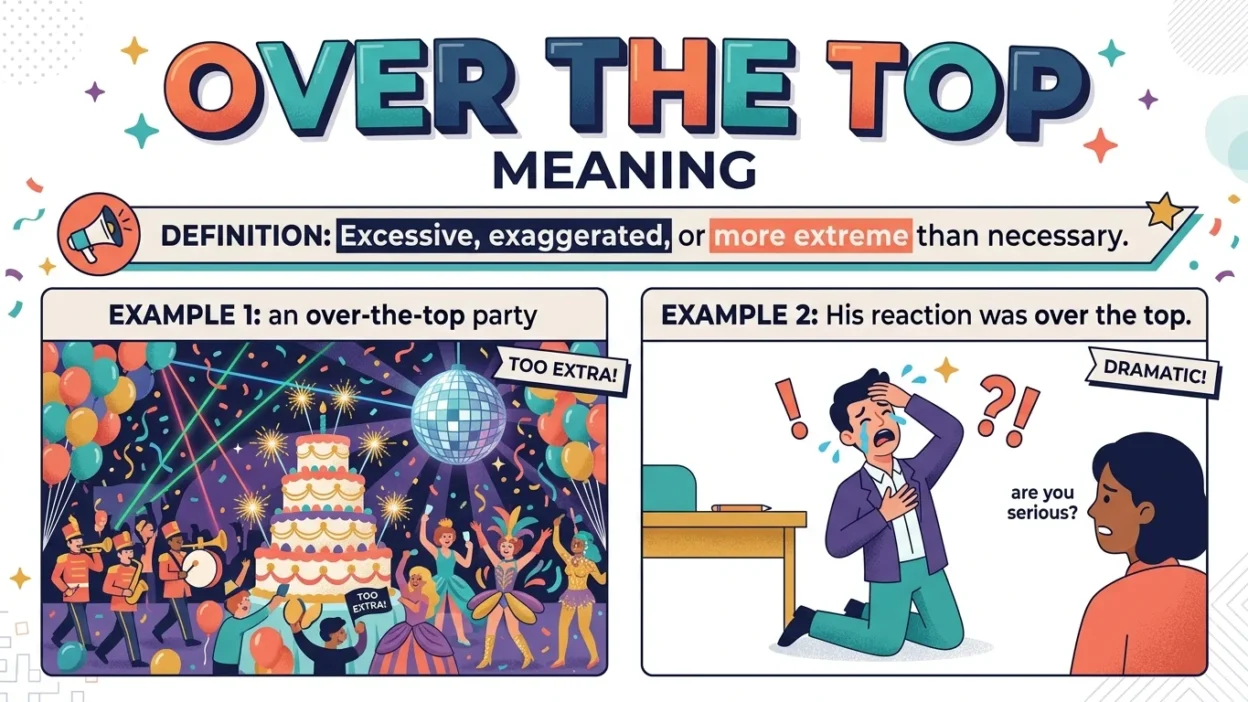
Over the top means excessive, exaggerated, or more extreme than is necessary or appropriate. It can describe dramatic behavior, extravagant spending, elaborate decorations, or an unusually strong reaction. Depending on the context, it can express criticism, humor, surprise, or admiration. For example, “His reaction was over the top” means he reacted too dramatically.
What Does Over the Top Mean?
The phrase over the top is an idiomatic expression used when something goes beyond a reasonable or expected limit.
It often describes something that seems too dramatic, expensive, emotional, elaborate, or exaggerated for the situation.
Examples:
- Her reaction was over the top.
- The wedding decorations were over the top.
- He went over the top with his birthday surprise.
- That movie was entertaining but a little over the top.
- The price they charged for the service was over the top.
In each example, the expression suggests that something exceeds what people would normally expect.
What Is the Origin of Over the Top?
The expression over the top is commonly associated with military history, particularly World War I. Soldiers used the phrase when climbing over the top of trench walls to advance toward enemy positions.
That action was extremely dangerous because soldiers were exposed to enemy fire. Over time, the expression developed broader figurative meanings associated with going beyond limits or behaving in an extreme way.
Today, people generally use over the top in everyday situations without referring to its military origin. It can describe anything from an exaggerated reaction to an extravagant party.
How Is Over the Top Used in Everyday English?
The expression can be used in several ways, depending on the situation.
1. To Describe Exaggerated Behavior
Use over the top when someone behaves more dramatically than the situation seems to require.
Examples:
- His reaction to the mistake was over the top.
- She made an over-the-top scene at the restaurant.
- You do not need to get so upset. You are going over the top.
- His dramatic performance was a little over the top.
2. To Describe Something Extravagant
The expression can describe something that is unusually expensive, elaborate, or luxurious.
Examples:
- They organized an over-the-top wedding.
- The hotel suite was over the top.
- She bought an over-the-top birthday cake.
- The company planned an extravagant, over-the-top celebration.
In these cases, the expression can be critical or admiring, depending on the speaker’s attitude.
3. To Describe Excessive Emotions
People use over the top when an emotional response seems stronger than expected.
Examples:
- His anger was completely over the top.
- Her excitement was a little over the top.
- The criticism seemed over the top.
- Their response to the announcement was over the top.
4. To Describe Entertainment and Style
The phrase can describe a movie, outfit, performance, or design that is unusually dramatic or exaggerated.
Examples:
- The actor’s performance was over the top.
- Her outfit was bold and a little over the top.
- The film uses over-the-top humor.
- The special effects were completely over the top.
Sometimes this is a compliment. A comedy, for example, may deliberately use exaggerated humor to entertain its audience.
Over the Top: Example Sentences
Here are 15 natural examples that show how the expression works in different contexts.
- His reaction to a simple question was over the top.
- The company threw an over-the-top launch party.
- She thought the price of the handbag was over the top.
- The movie’s action scenes were entertaining but over the top.
- He went over the top when planning the surprise.
- The decorations were beautiful, although a little over the top.
- Her comments about the mistake were completely over the top.
- They arranged an over-the-top celebration for their anniversary.
- The comedian’s over-the-top performance made everyone laugh.
- Spending that much money on a phone seems over the top.
- His reaction was so over the top that everyone became uncomfortable.
- The restaurant’s presentation was fancy but not over the top.
- The fans went over the top celebrating their team’s victory.
- That was an over-the-top way to apologize for being late.
- The designer created an over-the-top costume for the performance.
These sentences show that the expression can refer to behavior, money, emotions, entertainment, and special events.
Is Over the Top Positive or Negative?
Over the top can be positive, negative, or neutral. Its meaning depends on the context and the speaker’s tone.
| Context | Meaning | Example |
|---|---|---|
| Negative | Excessive or inappropriate | His anger was over the top. |
| Positive | Impressive or spectacular | The decorations were over the top in the best way. |
| Humorous | Deliberately exaggerated | The comedy was wonderfully over the top. |
| Neutral | Unusually elaborate | The event had an over-the-top theme. |
If someone says your reaction was over the top, they are probably suggesting that you reacted too strongly. If they say your party was over the top and smile while saying it, they might mean it was spectacular.
What Is the Difference Between Over the Top and Over-the-Top?
Both forms are used, but their grammatical roles often differ.
Over the top is commonly written without hyphens when it functions as a phrase after a verb or as a complement.
Examples:
- The decorations were over the top.
- His reaction went over the top.
- The performance was completely over the top.
Over-the-top is commonly hyphenated when it comes before a noun as a compound adjective.
Examples:
- It was an over-the-top performance.
- They planned an over-the-top wedding.
- He made an over-the-top gesture.
The hyphens help show that the words work together to describe the noun.
Over the Top vs. Similar Expressions
Several English expressions have meanings similar to over the top, but their shades of meaning can differ.
| Expression | Meaning | Example |
|---|---|---|
| Excessive | More than necessary or reasonable | The spending was excessive. |
| Exaggerated | Made to seem greater or more extreme | His story was exaggerated. |
| Overboard | Going too far with something | I think you went overboard with the decorations. |
| Too much | More than is wanted or appropriate | The noise was too much for me. |
| Dramatic | Showing strong emotions or theatrical behavior | Her response was dramatic. |
| Extravagant | Spending or using more than necessary, often luxuriously | They hosted an extravagant party. |
| Out of proportion | Not appropriate in size or degree | His reaction was out of proportion to the problem. |
Over the top is particularly useful in informal conversation because it can describe many kinds of excess without sounding overly formal.
Common Mistakes When Using Over the Top
Mistake 1: Thinking It Always Means Something Bad
The phrase can express admiration as well as criticism.
For example, “The concert was over the top in the best possible way” means it was spectacular or impressively extravagant.
Mistake 2: Using It Only for Behavior
The expression can describe many things, including prices, outfits, celebrations, decorations, performances, and emotional reactions.
Mistake 3: Forgetting the Hyphens Before a Noun
Both forms appear in English, but compound-adjective style generally favors hyphens before a noun.
- The party was over the top.
- It was an over-the-top party.
Mistake 4: Confusing It With “On Top Of”
Over the top can be idiomatic, meaning excessive or exaggerated. On top of usually refers to physical position or an additional responsibility.
For example:
- His reaction was over the top.
- The book is on top of the table.
These expressions have different meanings.
A Simple Memory Trick
Think of over the top as going beyond a limit.
Imagine a glass being filled with water. When the water rises above the rim and spills over, there is more than the glass can reasonably hold. In the same way, an over-the-top reaction, celebration, or design goes beyond what is normally expected.
Remember: over the top = too much, unusually extreme, or impressively extravagant, depending on the context.
Is Over the Top Formal or Informal?
Over the top is used in both everyday conversation and informal writing. It is common in reviews, interviews, entertainment discussions, and social media.
In very formal or academic writing, you may prefer alternatives such as excessive, disproportionate, exaggerated, or unduly elaborate, depending on what you mean.
For example:
- Conversational: His reaction was over the top.
- More formal: His reaction was disproportionate to the situation.
Neither expression is inherently incorrect. Choose the one that fits your audience and purpose.
Frequently Asked Questions
1. What does over the top mean in simple words?
It means something is too extreme, exaggerated, or more than necessary. It can describe a strong reaction, an expensive purchase, or an elaborate event.
2. Is over the top an idiom?
Yes. It is an idiomatic expression when it means excessive or exaggerated rather than referring to something physically positioned above a top or edge.
3. Is over the top positive or negative?
It can be either. It may criticize something as excessive, or it may praise something as spectacular, dramatic, or impressively extravagant.
4. What does it mean when someone says you are over the top?
They usually mean that your behavior, emotions, reaction, or actions are more extreme than the situation requires. Depending on their tone, they may be criticizing you or joking with you.
5. Is it over the top or over-the-top?
Use over the top when it functions as a phrase, as in “The show was over the top.” Use over-the-top as a compound adjective before a noun, as in “an over-the-top show.”
6. What is another word for over the top?
Depending on the context, alternatives include excessive, exaggerated, extravagant, dramatic, overboard, and disproportionate.
7. Can over the top be used in a sentence?
Yes. For example: “The decorations at the wedding were over the top.” This means the decorations were unusually elaborate or excessive.
8. What is the opposite of over the top?
Possible opposites include moderate, subtle, restrained, understated, and reasonable. The best choice depends on the situation.
Remember This
- Over the top means excessive, exaggerated, or unusually extreme.
- It can describe behavior, emotions, spending, style, and entertainment.
- It can be positive, negative, or humorous.
- Use over-the-top before a noun when it functions as a compound adjective.
- In formal writing, alternatives such as excessive or disproportionate may be more suitable.
Conclusion
The expression over the top is a common idiom that describes something that goes beyond what is normal, necessary, or appropriate. It can refer to an exaggerated reaction, an extravagant celebration, an elaborate outfit, or a dramatic performance. Although it often carries a negative meaning, it can also express admiration when something is impressively spectacular.
To use the expression correctly, consider the context and the tone you want to convey. Write “The performance was over the top” when describing it generally, and “an over-the-top performance” when using it before a noun. Understanding this distinction will help you use the phrase naturally in conversation and writing.

Charles Kevin is a passionate language writer and researcher at SimileHive, creating clear, engaging content about similes, idioms, metaphors, and figurative language to help readers improve English communication confidently every day.