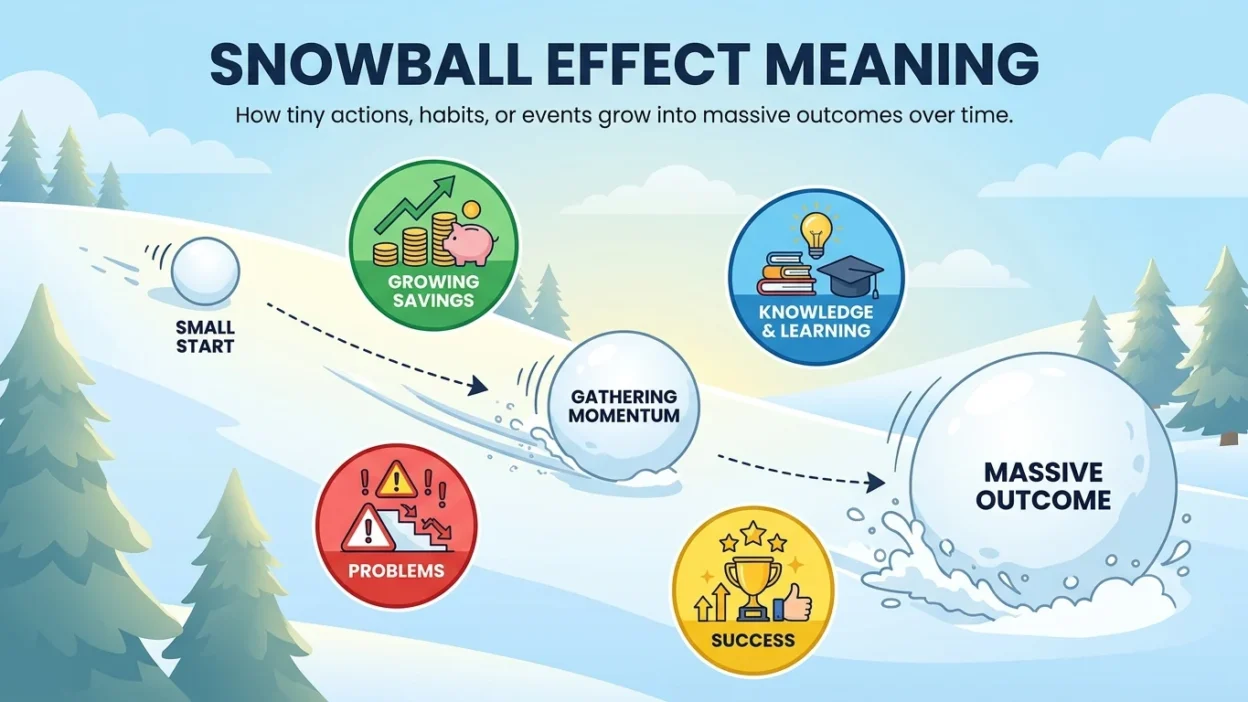
The phrase “snowball effect” describes a situation in which something starts small but gradually grows bigger, stronger, or more serious over time. Just as a small snowball becomes larger when it rolls down a snowy hill, a small action, problem, success, or change can lead to increasingly bigger results.
People use the snowball effect in everyday conversations, business, education, finance, relationships, and personal development. For example, saving a little money every month can help you build significant savings over time. Similarly, missing one assignment may lead to falling behind in other subjects if the problem continues.
The snowball effect can be positive or negative, depending on the situation. Small good habits can create bigger benefits, while small mistakes can develop into larger problems. Understanding this expression helps you describe how events build on one another and why seemingly minor actions can have important long-term consequences.
Quick Answer: What Does Snowball Effect Mean?
The snowball effect is a process in which something grows or becomes more significant as it continues. A small event or action triggers further changes, causing the overall result to increase over time. The effect can be positive, such as growing savings, or negative, such as a small problem becoming a major issue.
Why Do People Use the Phrase Snowball Effect?
People use this expression to explain how small beginnings can lead to much larger outcomes.
The image comes from a snowball rolling down a hill. As it rolls, it collects more snow and becomes bigger. In the same way, one event can trigger another, creating a chain of growing effects.
For example:
- A small investment earns returns that help increase future earnings.
- One missed deadline creates more work and leads to additional missed deadlines.
- A single act of kindness encourages others to help.
- A minor disagreement grows into a serious argument.
The phrase is useful when you want to explain growth, momentum, or a chain reaction.
What Is the Meaning of Snowball Effect?
The snowball effect means a gradual increase in the size, importance, or impact of something as one development leads to another.
It can describe several situations.
1. A Positive Snowball Effect
A positive snowball effect happens when small improvements lead to greater benefits.
Example: Reading for 15 minutes every day improves your vocabulary. A stronger vocabulary makes reading easier, which encourages you to read more and learn even faster.
2. A Negative Snowball Effect
A negative snowball effect occurs when a small problem grows into a bigger one.
Example: Someone ignores a small credit card payment. Interest and fees accumulate, making the debt harder to repay.
3. A Neutral Snowball Effect
The expression can also describe a process of increasing growth without suggesting that it is necessarily good or bad.
Example: The news spread across the town, and the snowball effect brought more people to the event.
Snowball Effect Examples in Everyday Life
Here are common situations that illustrate the expression.
| Situation | Snowball effect |
|---|---|
| Education | One missed lesson makes later lessons harder to understand. |
| Money | Savings and investment returns gradually build wealth. |
| Work | Completing tasks early creates more time for future projects. |
| Health habits | Regular exercise can make it easier to stay active. |
| Relationships | Small misunderstandings can grow into larger conflicts. |
| Business | Positive customer reviews attract more customers. |
| Social media | One popular post receives more shares and reaches a larger audience. |
| Debt | Interest and fees can cause unpaid balances to grow. |
| Learning | Practicing a skill regularly leads to faster improvement. |
| Environment | A small change in a system can trigger wider consequences. |
15 Example Sentences Using Snowball Effect
These sentences show how to use “snowball effect” naturally in writing and conversation.
- Missing one class created a snowball effect because I struggled to understand the next lesson.
- Saving a small amount every week can create a positive snowball effect over time.
- The argument started with a simple misunderstanding but soon had a snowball effect.
- Her daily reading habit had a snowball effect on her vocabulary and writing skills.
- Unpaid bills can have a snowball effect if interest and late fees continue to grow.
- The company’s first successful product created a snowball effect that helped its business expand.
- One kind gesture started a snowball effect, inspiring several people to help the community.
- Delaying the repair caused a snowball effect, leading to more expensive damage.
- Regular practice created a snowball effect, and he became more confident with every lesson.
- The rumor had a snowball effect as more people repeated and exaggerated the story.
- A small improvement in customer service can have a snowball effect on customer satisfaction.
- The team’s early victories created a snowball effect that increased its confidence.
- Ignoring minor problems at work may lead to a negative snowball effect.
- Her first online video became popular, and the snowball effect brought thousands of new followers.
- Developing good habits early can produce a snowball effect that benefits you for years.
How to Use Snowball Effect in a Sentence
You can use “snowball effect” as a noun phrase in several common patterns.
Pattern 1: Have a snowball effect
Use this structure when an action or event causes growing consequences.
Example: Poor communication can have a snowball effect on a team’s performance.
Pattern 2: Create a snowball effect
Use this when something starts a chain of growing results.
Example: One successful marketing campaign created a snowball effect for the new business.
Pattern 3: Lead to a snowball effect
Use this to explain how one situation causes a larger chain of events.
Example: Ignoring a small technical issue can lead to a snowball effect.
Pattern 4: A positive or negative snowball effect
Use an adjective to show whether the consequences are beneficial or harmful.
Example: Building a daily study routine can produce a positive snowball effect.
Snowball Effect vs. Domino Effect
The snowball effect and domino effect are similar because both describe how one event can lead to further consequences. However, they emphasize different things.
| Feature | Snowball effect | Domino effect |
|---|---|---|
| Main idea | Something grows larger or more powerful over time. | One event triggers a sequence of other events. |
| Focus | Increasing size, impact, or momentum. | A chain reaction of connected events. |
| Example | Debt grows as interest accumulates. | One canceled flight causes several connecting flights to be missed. |
| Can be positive? | Yes. | Yes. |
| Can be negative? | Yes. | Yes. |
Remember: The snowball effect emphasizes growth, while the domino effect emphasizes a chain of events. In some situations, both expressions may fit.
Snowball Effect vs. Ripple Effect
These expressions also have related meanings, but they are not identical.
| Phrase | Meaning | Example |
|---|---|---|
| Snowball effect | A process grows or intensifies over time. | One small debt becomes a much larger financial burden. |
| Ripple effect | One action spreads its influence to other people or situations. | A local charity project inspires other communities to volunteer. |
A snowball effect is about increasing size or impact. A ripple effect is about spreading consequences or influence.
Common Mistakes When Using Snowball Effect
1. Using It for Every Small Change
Not every change creates a snowball effect. The phrase is most suitable when the initial event leads to further developments that increase the overall impact.
Incorrect: I changed my pen, and it had a snowball effect.
Better: I began studying for 20 minutes daily, and the snowball effect helped me improve my grades over time.
2. Assuming It Is Always Negative
The snowball effect can describe good outcomes as well as bad ones.
Example: Small acts of generosity created a positive snowball effect in the neighborhood.
3. Confusing It With a Domino Effect
The two phrases overlap, but the snowball effect highlights growth, while the domino effect highlights a sequence of events.
4. Writing It as One Word
The standard expression is snowball effect, written as two words.
Example: The small success had a snowball effect on the company’s growth.
What Is a Simple Way to Remember Snowball Effect?
Think of a small snowball rolling down a snowy hill. It collects more snow as it moves, becoming larger and larger.
Connect that image to everyday life:
- Small savings grow into a larger amount.
- Small mistakes grow into bigger problems.
- Small improvements lead to greater progress.
- Small acts of kindness inspire more kindness.
Memory trick: Small start, growing impact, bigger result.
Is Snowball Effect Used in American and British English?
Yes. Snowball effect is widely understood and used in both American and British English. There is no major difference in its meaning between the two varieties.
Examples:
- American English: The rising costs had a snowball effect on the family budget.
- British English: The missed deadlines had a snowball effect on the project.
Both sentences are natural. The phrase is also used in business, news reporting, academic writing, and informal conversation.
Similar Words and Expressions
Here are a few related expressions you may find useful.
- Chain reaction: A series of events in which one event causes another.
- Domino effect: A sequence of connected events triggered by an initial event.
- Ripple effect: The wider influence of an action or event.
- Compounding effect: A process in which gains or losses build on earlier gains or losses.
- Momentum: Increasing strength or progress as something continues.
- Spiral: A process that continues in a particular direction, often becoming more extreme.
- Cascade effect: A series of consequences that follow from an initial event.
These expressions have overlapping meanings, but each emphasizes a different aspect of how consequences develop.
Frequently Asked Questions
1. Is the snowball effect positive or negative?
It can be either. A positive snowball effect occurs when small actions produce increasingly beneficial results. A negative snowball effect happens when a small problem grows into a larger one.
2. What is an example of the snowball effect?
A student misses one lesson and struggles with the next topic. The student then falls further behind, making future lessons even harder to understand. This is a negative snowball effect.
3. What does snowball effect mean in psychology?
In psychology, the phrase may describe how one thought, feeling, or behavior leads to others that intensify the original experience. For example, worrying about one mistake may cause someone to worry about several related problems.
4. What does snowball effect mean in business?
In business, it describes how an initial success or problem can grow through further developments. Positive reviews may attract more customers, while rising costs may create additional financial pressure.
5. Is snowball effect the same as domino effect?
No, although their meanings overlap. The snowball effect emphasizes something growing in size or impact, while the domino effect emphasizes one event triggering a sequence of other events.
6. Can you use snowball effect in formal writing?
Yes. It is common in professional and academic contexts, especially when explaining how small changes can produce larger consequences. In highly technical writing, you may want to define the process more precisely.
7. Why is it called the snowball effect?
The phrase comes from the image of a snowball rolling downhill and gathering more snow as it moves. The growing snowball represents a small beginning that develops into something much larger.
8. What is the opposite of the snowball effect?
There is no single exact opposite. Depending on the context, expressions such as gradual decline, diminishing impact, or breaking the cycle may communicate the opposite idea.
Remember This
The snowball effect describes how something small can grow into something much bigger through a series of continuing developments. It can explain positive growth, such as improving a skill, or negative consequences, such as accumulating debt.
The key idea is that the original event does not remain small. Its impact increases as the process continues.
Conclusion
The phrase “snowball effect” is a useful way to explain how small actions, events, or problems can gradually produce larger results. It is common in everyday conversation and in discussions about money, education, business, relationships, and personal growth. The phrase can describe both helpful progress and harmful consequences.
To use it correctly, focus on situations where an initial event leads to further developments that increase its overall impact. Remember the image of a snowball growing as it rolls downhill, and you will find it easier to understand the meaning and use the expression naturally.

Adam Aaron is a language enthusiast and content writer at SimileHive, creating clear, engaging guides on similes, idioms, metaphors, and figurative language to help readers improve English confidently every day.