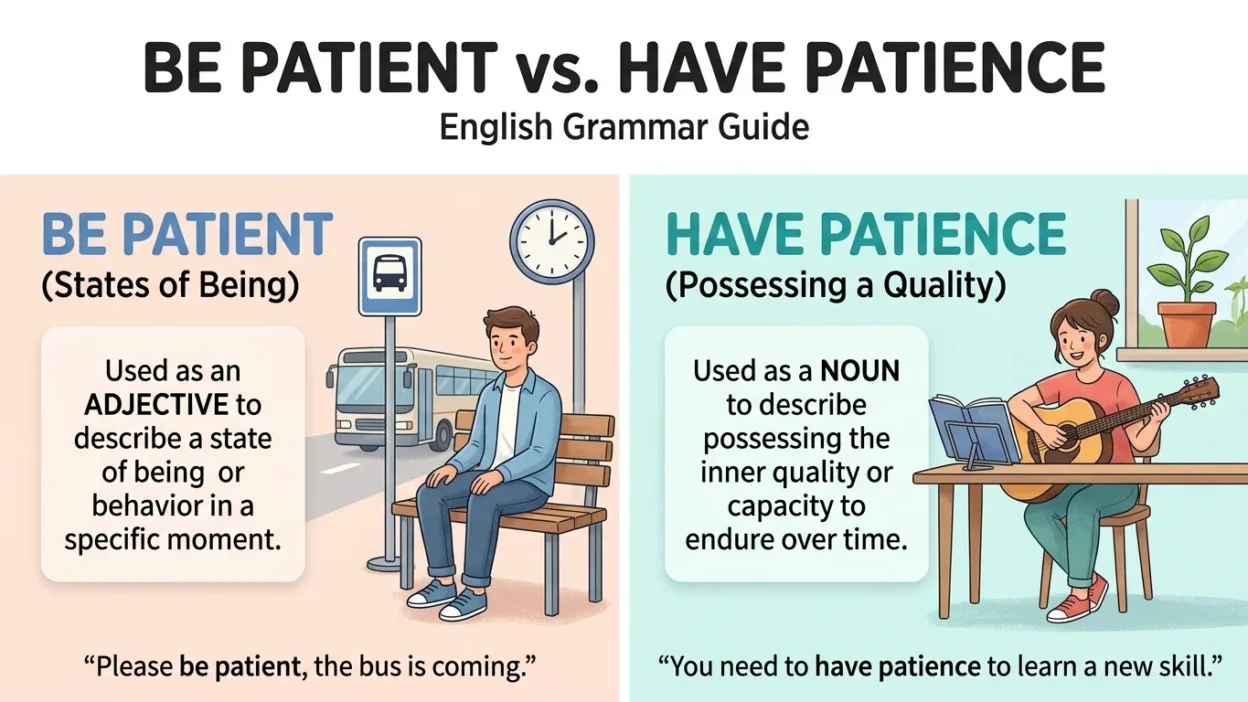
Should you say “be patient” or “have patience”? Both expressions are correct in English, and both encourage someone to remain calm while waiting or dealing with a difficult situation. However, they have slightly different grammatical structures and can emphasize different aspects of patience.
“Be patient” means to stay calm, avoid becoming annoyed, and allow time for something to happen. For example, “Please be patient while we process your application.” It describes how someone should behave in a particular situation.
“Have patience” means to possess or show the ability to wait calmly without becoming frustrated. For example, “You need to have patience when learning a new language.” It often emphasizes the quality or ability needed to handle a situation.
Although the expressions can frequently be used interchangeably, the surrounding sentence determines which sounds more natural. Understanding the difference will help you use both expressions confidently in conversations, emails, and formal writing.
Quick Answer
“Be patient” means to remain calm and wait without getting upset. “Have patience” means to show or maintain the ability to wait calmly. Both are correct, but “be patient” is especially common when giving advice or asking someone to wait, while “have patience” often emphasizes the quality needed to handle a situation.
Why Do People Confuse “Be Patient” and “Have Patience”?
People confuse these expressions because they communicate almost the same idea. Both relate to staying calm, waiting, and managing frustration.
The main difference is grammatical:
- Be patient: “Be” is a verb, and “patient” is an adjective.
- Have patience: “Have” is a verb, and “patience” is a noun.
Compare these examples:
- Be patient with your younger brother.
- Have patience with your younger brother.
Both sentences are correct. The first describes the behavior expected of you, while the second emphasizes the quality of patience you need to show.
What Does “Be Patient” Mean?
“Be patient” means to remain calm, understanding, and willing to wait without becoming angry or frustrated.
It is a common expression used to give advice, make a request, or encourage someone who is waiting for something.
Examples of “Be Patient”
- Please be patient while I finish this task.
- You need to be patient when teaching children.
- Be patient with yourself as you learn a new skill.
- Try to be patient while waiting for the results.
- She asked her children to be patient.
When Should You Use “Be Patient”?
Use “be patient” when you want someone to control their frustration, allow time for a process, or respond calmly to a difficult situation.
When asking someone to wait:
“Please be patient. Your order will arrive soon.”
When giving advice:
“You should be patient when learning to drive.”
When encouraging someone:
“Be patient with yourself. Improvement takes time.”
The expression is natural in casual conversations, workplaces, classrooms, and formal settings.
What Does “Have Patience” Mean?
“Have patience” means to possess or demonstrate the ability to wait calmly, tolerate delays, or deal with difficulties without becoming frustrated.
It often emphasizes the quality needed to manage a situation successfully.
Examples of “Have Patience”
- You must have patience when working with young children.
- Have patience; things will improve with time.
- Learning a new language requires patience.
- She has patience with people who make mistakes.
- You need to have patience when solving complicated problems.
When Should You Use “Have Patience”?
Use “have patience” when discussing the ability or quality required to handle a challenge, wait for results, or work toward a goal.
When discussing learning:
“You need to have patience when learning a musical instrument.”
When giving encouragement:
“Have patience. Success rarely happens overnight.”
When describing someone’s character:
“He has a lot of patience with his students.”
The expression is useful in both everyday conversation and formal writing.
Be Patient vs Have Patience: Key Differences
| Feature | Be patient | Have patience |
|---|---|---|
| Meaning | Remain calm and willing to wait | Show or maintain the ability to wait calmly |
| Grammar | Verb + adjective | Verb + noun |
| Common use | Instructions, requests, and advice | Advice, encouragement, and discussion of a quality |
| Example | Be patient with the process. | Have patience with the process. |
| Tone | Direct and natural | Often emphasizes the quality required |
| Correct English? | Yes | Yes |
Remember: The difference is not absolute. Both expressions can be used in many of the same situations.
Can You Use “Be Patient” and “Have Patience” Interchangeably?
Yes. In many sentences, both expressions communicate the same basic message.
For example:
- Be patient with your children.
- Have patience with your children.
Both encourage someone to remain calm and understanding.
However, some sentence structures favor one expression over the other.
More natural: “Please be patient while we check your account.”
More natural: “You need to have patience to master this skill.”
The first sentence gives a direct instruction about someone’s behavior. The second highlights the quality needed to achieve a goal.
You can also combine the expressions with other words:
- Be patient with someone.
- Have patience with someone.
- Be patient while waiting.
- Have patience when dealing with difficulties.
15 Example Sentences Using Both Expressions
Examples With “Be Patient”
- Please be patient while the teacher explains the lesson.
- You should be patient with people who are learning.
- Be patient, and you will eventually understand the problem.
- She tried to be patient while waiting for her interview.
- Parents need to be patient with their children.
- Be patient with yourself when learning something difficult.
- The customer was asked to be patient during the delay.
- You must be patient if you want to improve your writing.
Examples With “Have Patience”
- You need to have patience when learning a new language.
- Have patience, because good results take time.
- She has great patience with her students.
- It takes patience to solve difficult mathematical problems.
- Please have patience while we investigate your complaint.
- He learned to have patience with people who disagreed with him.
- If you have patience and keep practicing, you can improve your skills.
Common Mistakes to Avoid
1. Saying “Have Patient”
Incorrect: “Please have patient.”
Correct: “Please have patience.”
“Patient” is an adjective in “be patient,” while “patience” is the noun used after “have.”
2. Saying “Be Patience”
Incorrect: “You should be patience.”
Correct: “You should be patient.”
After “be,” use the adjective “patient,” not the noun “patience.”
3. Assuming One Expression Is More Correct
Both expressions are grammatically correct. Choose the one that fits your sentence and intended meaning.
4. Forgetting the Word “With”
When talking about how someone treats another person or handles a situation, both expressions commonly use “with.”
Examples:
- Be patient with your colleagues.
- Have patience with your colleagues.
Both are correct.
5. Confusing “Patient” With “Patience”
The word patient can also be a noun meaning someone receiving medical care. However, in “be patient,” it is an adjective meaning calm and willing to wait.
Patience is a noun referring to the ability to wait calmly or tolerate difficulties.
Memory Trick: How to Remember the Difference
Use this simple rule:
- Be patient: Describe how someone should act.
- Have patience: Describe the quality someone needs or demonstrates.
Think of these examples:
“Be patient while the bus arrives.”
“Have patience while working toward your goals.”
Also remember the grammatical pattern:
Be + patient (adjective)
Have + patience (noun)
This pattern makes it easier to avoid common mistakes.
American vs British English
“Be patient” and “have patience” are standard expressions in both American and British English. Their meanings and grammatical structures are essentially the same.
Examples in American English:
- Be patient while we process your request.
- You need to have patience when learning a new skill.
Examples in British English:
- Please be patient while we arrange your appointment.
- You must have patience when working with young children.
Neither expression belongs exclusively to one variety of English. Both are widely understood and used internationally.
Similar Words and Expressions
Here are several expressions related to patience:
- Be calm: Remain relaxed and avoid becoming upset.
- Wait patiently: Wait without becoming frustrated.
- Show patience: Demonstrate the ability to tolerate delays or difficulties.
- Exercise patience: Make a conscious effort to remain patient, often in challenging situations.
- Be understanding: Consider another person’s situation and feelings.
- Take your time: Avoid rushing and work at a comfortable pace.
- Keep your cool: Stay calm in a stressful situation.
- Have tolerance: Accept or endure differences, difficulties, or unpleasant situations.
These expressions are related, but they are not always interchangeable. For example, “keep your cool” focuses on staying calm, while “have patience” emphasizes waiting or tolerating difficulty.
Frequently Asked Questions
1. Is it correct to say “be patient” or “have patience”?
Both are correct. “Be patient” uses an adjective to describe behavior, while “have patience” uses a noun to describe a quality or ability.
2. Which is better: “be patient” or “have patience”?
Neither is universally better. “Be patient” is especially natural for direct instructions, such as “Be patient while you wait.” “Have patience” often emphasizes the quality needed to handle a challenge.
3. Can I say “please have patience”?
Yes. “Please have patience” is grammatically correct and polite. It is often used when asking people to tolerate a delay or wait calmly.
4. Is “have patience with me” correct?
Yes. “Please have patience with me” means you are asking someone to remain understanding and calm while dealing with you or your situation. “Please be patient with me” is equally correct.
5. What is the difference between patient and patience?
“Patient” is an adjective meaning willing to wait calmly, as in “She is patient.” “Patience” is a noun referring to that quality, as in “She has patience.”
6. Is “be patient” rude?
Not necessarily. It can sound polite, supportive, or direct depending on the tone and context. Adding “please” or offering an explanation can make the request sound more considerate.
7. What is another way to say “have patience”?
You can say “be patient,” “wait patiently,” “show patience,” or “exercise patience.” The most suitable alternative depends on the sentence and level of formality.
8. Can I use “have patience” in formal writing?
Yes. “Have patience” is appropriate in formal and informal contexts. In academic or professional writing, “patience is required” or “this process requires patience” may sometimes sound more objective.
Remember This
“Be patient” means to remain calm and willing to wait. “Have patience” means to possess or show the ability to wait calmly and deal with difficulties.
Both expressions are correct. Use “be patient” for direct instructions and “have patience” when emphasizing the quality needed to handle a situation, while remembering that their uses often overlap.
Conclusion
The difference between “be patient” and “have patience” is mainly grammatical and contextual. “Be patient” combines a verb with an adjective and commonly describes how someone should behave. “Have patience” combines a verb with a noun and often highlights the quality needed to handle waiting, challenges, or difficult people.
Both expressions are natural in American and British English, and you can often use them in the same situation. Remember the simple patterns “be patient” and “have patience,” and you will be able to use each expression correctly in everyday conversations, emails, and formal writing.

Lucas Luke is a passionate language writer and content creator at SimileHive, specializing in similes, idioms, metaphors, and figurative language. He enjoys making complex English expressions simple, engaging, and easy to understand for students, writers, and language enthusiasts through well-researched, practical content.