Is it “herself,” “her self,” or “herselves”? These expressions may look similar, but they have different uses, and one is the standard reflexive pronoun you will need in most everyday sentences. Understanding the difference can help you avoid spelling mistakes and write more naturally.
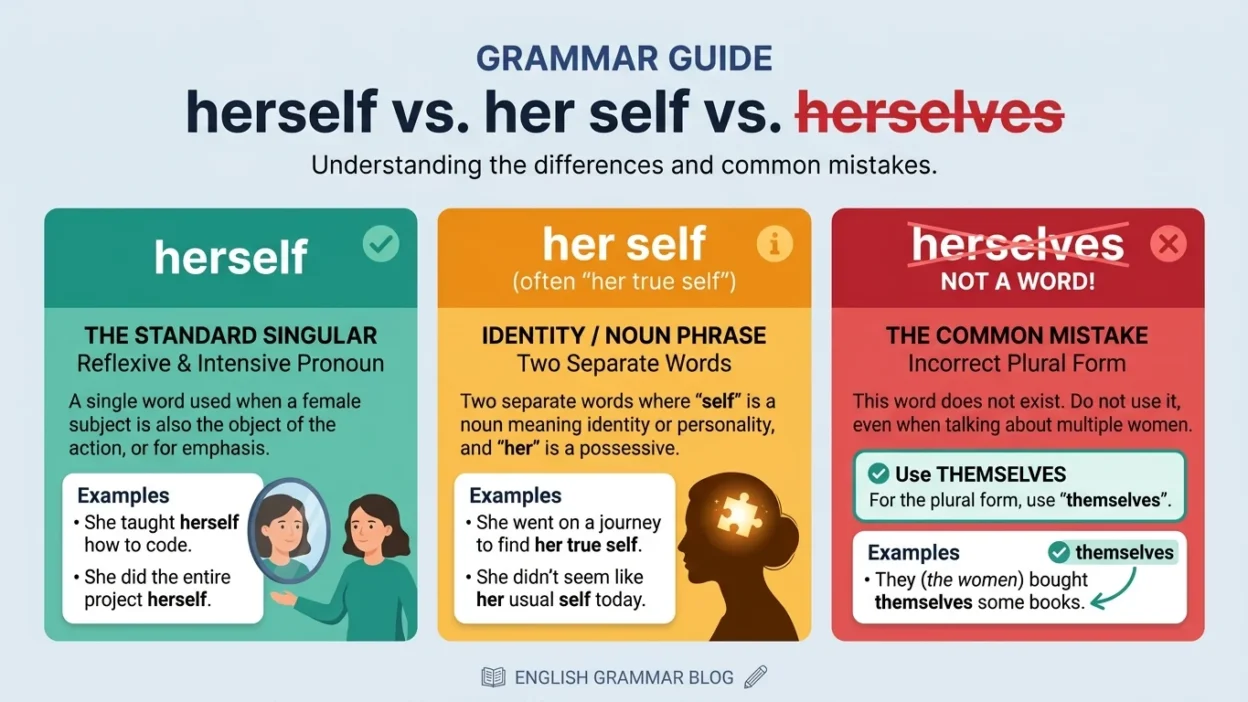
“Herself” is the standard reflexive or emphatic pronoun used when referring to a female person or girl. For example, “She prepared herself for the interview” and “She completed the project herself.” In these sentences, the word connects the action to the person doing it or adds emphasis.
“Her self” is a less common expression in which “her” and “self” are separate words. It may appear in philosophical, psychological, or literary writing when discussing someone’s identity or inner nature. “Herselves” is not the standard reflexive pronoun in modern English. The correct plural reflexive pronoun for a group of women or girls is “themselves.” Learning when to use each form will help you choose the right wording in formal writing, schoolwork, and everyday communication.
Quick Answer
Herself is the correct standard reflexive pronoun: “She taught herself to cook.” Her self is occasionally used as two words when “self” refers to a person’s identity or inner nature. Herselves is not standard modern English; use “themselves” for plural subjects, including a group of women or girls.
Why Do People Confuse Herself, Her Self, and Herselves?
People confuse these forms because they contain the same basic words and seem to follow similar spelling patterns.
English reflexive pronouns usually combine a personal pronoun with “self” or “selves”:
- I → myself
- You → yourself
- He → himself
- She → herself
- It → itself
- We → ourselves
- You (plural) → yourselves
- They → themselves
Notice that “herself” is written as one word. English does not normally form the plural reflexive pronoun for women by changing “herself” to “herselves.” Instead, it uses “themselves.”
The separate phrase “her self” is possible in special contexts, but it is not a replacement for the ordinary pronoun “herself.”
What Does “Herself” Mean?
Herself is a reflexive pronoun or an emphatic pronoun that refers back to a female person already mentioned or understood.
It has two main uses.
1. Herself as a Reflexive Pronoun
Use “herself” when the person doing an action is also the person receiving that action.
Examples:
- She blamed herself for the mistake.
- Maria taught herself to play the guitar.
- She looked at herself in the mirror.
- The girl dressed herself without help.
- She introduced herself to the new students.
In these examples, “herself” refers back to “she,” “Maria,” or “the girl.”
2. Herself for Emphasis
Use “herself” to emphasize that a particular woman or girl performed an action personally, rather than someone else doing it for her.
Examples:
- She herself approved the final design.
- The principal herself welcomed the visitors.
- Emma baked the cake herself.
- The author herself attended the event.
- She completed the assignment herself.
Here, “herself” adds emphasis. It does not mean that the person performed an action on herself.
What Does “Her Self” Mean?
Her self consists of two separate words. It is uncommon in ordinary English and is usually found in specialized, philosophical, psychological, or literary contexts.
In this construction, “her” indicates possession or association, while “self” refers to a person’s identity, nature, or sense of who they are.
Examples:
- The poem explores her inner self.
- She wanted to reconnect with her true self.
- The character struggled to understand her former self.
- The story reveals her private self and public image.
- She felt more connected to her authentic self after making the change.
Notice that these examples use phrases such as “inner self,” “true self,” and “former self.” They do not require the phrase “her self” to be written as two words in every context.
In ordinary modern English, “herself” is not interchangeable with “her self.” If you mean the reflexive pronoun, write it as one word. If you mean someone’s identity or inner nature, a phrase such as “her true self” is usually clearer and more natural than “her self.”
What Does “Herselves” Mean?
Herselves is not the standard plural reflexive pronoun in contemporary standard English. Although it may appear in nonstandard writing, dialectal speech, or creative language, it is generally not appropriate for formal schoolwork or professional writing.
The standard plural reflexive pronoun is themselves, regardless of whether the group consists of women, men, or people of different genders.
Examples:
Incorrect in standard English: “The girls prepared herselves for the competition.”
Correct: “The girls prepared themselves for the competition.”
Incorrect in standard English: “The women introduced herselves.”
Correct: “The women introduced themselves.”
Incorrect in standard English: “They should believe in herselves.”
Correct: “They should believe in themselves.”
Herself vs Her Self vs Herselves: Comparison Table
| Feature | Herself | Her self | Herselves |
|---|---|---|---|
| Standard spelling | Yes | Possible in specific constructions, but uncommon as a standalone phrase | No, not as the standard reflexive pronoun |
| Main use | Reflexive or emphatic pronoun | Refers to identity or inner nature in certain contexts | Nonstandard or specialized usage |
| Example | She helped herself. | She wanted to discover her true self. | Use “themselves” instead |
| Suitable for formal writing | Yes | Depends on context | Generally no |
| Best everyday choice | For a female subject | Usually use a clearer phrase such as “her true self” | Themselves |
When Should You Use Each Form?
Use “Herself” for Actions That Refer Back to the Subject
Use “herself” when a female person performs an action on herself.
Examples:
- She hurt herself while running.
- She reminded herself to call her mother.
- She taught herself French.
Use “Herself” for Emphasis
Use it when you want to stress that the person personally performed an action.
Examples:
- The manager herself answered the phone.
- She herself made the decision.
Use “Her Self” When Referring to Identity
Use “self” as a separate noun when talking about someone’s identity, personality, or inner nature. Usually, another word makes the meaning clearer.
Examples:
- She wanted to be her authentic self.
- She felt like her old self again.
- She was learning to accept her true self.
Use “Themselves” for Plural Subjects
When the subject is plural, use “themselves” in standard English.
Examples:
- The girls introduced themselves.
- The women organized the event themselves.
- They reminded themselves of their goals.
15 Example Sentences to Understand the Difference
Examples With “Herself”
- She taught herself how to swim.
- Maria looked at herself in the mirror.
- She completed the entire assignment herself.
- The actress prepared herself for the role.
- The teacher herself explained the difficult lesson.
- She reminded herself to remain calm.
Examples With “Her Self” or Related Identity Phrases
- She wanted to discover her true self.
- After the holiday, she felt like her old self again.
- The novel explores her inner self.
- She finally felt comfortable being her authentic self.
- The experience helped her understand her former self.
Examples With “Themselves” Instead of “Herselves”
- The girls introduced themselves to the new teacher.
- The women prepared themselves for the journey.
- They taught themselves how to use the software.
- The students reminded themselves to check their answers.
Common Mistakes to Avoid
1. Writing “Her Self” Instead of “Herself”
Incorrect: “She blamed her self for the mistake.”
Correct: “She blamed herself for the mistake.”
When you need the reflexive pronoun, write “herself” as one word.
2. Using “Herselves” as the Plural of “Herself”
Incorrect in standard English: “The girls enjoyed herselves.”
Correct: “The girls enjoyed themselves.”
The standard plural form is “themselves,” not “herselves.”
3. Confusing a Reflexive Pronoun With a Noun Phrase
Compare:
- She recognized herself in the photograph.
- She wanted to rediscover her true self.
The first sentence uses a reflexive pronoun. The second uses “self” as a noun modified by “true.”
4. Assuming “Herself” Always Means “Alone”
In “She completed the project herself,” the word emphasizes that she personally completed the project. It does not always mean that nobody helped her in any way.
If you specifically mean that she was alone, say, “She completed the project by herself.”
Memory Trick: How to Remember the Correct Form
Use these simple rules:
- Herself: One female person referring back to herself.
- Her true self: A person’s identity or inner nature.
- Themselves: Two or more people referring back to the group, including an all-female group.
Remember the standard pronoun pattern:
She → herself → they → themselves
Do not automatically create “herselves” just because “ourselves” and “themselves” end in “selves.”
American vs British English
There is no significant difference between American and British English in these forms.
Both varieties use:
- “Herself” as the standard singular reflexive pronoun.
- “Themselves” as the standard plural reflexive pronoun.
- Phrases such as “her true self” and “her inner self” when discussing identity.
“Herselves” is not the standard plural reflexive pronoun in either variety. For formal writing, examinations, emails, and professional communication, use “themselves” for plural subjects.
Similar Words and Expressions
Here are related forms that can help you understand reflexive pronouns and the noun “self.”
- Himself: The reflexive or emphatic pronoun for a male person.
- Myself: Refers back to “I” or adds emphasis to the speaker.
- Yourself: Refers back to “you” when addressing one person.
- Ourselves: Refers back to “we.”
- Themselves: Refers back to “they,” including a group of women or girls.
- Her own: Shows possession or emphasizes that something belongs to her.
- Her true self: Refers to her genuine identity or personality.
- By herself: Usually means alone or without help, depending on context.
Frequently Asked Questions
1. Is “herself” one word or two?
“Herself” is one word when used as a reflexive or emphatic pronoun. For example, “She completed the work herself.” When discussing identity, you can use a noun phrase such as “her true self.”
2. Is “her self” ever correct?
Yes, separate words can appear in constructions where “self” is a noun, as in “her true self” or “her inner self.” However, “her self” alone is uncommon in ordinary English and should not replace the pronoun “herself.”
3. Is “herselves” a real word?
It may appear in nonstandard, dialectal, or creative language, but it is not the standard reflexive pronoun in modern English. In formal writing, use “themselves” for plural subjects.
4. What is the plural of “herself”?
The standard plural reflexive pronoun is “themselves.” For example, “The women introduced themselves to the audience.”
5. Should I write “they prepared herselves” or “they prepared themselves”?
Write “they prepared themselves.” “Themselves” is the standard reflexive pronoun for the plural subject “they,” regardless of the group’s gender.
6. What is the difference between “herself” and “by herself”?
“Herself” can be reflexive or emphatic. “By herself” often means that a person is alone or does something without help. For example, “She dressed herself” focuses on the action, while “She traveled by herself” commonly means she traveled alone.
7. Is “herself” more formal than “her self”?
No. They have different grammatical functions. “Herself” is the ordinary pronoun, while “her self” is associated with specific uses of “self” as a noun. The appropriate form depends on the meaning.
Remember This
Use “herself” when referring to a female person in a reflexive or emphatic way. Use phrases such as “her true self” when discussing identity. For a plural group, use “themselves,” not “herselves,” in standard English.
Conclusion
The difference between “herself,” “her self,” and “herselves” comes down to grammar and meaning. “Herself” is the correct standard reflexive pronoun for one female person. “Her self” may occur when “self” is used as a noun to describe identity, especially in phrases such as “her inner self” or “her true self.” “Herselves” is not the standard plural reflexive pronoun.
For everyday English, the rule is simple: write “herself” for one female person and “themselves” for a plural subject. When talking about someone’s personality or identity, use a clear phrase such as “her true self.” These choices will help you write accurately and naturally.

Charles Kevin is a passionate language writer and researcher at SimileHive, creating clear, engaging content about similes, idioms, metaphors, and figurative language to help readers improve English communication confidently every day.