“Sorry for bothering you” and “sorry to bother you” are both correct and natural expressions in English. People use them to apologize for interrupting someone, taking their time, or causing an inconvenience. Although their meanings are very similar, they are often used in slightly different situations.
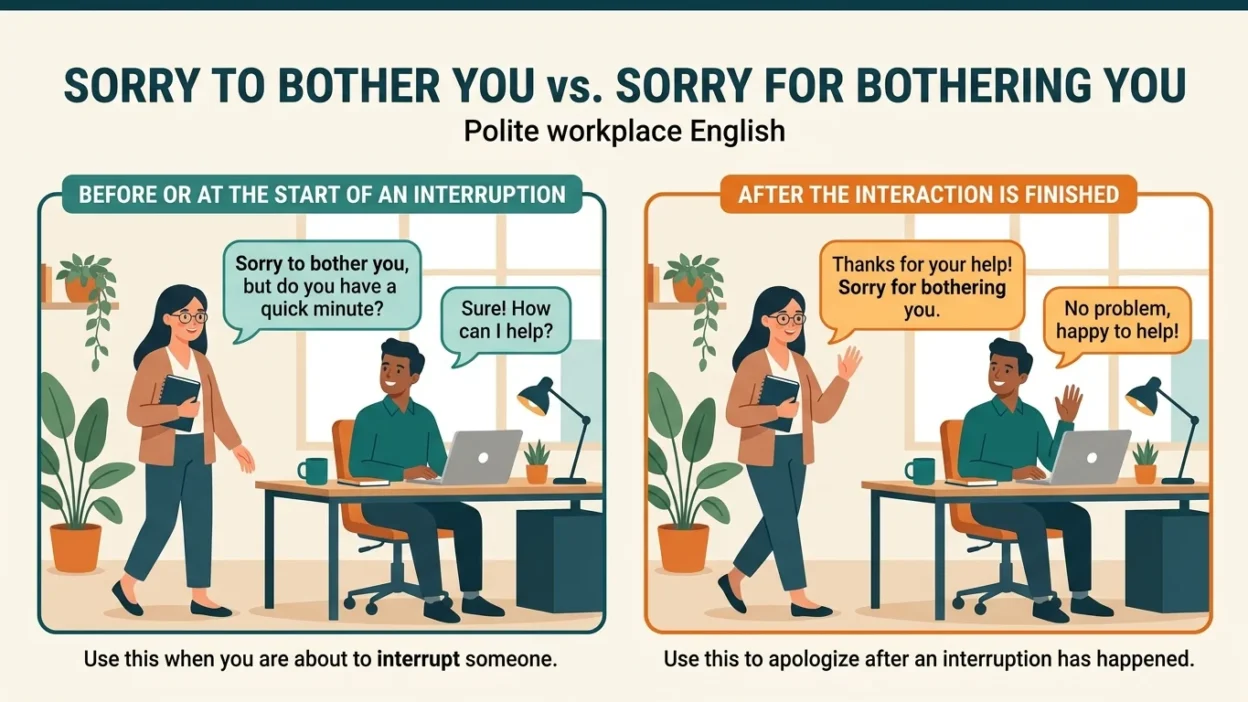
“Sorry to bother you” is especially common when you are about to interrupt someone or when you are starting a conversation with a request. For example, you might say it before asking a coworker a question or contacting someone who is busy.
“Sorry for bothering you” is often used when you are apologizing for an interruption that has already happened or for taking someone’s time. However, both expressions can be used before or after an interruption, depending on the context. The main difference is grammatical: “to bother” uses an infinitive, while “for bothering” uses a preposition followed by a gerund. Understanding this difference will help you choose the expression that sounds most natural.
Quick Answer
Both “sorry for bothering you” and “sorry to bother you” are grammatically correct. Use “sorry to bother you” when introducing a request or interrupting someone, especially at the start of a conversation. Use “sorry for bothering you” when apologizing for the interruption or inconvenience itself. In everyday English, the two expressions often overlap.
Why Do People Confuse These Expressions?
People confuse these phrases because they communicate nearly the same message: an apology for disturbing someone or taking their time.
The difference comes from the words that follow “sorry.”
- Sorry to bother you: “To bother” is an infinitive verb phrase.
- Sorry for bothering you: “For” is a preposition, so it is followed by the gerund “bothering.”
Both structures are correct, and neither is universally more polite than the other. The best choice depends on the situation and the tone you want to convey.
What Does “Sorry to Bother You” Mean?
“Sorry to bother you” is a polite expression used when you are about to interrupt someone, ask for help, or take their attention away from something.
It is especially useful when you want to make a request without sounding demanding.
Examples:
- Sorry to bother you, but could you help me with this question?
- Sorry to bother you while you’re working.
- Sorry to bother you so late, but I need to ask you something.
- Sorry to bother you. Do you have a minute?
- Sorry to bother you again, but I need some clarification.
When Should You Use “Sorry to Bother You”?
Use this expression when approaching someone, beginning a message, or preparing to ask a question.
For example:
At work:
“Sorry to bother you, but could you check this report?”
In an email:
“Sorry to bother you during your busy schedule. I wanted to ask about the meeting.”
In a text message:
“Sorry to bother you, but are you available for a quick call?”
The expression sounds considerate and helps introduce a request politely.
What Does “Sorry for Bothering You” Mean?
“Sorry for bothering you” is an apology for disturbing someone, interrupting them, or taking up their time.
It often focuses on the act of bothering the person rather than simply introducing a request.
Examples:
- Sorry for bothering you while you were studying.
- I’m sorry for bothering you with so many questions.
- Sorry for bothering you during your lunch break.
- I’m sorry for bothering you again about the same issue.
- Sorry for bothering you when you were busy.
When Should You Use “Sorry for Bothering You”?
Use this expression when you want to acknowledge that your interruption or repeated requests may have inconvenienced someone.
For example:
After interrupting someone:
“Sorry for bothering you earlier. I didn’t realize you were in a meeting.”
After asking several questions:
“I’m sorry for bothering you with so many questions. I really appreciate your help.”
When following up:
“Sorry for bothering you again, but I wanted to check whether you received my email.”
Although the expression often refers to something that has already happened, it can also be used before or during an interruption.
Sorry for Bothering You vs Sorry to Bother You: Key Differences
| Feature | Sorry to bother you | Sorry for bothering you |
|---|---|---|
| Grammar | To + base verb | For + gerund |
| Common use | Introducing a request or interruption | Apologizing for the disturbance |
| Typical focus | The interruption you are about to make | The act of bothering someone |
| Politeness | Polite and considerate | Polite and considerate |
| Formality | Suitable for professional and casual situations | Suitable for professional and casual situations |
| Is it correct? | Yes | Yes |
Important: These are tendencies, not strict rules. You can use either expression in many of the same situations.
12 Example Sentences
Here are examples showing how both expressions work in everyday English.
Examples With “Sorry to Bother You”
- Sorry to bother you, but could you tell me the time?
- Sorry to bother you while you’re working, but I need your signature.
- Sorry to bother you so early in the morning.
- Sorry to bother you, but I have a quick question about the assignment.
- I’m sorry to bother you on your day off.
- Sorry to bother you again, but could you explain the last point?
Examples With “Sorry for Bothering You”
- Sorry for bothering you during your meeting.
- I’m sorry for bothering you with all these questions.
- Sorry for bothering you earlier; I didn’t know you were busy.
- I’m sorry for bothering you so late at night.
- Sorry for bothering you again about the same problem.
- I apologize for bothering you when you needed some quiet time.
Can You Use Both Expressions in the Same Situation?
Yes. In many situations, both expressions sound natural.
Consider these examples:
Before asking a coworker for help:
- Sorry to bother you, but could you review this document?
- Sorry for bothering you, but could you review this document?
Both are acceptable. The first is a particularly natural way to open a request, while the second places slightly more emphasis on the possible inconvenience.
After interrupting someone:
- Sorry to bother you earlier.
- Sorry for bothering you earlier.
Both are correct. The second is often more explicit about apologizing for the interruption.
Common Mistakes to Avoid
1. Thinking One Expression Is Incorrect
Both expressions are grammatically correct. The choice depends on the context, not on one being right and the other wrong.
2. Using “For” With the Base Verb
Incorrect: “Sorry for bother you.”
Correct: “Sorry for bothering you.”
After the preposition “for,” use the gerund form “bothering.”
3. Using “To” With the Gerund in This Construction
Incorrect: “Sorry to bothering you.”
Correct: “Sorry to bother you.”
In this expression, “to” is part of the infinitive, so it is followed by the base verb “bother.”
4. Assuming an Apology Is Always Necessary
You do not need to apologize every time you ask a reasonable question. Sometimes a simple, polite opening sounds more confident.
For example: “Could you help me with this report when you have a moment?”
Memory Trick: How to Choose the Right Expression
Remember these two simple patterns:
- Sorry to bother you: Think of an interruption or request you are about to make.
- Sorry for bothering you: Think of the act of bothering someone that you are apologizing for.
For example, when starting a conversation, say, “Sorry to bother you, but I have a question.”
When acknowledging an interruption, say, “Sorry for bothering you while you were busy.”
These are helpful guidelines, but they are not strict rules.
American vs British English
Both “sorry to bother you” and “sorry for bothering you” are standard in American and British English. There is no meaningful difference in their basic meanings between the two varieties.
Examples in American English:
- Sorry to bother you, but can I ask a quick question?
- Sorry for bothering you during your break.
Examples in British English:
- Sorry to bother you, but could you give me a hand?
- Sorry for bothering you while you were working.
Both expressions are natural in professional emails, text messages, and everyday conversations in either variety.
Similar Expressions You Can Use
Depending on the situation, these alternatives may also sound natural:
- Sorry to interrupt: Best when someone is already speaking or doing something.
- Sorry for the interruption: A direct apology for interrupting.
- Excuse me: Useful when politely getting someone’s attention.
- Sorry to trouble you: A polite expression, often used when asking someone for help.
- I hope I’m not disturbing you: Useful when checking whether someone is available.
- Sorry for the inconvenience: More formal and suitable for professional situations.
- I hate to bother you, but…: A conversational way to introduce a request.
Frequently Asked Questions
1. Is “sorry for bothering you” grammatically correct?
Yes. “For” is a preposition, and “bothering” is a gerund. The phrase is grammatically correct and commonly used to apologize for disturbing someone.
2. Is “sorry to bother you” more polite?
Not necessarily. Both are polite. “Sorry to bother you” is especially natural when opening a request, while “sorry for bothering you” can emphasize the inconvenience caused.
3. Should I say “sorry to bother you” or “sorry for bothering you” in an email?
Both work. For example, “Sorry to bother you, but I have a question about the report” is a natural way to begin a request. If you are apologizing for repeated messages, “Sorry for bothering you again” is also appropriate.
4. Can I say “sorry for bothering you again”?
Yes. It is a natural expression when you need to contact someone again and want to acknowledge that you may be taking more of their time.
5. Can I say “sorry to bother you again”?
Yes. It is also correct, especially when introducing another request or interruption. For example, “Sorry to bother you again, but I forgot to ask one more thing.”
6. Is “sorry to disturb you” the same as “sorry to bother you”?
They are similar. “Sorry to disturb you” often emphasizes interrupting someone’s peace, concentration, or privacy. “Sorry to bother you” is broader and commonly used when asking for help or attention.
7. Which expression is better for a formal message?
Both are appropriate. “Sorry to bother you” is a natural opening for a polite request, while “I apologize for bothering you” sounds more formal and explicit.
Remember This
“Sorry to bother you” and “sorry for bothering you” are both correct. The first is commonly used to introduce a request or interruption, while the second often emphasizes apologizing for the disturbance itself.
Choose the expression that fits your situation, and remember the grammar: to bother and for bothering.
Conclusion
The difference between “sorry for bothering you” and “sorry to bother you” is mainly grammatical and contextual. “Sorry to bother you” is particularly useful when you are about to ask a question or interrupt someone politely. “Sorry for bothering you” is often suitable when acknowledging that your actions may have disturbed or inconvenienced someone. Both expressions are widely accepted in American and British English.
If you are unsure which one to use, “Sorry to bother you, but…” is an excellent way to begin a polite request. If you want to apologize for taking someone’s time, “Sorry for bothering you” is equally natural. Pay attention to the situation, use the correct verb form, and you will communicate politely and clearly.

Adam Aaron is a language enthusiast and content writer at SimileHive, creating clear, engaging guides on similes, idioms, metaphors, and figurative language to help readers improve English confidently every day.