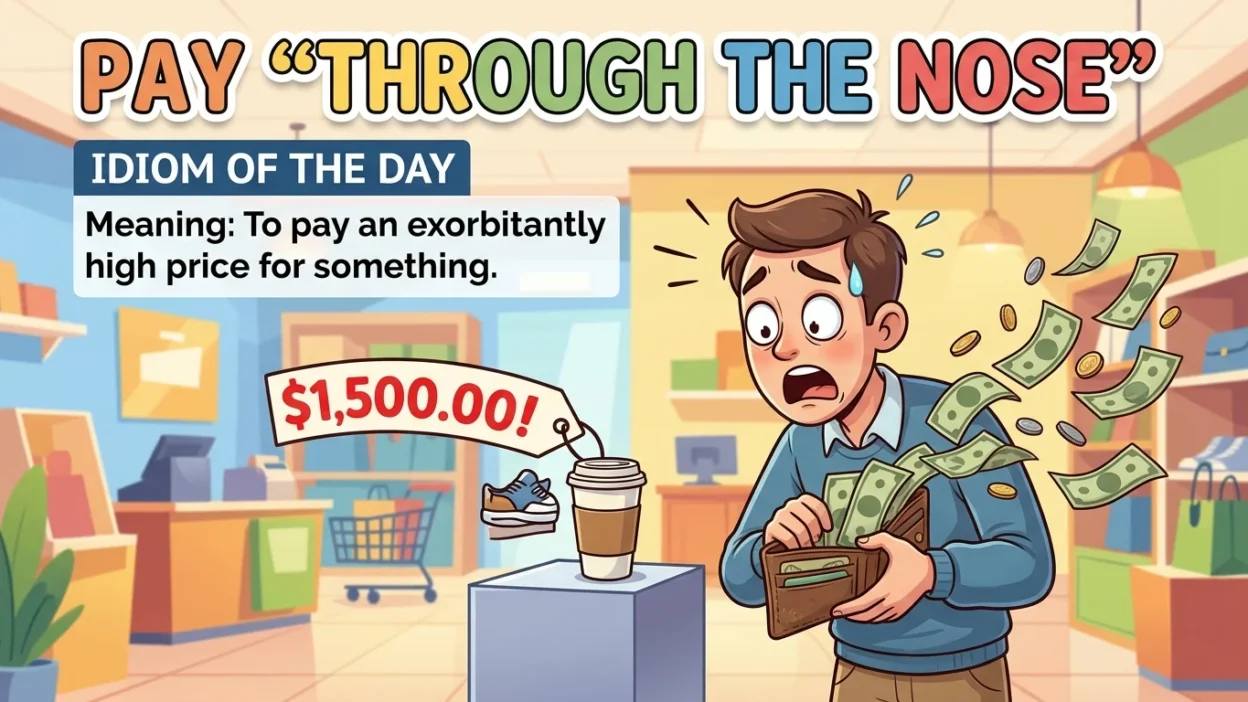
Have you ever paid much more for something than you expected? In English, there is a popular idiom for this situation: “pay through the nose.” It means to pay an excessively high price for something, often more than you think it is worth or more than you would normally expect to pay.
For example, if you pay a huge amount for a hotel room during a busy holiday weekend, you might say, “We had to pay through the nose for our hotel room.” The expression does not mean that money literally passes through your nose. Instead, it uses figurative language to emphasize how expensive something is.
People commonly use this idiom when talking about shopping, travel, rent, repairs, services, and other expenses. It often expresses frustration or dissatisfaction with a high price, although the tone can also be humorous. Learning this expression will help you understand everyday conversations, books, movies, and English-language articles more easily.
Quick Answer: What Does “Pay Through the Nose” Mean?
“Pay through the nose” means to pay an excessively high price for something. It is an informal English idiom used when someone feels that a product, service, or experience costs far too much. For example, “We paid through the nose for concert tickets” means the tickets were extremely expensive.
Why Do People Confuse This Idiom?
People sometimes misunderstand “pay through the nose” because its literal meaning sounds strange. The expression uses an unusual image to describe the pain or frustration of spending too much money.
Like many idioms, its meaning cannot be understood simply by looking at each word separately.
For example:
- Literal meaning: Paying money through someone’s nose.
- Figurative meaning: Paying an unusually high price for something.
In normal English conversation, the phrase almost always has the figurative meaning.
What Is the Meaning of “Pay Through the Nose”?
The idiom means to pay a lot of money for something, especially when the price seems unfair, excessive, or higher than expected.
It can describe both necessary expenses and optional purchases.
Examples of the Meaning
1. Expensive travel
“We paid through the nose for flights during the holiday season.”
Meaning: The flights cost much more than usual.
2. Costly repairs
“I had to pay through the nose to repair my old car.”
Meaning: The repair bill was extremely high.
3. Expensive housing
“They pay through the nose for their apartment in the city center.”
Meaning: Their rent is very expensive.
4. Overpriced products
“You don’t need to pay through the nose for a good pair of shoes.”
Meaning: You do not need to spend an excessive amount to get good shoes.
Where Did the Idiom “Pay Through the Nose” Come From?
The exact origin of “pay through the nose” is uncertain. One popular explanation connects it with historical punishments or taxes, but there is not enough reliable evidence to establish that explanation as the definite source of the idiom.
The expression has been used in English for centuries and developed the figurative meaning of paying an excessive amount.
For modern English learners, the most important point is its established meaning: to pay far too much for something.
15 Example Sentences Using “Pay Through the Nose”
Here are 15 natural examples showing how to use the idiom in everyday English.
- We had to pay through the nose for our hotel room during the festival.
- If you buy concert tickets at the last minute, you may pay through the nose.
- She paid through the nose to get her laptop repaired quickly.
- They pay through the nose for rent because they live in an expensive neighborhood.
- I don’t want to pay through the nose for a phone that I barely use.
- Tourists often pay through the nose for food near popular attractions.
- He paid through the nose for a used car that needed several repairs.
- We paid through the nose for our flights because we booked too late.
- You can find good quality clothes without paying through the nose.
- The company had to pay through the nose to replace its damaged equipment.
- My neighbors paid through the nose for their wedding reception.
- She refuses to pay through the nose for designer handbags.
- We had to pay through the nose to get the plumbing fixed on a holiday.
- Some people pay through the nose for tickets to sold-out sporting events.
- If you don’t compare prices, you could end up paying through the nose.
How to Use “Pay Through the Nose” in a Sentence
The expression usually appears with the verb “pay” in different tenses. The word “through” is part of the fixed idiom.
1. Pay Through the Nose
Use this form for the present tense with “I,” “you,” “we,” and “they,” or after modal verbs.
Example: “We don’t want to pay through the nose for a short trip.”
2. Pays Through the Nose
Use “pays” with a singular third-person subject in the simple present tense.
Example: “He pays through the nose for his downtown apartment.”
3. Paid Through the Nose
Use “paid” when talking about a past expense.
Example: “I paid through the nose for those concert tickets.”
4. Paying Through the Nose
Use this form with a continuous verb or after certain verbs and prepositions.
Example: “We are paying through the nose for electricity this winter.”
5. End Up Paying Through the Nose
Use this common pattern when someone eventually pays too much, often because of a poor decision or an unexpected situation.
Example: “Without comparing prices, you could end up paying through the nose.”
Pay Through the Nose vs. Pay a Fortune vs. Cost an Arm and a Leg
These expressions are related, but they have slightly different uses.
| Expression | Meaning | Example |
|---|---|---|
| Pay through the nose | Pay an excessively high price | We paid through the nose for the hotel. |
| Pay a fortune | Spend a very large amount of money | She paid a fortune for that necklace. |
| Cost an arm and a leg | Be extremely expensive | That new car costs an arm and a leg. |
| Break the bank | Cost more than someone can comfortably afford | The vacation won’t break the bank. |
| Rip someone off | Charge someone unfairly or cheat them financially | The mechanic ripped me off. |
Key difference: “Pay through the nose” emphasizes paying too much. “Rip someone off” more directly suggests unfair treatment or dishonesty, while “cost an arm and a leg” simply emphasizes a very high cost.
Common Mistakes to Avoid
1. Taking the Idiom Literally
Incorrect interpretation: “He paid through the nose” means money physically went through his nose.
Correct interpretation: He paid an excessive amount of money.
2. Using the Wrong Preposition
The standard idiom is “pay through the nose.”
Example: “We paid through the nose for the tickets.”
Do not change “through” to “from,” “by,” or “with” when using this idiom.
3. Assuming It Always Means Being Cheated
Paying through the nose does not necessarily mean someone has been cheated. Prices may be high because of demand, scarcity, location, or timing.
Example: “We paid through the nose for a hotel during the Olympics.”
The hotel may simply have been very expensive during a major event.
4. Forgetting That the Phrase Is Informal
The idiom is common in conversation and informal writing. In a formal report, expressions such as “pay an excessive price” or “incur unusually high costs” may be more appropriate.
Memory Trick: How to Remember “Pay Through the Nose”
Imagine buying an ordinary product and discovering that the price is unbelievably high. You might feel as if paying for it is almost painful.
That exaggerated image helps you remember the expression.
Memory trick: Pay through the nose = pay far too much.
For example, if a simple meal costs three times more than you expected, you could say, “I paid through the nose for lunch.”
Is “Pay Through the Nose” Used in American and British English?
Yes. “Pay through the nose” is understood and used in both American and British English. Its meaning is essentially the same in both varieties.
American English example: “We paid through the nose for parking near the stadium.”
British English example: “They paid through the nose for a hotel in central London.”
The idiom is informal but widely understood. It can appear in everyday conversations, newspaper articles, novels, and other forms of writing.
Similar Idioms and Expressions
Here are other useful expressions related to high prices and spending money.
- Cost an arm and a leg: Be extremely expensive.
- Pay a fortune: Spend a very large amount of money.
- Break the bank: Cost more than someone can comfortably afford.
- Rip someone off: Cheat someone or charge an unfair price.
- Overpriced: More expensive than something seems worth.
- Shell out: Spend money, often reluctantly or in a large amount.
- Fork out: Pay money, especially when the expense is unwelcome.
- Money down the drain: Money spent wastefully with little or no benefit.
These expressions can help you discuss expensive purchases and financial situations in more natural English.
Frequently Asked Questions
1. What does “pay through the nose” mean in simple words?
It means to pay too much money for something. For example, “I paid through the nose for my new phone” means the phone cost me a lot more than I expected or wanted to pay.
2. Is “pay through the nose” an idiom?
Yes. It is an idiom because its figurative meaning is different from the literal meanings of its individual words.
3. Is “pay through the nose” positive or negative?
It is usually negative because it suggests that something is excessively expensive. However, it can be used humorously or casually when discussing a costly purchase.
4. Can I use “pay through the nose” in formal writing?
It is generally better suited to informal or conversational writing. In a formal report, “pay an excessive price” or “incur high costs” may be more appropriate.
5. What is another way to say “pay through the nose”?
You can say “pay a fortune,” “pay an excessive price,” or “spend far too much.” “Cost an arm and a leg” is another common idiom with a similar meaning.
6. Does “pay through the nose” mean someone has been cheated?
Not necessarily. It means paying an excessive amount. The high price may result from strong demand or an expensive location rather than dishonesty.
7. What is the past tense of “pay through the nose”?
The past tense is “paid through the nose.” For example, “We paid through the nose for our holiday accommodation.”
8. Why do people say “pay through the nose”?
The exact historical origin is uncertain. The phrase has been used for centuries to describe paying an excessive amount, and several explanations of its origin exist.
Remember This
“Pay through the nose” means to pay far too much money for something. It is an informal idiom that often expresses frustration about a high price.
For example, “We paid through the nose for our holiday tickets” means the tickets were extremely expensive. Remember the figurative meaning rather than interpreting the words literally.
Conclusion
The idiom “pay through the nose” is a useful expression for describing an expensive purchase or an unusually high bill. It is common in everyday English and can be used when talking about travel, rent, shopping, repairs, entertainment, and many other expenses. Although it often suggests frustration, it does not automatically mean that someone has been cheated.
To use the expression correctly, keep the wording “pay through the nose” and adjust the verb tense to fit your sentence. Whether you paid through the nose for a hotel room or want to avoid paying through the nose for a new phone, this idiom helps you communicate the idea of excessive cost naturally.

Lucas Luke is a passionate language writer and content creator at SimileHive, specializing in similes, idioms, metaphors, and figurative language. He enjoys making complex English expressions simple, engaging, and easy to understand for students, writers, and language enthusiasts through well-researched, practical content.