Restrictive and nonrestrictive clauses are important parts of English grammar. They help writers add information to sentences, identify people or things, and make their meaning clear. However, the two types of clauses serve different purposes, and understanding the difference can help you use commas correctly in writing.
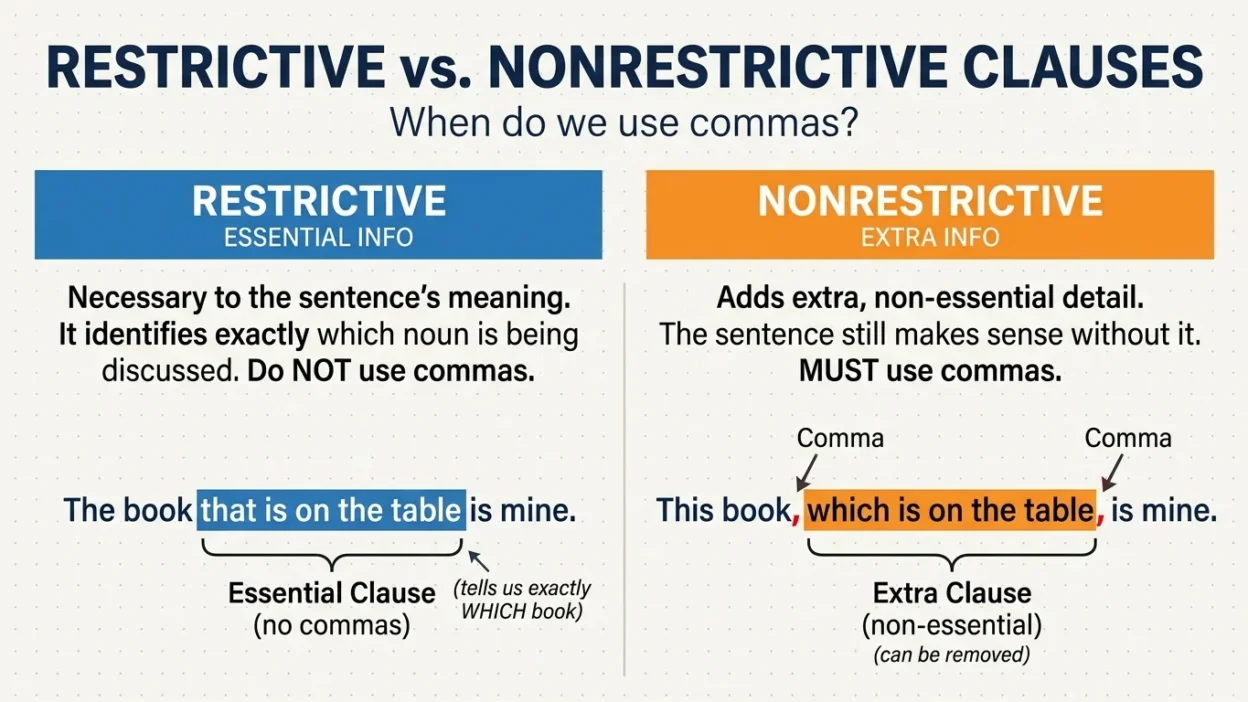
A restrictive clause provides essential information that identifies exactly which person or thing the sentence refers to. A nonrestrictive clause adds extra information that is not necessary to identify the person or thing. The most important difference is punctuation: restrictive clauses generally do not use commas, while nonrestrictive clauses are set off by commas.
For example, “The students who studied passed the test” means that the students who studied passed, not necessarily every student. In contrast, “The students, who studied, passed the test” suggests that the students studied and passed, with the clause providing additional information. Learning how these clauses work will help you write clearer sentences, avoid punctuation mistakes, and understand how small changes in commas can affect meaning.
Quick Answer: What Is the Difference Between Restrictive and Nonrestrictive Clauses?
A restrictive clause identifies or limits the noun it modifies and is not separated by commas. A nonrestrictive clause adds extra information about a noun and is separated by commas. For example, “The car that is red is mine” uses a restrictive clause, while “My car, which is red, is parked outside” uses a nonrestrictive clause.
What Is a Restrictive Clause?
A restrictive clause is a dependent clause that gives essential information about a noun. It tells readers exactly which person, place, thing, or group the sentence refers to.
Without the restrictive clause, the meaning may become unclear or change significantly.
Restrictive clauses are also called essential clauses or defining relative clauses.
Examples of Restrictive Clauses
- The woman who lives next door is a doctor.
- The book that you recommended was excellent.
- Students who arrive late must report to the office.
- The dog that has a brown collar belongs to my neighbor.
- The house where I grew up has been renovated.
In these examples, the bold clauses identify a particular woman, book, group of students, dog, or house.
Do Restrictive Clauses Use Commas?
Generally, no. Restrictive clauses are not separated from the rest of the sentence by commas because their information is essential to the intended meaning.
Correct: The employees who completed the training received certificates.
This means that the employees who completed the training received certificates. It does not necessarily say that every employee completed the training or received a certificate.
Incorrect for the intended restrictive meaning: The employees, who completed the training, received certificates.
The commas suggest that completing the training is additional information about the employees, rather than information that identifies which employees received certificates.
What Is a Nonrestrictive Clause?
A nonrestrictive clause adds extra information about a noun that is already identifiable from the context. The information may be helpful or interesting, but it is not needed to identify the noun.
Nonrestrictive clauses are also called nonessential clauses or nondefining relative clauses.
Examples of Nonrestrictive Clauses
- My sister, who lives in London, is visiting us.
- The Eiffel Tower, which is in Paris, attracts millions of visitors.
- Mr. Ahmed, who teaches English, helped me with my essay.
- My laptop, which I bought last year, is still working well.
- Our school library, which was renovated recently, looks beautiful.
In these examples, the clauses add information about people or things that are already identified.
Do Nonrestrictive Clauses Use Commas?
Yes. A nonrestrictive clause is normally separated from the rest of the sentence by commas. If it appears in the middle of a sentence, use a comma before and after it. If it appears at the end, place a comma before it.
Correct: My brother, who works in a bank, lives nearby.
Correct: I visited the museum, which opened last year.
The commas show that the relative clauses provide additional information rather than identify which brother or museum is meant.
Restrictive vs. Nonrestrictive Clause: Main Differences
| Feature | Restrictive Clause | Nonrestrictive Clause |
|---|---|---|
| Purpose | Identifies or limits a noun | Adds extra information |
| Importance | Essential to the intended meaning | Not essential to identifying the noun |
| Commas | Generally no commas | Set off by commas |
| Common name | Essential or defining clause | Nonessential or nondefining clause |
| Common relative words | That, who, whom, whose, which, where, when, depending on context | Who, whom, whose, which, where, when, depending on context |
| Example | The book that has a blue cover is mine. | This book, which has a blue cover, is mine. |
The key distinction is not simply the relative pronoun used. It is whether the clause identifies the noun or adds information about a noun that is already clear.
How Do Commas Change the Meaning?
Commas can change the meaning of a sentence by showing whether the information is essential or additional.
Consider these examples.
Example 1: The Students
Restrictive: The students who passed the exam celebrated.
Meaning: The students who passed celebrated. Other students may not have passed or celebrated.
Nonrestrictive: The students, who passed the exam, celebrated.
Meaning: The sentence presents the students as an already identified group and adds that they passed the exam. In the intended reading, all the students being discussed passed.
Example 2: My Brothers
Restrictive: My brothers who live abroad are visiting me.
Meaning: The brothers who live abroad are visiting. This wording suggests that the speaker may have other brothers who live elsewhere.
Nonrestrictive: My brothers, who live abroad, are visiting me.
Meaning: The speaker presents the brothers as an identified group and adds that they live abroad. The wording may suggest that all the brothers being discussed live abroad.
Example 3: The Cars
Restrictive: The cars that were damaged need repairs.
Meaning: Only the cars that were damaged need repairs.
Nonrestrictive: The cars, which were damaged, need repairs.
Meaning: The cars being discussed are presented as an identified group, and the sentence adds that they were damaged.
Remember that context can influence interpretation. Commas provide important clues, but readers also use the surrounding information to understand the intended meaning.
When Should You Use a Restrictive Clause?
Use a restrictive clause when readers need the information to identify the exact person or thing you mean.
Common situations include:
- Identifying one person among several.
- Selecting a particular item from a larger group.
- Explaining which people meet a condition.
- Describing the specific place, time, or reason being discussed.
Examples
- The teacher who taught us grammar has retired.
- I lost the keys that were on the kitchen table.
- People who exercise regularly may improve their fitness.
- The restaurant that serves Italian food is around the corner.
- The day when we first met was unforgettable.
In each example, the clause helps narrow down the noun or identify the intended meaning.
When Should You Use a Nonrestrictive Clause?
Use a nonrestrictive clause when the noun is already clear and you want to add extra information.
Common situations include:
- Adding a detail about a person already named.
- Providing background information about a place.
- Including an interesting fact about an object.
- Adding descriptive information that does not identify the noun.
Examples
- Sarah, who is my oldest friend, lives in Toronto.
- The Nile, which flows through northeastern Africa, is one of the world’s best-known rivers.
- My phone, which has a cracked screen, still works.
- Mr. Khan, whose son attends our school, is a kind neighbor.
- Paris, where I spent my summer vacation, was beautiful.
The clauses add information without narrowing down which Sarah, phone, or Mr. Khan is meant.
Restrictive vs. Nonrestrictive Clauses: 15 More Examples
Here are additional examples to help you recognize the difference.
| Restrictive Clause | Nonrestrictive Clause |
|---|---|
| The girl who won the race is my cousin. | Emma, who won the race, is my cousin. |
| The house that has a red door is ours. | Our house, which has a red door, is easy to find. |
| The students who need help should stay after class. | The students, who need help, should stay after class. |
| The book that contains the answer is on the shelf. | This book, which contains the answer, is on the shelf. |
| The man whose car was stolen called the police. | Mr. Ali, whose car was stolen, called the police. |
| The road that leads to the village is closed. | This road, which leads to the village, is closed. |
| The employee who handles payroll is absent. | Lisa, who handles payroll, is absent. |
| The paintings that were damaged need restoration. | The paintings, which were damaged, need restoration. |
| The restaurant where we ate was crowded. | The restaurant, where we ate last night, was crowded. |
| The day when the accident happened was rainy. | Monday, when the accident happened, was rainy. |
| The students who submitted their work received feedback. | The students, who submitted their work, received feedback. |
| The laptop that I use for work is lightweight. | My laptop, which I use for work, is lightweight. |
| The players who practiced regularly improved. | The players, who practiced regularly, improved. |
| The village where my grandparents live is peaceful. | My grandparents’ village, where they live, is peaceful. |
| The files that you requested are attached. | The files, which you requested yesterday, are attached. |
Notice that the nonrestrictive examples work best when the noun is already identified by a name, possessive, demonstrative, or context. Some examples may require a particular context to sound natural.
Which Relative Pronouns Can You Use?
Restrictive and nonrestrictive clauses can use relative words such as who, whom, whose, which, that, where, and when. However, their use depends on the clause and the sentence.
Using “That”
“That” is commonly used in restrictive clauses.
Example: The movie that we watched was exciting.
In standard edited English, “that” is generally not used to introduce a nonrestrictive relative clause.
Less suitable in formal writing: My car, that I bought last year, is blue.
Better: My car, which I bought last year, is blue.
Using “Which”
“Which” can introduce either type of clause.
Restrictive: The jacket which has a hood belongs to me.
Nonrestrictive: My jacket, which has a hood, belongs to me.
In American English, writers often prefer “that” for restrictive clauses referring to things, although “which” is also used in restrictive clauses, particularly in British English.
Using “Who” and “Whom”
“Who” and “whom” refer to people.
Restrictive: The woman who called you is my aunt.
Nonrestrictive: Mrs. Brown, who called you earlier, is my aunt.
“Whom” is more formal and is used when the relative pronoun functions as an object.
Example: The colleague whom I met yesterday was helpful.
Using “Whose”
“Whose” shows possession and can be used in both types of clauses.
Restrictive: The student whose notebook is missing should speak to me.
Nonrestrictive: Daniel, whose notebook is missing, is looking for it.
Common Mistakes to Avoid
1. Adding Commas Around a Restrictive Clause
Incorrect for the intended restrictive meaning: The people, who arrived early, got seats.
Correct: The people who arrived early got seats.
The first sentence suggests that the people are already identified and adds that they arrived early. The second identifies which people got seats.
2. Leaving Out Commas Around a Nonrestrictive Clause
Incorrect: My car which I bought last year is blue.
If you mean that you have one already identified car and want to add information about it, write:
Correct: My car, which I bought last year, is blue.
Without commas, the sentence may be read as restrictive, especially if the speaker has more than one car.
3. Using “That” in a Nonrestrictive Clause
In standard edited English, use “which” or an appropriate pronoun such as “who” for a nonrestrictive clause.
Less suitable: My dog, that is very friendly, loves children.
Better: My dog, which is very friendly, loves children.
4. Assuming Every Clause Beginning with “Which” Is Nonrestrictive
“Which” can introduce a restrictive clause, too.
Example: The route which avoids the highway is faster.
Here, the clause identifies which route is faster. In American English, many writers would choose “that” in this sentence.
5. Thinking the Difference Is Only About Punctuation
Commas are a useful signal, but the main difference is meaning. First decide whether the information identifies the noun or adds extra information. Then punctuate accordingly.
Memory Trick: How to Remember the Difference
Use this simple rule:
Restrictive = required to identify.
Nonrestrictive = extra information.
Ask yourself one question: “Do readers need this clause to know exactly which person or thing I mean?”
If the answer is yes, the clause is restrictive and generally takes no commas.
If the answer is no, the clause is nonrestrictive and should be set off by commas.
For example:
- The dog that barked all night belongs to us. The clause identifies which dog.
- Our dog, which barked all night, belongs to us. The clause adds information about an already identified dog.
Are Restrictive and Nonrestrictive Clauses Different in American and British English?
The basic grammatical distinction is the same in American and British English. Both varieties use restrictive clauses to identify nouns and nonrestrictive clauses to add extra information.
There is, however, a difference in common style preferences:
- American English: Writers often use “that” for restrictive clauses about things and “which” for nonrestrictive clauses.
- British English: “Which” is more commonly accepted in restrictive clauses as well as nonrestrictive clauses.
These are tendencies, not absolute rules. The choice of relative pronoun depends on the sentence, the style guide, and the intended meaning. In both varieties, commas around nonrestrictive clauses help readers recognize that the information is additional.
Frequently Asked Questions
1. What is a restrictive clause in simple words?
A restrictive clause gives essential information that tells readers which person or thing you mean. For example, “The boy who is wearing a red shirt is my brother” identifies the boy by his shirt.
2. What is a nonrestrictive clause in simple words?
A nonrestrictive clause adds extra information about a person or thing that is already identified. For example, “Tom, who is wearing a red shirt, is my brother” adds information about Tom.
3. Do restrictive clauses need commas?
No. Restrictive clauses generally do not take commas because their information is essential to the intended meaning.
4. Do nonrestrictive clauses need commas?
Yes. Nonrestrictive clauses are normally separated from the rest of the sentence by commas. Use a comma on each side when the clause appears in the middle of a sentence.
5. Can “which” be used in a restrictive clause?
Yes. “Which” can introduce a restrictive clause, particularly in British English. In American English, “that” is often preferred for restrictive clauses referring to things.
6. Can “that” introduce a nonrestrictive clause?
In standard edited English, “that” is generally not used to introduce a nonrestrictive relative clause. Use “which” for things or “who” for people, as appropriate.
7. Can punctuation change the meaning of a sentence?
Yes. Compare “The teachers who attended the meeting received lunch” with “The teachers, who attended the meeting, received lunch.” The first identifies the teachers who attended; the second presents attendance as extra information about the teachers being discussed.
8. What are other names for restrictive and nonrestrictive clauses?
Restrictive clauses are also called essential or defining clauses. Nonrestrictive clauses are also called nonessential or nondefining clauses.
Remember This
Restrictive clauses identify or limit the noun they describe, so they generally do not use commas. Nonrestrictive clauses add extra information about a noun that is already clear, so they are set off by commas.
When choosing between them, focus on the meaning first and punctuation second. If the clause tells readers which person or thing you mean, it is restrictive. If it merely adds a detail, it is nonrestrictive.
Conclusion
Understanding restrictive and nonrestrictive clauses helps you write accurate, clear, and natural English. Although both types of clauses provide information about nouns, restrictive clauses identify the intended noun, while nonrestrictive clauses add details about an already identified noun. This difference is especially important when writing sentences with relative pronouns such as “who,” “which,” and “that.”
The easiest way to remember the rule is to ask whether the clause is essential to identifying the noun. Restrictive clauses generally do not need commas, while nonrestrictive clauses do. With practice, you will become more confident in choosing the correct punctuation and expressing your meaning clearly.

Lucas Luke is a passionate language writer and content creator at SimileHive, specializing in similes, idioms, metaphors, and figurative language. He enjoys making complex English expressions simple, engaging, and easy to understand for students, writers, and language enthusiasts through well-researched, practical content.