Have you ever wondered whether to write lite or light? Although these words look and sound similar, they are not always interchangeable. The correct choice depends on what you want to express and the context in which you are writing.
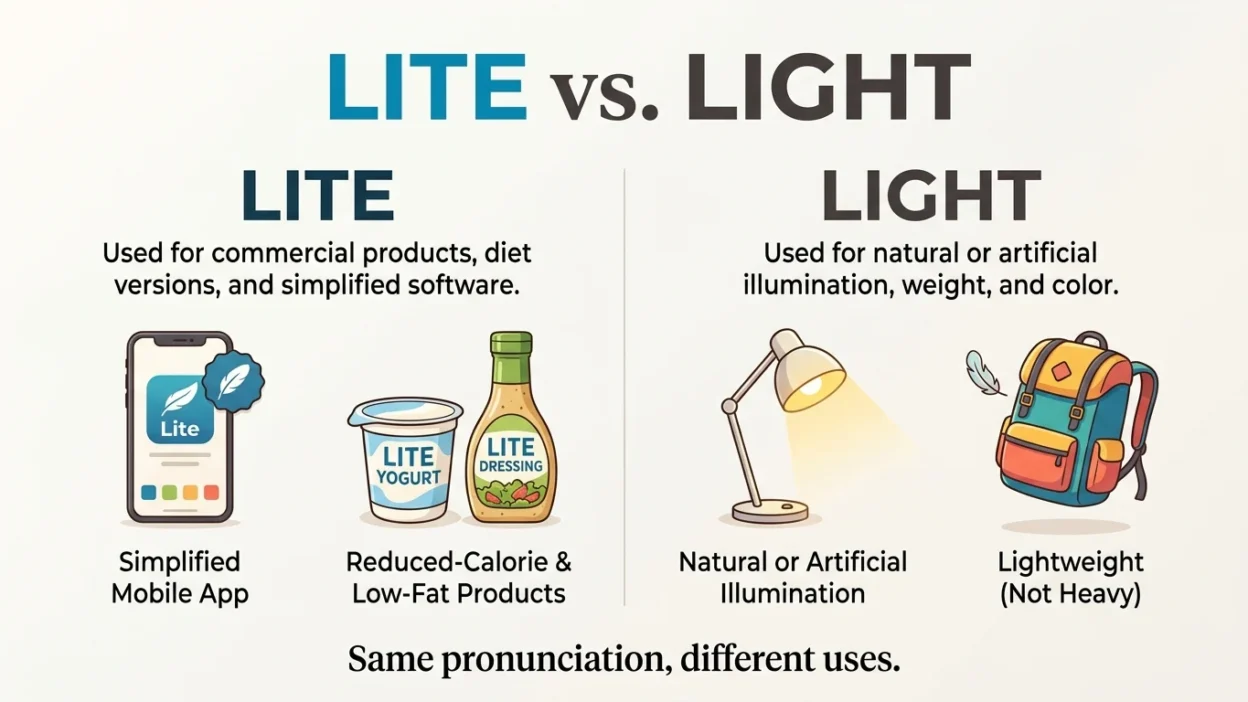
Light is the standard English word with several meanings. It can refer to brightness, something that is not heavy, a pale color, or something that is gentle or not intense. Lite, on the other hand, is an informal or commercial spelling often used in product names to suggest a version with fewer calories, less fat, fewer features, or a simpler design.
For example, you might write “a light bag” to describe something easy to carry, but see “Lite” in the name of a reduced-calorie drink or a simplified software application.
Understanding the difference will help you avoid spelling mistakes, choose the right word for your audience, and recognize why companies often use “lite” in advertising and product labels.
Quick Answer: What Is the Difference Between Lite and Light?
Light is the standard English spelling used for brightness, low weight, and many other meanings. Lite is a nonstandard variant commonly used in marketing, product names, and informal contexts to suggest a reduced or simplified version. For example, “a light meal” is standard, while “Lite” may appear on a reduced-calorie product label.
What Does Light Mean?
Light is a standard English word that can function as a noun, adjective, or verb. Its meaning depends on how it is used in a sentence.
1. Light as a Noun
As a noun, light can mean the brightness that allows us to see or a device that produces illumination.
Examples:
- The light from the window filled the room.
- Please turn on the light.
- Sunlight provides natural light during the day.
2. Light as an Adjective
As an adjective, light has several common meanings.
Not heavy:
- This suitcase is light enough to carry.
- She bought a light jacket for spring.
Pale in color:
- He painted the bedroom light blue.
- She prefers light colored curtains.
Not strong or intense:
- We had a light lunch before the meeting.
- A light rain began in the afternoon.
Gentle or not severe:
- He gave the door a light push.
- The patient was advised to do light exercise.
3. Light as a Verb
As a verb, light can mean to make something begin burning or to illuminate an area.
Examples:
- She used a match to light the candle.
- The streetlights light the road at night.
- He lit the fireplace before dinner.
The past tense and past participle are commonly lit or lighted, depending on the context.
What Does Lite Mean?
Lite is an alternative spelling of light used mainly in informal, commercial, and specialized contexts. It is especially common in product names and advertising.
It often suggests that something has fewer calories, less fat, fewer ingredients, or fewer features than a standard version.
1. Lite in Food and Drinks
Companies may use lite to market products with reduced calories, fat, sugar, or alcohol content, depending on the product and its labeling rules.
Examples:
- The store sells a lite version of the dressing.
- She chose a lite yogurt for breakfast.
- The brand introduced a lite beverage option.
In ordinary writing, light is also correct in phrases such as “light yogurt” or “light dressing.” The spelling used on a specific product may follow its official brand name or label.
2. Lite in Software and Technology
Technology companies sometimes use Lite in the names of simpler applications or versions designed to use less storage, data, or processing power.
Examples:
- I downloaded the Lite version of the app.
- The company released a Lite edition for older devices.
- This Lite application uses less storage space.
In these examples, Lite is part of a product name or a descriptive label, not the usual spelling for general English prose.
3. Lite in Informal Writing
Sometimes, people use lite informally to suggest a simpler or less serious version of something.
Examples:
- The course offers a lite introduction to coding.
- The event was a lite version of the original festival.
- The book presents a lite overview of the subject.
In formal writing, light or a more precise word such as simplified, basic, or introductory is usually preferable unless Lite is part of an established name.
Lite vs. Light: Main Differences
| Feature | Light | Lite |
|---|---|---|
| Standard spelling | Yes | Usually a specialized or commercial variant |
| Meaning | Brightness, low weight, pale color, gentle intensity, and more | Often suggests a reduced or simplified version |
| Common usage | Everyday and formal English | Product names, marketing, and informal contexts |
| Used for brightness | Yes | No, except in unusual names or branding |
| Used for low weight | Yes | Not normally in standard writing |
| Example | This bag is light. | Try the Lite version of the app. |
The key distinction is that light is the normal spelling for general English, while lite is usually reserved for specific commercial or informal uses.
Lite vs. Light: 15 Examples in Sentences
Here are examples showing when each word is appropriate.
Examples Using Light
- The room needs more light because the curtains are too thick.
- This backpack is light and easy to carry.
- She wore a light blue dress to the wedding.
- We prepared a light meal before the journey.
- Please light the candle before the guests arrive.
- The rain was light, so we continued walking.
- He prefers light exercise in the morning.
- The lamp provides enough light for reading.
Examples Using Lite
- The company launched a Lite version of its mobile app.
- I chose the lite dressing listed on the menu.
- The software’s Lite edition requires less storage.
- The brand introduced a lite alternative to its original product.
- She downloaded the Lite app because her phone has limited space.
- The company advertised a lite option for customers seeking a reduced-calorie product.
- The basic plan is marketed as the Lite package.
Remember that product names and food labels may use Lite or lite according to the brand’s official styling. When writing about a named product, preserve its official spelling.
When Should You Use Light?
Use light in ordinary writing whenever you mean brightness, low weight, a pale shade, low intensity, or the act of lighting something.
Common phrases include:
- Light weight
- Natural light
- Light blue
- Light rain
- Light meal
- Light exercise
- Light sleeper
- Light a candle
Example Paragraph
The room was filled with natural light, and the walls were painted light yellow. I carried a light bag and ate a light lunch before leaving for work.
Here, light is the correct standard spelling in every instance.
When Should You Use Lite?
Use lite when it appears in a recognized product name, marketing label, or informal description of a reduced or simplified version.
Common examples include:
- Lite version
- Lite edition
- Lite app
- Lite plan
- Lite product
Example Paragraph
My phone was running out of storage, so I downloaded the Lite version of the application. It offered fewer features but used less space.
Here, Lite describes a simplified software version.
Common Mistakes to Avoid
1. Writing “Lite” When You Mean Low Weight
Incorrect: This suitcase is very lite.
Better: This suitcase is very light.
Use light when describing an object’s weight in standard English.
2. Using “Lite” to Mean Brightness
Incorrect: The lite in the room was too bright.
Correct: The light in the room was too bright.
Use light for illumination.
3. Assuming “Lite” Is Always Wrong
It is not always wrong. Lite is commonly used in product names and commercial language.
Example: I installed the Lite version of the application.
4. Replacing a Product’s Official Spelling
If a product is officially named “Lite,” preserve that spelling when referring to it.
Example: The company released its Lite edition last month.
5. Using “Lite” in Formal Writing Without a Reason
In a formal report, a phrase such as “a lite explanation” may sound informal or promotional.
Better alternatives include:
- A simplified explanation
- A basic introduction
- A shorter version
- A reduced-calorie product, where that is the intended meaning
Lite vs. Light vs. Lightweight
These terms are related but serve different purposes.
| Word | Meaning | Example |
|---|---|---|
| Light | Not heavy, bright, pale, or gentle | This chair is light. |
| Lite | A commercial or informal label for a reduced or simplified version | I use the Lite app. |
| Lightweight | Having little weight; sometimes also meaning lacking seriousness or depth | This lightweight laptop is easy to carry. |
Use lightweight when you want to emphasize low physical weight, especially when describing products such as laptops, luggage, clothing, or equipment.
Memory Trick: How to Remember Lite vs. Light
Use this simple rule:
Light = the standard word.
Lite = a special spelling often used for products.
If you are talking about a lamp, a bag, a color, a meal, or rain, use light in standard writing.
If you are referring to a product advertised as a reduced or simplified version, lite may be appropriate.
For example:
- The bag is light.
- I downloaded the Lite app.
Is Lite or Light Different in American and British English?
The basic distinction is similar in American and British English. Both varieties use light as the standard spelling for ordinary meanings, including illumination and low weight.
Lite is mainly associated with commercial branding, product labels, and informal uses in both varieties. It is not simply the British or American spelling of light.
Examples:
- American English: The bag is light. I downloaded the Lite app.
- British English: The bag is light. I downloaded the Lite app.
Both versions are correct. The main difference is context, not regional spelling convention.
Frequently Asked Questions
1. Is lite a real word?
Yes. Lite is an established alternative spelling used mainly in commercial names, product descriptions, and informal contexts. It is not the usual spelling for the standard meanings of light.
2. Is lite or light correct?
Both can be correct, but they are used differently. Light is the standard spelling for general English. Lite is commonly used for products marketed as reduced or simplified versions.
3. Does lite mean less heavy?
Not normally in standard English. Use light or lightweight to describe something that is not heavy.
4. Why do companies use lite instead of light?
Companies often use lite as a marketing spelling to suggest fewer calories, less fat, fewer features, or a simpler version. The exact meaning depends on the product.
5. Is lite the American spelling of light?
No. Lite is not simply the American spelling of light. American and British English both use light for ordinary meanings, while lite is mainly a specialized or commercial spelling.
6. Can I write “light version” instead of “lite version”?
Yes. “Light version” is understandable and can be appropriate in ordinary writing. However, if the official product name is “Lite version,” preserve the brand’s spelling.
7. Are lite and light pronounced the same?
Yes. In standard English, lite and light are homophones: they are pronounced the same but have different spellings and usage patterns.
8. What is the opposite of light?
The opposite depends on the meaning. For weight, the opposite is heavy. For brightness, it may be darkness or dark. For color, it may be dark. There is no single opposite that fits every meaning of light.
Remember This
Light is the standard English spelling for brightness, low weight, pale colors, gentle intensity, and many other meanings. Lite is commonly used in product names and marketing to suggest a reduced or simplified version.
When in doubt, choose light for ordinary writing. Use lite when it is the established spelling of a product name or when the informal commercial meaning is intended.
Conclusion
The difference between lite and light is mainly about spelling and context. Both are pronounced the same, but light is the standard English word used in everyday speech and writing. Lite is a specialized spelling often used in advertising, food labels, software names, and other products that offer a reduced or simplified version.
To choose correctly, consider what you are describing. If you mean brightness, low weight, a pale color, or something gentle, write light. If you are referring to a product labeled Lite, follow its official spelling. This simple distinction will help you use both words accurately and confidently.

Adam Aaron is a language enthusiast and content writer at SimileHive, creating clear, engaging guides on similes, idioms, metaphors, and figurative language to help readers improve English confidently every day.