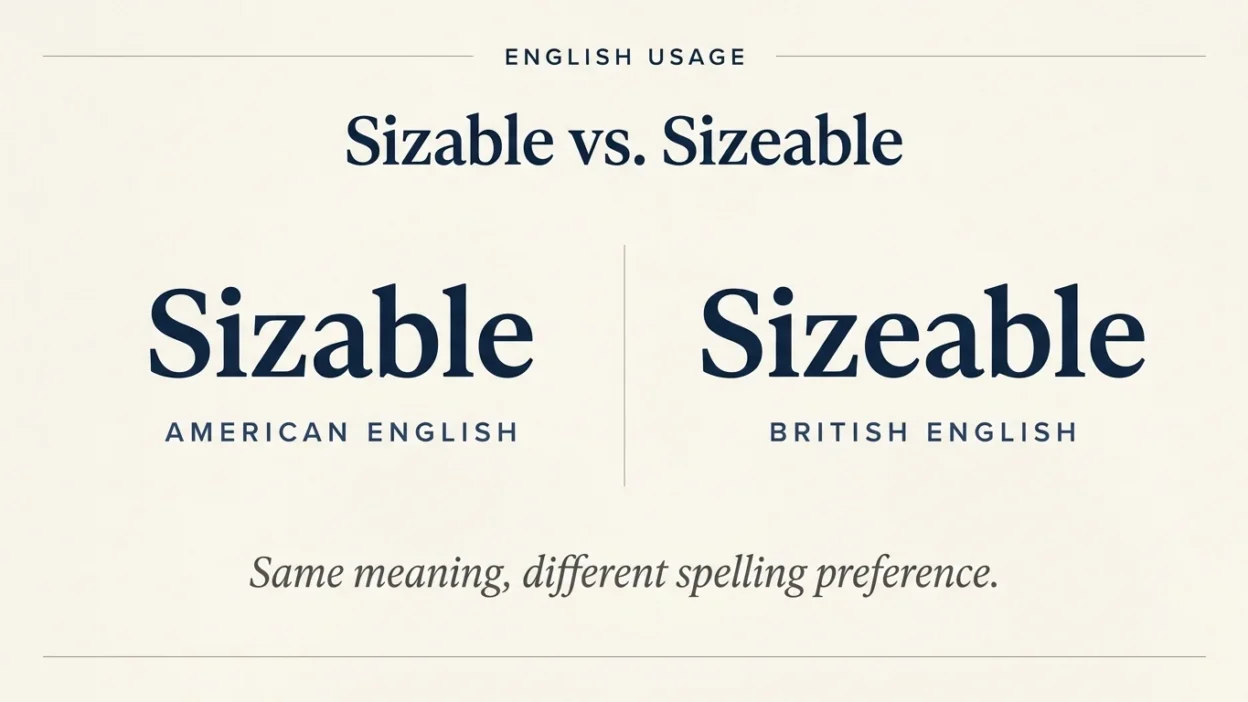
Have you ever wondered whether to write sizable or sizeable? Both spellings are correct, and both mean large enough to be noticed, considerable in size, or significant in amount. The only difference is spelling, not meaning.
The word sizable is generally preferred in American English, while sizeable is more common in British English. Both forms are widely understood, so you can use either one without changing the meaning of your sentence. For example, “The company made a sizable profit” and “The company made a sizeable profit” express the same idea.
Knowing which spelling to choose can help you write consistently in school assignments, professional documents, blog posts, and other forms of communication. In this guide, you will learn the meaning of each word, how American and British English differ, examples of correct usage, common spelling mistakes, and easy ways to remember the difference.
Quick Answer: What Is the Difference Between Sizable and Sizeable?
Sizable and sizeable have the same meaning: fairly large, considerable, or significant in amount. Sizable is the preferred spelling in American English, while sizeable is more common in British English. Both are correct, and neither spelling changes the word’s meaning or grammatical function.
What Does Sizable Mean?
Sizable is an adjective that describes something that is fairly large or considerable in size, amount, number, or importance.
It can describe money, profits, crowds, buildings, investments, risks, and many other things.
Examples of Sizable in Sentences
- The company earned a sizable profit last year.
- We need a sizable room for the meeting.
- She received a sizable bonus for her excellent work.
- The project requires a sizable investment.
- A sizable crowd gathered outside the stadium.
- He made a sizable contribution to the charity.
- The team has a sizable advantage over its competitors.
- The family owns a sizable piece of land.
In each sentence, sizable indicates that something is fairly large or considerable.
What Does Sizeable Mean?
Sizeable is another spelling of the same adjective. It has exactly the same meaning as sizable.
It is commonly used in British English and other varieties that generally follow British spelling conventions.
Examples of Sizeable in Sentences
- The company earned a sizeable profit last year.
- We need a sizeable room for the meeting.
- She received a sizeable bonus for her excellent work.
- The project requires a sizeable investment.
- A sizeable crowd gathered outside the stadium.
- He made a sizeable contribution to the charity.
- The team has a sizeable advantage over its competitors.
- The family owns a sizeable piece of land.
These sentences mean the same as the examples using sizable. Only the spelling has changed.
Sizable vs. Sizeable: Main Differences
| Feature | Sizable | Sizeable |
|---|---|---|
| Meaning | Fairly large or considerable | Fairly large or considerable |
| Part of speech | Adjective | Adjective |
| American English | Generally preferred | Correct but less common |
| British English | Understood and used | Generally preferred |
| Pronunciation | The same | The same |
| Example | A sizable investment | A sizeable investment |
The most important point is that the two spellings are interchangeable in meaning. The choice usually depends on your preferred variety of English or the style guide you are following.
Why Are There Two Spellings?
English spelling varies across regions. American English often favors shorter spellings, while British English retains or prefers certain alternative forms.
The difference between sizable and sizeable follows this pattern. Both spellings developed as accepted forms of the adjective, and both remain in use today.
You do not need to learn two separate definitions. Instead, remember that the words have the same meaning but different spelling preferences.
When Should You Use Sizable?
Use sizable when writing in American English, especially if your audience, publication, school, or organization follows American spelling conventions.
Examples:
- The business secured a sizable contract.
- The city has a sizable population.
- We made a sizable donation to the local shelter.
- The new policy could have a sizable impact on the economy.
- The investor took a sizable risk.
If you are writing an American English article or website, sizable is usually the safer choice.
When Should You Use Sizeable?
Use sizeable when writing in British English or when your publication follows British spelling conventions.
Examples:
- The business secured a sizeable contract.
- The city has a sizeable population.
- We made a sizeable donation to the local shelter.
- The new policy could have a sizeable impact on the economy.
- The investor took a sizeable risk.
If your audience is primarily British, sizeable is a natural choice.
Sizable vs. Sizeable: 12 Example Sentences
Here are more examples showing how both spellings work in everyday English.
- The school received a sizable donation from an anonymous supporter.
- The school received a sizeable donation from an anonymous supporter.
- The company experienced a sizable increase in sales.
- The company experienced a sizeable increase in sales.
- They spent a sizable amount of money renovating the house.
- They spent a sizeable amount of money renovating the house.
- The government allocated a sizable budget to education.
- The government allocated a sizeable budget to education.
- The restaurant attracts a sizable number of customers each weekend.
- The restaurant attracts a sizeable number of customers each weekend.
- The change had a sizable effect on the final results.
- The change had a sizeable effect on the final results.
All 12 sentences are correct. The spelling choice does not change the meaning.
Common Mistakes to Avoid
1. Thinking One Spelling Is Incorrect
Incorrect belief: Sizeable is always wrong.
Correct: Both sizable and sizeable are accepted spellings.
2. Using Both Spellings Inconsistently
Try not to switch between sizable and sizeable in the same article or document without a reason.
For example, if you choose American English, use sizable consistently. If you choose British English, use sizeable consistently, unless a required style guide specifies otherwise.
3. Confusing the Word with “Size”
Although sizeable contains the word size, it does not simply mean that something has a measurable size. It usually means that the size, amount, or effect is considerable.
For example:
- “The box has a size of 30 centimeters” gives a measurement.
- “The box is sizeable” suggests that the box is fairly large.
4. Assuming “Sizable” Always Means Huge
Both spellings generally mean fairly large or considerable. They do not necessarily mean enormous.
For example, a sizable donation may be large compared with typical donations, even if it is not the largest donation ever made.
Sizable vs. Sizeable vs. Considerable
These words have similar meanings, but they are not always identical in tone.
| Word | Meaning | Example |
|---|---|---|
| Sizable | Fairly large or considerable | The project needs a sizable budget. |
| Sizeable | Same meaning as sizable | The project needs a sizeable budget. |
| Considerable | Large or important enough to deserve attention | The project requires considerable effort. |
| Substantial | Large in amount, value, or importance | The company made a substantial investment. |
| Significant | Important or noticeable in effect | The policy had a significant impact. |
Sizable and sizeable are spelling alternatives. The other words are related in meaning, but their suitability depends on the context.
Memory Trick: How to Remember Sizable vs. Sizeable
Use this simple memory trick:
American English: sizable.
British English: sizeable.
Think of sizable as the shorter American spelling and sizeable as the spelling commonly preferred in British English.
If you cannot remember which one to use, check the spelling convention of the publication or organization you are writing for. The meaning remains the same either way.
Is Sizable or Sizeable More Common in American and British English?
The difference is mainly regional.
- American English: Sizable is generally the preferred form.
- British English: Sizeable is generally more common.
- Canadian, Australian, and other varieties: Usage may vary by publication and style guide, so consistency is the best approach.
Both forms are understood internationally. If you are writing for a specific audience, choose the spelling that matches its usual conventions.
Frequently Asked Questions
1. Is sizable or sizeable correct?
Both are correct. They are alternative spellings of the same adjective and have the same meaning.
2. Is sizable American or British English?
Sizable is generally preferred in American English, although it is also understood and used elsewhere.
3. Is sizeable British English?
Yes. Sizeable is commonly preferred in British English, but it is not limited to Britain.
4. Do sizable and sizeable mean the same thing?
Yes. Both mean fairly large, considerable, or significant in amount or size.
5. Are sizable and sizeable pronounced the same way?
Yes. They have the same standard pronunciation despite the difference in spelling.
6. Which spelling should I use in an SEO article?
Choose the spelling that matches your target audience. Use sizable for an American audience and sizeable for a British audience. Keep the spelling consistent throughout the article.
7. Can I use sizeable in American English?
Yes. Readers will understand it, but sizable is the more typical American spelling.
8. What is a synonym for sizable or sizeable?
Depending on the context, synonyms include considerable, substantial, large, significant, and sizeable. Remember that sizable and sizeable are themselves equivalent spellings.
Remember This
Sizable and sizeable are both correct. They have the same meaning, pronunciation, and grammatical role. The main difference is regional spelling preference: sizable is generally preferred in American English, while sizeable is more common in British English.
Choose the spelling that matches your audience or style guide, and use it consistently throughout your writing.
Conclusion
The difference between sizable and sizeable is simple: both words mean fairly large or considerable, but they follow different regional spelling preferences. American English generally favors sizable, while British English commonly uses sizeable. Neither spelling is inherently wrong, and both are widely understood.
When writing an article, email, school assignment, or business document, focus on consistency rather than treating one form as incorrect. Once you know your audience, choosing the right spelling becomes easy.

Lucas Luke is a passionate language writer and content creator at SimileHive, specializing in similes, idioms, metaphors, and figurative language. He enjoys making complex English expressions simple, engaging, and easy to understand for students, writers, and language enthusiasts through well-researched, practical content.