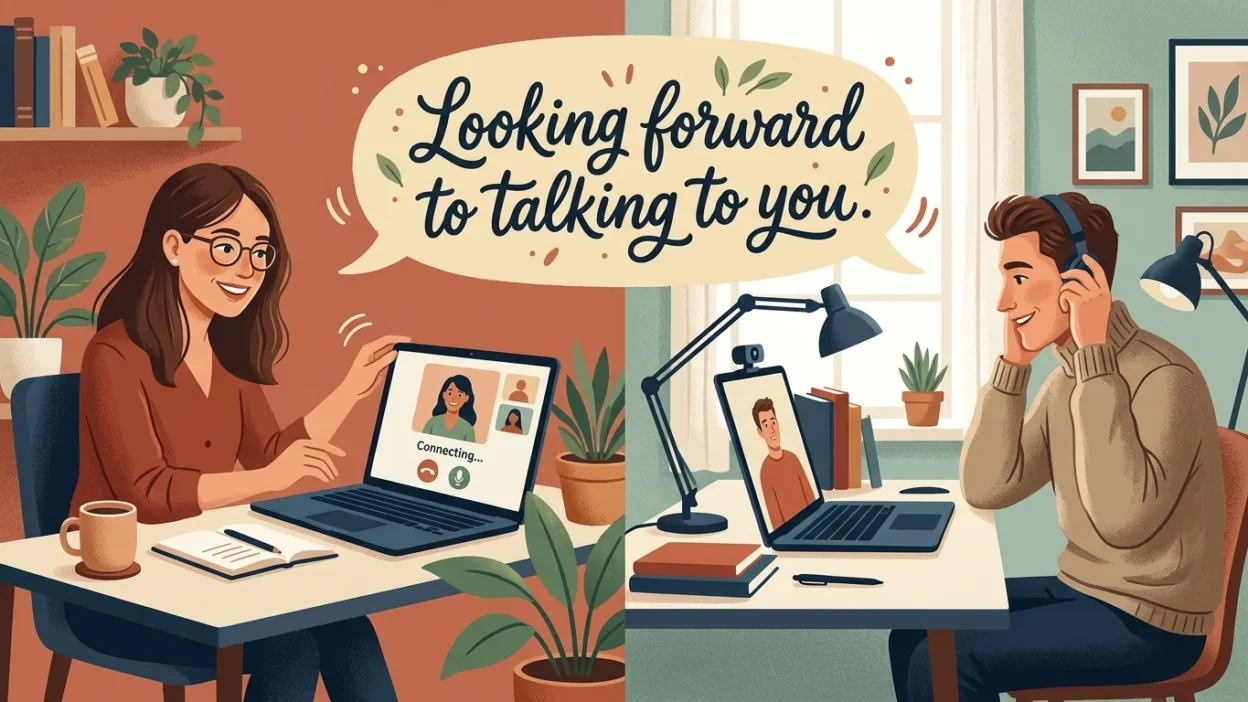
The phrase “looking forward to talking to you” is a polite and friendly expression used when you are excited or pleased about a future conversation with someone. It is common in emails, professional messages, business communication, interviews, and everyday conversations. For example, you might write, “Thank you for your time. I’m looking forward to talking to you tomorrow.”
Although the phrase is simple, it can sometimes confuse English learners because the word to is followed by talking rather than talk. This happens because to functions as a preposition in the expression “look forward to,” so it is followed by a noun or a gerund, which is a verb ending in -ing. Therefore, “looking forward to talking to you” is grammatically correct, while “looking forward to talk to you” is generally incorrect in standard English.
In this article, you will learn the phrase’s meaning, grammar, correct usage, common alternatives, and practical examples for both formal and informal situations.
Quick Answer: What Does “Looking Forward to Talking to You” Mean?
“Looking forward to talking to you” means that you feel pleased, interested, or excited about having a conversation with someone in the future. It is a polite expression commonly used in emails, meetings, interviews, and personal messages. The correct grammatical form is “looking forward to talking to you,” because to is followed by a gerund.
What Does “Looking Forward to Talking to You” Mean?
The phrase expresses positive feelings about a conversation that is expected to happen later.
It usually communicates three things:
- Expectation: You believe a conversation will take place.
- Interest: You want to speak with the other person.
- Politeness: You are expressing your anticipation in a friendly or professional way.
For example:
“I enjoyed reading your proposal and am looking forward to talking to you about it.”
This means the speaker is interested in discussing the proposal and expects the conversation to happen.
The phrase does not necessarily mean that the conversation has already been scheduled. Depending on the context, it may refer to a planned call, an upcoming meeting, or a conversation that the speaker hopes to have.
Is “Looking Forward to Talking to You” Grammatically Correct?
Yes. “Looking forward to talking to you” is grammatically correct.
The key is understanding the expression “look forward to.” In this expression, to is a preposition, not the infinitive marker used in phrases such as “to talk” or “to speak.”
A preposition can be followed by a noun, pronoun, or gerund.
Examples:
- I look forward to the meeting.
- I look forward to your reply.
- I look forward to talking to you.
- I look forward to speaking with you.
Here, talking and speaking are gerunds. They are verb forms ending in -ing that function like nouns.
Why Is “Looking Forward to Talk to You” Incorrect?
The expression “look forward to” requires a noun or gerund after to, not a bare verb.
Incorrect: I am looking forward to talk to you.
Correct: I am looking forward to talking to you.
Correct: I am looking forward to speaking with you.
The same grammar rule applies to other expressions that use to as a preposition.
Examples:
- I look forward to meeting you.
- She is looking forward to starting her new job.
- We look forward to hearing from you.
- He looks forward to working with the team.
“Looking Forward to Talking to You” vs. “Looking Forward to Talk to You”
These two expressions look similar, but only one is standard English.
| Expression | Correct? | Explanation |
|---|---|---|
| Looking forward to talking to you | Yes | Uses a gerund after the preposition to. |
| Looking forward to talk to you | Generally no | Uses a bare verb after the preposition to. |
| Looking forward to speaking to you | Yes | Uses the gerund speaking. |
| Looking forward to speak to you | Generally no | Does not follow the grammar of look forward to. |
| I look forward to our conversation | Yes | Uses the noun phrase our conversation. |
| I am looking forward to our conversation | Yes | Uses the same noun phrase after to. |
Remember that the problem is not the word talk. It is the grammatical form that follows to in this expression.
Should You Say “Talking to You” or “Talking With You”?
Both “talking to you” and “talking with you” are correct.
They often have the same meaning, especially in modern English.
Looking Forward to Talking to You
This is natural in both everyday and professional communication. It simply expresses anticipation about speaking with someone.
Example: “Thank you for arranging the interview. I’m looking forward to talking to you.”
Looking Forward to Talking With You
This version can emphasize a conversation or exchange of ideas between two people, although the difference is not strict.
Example: “I’m looking forward to talking with you about the new project.”
Which One Is Better?
Neither is universally better. Use whichever sounds natural in your sentence and fits your preferred style.
Both are appropriate for emails, messages, phone calls, and professional conversations.
“Looking Forward to Talking to You” vs. “Looking Forward to Speaking With You”
Both expressions are correct, but their tone can differ slightly.
| Phrase | Tone | Common Use |
|---|---|---|
| Looking forward to talking to you | Friendly and natural | Everyday messages, work emails, calls |
| Looking forward to speaking with you | Slightly more formal | Business emails, interviews, professional communication |
| Looking forward to chatting with you | Casual and friendly | Informal messages and relaxed conversations |
| Looking forward to our conversation | Neutral and professional | Emails, meetings, appointments |
| Looking forward to connecting with you | Professional and modern | Networking, business introductions |
These differences are tendencies rather than strict rules. The relationship between the speakers and the context matter more than the wording alone.
When Should You Use “Looking Forward to Talking to You”?
Use this phrase when you want to express interest in a future conversation.
1. In Professional Emails
The phrase is suitable when writing to colleagues, clients, recruiters, or business partners.
Example:
“Thank you for sharing the details. I’m looking forward to talking to you about the next steps.”
2. After Scheduling a Meeting
You can use it to acknowledge a planned conversation.
Example:
“Our meeting is scheduled for Thursday at 10 a.m. I’m looking forward to talking to you then.”
3. Before a Job Interview
It communicates enthusiasm and professionalism.
Example:
“Thank you for considering my application. I’m looking forward to talking to you during the interview.”
4. In Networking Messages
It works when you want to connect with someone professionally.
Example:
“It was great connecting with you on LinkedIn. I’m looking forward to talking to you about your experience in the industry.”
5. In Personal Messages
The expression can also be warm and friendly.
Example:
“It has been a while since we last spoke. I’m looking forward to talking to you this weekend.”
15 Example Sentences Using “Looking Forward to Talking to You”
Here are 15 examples showing how to use the phrase in different situations.
- Thank you for your email. I’m looking forward to talking to you soon.
- I’m looking forward to talking to you about the new project.
- It was nice meeting you yesterday, and I’m looking forward to talking to you again.
- I’m looking forward to talking to you during our scheduled meeting.
- Thank you for inviting me to the interview. I’m looking forward to talking to you.
- We have several ideas to discuss, and I’m looking forward to talking to you about them.
- I’m looking forward to talking to you and learning more about your business.
- It was a pleasure connecting with you, and I’m looking forward to talking to you soon.
- I’m looking forward to talking to you on the phone tomorrow.
- Please let me know if the meeting time changes. I’m looking forward to talking to you.
- I’m looking forward to talking to you about the opportunities available at your company.
- Thanks for agreeing to help me. I’m looking forward to talking to you this evening.
- Our team is looking forward to talking to you about the proposal.
- I’m looking forward to talking to you and hearing your suggestions.
- It will be great to catch up. I’m looking forward to talking to you again.
How to Use the Phrase in an Email
The phrase is especially useful at the end of an email when you want to express enthusiasm about a future conversation.
Formal Email Example
Subject: Upcoming Meeting
Dear Mr. Smith,
Thank you for sharing the meeting details. I appreciate the opportunity to discuss the project with you.
I am looking forward to talking to you on Monday and learning more about the proposed plans.
Best regards,
Your Name
Friendly Professional Email Example
Subject: Follow-Up on Our Discussion
Hi Sarah,
Thank you for your message. I’m glad we have an opportunity to discuss the project further.
I’m looking forward to talking to you next week.
Best,
Your Name
Informal Message Example
Hey Alex,
It was great hearing from you! I’m looking forward to talking to you this weekend. Let me know when you’re free.
Talk soon!
These examples show that the phrase works across different levels of formality. You can adjust the surrounding language to suit your audience.
Common Mistakes to Avoid
1. Using “To Talk” Instead of “To Talking”
Incorrect: I am looking forward to talk to you.
Correct: I am looking forward to talking to you.
The expression “look forward to” takes a noun or gerund after to.
2. Forgetting the Verb “Am,” “Is,” or “Are”
When using the present continuous form, include the appropriate form of be.
Incorrect: I looking forward to talking to you.
Correct: I am looking forward to talking to you.
However, “Looking forward to talking to you!” is acceptable as an informal email or message closing because it is a shortened expression with the subject and auxiliary verb understood.
3. Thinking “Talk to You” Is Always Wrong
“Talk to you” is perfectly correct in many sentences.
Examples:
- I want to talk to you.
- I will talk to you tomorrow.
- I hope to talk to you soon.
The issue occurs specifically after the expression “look forward to.”
4. Using the Phrase When No Future Conversation Is Intended
“Looking forward to talking to you” expresses anticipation of a conversation. If you are referring to a conversation that has already happened, use a past-tense expression instead.
Instead of: I’m looking forward to talking to you yesterday.
Write: I enjoyed talking to you yesterday.
5. Making the Phrase Too Formal for a Casual Conversation
The phrase is appropriate in many contexts, but a very casual conversation may call for something simpler.
For example, “Looking forward to chatting!” may sound more relaxed when messaging a friend.
Memory Trick: How to Remember the Correct Grammar
Remember this rule:
Look forward to + noun or verb ending in -ing.
Examples:
- Look forward to the meeting.
- Look forward to your reply.
- Look forward to talking.
- Look forward to meeting.
- Look forward to hearing from you.
Think of to as part of the expression “look forward to,” rather than as a signal that the next verb must be in its base form.
This simple rule will help you avoid common mistakes in emails, conversations, and professional writing.
Is “Looking Forward to Talking to You” Different in American and British English?
The phrase is correct and widely used in both American and British English. There is no major grammatical difference between the two varieties.
Both use expressions such as:
- I’m looking forward to talking to you.
- I’m looking forward to speaking with you.
- I look forward to hearing from you.
The choice between talking to and talking with depends mainly on personal preference, context, and tone rather than nationality.
In formal emails, “I look forward to speaking with you” may sound slightly more polished, while “I’m looking forward to talking to you” often feels friendly and conversational.
Frequently Asked Questions
1. Is “looking forward to talking to you” correct?
Yes. It is grammatically correct and commonly used to express anticipation about a future conversation.
2. Is it correct to say “looking forward to talk to you”?
Generally, no. The expression “look forward to” is followed by a noun or gerund, so the correct form is “looking forward to talking to you.”
3. Is “looking forward to talking with you” correct?
Yes. Both “talking to you” and “talking with you” are correct. They usually communicate the same idea, although “talking with” may emphasize a shared conversation in some contexts.
4. Is “looking forward to talking to you” formal or informal?
It can be used in both formal and informal communication. It is suitable for professional emails, interviews, meetings, and friendly messages.
5. Can I end an email with “looking forward to talking to you”?
Yes. It is a natural way to end an email when you expect a future conversation. For a more formal tone, you can write, “I look forward to speaking with you.”
6. What is the difference between “I look forward to talking to you” and “I am looking forward to talking to you”?
Both are correct. “I look forward to talking to you” often sounds slightly more formal or conventional in business writing. “I am looking forward to talking to you” emphasizes your present anticipation and can sound a little more conversational.
7. Can I say “looking forward to our conversation”?
Yes. This is a correct and concise alternative. For example: “Thank you for arranging the meeting. I’m looking forward to our conversation.”
8. What is a shorter way to say “looking forward to talking to you”?
Depending on the situation, you can write “Looking forward to speaking with you,” “Looking forward to chatting,” or simply “Talk soon.” The best choice depends on the tone and whether a future conversation is already arranged.
Remember This
“Looking forward to talking to you” means that you are pleased or excited about a future conversation. It is correct in both professional and personal communication.
The most important grammar rule is that “look forward to” is followed by a noun or gerund, so write “looking forward to talking,” not “looking forward to talk.”
Conclusion
The phrase “looking forward to talking to you” is a natural, polite, and versatile expression used to show interest in a future conversation. It works well in professional emails, job interviews, business meetings, networking messages, and everyday communication. Depending on the situation, you can also use alternatives such as “looking forward to speaking with you” or “looking forward to our conversation.”
To use the expression correctly, remember that to in “look forward to” is a preposition. This is why it is followed by talking, speaking, meeting, or another gerund. Once you understand this simple grammar rule, you can use the phrase confidently in both formal and informal English.

Lucas Luke is a passionate language writer and content creator at SimileHive, specializing in similes, idioms, metaphors, and figurative language. He enjoys making complex English expressions simple, engaging, and easy to understand for students, writers, and language enthusiasts through well-researched, practical content.