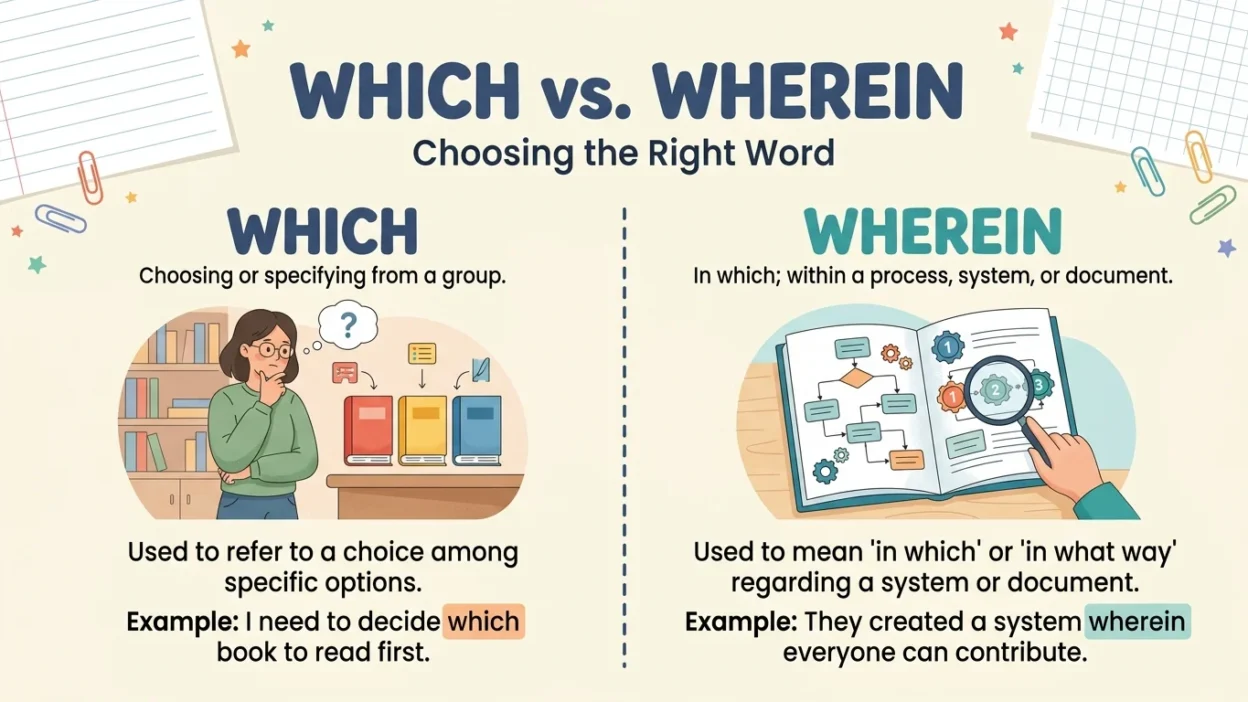
“Which” and “wherein” are both used to connect ideas, but they serve different grammatical purposes. Which is a common relative pronoun or interrogative word used to identify something, ask a question, or add information about a noun. Wherein is a more formal word meaning “in which” or “in what,” and it is usually used to describe a situation, document, system, or context in which something happens.
For example, you might write, “I read a book which explains English grammar.” Here, which introduces information about the book. In contrast, “The report describes a process wherein each applicant is evaluated separately” means that each applicant is evaluated within that process.
Choosing the correct word depends on the meaning you want to express and the structure of your sentence. In everyday English, which is much more common, while wherein often appears in formal, academic, legal, or technical writing.
This guide explains the meanings, grammatical rules, differences, and examples of which and wherein so you can use both words confidently.
Quick Answer: Which vs. Wherein
Which identifies or refers to a person, thing, or idea, or introduces additional information about it. Wherein means “in which” and refers to the context, situation, system, or place in which something occurs. For example, “The book, which is popular, is on the desk” uses which to describe the book, while “The book explains a system wherein every member has a role” uses wherein to describe a system.
What Does Which Mean?
Which is a pronoun or determiner used to identify a particular thing, ask a question, or introduce information about a noun.
It is common in everyday conversations, academic writing, emails, and formal documents.
1. Which as a Relative Pronoun
As a relative pronoun, which introduces a clause that describes or provides information about a thing or idea.
Examples:
- I bought a laptop which has a powerful processor.
- She recommended a book which explains grammar clearly.
- The car, which was parked outside, belongs to my neighbor.
- We visited a museum which displays ancient artifacts.
- He submitted a report which contained several useful suggestions.
In these sentences, which refers to a noun mentioned earlier.
In standard edited English, which commonly introduces nonrestrictive clauses that add extra information, usually set off by commas. It can also introduce restrictive clauses, especially in British English. In American English, that is often preferred for restrictive clauses, although which is also used in some styles.
2. Which as a Question Word
Which can also be used to ask someone to choose or identify something from a group.
Examples:
- Which book do you prefer?
- Which road leads to the station?
- Which answer is correct?
- Which movie did you watch last night?
- Which option would you recommend?
Here, which helps identify a particular choice.
3. Which as a Determiner
When placed directly before a noun, which can function as a determiner.
Examples:
- Which subject do you enjoy most?
- Which restaurant serves vegetarian food?
- Which day is convenient for you?
- Which color looks better?
What Does Wherein Mean?
Wherein is a formal word meaning “in which” or, in some contexts, “in what.” It connects a situation, process, document, arrangement, or system with something that happens within it.
It is often found in legal documents, academic discussions, technical writing, and formal explanations. It is less common in everyday conversation.
Examples of Wherein in Sentences
- The contract describes a process wherein both parties must approve the changes.
- We studied a system wherein each employee had a specific responsibility.
- The book presents a world wherein technology controls daily life.
- The agreement establishes conditions wherein the company may terminate the service.
- The researchers developed a model wherein several variables interact.
- The document outlines a procedure wherein all applications are reviewed.
- They created an environment wherein students could express their ideas freely.
- The story depicts a society wherein everyone shares resources.
- The policy explains circumstances wherein refunds may be issued.
- The report describes a framework wherein data is collected and analyzed.
In each example, wherein means something similar to “in which” and refers to a situation, framework, procedure, or other context.
When Should You Use Wherein?
Use wherein when you want to express that something happens or exists within a particular situation, system, process, or context.
For example:
- Formal: The policy specifies circumstances wherein an exception may be granted.
- Simpler: The policy specifies circumstances in which an exception may be granted.
Both sentences are grammatical. The second is usually more natural for general readers.
Which vs. Wherein: Key Differences
The main difference is that which identifies or refers to something, while wherein means “in which” and describes the context in which something occurs.
| Feature | Which | Wherein |
|---|---|---|
| Main meaning | What one, or referring to a thing | In which |
| Grammatical role | Pronoun or determiner; sometimes an interrogative word | Formal relative adverb |
| Main purpose | Identifies something or adds information | Connects an event or condition to its context |
| Common usage | Everyday and formal English | Mostly formal or technical English |
| Example | The book, which is new, is mine. | The book describes a world wherein magic exists. |
| Simpler alternative | Depends on context; sometimes “that” | “In which” |
Can Which and Wherein Be Used Interchangeably?
Usually, which and wherein cannot simply replace each other because they have different grammatical functions.
Consider these examples:
Correct: This is the document which explains the rules.
Here, which introduces information about the document.
Correct: This is the document wherein the rules are explained.
Here, wherein means “in which,” referring to the document as the place or context where the rules are explained.
The two sentences communicate related ideas, but their structures differ.
A useful test is to replace wherein with “in which.” If the sentence keeps its intended meaning and remains grammatical, wherein may be appropriate.
For example:
- The situation wherein the mistake occurred.
- The situation in which the mistake occurred.
Both are grammatical, although the second sounds more natural in everyday English.
When to Use Which
Use which when you want to identify something, ask a question, or add information about a noun.
Use Which to Identify a Choice
Examples:
- Which phone is yours?
- Which candidate received the most votes?
- Which route is the fastest?
Use Which to Describe Something
Examples:
- I found a website which offers free lessons.
- The house, which is near the river, is very old.
- She bought a dress which matched her shoes.
Use Which to Refer to an Entire Idea
Which can sometimes refer to a whole preceding statement rather than just one noun.
Example:
- He missed the deadline, which caused a delay.
Here, which refers to the fact that he missed the deadline.
When to Use Wherein
Use wherein when you want to emphasize the setting or framework in which something takes place.
Use Wherein in Formal Documents
Example:
- The agreement describes conditions wherein either party may withdraw.
A simpler version is:
- The agreement describes conditions in which either party may withdraw.
Use Wherein in Academic Writing
Example:
- The study examines a model wherein social factors influence individual choices.
A simpler version is:
- The study examines a model in which social factors influence individual choices.
Use Wherein to Describe Systems or Situations
Example:
- The novel imagines a society wherein personal freedom is restricted.
Here, wherein introduces the conditions within that imagined society.
Writing tip: Although wherein is correct in formal writing, do not use it merely to make a sentence sound more sophisticated. “In which” is often clearer and easier to understand.
Which vs. Wherein: 15 Example Sentences
The following examples show how each word works in different contexts.
| Which | Wherein |
|---|---|
| Which dress should I wear? | The ceremony follows a tradition wherein guests exchange gifts. |
| I bought a phone which takes excellent photos. | The manual describes a process wherein the device resets automatically. |
| Which answer did you select? | The agreement contains a clause wherein both parties accept responsibility. |
| The movie, which won an award, was excellent. | The story presents a world wherein animals can speak. |
| Which road should we take? | The plan creates a system wherein tasks are shared equally. |
| She read an article which explained the issue. | The report describes a situation wherein resources are limited. |
| Which employee completed the task? | The company developed a framework wherein every department contributes. |
| The house, which was recently renovated, looks beautiful. | The policy lists circumstances wherein exceptions are allowed. |
| Which subject do you find difficult? | The researchers designed an experiment wherein participants worked in pairs. |
| He gave me a suggestion which proved useful. | The program offers a setting wherein students can learn independently. |
| Which option is more affordable? | The document explains a procedure wherein complaints are reviewed. |
| The painting, which hangs in the gallery, is valuable. | The author imagines a future wherein robots perform most routine tasks. |
| Which team won the match? | The rules establish conditions wherein players may be disqualified. |
| I watched a documentary which discussed climate change. | The study considers a situation wherein demand exceeds supply. |
| Which book did you borrow? | The system operates within an environment wherein data is constantly updated. |
Common Mistakes When Using Which and Wherein
Mistake 1: Using Wherein Instead of Which in a Question
Incorrect: Wherein book do you want to read?
Correct: Which book do you want to read?
Why? Use which to ask someone to identify or choose a book. Wherein means “in which” and does not work as a direct replacement.
Mistake 2: Using Which When You Mean “In Which”
Awkward: The situation which the error occurred was unusual.
Better: The situation in which the error occurred was unusual.
Also correct, but more formal: The situation wherein the error occurred was unusual.
Why? The preposition in is needed to express the context where the error happened.
Mistake 3: Using Wherein in Everyday Conversation Unnecessarily
Overly formal: This is the room wherein we keep our shoes.
More natural: This is the room where we keep our shoes.
Also possible: This is the room in which we keep our shoes.
Why? Wherein is often unnecessarily formal for simple descriptions of physical places.
Mistake 4: Assuming Wherein Always Refers to a Physical Place
Incorrect assumption: Wherein can only describe a room, building, or location.
Correct understanding: Wherein can refer to an abstract context, such as a process, arrangement, situation, or system.
Example: The researchers created a model wherein several factors interact.
Mistake 5: Confusing Which with Where
Incorrect: Which do you live?
Correct: Where do you live?
Why? Use where to ask about a location. Use which to identify or choose among options. Wherein generally means “in which,” not simply “where” in every context.
Easy Memory Trick: Which vs. Wherein
Use these simple reminders:
- Which = what one? “Which shirt do you want?”
- Which = referring to something: “The shirt, which is blue, is mine.”
- Wherein = in which: “The document wherein the rules appear.”
When you are unsure about wherein, try replacing it with “in which.” If the sentence still makes sense, wherein may work, particularly in formal writing.
Which vs. Wherein in American and British English
The meanings of which and wherein are broadly the same in American and British English.
However, there are some differences in style and relative-clause preferences:
- Which: Used in both varieties to ask questions and refer to things. British English commonly uses which in restrictive clauses, while American English often favors that in such clauses, particularly in formal edited prose.
- Wherein: Used in both varieties, especially in formal, legal, academic, or technical writing. It is uncommon in casual conversation in either variety.
For example:
- British English: The book which I borrowed was interesting.
- American English: The book that I borrowed was interesting.
- Both varieties: The contract describes a situation wherein either party may withdraw.
These are tendencies rather than absolute rules. The best choice also depends on the sentence and the style guide being followed.
Similar Words to Which and Wherein
Understanding related words can help you choose the most natural expression.
| Word or phrase | Meaning | Example |
|---|---|---|
| That | Introduces identifying information about a noun | The book that I bought is new. |
| Where | Refers to a place or, sometimes, a situation | This is the town where I grew up. |
| In which | Means within or as part of which | The situation in which we met was unusual. |
| Whereby | By which means or through which | They created a system whereby users can submit requests. |
| Whereupon | Immediately after which or as a result of which | He signed the form, whereupon the meeting ended. |
| Wherefore | For what reason; why | Wherefore did you leave? |
| Whichever | Any one of a set of options | Choose whichever option works best. |
Note that whereby and whereupon have meanings different from wherein. They are not interchangeable in every sentence.
Frequently Asked Questions
1. What is the main difference between which and wherein?
Which identifies or refers to something, asks a question, or introduces additional information. Wherein means “in which” and describes the context or situation in which something happens.
2. Is wherein the same as in which?
In many contexts, yes. Wherein is a formal alternative to in which. For example, “a system wherein every member has a role” means “a system in which every member has a role.”
3. Is wherein grammatically correct?
Yes. Wherein is a correct English word, particularly in formal, academic, legal, and technical writing. However, “in which” is often more natural and accessible.
4. Can I use which and wherein in the same sentence?
Yes, when each word serves a different grammatical purpose.
Example: “The report, which describes a system wherein every applicant is evaluated fairly, was published yesterday.”
Here, which introduces information about the report, while wherein describes the system.
5. Can wherein refer to a person?
It generally refers to a situation, document, arrangement, system, or context rather than directly to a person. To refer to a person, use expressions such as who, whom, or in whom, depending on the sentence.
For example: “She is someone in whom I have great trust.”
6. Is wherein too formal for everyday English?
Often, yes. Although it is not incorrect, it may sound stiff or old-fashioned in casual conversation. “In which” or “where” is usually more natural, depending on the intended meaning.
7. What is the difference between wherein and whereby?
Wherein means “in which,” referring to a context or situation. Whereby means “by which means” or “through which.” For example, “a system wherein everyone has a role” describes the system, while “a system whereby users can submit requests” describes how the system works.
8. Should I use which or wherein in academic writing?
Use whichever word accurately expresses your meaning. Which is useful for referring to things and introducing additional information. Wherein can be appropriate when describing a process, framework, or context, but “in which” is often clearer. Academic writing should prioritize precision and readability over unnecessarily formal vocabulary.
Remember This
The easiest way to distinguish which from wherein is to remember their main functions.
- Use which to ask a question, identify something, or add information about a noun.
- Use wherein when you mean “in which” and want to describe a context, system, process, or situation.
- Prefer in which or where when those alternatives make your writing clearer and more natural.
Conclusion
Which and wherein are both useful English words, but they have different roles. Which is common in everyday language and helps identify things, ask questions, or introduce descriptive information. Wherein is more formal and connects an event, condition, or action to the context in which it occurs.
To use them correctly, consider the meaning of your sentence before choosing a word. If you are asking someone to identify an option or describing a particular thing, which is often appropriate. If you mean “in which,” especially when discussing a system, document, or situation, wherein may fit. In most general writing, clear and simple wording is the best choice.

Charles Kevin is a passionate language writer and researcher at SimileHive, creating clear, engaging content about similes, idioms, metaphors, and figurative language to help readers improve English communication confidently every day.