Possessive nouns are an important part of English grammar because they show ownership, relationships, and connections between people, animals, places, and things. Words such as Sarah’s book, the dog’s tail, and the students’ classroom contain possessive nouns. They help readers understand who owns something or what something belongs to.
Learning possessive nouns is easier when you understand how apostrophes work. In many cases, you add ’s to a singular noun or an apostrophe after the s in a regular plural noun. However, some plural nouns do not end in s, so they follow a different rule. Possessive nouns can also express relationships that do not involve literal ownership, such as my mother’s advice or the company’s success.
In this guide, you will learn what possessive nouns are, how to form them correctly, when to use an apostrophe, and how to avoid common mistakes. You will also find clear examples, comparison tables, and practice tips to help you use possessive nouns confidently in speaking and writing.
Quick Answer: What Are Possessive Nouns?
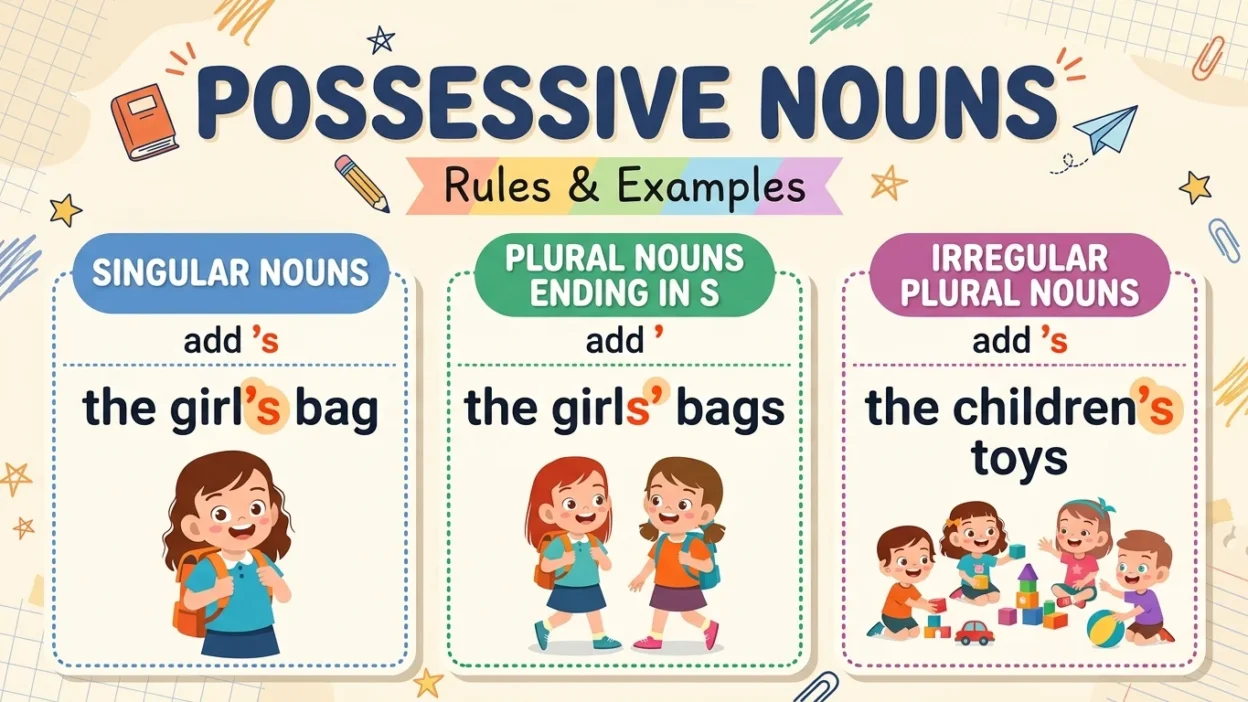
Possessive nouns are nouns that show ownership, possession, or a relationship with someone or something. They are usually formed by adding an apostrophe and s (’s) to a singular noun, as in the girl’s bag, or by adding an apostrophe after the s of a regular plural noun, as in the girls’ bags. The correct form depends on whether the noun is singular or plural.
What Is a Possessive Noun?
A possessive noun is a noun that shows that something belongs to, is connected with, or is associated with another person, animal, place, or thing.
Possessive nouns usually contain an apostrophe. The apostrophe helps show the relationship between the noun and the thing being discussed.
Examples of Possessive Nouns
- Emma’s notebook: The notebook belongs to Emma.
- The cat’s food: The food is for or associated with the cat.
- My brother’s bicycle: The bicycle belongs to my brother.
- The teachers’ lounge: The lounge is used by the teachers.
- The company’s policy: The policy belongs to or is established by the company.
Possessive nouns are not limited to physical objects. They can also show relationships, ideas, and responsibilities.
For example:
- My father’s advice helped me.
- The team’s success made everyone proud.
- The country’s history is fascinating.
- The child’s happiness matters.
How to Form Possessive Nouns
The main rule for forming possessive nouns depends on whether the noun is singular, plural, or an irregular plural.
1. Singular Possessive Nouns
For most singular nouns, add ’s to show possession.
Rule: Singular noun + ’s
Examples:
| Singular noun | Possessive noun | Example sentence |
|---|---|---|
| Girl | Girl’s | The girl’s dress is beautiful. |
| Boy | Boy’s | The boy’s shoes are muddy. |
| Teacher | Teacher’s | The teacher’s desk is clean. |
| Dog | Dog’s | The dog’s collar is red. |
| Student | Student’s | The student’s answer was correct. |
| Doctor | Doctor’s | The doctor’s office is nearby. |
| James | James’s | James’s car is parked outside. |
| Child | Child’s | The child’s toy is missing. |
Even when a singular name ends in s, many modern style guides recommend adding ’s, as in James’s book. Some style guides allow just an apostrophe, as in James’ book. Follow the style guide required for your writing.
2. Plural Possessive Nouns Ending in S
When a plural noun already ends in s, add only an apostrophe after the final s.
Rule: Plural noun ending in s + ’
Examples:
| Plural noun | Possessive noun | Example sentence |
|---|---|---|
| Girls | Girls’ | The girls’ classroom is upstairs. |
| Boys | Boys’ | The boys’ team won the match. |
| Teachers | Teachers’ | The teachers’ meeting starts at noon. |
| Students | Students’ | The students’ projects are ready. |
| Dogs | Dogs’ | The dogs’ toys are in the basket. |
| Parents | Parents’ | The parents’ meeting was helpful. |
| Workers | Workers’ | The workers’ uniforms are blue. |
| Players | Players’ | The players’ locker room is large. |
Notice the difference:
- The girl’s bag means one girl owns or is associated with the bag.
- The girls’ bags means the bags belong to or are associated with multiple girls.
3. Irregular Plural Possessive Nouns
Some plural nouns do not end in s. These nouns usually form the possessive by adding ’s.
Rule: Irregular plural noun + ’s
Examples:
| Singular noun | Plural noun | Possessive plural |
|---|---|---|
| Child | Children | Children’s |
| Man | Men | Men’s |
| Woman | Women | Women’s |
| Person | People | People’s |
| Mouse | Mice | Mice’s |
| Foot | Feet | Feet’s |
Example sentences:
- The children’s playground is new.
- The men’s shoes are near the door.
- The women’s team played well.
- The people’s voices were heard.
- The mice’s movements were difficult to track.
- The feet’s position affects balance.
Some examples, such as feet’s position, are grammatically possible but may sound unusual depending on the context. The possessive form should always fit the meaning of the sentence.
4. Possessive Nouns Ending in S
When a singular noun ends in s, the possessive form can vary according to the style guide.
For example:
- James’s bicycle is new.
- James’ bicycle is new.
Both forms are accepted by different style conventions. Many contemporary American English style guides favor James’s, while some publications use James’.
For plural nouns that already end in s, the usual form is an apostrophe after the final s:
- The students’ books are on the table.
- The actresses’ costumes are ready.
Possessive Nouns vs. Plural Nouns
One common grammar mistake is confusing possessive nouns with plural nouns. A plural noun refers to more than one person, animal, or thing. A possessive noun shows ownership or a relationship.
| Word | Type | Meaning |
|---|---|---|
| Cat | Singular noun | One cat |
| Cats | Plural noun | More than one cat |
| Cat’s | Singular possessive noun | Something belonging to one cat |
| Cats’ | Plural possessive noun | Something belonging to multiple cats |
| Child | Singular noun | One child |
| Children | Plural noun | More than one child |
| Child’s | Singular possessive noun | Something belonging to one child |
| Children’s | Plural possessive noun | Something belonging to multiple children |
Compare These Examples
- The cat is sleeping. One cat is sleeping.
- The cats are sleeping. More than one cat is sleeping.
- The cat’s bed is soft. The bed belongs to or is used by one cat.
- The cats’ beds are soft. The beds belong to or are used by multiple cats.
Remember that adding an apostrophe does not automatically make a noun plural.
Possessive Nouns vs. Possessive Pronouns
Possessive nouns and possessive pronouns both express possession, but they have different forms.
A possessive noun uses a noun with an apostrophe, while a possessive pronoun replaces a noun phrase or indicates ownership without an apostrophe.
| Possessive noun | Possessive pronoun | Example |
|---|---|---|
| Sarah’s | Hers | Sarah’s bag is red. The red bag is hers. |
| John’s | His | John’s phone is new. The phone is his. |
| The dog’s | Its | The dog’s bowl is empty. Its bowl is empty. |
| The children’s | Theirs | The children’s toys are here. The toys are theirs. |
| My parents’ | Theirs | My parents’ house is large. The house is theirs. |
Important: Possessive pronouns such as hers, yours, theirs, and ours do not use apostrophes. The word its is also possessive, while it’s means it is or it has.
Possessive Nouns vs. Possessive Adjectives
Possessive adjectives, also called possessive determiners, appear before nouns to show a relationship or ownership. They do not use apostrophes.
Examples include my, your, his, her, its, our, and their.
| Possessive noun | Possessive adjective or determiner |
|---|---|
| Maria’s book | Her book |
| Tom’s car | His car |
| The dog’s tail | Its tail |
| The children’s toys | Their toys |
| My parents’ house | Our parents’ house |
The correct choice depends on the sentence and the person or thing being discussed.
When to Use Possessive Nouns
Possessive nouns can express several kinds of relationships, not just ownership.
1. To Show Ownership
Use a possessive noun when something belongs to someone or something.
Examples:
- Lisa’s phone is ringing.
- The dog’s bowl is empty.
- The student’s notebook is missing.
2. To Show Family Relationships
Possessive nouns often describe family members or personal relationships.
Examples:
- My sister’s birthday is tomorrow.
- Daniel’s mother is a doctor.
- The children’s grandparents live nearby.
3. To Show Time or Duration
Possessive forms are often used with time expressions.
Examples:
- A day’s work can be tiring.
- Two weeks’ vacation sounds wonderful.
- A month’s salary was saved.
- In a year’s time, the project may be complete.
4. To Show Organizations or Groups
Possessive nouns can show that something is associated with an organization or group.
Examples:
- The company’s decision surprised everyone.
- The school’s rules are clear.
- The team’s performance improved.
- The government’s announcement was widely discussed.
5. To Show Ideas or Qualities
Possessive nouns can also connect people or things with abstract qualities, feelings, or ideas.
Examples:
- Her friend’s kindness was unforgettable.
- The country’s future depends on its people.
- The student’s confidence grew.
- The community’s strength comes from cooperation.
Possessive Nouns with Joint and Separate Ownership
When two or more people are connected to the same thing, the placement of apostrophes can change the meaning.
Joint Ownership
If two people share or jointly own one thing, place the possessive ending on the final name.
Example:
- Jack and Emily’s house is beautiful.
This usually means Jack and Emily share one house.
Separate Ownership
If each person owns a different thing, add the possessive ending to each name.
Example:
- Jack’s and Emily’s houses are beautiful.
This suggests Jack has a house and Emily has a separate house.
Another example:
- Mia and Noah’s project won first prize. (One shared project.)
- Mia’s and Noah’s projects won first prize. (Separate projects.)
Context can sometimes affect interpretation, so explain the relationship clearly when it matters.
Common Mistakes with Possessive Nouns
Mistake 1: Confusing Its and It’s
Incorrect: The dog wagged it’s tail.
Correct: The dog wagged its tail.
Why? Its is possessive. It’s is a contraction meaning it is or it has.
Mistake 2: Adding an Apostrophe to a Regular Plural
Incorrect: The apple’s are fresh.
Correct: The apples are fresh.
Why? The sentence needs a plural noun, not a possessive noun.
Mistake 3: Forgetting the Apostrophe in a Singular Possessive
Incorrect: The teachers desk is clean. (If one teacher owns or uses the desk.)
Correct: The teacher’s desk is clean.
Why? The apostrophe and s show the relationship between the teacher and the desk.
Mistake 4: Putting the Apostrophe in the Wrong Place
Incorrect: The student’s books are on the table. (If several students own the books.)
Correct: The students’ books are on the table.
Why? A regular plural noun ending in s normally takes an apostrophe after the final s.
Mistake 5: Using an Apostrophe with a Possessive Pronoun
Incorrect: The book is her’s.
Correct: The book is hers.
Why? Possessive pronouns such as hers, ours, yours, and theirs do not use apostrophes.
Easy Memory Trick for Possessive Nouns
Remember these three simple rules:
- One owner: Add ’s. Example: the boy’s bicycle.
- Several owners, plural ending in s: Add ’ after the s. Example: the boys’ bicycles.
- Irregular plural without a final s: Add ’s. Example: the children’s toys.
Before adding an apostrophe, ask yourself: Is the noun singular or plural? Does the plural already end in s? Your answers will usually tell you where the apostrophe belongs.
Possessive Nouns in American and British English
The basic rules for possessive nouns are generally the same in American and British English. Both use apostrophes to show possession.
Some differences come from style guides, particularly with singular names ending in s.
Examples:
- James’s book is on the desk.
- James’ book is on the desk.
Both forms appear in published English, although individual style guides may prefer one over the other.
The standard plural possessive forms remain the same in both varieties:
- The students’ books
- The teachers’ room
- The children’s playground
When writing for school, work, or publication, follow the required style guide and apply it consistently.
Practice: Choose the Correct Possessive Noun
Test your understanding with these short questions.
{@body const questions = [{q:”1. The ___ toys are on the floor. (one child)”, options:[“childs’”,”child’s”,”childs”], answer:”child’s”, why:”Child is singular, so add ’s: child’s toys.”},{q:”2. The ___ classroom is upstairs. (several teachers)”, options:[“teacher’s”,”teachers”,”teachers’”], answer:”teachers’”, why:”Teachers is a plural noun ending in s, so add an apostrophe after the s.”},{q:”3. The ___ tails are fluffy. (several cats)”, options:[“cat’s”,”cats’”,”cats’s”], answer:”cats’”, why:”Cats is plural and ends in s, so its possessive form is cats’.”},{q:”4. The ___ shoes are by the door. (one man)”, options:[“mans’”,”man’s”,”men’s”], answer:”man’s”, why:”Man is singular. Its possessive form is man’s.”},{q:”5. The ___ meeting starts at nine. (several parents)”, options:[“parents’”,”parent’s”,”parents”], answer:”parents’”, why:”Parents is plural and ends in s, so the possessive form is parents’.”}]}
{@body const [answers, setAnswers] = DIL.useState({})}
<box border radius=”xl” padding={4} gap={4}>
{#each questions as question, i}
<box key={question.q} gap={2}>
<text weight=”medium”>{question.q}</text>
<radio-group value={answers[i] || “”} onChange={v => setAnswers(prev => ({…prev, [i]}))} direction=”col”>
{#each question.options as option}
<radio key={option} value={option}>{option}</radio>
{/each}
</radio-group>
{#if answers[i]}
<text color={answers[i] === question.answer ? “success” : “danger”} size=”sm”>{answers[i] === question.answer ? “Correct!” : “Not quite.”} {question.why}</text>
{/if}
</box>
{#if i < questions.length – 1}
<divider color=”subtle”/>
{/if}
{/each}
<row align=”center” justify=”between”>
<text color=”secondary” size=”sm”>{Object.keys(answers).length} of {questions.length} answered</text>
<button variant=”outline” onClick={() => setAnswers({})}>Try again</button>
</row>
</box>
Frequently Asked Questions
1. What is a possessive noun?
A possessive noun is a noun that shows ownership, possession, or a relationship. Examples include the girl’s bag, the teachers’ lounge, and the children’s books.
2. What are five examples of possessive nouns?
Five examples are Sarah’s phone, the dog’s collar, the students’ classroom, the children’s toys, and the company’s policy. Each example shows ownership or a connection between a noun and something else.
3. How do you make a noun possessive?
For most singular nouns, add ’s, as in the boy’s hat. For regular plural nouns ending in s, add an apostrophe after the final s, as in the boys’ hats. For irregular plurals such as children, add ’s, as in the children’s hats.
4. What is the difference between a plural noun and a possessive noun?
A plural noun means more than one person, animal, or thing, as in dogs. A possessive noun shows ownership or a relationship, as in the dog’s bowl or the dogs’ bowls.
5. Is it James’ or James’s?
Both forms are used. Many style guides prefer James’s, while others allow or prefer James’. Follow the style guide used by your school, workplace, or publication.
6. Do possessive nouns always show ownership?
No. They can also show relationships, origin, responsibility, or association. For example, my mother’s advice refers to advice given by a mother, while the company’s success refers to success associated with a company.
7. What is the difference between its and it’s?
Its is a possessive determiner, as in “The bird spread its wings.” It’s is a contraction of it is or it has, as in “It’s raining.” The apostrophe in it’s does not show possession.
8. Can two people share one possessive noun?
Yes. For joint ownership, place the possessive ending on the final name, as in “Liam and Ava’s house.” If they own separate things, use “Liam’s and Ava’s houses.”
Remember This
Possessive nouns help make writing more precise by showing who owns, uses, or is connected with something.
- Singular noun: the student’s book
- Regular plural noun: the students’ books
- Irregular plural noun: the children’s books
- Singular name ending in s: James’s book or James’ book, depending on the style guide
The most important rule is to identify whether the noun is singular or plural before placing the apostrophe. With practice, you will be able to form possessive nouns accurately and avoid common punctuation mistakes.
Conclusion
Possessive nouns are an essential part of English grammar. They show ownership and relationships in sentences, helping readers understand who something belongs to or what it is connected with. Whether you are writing about a friend’s phone, a teacher’s advice, or the students’ projects, the correct apostrophe placement makes your meaning clear.
To use possessive nouns correctly, remember the difference between singular nouns, regular plural nouns, and irregular plural nouns. Add ’s to most singular nouns, add an apostrophe after the s in regular plural nouns, and use ’s with irregular plurals that do not end in s. Practice these patterns in everyday writing, and possessive nouns will become much easier to use.

Adam Aaron is a language enthusiast and content writer at SimileHive, creating clear, engaging guides on similes, idioms, metaphors, and figurative language to help readers improve English confidently every day.