Are and were are both forms of the verb to be, but they are used in different situations. Are usually describes a present condition, identity, or action, while were generally describes a past condition or situation. Understanding the difference between these two words can help you write clearer sentences and avoid common grammar mistakes.
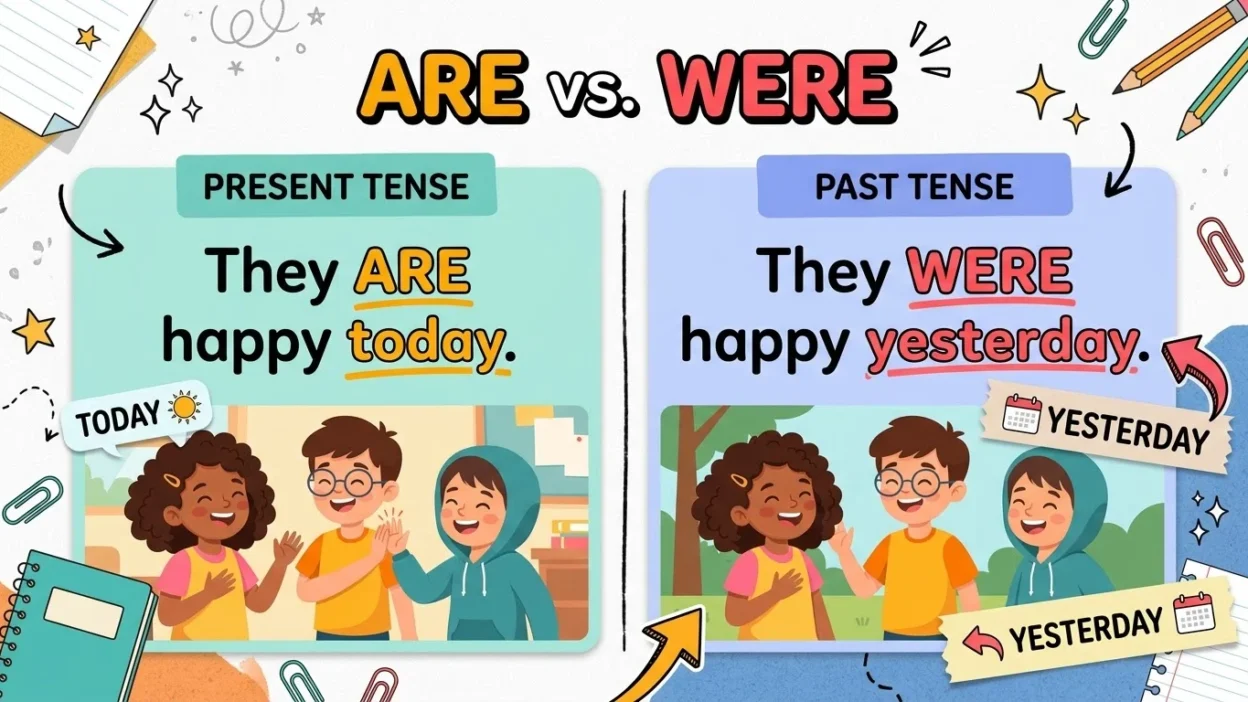
For example, you would say, “They are happy” when describing how people feel now. If you are talking about an earlier time, you would say, “They were happy yesterday.” The subject of the sentence also matters because are and were are not interchangeable with every pronoun or noun. In addition, were can appear in hypothetical sentences, such as “If I were you,” where it does not simply describe the past.
In this guide, you will learn the meanings of are and were, the rules for using each word, their differences, and plenty of practical examples to help you choose the correct form.
Quick Answer: Are vs. Were
Are is the present-tense form of to be used with you, we, they, and plural nouns. Were is usually the past-tense form used with the same subjects. For example, “They are busy today” describes the present, while “They were busy yesterday” describes the past. Were is also used in hypothetical expressions such as “If I were you.”
What Does Are Mean?
Are is a present-tense form of the verb to be. It is commonly used with the pronouns you, we, and they, as well as plural nouns.
It helps describe a person’s condition, identity, location, or situation in the present.
Examples of Are in Sentences
- You are a good friend.
- We are ready for the meeting.
- They are at home.
- The children are excited.
- These books are expensive.
- You are learning English.
- My parents are very supportive.
- The students are in the classroom.
- We are happy with the results.
- Those flowers are beautiful.
When Should You Use Are?
Use are when talking about:
- Present conditions: They are tired.
- Present locations: We are at school.
- Identities or descriptions: You are a talented writer.
- Ongoing actions: They are playing football.
- General facts: These plants are useful.
Remember that are is not used with every subject. In standard English, we say “I am,” “he is,” and “she is,” rather than “I are,” “he are,” or “she are.”
What Does Were Mean?
Were is generally the past-tense form of the verb to be. It is used with you, we, and they, as well as plural nouns, when describing past situations or conditions.
It can also be used with I, he, and she in certain hypothetical or unreal expressions, especially with the subjunctive construction.
Examples of Were in Sentences
- You were late yesterday.
- We were happy to see you.
- They were at the park last Sunday.
- The children were tired after school.
- My friends were excited about the trip.
- The books were on the table.
- You were very helpful last week.
- We were watching a movie.
- The students were preparing for the exam.
- They were living in London at that time.
When Should You Use Were?
Use were when talking about:
- Past conditions: They were sick yesterday.
- Past locations: We were at the library.
- Past identities or descriptions: You were a great teammate.
- Past ongoing actions: They were studying when I called.
- Hypothetical situations: If I were rich, I would travel the world.
The last example is important because were can be used in hypothetical statements even when the situation refers to the present or future, not the past.
Are vs. Were: Key Differences
The main difference between are and were is tense and meaning. Are usually refers to the present, whereas were usually refers to the past. Were also appears in certain hypothetical constructions.
| Feature | Are | Were |
|---|---|---|
| Main use | Present tense | Past tense |
| Common subjects | You, we, they, plural nouns | You, we, they, plural nouns |
| Example | They are ready. | They were ready. |
| Time reference | Now or generally | Earlier or in the past |
| Ongoing action | They are working. | They were working. |
| Hypothetical use | Not normally used in this way | If I were you |
How to Use Are and Were Correctly
Choosing between are and were becomes easier when you identify the time and meaning of the sentence.
1. Use Are for the Present
When describing something that is true now, use are with the appropriate subjects.
Examples:
- The students are quiet.
- We are ready to leave.
- You are correct.
- My cousins are visiting us today.
2. Use Were for the Past
When describing a condition or event at an earlier time, use were with the appropriate subjects.
Examples:
- The students were quiet yesterday.
- We were ready an hour ago.
- You were correct about the answer.
- My cousins were visiting us last weekend.
3. Use Are for Present Continuous Actions
The present continuous tense uses are + verb ending in -ing with you, we, they, and plural nouns.
Examples:
- They are cooking dinner.
- We are learning grammar.
- You are improving your writing.
- The workers are repairing the road.
4. Use Were for Past Continuous Actions
The past continuous tense uses were + verb ending in -ing with you, we, they, and plural nouns.
Examples:
- They were cooking dinner when I arrived.
- We were learning grammar yesterday.
- You were improving your writing.
- The workers were repairing the road all morning.
5. Use Were in Hypothetical Statements
In standard English, were is commonly used in hypothetical expressions involving situations that are unreal, imagined, or contrary to fact.
Examples:
- If I were you, I would apologize.
- If she were here, she could help us.
- I wish he were more careful.
- If the weather were better, we could go outside.
In informal speech, some speakers use was in certain hypothetical sentences, such as “If I was you.” However, “If I were you” is the established standard expression.
Are vs. Were Examples in Everyday English
Here are 15 additional examples showing how the two words work in different contexts.
| Are | Were |
|---|---|
| You are my best friend. | You were my best friend in school. |
| We are very busy today. | We were very busy yesterday. |
| They are in the garden. | They were in the garden earlier. |
| The children are hungry. | The children were hungry after the game. |
| These shoes are new. | Those shoes were new last year. |
| You are early. | You were early this morning. |
| We are excited about the trip. | We were excited about the trip last month. |
| They are playing outside. | They were playing outside when it rained. |
| The rooms are clean. | The rooms were clean before the party. |
| The teachers are helpful. | The teachers were helpful during my first year. |
| You are making progress. | You were making progress before the break. |
| We are working together. | We were working together last summer. |
| They are interested in science. | They were interested in science as children. |
| The flowers are fresh. | The flowers were fresh this morning. |
| We are ready now. | We were ready an hour ago. |
Common Mistakes When Using Are and Were
Even English learners sometimes confuse these words. Here are some frequent mistakes and their corrections.
Mistake 1: Using Are for a Past Situation
Incorrect: They are tired yesterday.
Correct: They were tired yesterday.
Why? The word yesterday indicates the past, so were is appropriate.
Mistake 2: Using Were for a Present Situation
Incorrect: We were happy right now.
Correct: We are happy right now.
Why? The phrase right now refers to the present.
Mistake 3: Using Are with a Singular Subject
Incorrect: The boy are at school.
Correct: The boy is at school.
Why? A singular subject such as the boy normally takes is, not are.
Mistake 4: Using Were with a Singular Subject in an Ordinary Past Statement
Incorrect: She were at home yesterday.
Correct: She was at home yesterday.
Why? In ordinary past-tense statements, she takes was. However, were may be correct in hypothetical expressions such as “If she were here.”
Mistake 5: Forgetting the Hypothetical Use of Were
Less standard in formal writing: If I was you, I would wait.
Preferred standard expression: If I were you, I would wait.
Why? “If I were you” is the conventional form for giving advice through a hypothetical situation.
Easy Memory Trick: Are vs. Were
Use this simple trick to remember the difference:
- Are = now: They are happy today.
- Were = before: They were happy yesterday.
- Were = imaginary situation: If I were you, I would study.
You can also look for time clues. Words such as now, today, and currently often go with are. Words such as yesterday, last week, and earlier often go with were.
These clues are helpful, but always consider the full sentence because hypothetical statements can use were without referring to the past.
Are vs. Were in American and British English
The basic grammar rules for are and were are the same in American and British English.
Both varieties use:
- “They are ready.”
- “They were ready yesterday.”
- “If I were you, I would ask for help.”
The main differences you may notice involve pronunciation or informal speech, not the fundamental meanings of these words. In both varieties, are generally describes the present and were usually describes the past.
Similar Words to Are and Were
Understanding related forms of to be can make English grammar easier.
| Word | Main use | Example |
|---|---|---|
| Am | Present with I | I am ready. |
| Is | Present with he, she, it, and singular nouns | She is happy. |
| Are | Present with you, we, they, and plural nouns | They are happy. |
| Was | Past with I, he, she, it, and singular nouns | She was happy. |
| Were | Past with you, we, they, and plural nouns | They were happy. |
| Be | Base form | Be careful. |
| Been | Past participle | They have been helpful. |
| Being | Present participle or gerund | They are being helpful. |
Frequently Asked Questions
1. What is the main difference between are and were?
Are is generally used for present situations, while were is generally used for past situations. For example, “They are busy today” describes the present, whereas “They were busy yesterday” describes the past.
2. Is were past tense or present tense?
Were is usually a past-tense form of the verb to be. However, it is also used in hypothetical expressions such as “If I were you,” where it does not necessarily refer to past time.
3. Can I use were with you?
Yes. Were is correct with you when referring to the past. For example, “You were very kind yesterday.” In the present tense, you would say, “You are very kind.”
4. Should I say “they are” or “they were”?
Use “they are” when describing the present and “they were” when describing the past. For example, “They are at home now” and “They were at home last night.”
5. Is “If I were you” correct?
Yes. “If I were you” is the standard expression used when giving advice about a hypothetical situation. For example, “If I were you, I would check the answer again.”
6. Can are and were be used in continuous tenses?
Yes. Are is used in the present continuous tense, as in “They are working.” Were is used in the past continuous tense, as in “They were working when I called.”
7. What is the difference between are, was, and were?
Are is present tense and is used with you, we, they, and plural nouns. Was is past tense and is used with I, he, she, it, and singular nouns in ordinary statements. Were is past tense and is used with you, we, they, and plural nouns. It also appears in hypothetical expressions such as “If I were you.”
8. Is “we was” correct?
In standard written English, use “we were,” not “we was.” For example, “We were happy to see you” is correct. Some nonstandard dialects use we was in everyday speech, but it is generally not appropriate for formal writing or standard English assignments.
Remember This
The difference between are and were is simple once you identify the time and subject of your sentence.
- Use are for present situations: “They are ready.”
- Use were for past situations: “They were ready yesterday.”
- Use were in standard hypothetical expressions: “If I were you, I would ask.”
Always check your subject and the time reference before choosing the correct word. With regular practice, you will be able to use are and were confidently in conversations, schoolwork, and professional writing.
Conclusion
Are and were are important forms of the verb to be. Although both can describe a person’s condition, location, or situation, they serve different purposes. Are usually refers to the present, while were generally refers to the past. Learning which subjects take each form will help you build grammatically correct sentences.
Remember that were has another important role in hypothetical expressions such as “If I were you.” By practicing examples, noticing time clues, and checking the subject of each sentence, you can avoid common mistakes and improve your English grammar.

Adam Aaron is a language enthusiast and content writer at SimileHive, creating clear, engaging guides on similes, idioms, metaphors, and figurative language to help readers improve English confidently every day.