Are you unsure whether to write “independent of” or “independent from”? Both expressions are grammatically correct, but they are used in slightly different contexts. The right choice depends on what you want to express and how the sentence is structured.
Independent of is the more common choice when describing freedom from influence, control, or dependence, or when saying that something does not rely on another factor. For example, “The committee must remain independent of political influence.” Independent from often emphasizes separation from a person, organization, authority, or previous state of dependence. For example, “The country became independent from colonial rule.”
In many situations, the two phrases overlap, and one may sound more natural than the other depending on context. Understanding their usual patterns will help you write more clearly in academic essays, professional emails, business documents, and everyday English. This guide explains their meanings, differences, grammar, examples, common mistakes, and regional usage.
Quick Answer: What Is the Difference Between Independent Of and Independent From?
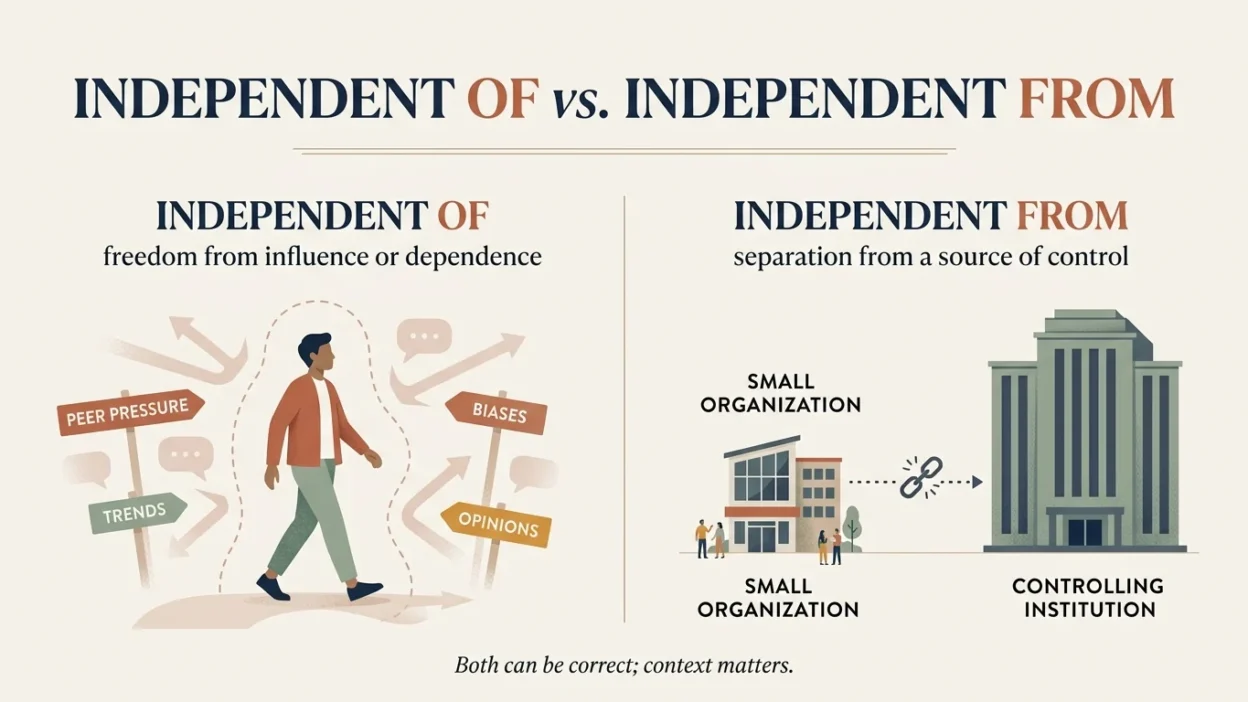
Independent of usually emphasizes freedom from influence, control, or reliance, while independent from often emphasizes separation from a source of control or dependence. Both can be correct, and their meanings sometimes overlap. For example, “independent of political pressure” is natural, while “independent from colonial rule” is common when describing political independence.
What Does Independent Of Mean?
Independent of means not controlled by, influenced by, or dependent on someone or something. It can also mean that something remains true regardless of another factor.
This expression is widely used in formal writing, academic discussions, business communication, and everyday English.
Examples of Independent Of
- The judge must remain independent of political pressure.
- She is financially independent of her parents.
- The research findings are independent of the funding source.
- Our decision should be independent of personal preferences.
- The committee operates independently of the government.
- The result is independent of the order in which the steps are performed.
- He wants to make decisions independent of outside influence.
- The organization must remain independent of commercial interests.
In these sentences, independent of emphasizes a lack of dependence, influence, or control.
What Does Independent From Mean?
Independent from can describe a state of separation from a person, organization, authority, or condition that previously controlled or supported something.
It is especially natural when discussing political independence, separation from an institution, or a change from dependence to autonomy.
Examples of Independent From
- The country became independent from colonial rule.
- The organization wants to become independent from its parent company.
- She worked hard to become financially independent from her family.
- The region sought to become independent from central government control.
- The new department operates independently from the main office.
- The company is now independent from its former owner.
- The community hopes to become independent from outside assistance.
- The institution became independent from the authority that originally supervised it.
In these examples, independent from highlights separation or freedom from a source of control or dependence.
Important: These are tendencies, not absolute rules. “Independent of colonial rule” and “independent of its parent company” are also correct. The most natural preposition depends on the sentence and the intended emphasis.
Independent Of vs. Independent From: Main Differences
| Feature | Independent Of | Independent From |
|---|---|---|
| Main emphasis | Lack of dependence, influence, or control | Separation from a source of control or dependence |
| Common use | Formal, academic, scientific, and general writing | Political, organizational, and personal contexts |
| Typical example | Independent of political influence | Independent from colonial rule |
| Grammatical correctness | Correct | Correct |
| Can the meanings overlap? | Yes | Yes |
The distinction is not a strict grammatical rule. Both expressions can describe freedom from control or dependence, so context and idiomatic usage should guide your choice.
Why Do People Confuse Independent Of and Independent From?
People confuse these phrases because the adjective independent describes a lack of dependence, and both of and from can introduce the person, institution, or thing from which that dependence is absent.
For example:
- The organization is independent of the government.
- The organization is independent from the government.
Both sentences are understandable and may be correct. The first is a conventional choice in formal descriptions of autonomy. The second may emphasize separation from the government, particularly in a context involving a change in status or organizational structure.
The best approach is to consider the meaning of the entire sentence instead of memorizing an inflexible rule.
When Should You Use Independent Of?
Use independent of when you want to emphasize that someone or something does not rely on, answer to, or receive influence from another person, factor, or organization.
1. To Describe Freedom From Influence
Example: “The journalist’s conclusions should be independent of political pressure.”
This means the conclusions should not be influenced by political pressure.
2. To Describe Financial Independence
Example: “She is financially independent of her parents.”
This means she does not rely on her parents for financial support.
3. In Academic and Scientific Writing
Example: “The outcome is independent of the initial temperature.”
This means the outcome does not depend on the initial temperature under the conditions being discussed.
4. To Describe Institutional Autonomy
Example: “The commission must remain independent of the executive branch.”
This means the commission should not be controlled by or subject to the executive branch’s influence.
5. To Express Something That Applies Regardless of Another Factor
Example: “Every applicant will be considered independent of age or background.”
In this context, independent of means regardless of the factors mentioned. Depending on the intended meaning, “regardless of age or background” may be clearer.
When Should You Use Independent From?
Use independent from when the sentence naturally emphasizes separation from a source of control, support, or dependence.
1. To Describe Political Independence
Example: “The nation became independent from colonial administration.”
This highlights the country’s separation from colonial control.
2. To Describe Separation From a Company
Example: “The subsidiary became independent from its parent company.”
This emphasizes a change in the relationship between the two organizations.
3. To Describe Personal Independence
Example: “He wants to become independent from his family.”
This emphasizes becoming free from reliance on family support or control.
4. To Describe a Change in Organizational Status
Example: “The research institute became independent from the university.”
This suggests that the institute separated from the university’s control or structure.
5. To Emphasize Freedom From a Previous Source of Support
Example: “The project aims to become independent from external funding.”
This emphasizes a move away from reliance on outside funding. In many contexts, “independent of external funding” would also be natural.
Independent Of vs. Independent From: 15 Example Sentences
The following examples show common patterns and situations where both expressions may be possible.
- The judge must remain independent of political pressure.
- The nation became independent from colonial administration.
- She is financially independent of her parents.
- The company became independent from its former parent organization.
- The results are independent of the method used to collect the data.
- The institute became independent from the university’s administrative structure.
- The committee should be independent of commercial interests.
- The region sought to become independent from central government control.
- His opinion is independent of what others think.
- The new business operates independently from its previous owner.
- The outcome is independent of the order of the calculations.
- The organization wants to become independent from outside assistance.
- The agency must be independent of political parties.
- The department now works independently from the main office.
- She wants to make decisions independent of other people’s expectations.
Notice that sentences 10 and 14 use independently from. This is the adverbial form of independent and follows a similar usage pattern. In many contexts, independently of is also possible.
Independent Of vs. Independent From in Different Contexts
| Context | Natural Example | Why It Works |
|---|---|---|
| Politics | Independent of political influence | Emphasizes freedom from influence |
| History | Independent from colonial rule | Emphasizes separation from former control |
| Finance | Independent of parental support | Emphasizes lack of financial dependence |
| Business | Independent from its former parent company | Highlights organizational separation |
| Science | Independent of the input variable | Describes a lack of dependence |
| Personal life | Independent of other people’s approval | Emphasizes autonomy |
These examples show common preferences rather than fixed restrictions. In many contexts, both prepositions are possible.
Common Mistakes to Avoid
1. Assuming One Phrase Is Always Correct
Incorrect rule: “Independent of” is always correct, and “independent from” is always wrong.
Correct understanding: Both are accepted, but their naturalness depends on context.
2. Using “Independent From” Automatically in Scientific Writing
In mathematics, statistics, and scientific writing, independent of is often the established choice.
Example: “The result is independent of the input variable.”
Although “independent from” may be understandable, independent of is usually more idiomatic in this type of sentence.
3. Forgetting the Meaning of the Sentence
Do not choose a preposition simply because a particular phrase seems more formal. Decide whether you are emphasizing lack of dependence, freedom from influence, or separation from a former authority.
4. Confusing Independent With Independence
Independent is an adjective, while independence is a noun.
Correct: The country is independent from colonial rule.
Correct: The country achieved independence from colonial rule.
The second sentence uses independence as a noun.
5. Confusing Independent With Independently
Independent is an adjective, while independently is an adverb.
Correct: The organization is independent of the government.
Correct: The organization operates independently of the government.
Choose the form that fits the grammatical structure of your sentence.
Independent Of vs. Independent From vs. Free From
These expressions are related but not always interchangeable.
| Expression | Meaning | Example |
|---|---|---|
| Independent of | Not dependent on or influenced by something | Her decision is independent of public opinion. |
| Independent from | Separated from a source of control or dependence | The country became independent from colonial rule. |
| Free from | Not affected by or experiencing something unwanted | The report is free from obvious errors. |
| Separate from | Not joined to or connected with something | The department is separate from the main office. |
| Autonomous | Able to govern or manage itself | The institution is an autonomous body. |
Use independent of or independent from when the idea of independence is central. Use free from when you want to emphasize the absence of something, and separate from when the focus is on distinction or physical or organizational separation.
Memory Trick: How to Remember Independent Of vs. Independent From
Try this simple guide:
Independent of = not relying on or influenced by.
Independent from = often emphasizes separation from a source of control.
For example:
- The decision is independent of political pressure.
- The country became independent from colonial rule.
Remember that this is a useful tendency, not a rule that applies to every sentence. If both options sound possible, check which one is more idiomatic in the context you are writing about.
Is Independent Of or Independent From Different in American and British English?
Both expressions are used in American and British English. There is no strict regional rule that assigns independent of exclusively to one variety and independent from to the other.
In both varieties:
- Independent of is especially common in formal, academic, scientific, and institutional writing.
- Independent from is also used, particularly when emphasizing separation from a former authority or source of dependence.
For example, an American writer might say, “The organization is independent of government influence,” while a British writer might use the same wording. Both may also use independent from in a suitable context.
The most important consideration is idiomatic usage and the meaning you want to convey.
Frequently Asked Questions
1. Is “independent of” grammatically correct?
Yes. “Independent of” is a standard and widely used expression. It describes a lack of dependence, influence, or control.
2. Is “independent from” grammatically correct?
Yes. “Independent from” is also correct. It is often used when emphasizing separation from a person, organization, authority, or source of dependence.
3. Which is better: independent of or independent from?
Neither is always better. Independent of is often the more natural choice for describing a lack of influence or dependence, while independent from may be preferred when emphasizing separation. Context determines the best choice.
4. Should I say “independent of the government” or “independent from the government”?
Both can be correct. “Independent of the government” is a common choice when emphasizing freedom from government influence or control. “Independent from the government” can also work, particularly when the sentence emphasizes separation from government authority.
5. Is “financially independent of my parents” correct?
Yes. It is natural and widely used. You can also say “financially independent from my parents,” although independent of my parents is a common phrasing.
6. Do scientists use “independent of” or “independent from”?
“Independent of” is generally the more conventional expression in scientific and mathematical contexts. For example, “The variables are independent of each other.”
7. What is the difference between “independent of” and “free from”?
“Independent of” emphasizes a lack of dependence or influence. “Free from” emphasizes the absence of something, often something unwanted. For example, “The committee is independent of the company” differs slightly from “The report is free from errors.”
8. Can I use “independently from” in a sentence?
Yes. “Independently from” can be used, especially when describing separate action or operation. For example, “The two departments operate independently from each other.” In many contexts, “independently of each other” is also natural.
Remember This
Independent of and independent from are both grammatically acceptable. Independent of commonly emphasizes freedom from influence or reliance, while independent from often highlights separation from a source of control or dependence.
These are usage tendencies, not absolute rules. Consider your context, choose the phrase that sounds natural, and use it consistently.
Conclusion
The difference between independent of and independent from is subtle. Both expressions describe independence, but they often emphasize different aspects of the relationship. Independent of is widely used when discussing freedom from influence, reliance, or dependence. Independent from often highlights separation from a former authority, organization, or source of support.
To choose the right expression, think about what you want to emphasize rather than memorizing a strict rule. In academic, scientific, and formal writing, independent of is often a safe and natural choice. When describing political or organizational separation, independent from may also fit well. Both forms are accepted in modern English when used appropriately.

Charles Kevin is a passionate language writer and researcher at SimileHive, creating clear, engaging content about similes, idioms, metaphors, and figurative language to help readers improve English communication confidently every day.