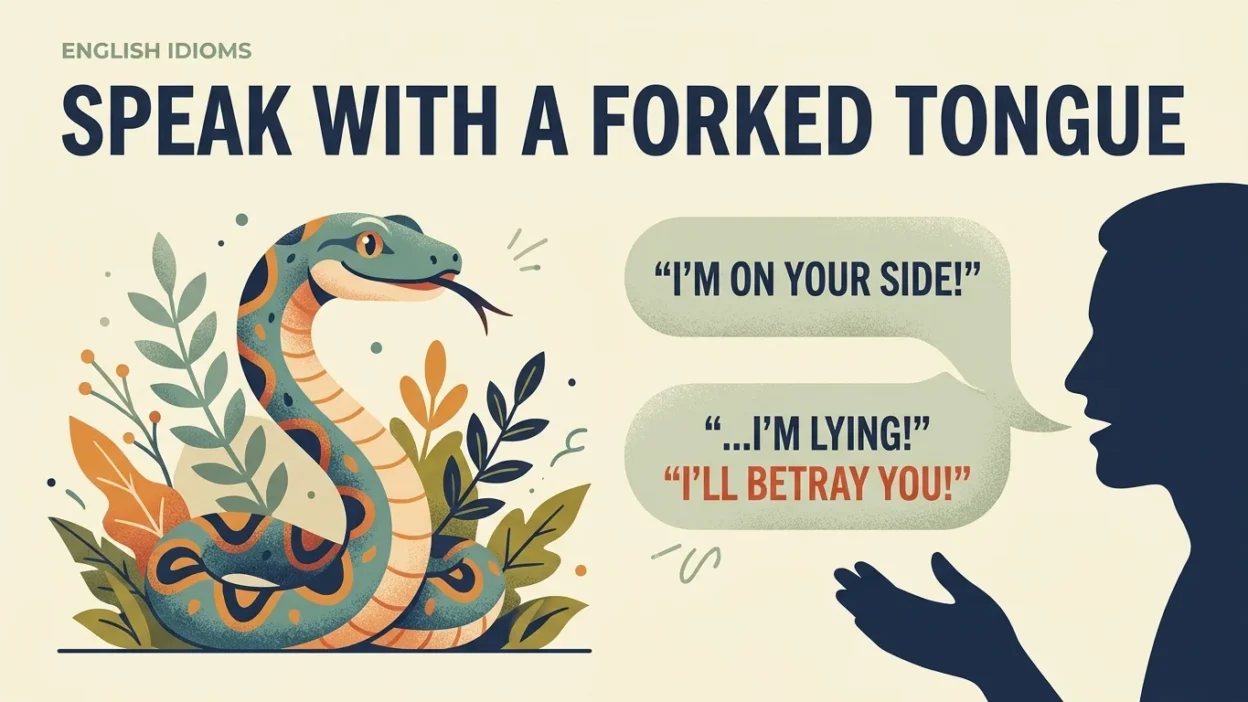
The phrase “speak with a forked tongue” means to lie, deceive people, or say things that are dishonest or misleading. It describes someone whose words cannot be trusted because they do not tell the truth or say one thing while secretly meaning another. For example, if a politician promises to help a community but secretly plans to take away its benefits, people might say that the politician speaks with a forked tongue.
This expression is often used when someone is dishonest, makes false promises, or deliberately misleads others. It can describe people in politics, business, friendships, relationships, and everyday life. The phrase creates a strong image of a person whose words are divided or twisted, much like a snake’s forked tongue. However, the expression is figurative, not literal. Understanding its meaning, examples, and proper usage can help you recognize it in books, conversations, news reports, and other forms of communication.
Quick Answer: What Does “Speak with a Forked Tongue” Mean?
“Speak with a forked tongue” means to lie, deceive, or speak dishonestly. It is used when someone says misleading things, breaks promises, or pretends to be truthful while hiding their real intentions. For example, “Don’t trust him; he speaks with a forked tongue” means that his words are not reliable.
Why Do People Use the Phrase “Speak with a Forked Tongue”?
People use this expression to criticize dishonesty and warn others not to trust someone’s words. It suggests that a person is deliberately misleading others rather than simply making an innocent mistake.
The phrase is stronger than saying someone is confused or mistaken. It usually implies dishonesty, deception, or a lack of sincerity.
For example:
- “She speaks with a forked tongue, so I never believe her promises.”
- “The salesman spoke with a forked tongue when he described the product.”
- “People stopped trusting the leader because he spoke with a forked tongue.”
In each example, the speaker suggests that the person’s words cannot be trusted.
What Is the Origin of “Speak with a Forked Tongue”?
The expression is associated with the image of a snake, whose tongue has two pointed tips. In figurative language, this image suggests that a person’s words are divided, deceptive, or untrustworthy.
The phrase is also widely associated with historical portrayals of Indigenous peoples in North America and expressions used during periods of European colonial expansion. It appeared in contexts involving broken agreements and distrust between groups. However, the historical development of the expression is complex, and it should not be treated as proof that any particular group naturally speaks dishonestly.
Today, the phrase is a common English idiom used to describe deception, hypocrisy, and dishonest communication.
What Does “Speak with a Forked Tongue” Mean in Different Contexts?
1. In Everyday Conversation
In daily conversation, the phrase describes someone who lies or frequently changes their story.
Example: “He told me he was at home, but I saw him at the restaurant. He speaks with a forked tongue.”
This means the speaker believes the person was dishonest.
2. In Politics
The expression is often used when politicians make promises they do not intend to keep or give misleading statements.
Example: “Voters accused the candidate of speaking with a forked tongue after he changed his position.”
It suggests that the candidate’s words and intentions do not match.
3. In Business
In business, the phrase may describe a person or company that makes misleading claims or promises benefits it cannot or will not deliver.
Example: “The company spoke with a forked tongue about the quality of its products.”
This means the company was not honest in its claims.
4. In Personal Relationships
The idiom can describe someone who pretends to care while secretly acting against another person’s interests.
Example: “I thought she was my friend, but she spoke with a forked tongue behind my back.”
The speaker feels betrayed because the person’s words did not reflect their true intentions.
15 Examples of “Speak with a Forked Tongue” in Sentences
Here are 15 examples showing how to use the idiom naturally.
- Don’t trust him because he speaks with a forked tongue. His promises rarely mean anything.
- The politician was accused of speaking with a forked tongue. He promised change but later supported the opposite policy.
- She speaks with a forked tongue whenever money is involved. I always double-check what she tells me.
- The manager spoke with a forked tongue when he assured employees that no jobs would be cut.
- People stopped believing the salesman because he spoke with a forked tongue.
- My friend felt betrayed when he discovered that his business partner spoke with a forked tongue.
- The witness was accused of speaking with a forked tongue after giving conflicting statements.
- A leader who speaks with a forked tongue will eventually lose the trust of the people.
- She claimed to support the project, but her actions showed that she spoke with a forked tongue.
- The customer felt cheated because the seller had spoken with a forked tongue about the product’s condition.
- He may sound convincing, but he speaks with a forked tongue when making promises.
- The villagers no longer trusted the official because he had spoken with a forked tongue.
- I don’t want to work with someone who speaks with a forked tongue.
- The company was criticized for speaking with a forked tongue about its environmental policies.
- If you speak with a forked tongue, people may eventually stop listening to you.
Speak with a Forked Tongue vs. Similar Expressions
These expressions all relate to dishonesty, but they have slightly different meanings.
| Expression | Meaning | Example |
|---|---|---|
| Speak with a forked tongue | Speak dishonestly or deceptively | He speaks with a forked tongue. |
| Tell a lie | Say something untrue | She told a lie about her age. |
| Break a promise | Fail to do something promised | He broke his promise to help. |
| Talk out of both sides of your mouth | Say contradictory things to different people | The manager talked out of both sides of his mouth. |
| Beat around the bush | Avoid saying something directly | Stop beating around the bush and answer me. |
| Pull the wool over someone’s eyes | Trick or deceive someone | The seller tried to pull the wool over my eyes. |
| Be two-faced | Pretend to be friendly while acting differently behind someone’s back | He is two-faced with his coworkers. |
Is “Speak with a Forked Tongue” the Same as “Talk Out of Both Sides of Your Mouth”?
They are similar, but not exactly the same.
“Speak with a forked tongue” generally emphasizes dishonesty or deception. “Talk out of both sides of your mouth” more specifically suggests saying contradictory things, often to please different people or avoid taking a clear position.
For example:
- Forked tongue: “He spoke with a forked tongue when he promised to repay the money despite knowing he could not.”
- Both sides of your mouth: “She told her coworkers she supported the proposal but told the director she opposed it.”
When Should You Use “Speak with a Forked Tongue”?
Use this idiom when you want to describe someone whose words are dishonest, misleading, or inconsistent with their real intentions.
Appropriate situations include:
- Describing a person who makes dishonest promises.
- Criticizing a public figure who misleads people.
- Explaining why someone has lost your trust.
- Describing a businessperson who makes false claims.
- Discussing hypocrisy or deliberate deception.
Avoid using it when someone simply makes an honest mistake or forgets something accidentally. The phrase generally carries a negative judgment about the person’s honesty.
Common Mistakes to Avoid
Mistake 1: Taking the Phrase Literally
Incorrect interpretation: A person has an actual forked tongue.
Correct interpretation: The person speaks dishonestly or deceptively.
Mistake 2: Using It for Every Small Mistake
If someone gives the wrong answer by accident, it does not necessarily mean they speak with a forked tongue. The expression usually suggests deliberate deception or a pattern of dishonesty.
Mistake 3: Confusing It with Being Indecisive
An indecisive person may struggle to choose between two options. Someone who speaks with a forked tongue is generally understood to be misleading others.
Mistake 4: Forgetting the Correct Form
The common expression is “speak with a forked tongue.” Depending on the sentence, you can change the verb tense:
- Present: He speaks with a forked tongue.
- Past: He spoke with a forked tongue.
- Present perfect: He has spoken with a forked tongue.
- Future: He will speak with a forked tongue.
Memory Trick: How to Remember the Meaning
Imagine a snake with a forked tongue. The tongue has two tips, creating an image of words that seem to point in different directions.
Connect that image with a person whose words cannot be trusted. If someone says one thing but means another, or deliberately misleads people, you can remember the expression “speak with a forked tongue.”
Easy memory tip: Forked tongue = deceptive words = dishonesty.
Is “Speak with a Forked Tongue” Used in American and British English?
Yes. The idiom is understood in both American and British English. It is not limited to one variety of English, although it may sound more dramatic or literary than everyday expressions such as “lie” or “be dishonest.”
American English: “The candidate speaks with a forked tongue.”
British English: “The politician speaks with a forked tongue.”
Both sentences are grammatically correct and have the same basic meaning.
FAQs About “Speak with a Forked Tongue”
1. What is the simple meaning of “speak with a forked tongue”?
It means to lie, deceive, or say things that are misleading. It describes someone whose words cannot be trusted.
2. Is “speak with a forked tongue” an idiom?
Yes. It is an idiom because its figurative meaning is different from the literal meaning of the words. It describes dishonest or deceptive speech.
3. Is speaking with a forked tongue always intentional?
The expression usually suggests deliberate dishonesty or deception. However, the exact meaning depends on context, and people may sometimes use it loosely to describe someone they consider untrustworthy.
4. What is a synonym for “speak with a forked tongue”?
Possible alternatives include “lie,” “deceive,” “mislead,” “be dishonest,” and “talk out of both sides of your mouth.” The best choice depends on the situation.
5. Can you use “speak with a forked tongue” in a sentence?
Yes. For example: “I no longer trust him because he speaks with a forked tongue.” This means the speaker believes the person is dishonest.
6. What is the opposite of “speak with a forked tongue”?
Opposite expressions include “tell the truth,” “speak honestly,” “be sincere,” and “keep your word.”
7. Is “forked tongue” offensive?
It is a negative expression because it accuses someone of dishonesty. It can sound harsh or confrontational, especially when directed at a specific person.
8. Does “speak with a forked tongue” mean hypocrisy?
It can describe hypocrisy when someone’s words do not match their actions or real beliefs. More broadly, it refers to deceptive or dishonest speech.
Remember This
“Speak with a forked tongue” means to speak dishonestly, mislead others, or make statements that cannot be trusted. It is a figurative English idiom, not a literal description of someone’s tongue.
Use it when describing deception, false promises, or words that hide a person’s real intentions. Remember that the expression is stronger than simply saying someone is mistaken because it generally suggests dishonesty.
Conclusion
The idiom “speak with a forked tongue” is a memorable way to describe dishonest or misleading communication. It can be used in conversations about politics, business, friendships, and everyday situations in which a person’s words do not match their intentions. Its imagery makes the idea of deception easy to understand.
Learning this phrase can also improve your vocabulary and help you understand figurative language in books, articles, and conversations. Use it thoughtfully because it carries a strong negative meaning and may sound like a direct accusation when applied to someone.

Charles Kevin is a passionate language writer and researcher at SimileHive, creating clear, engaging content about similes, idioms, metaphors, and figurative language to help readers improve English communication confidently every day.