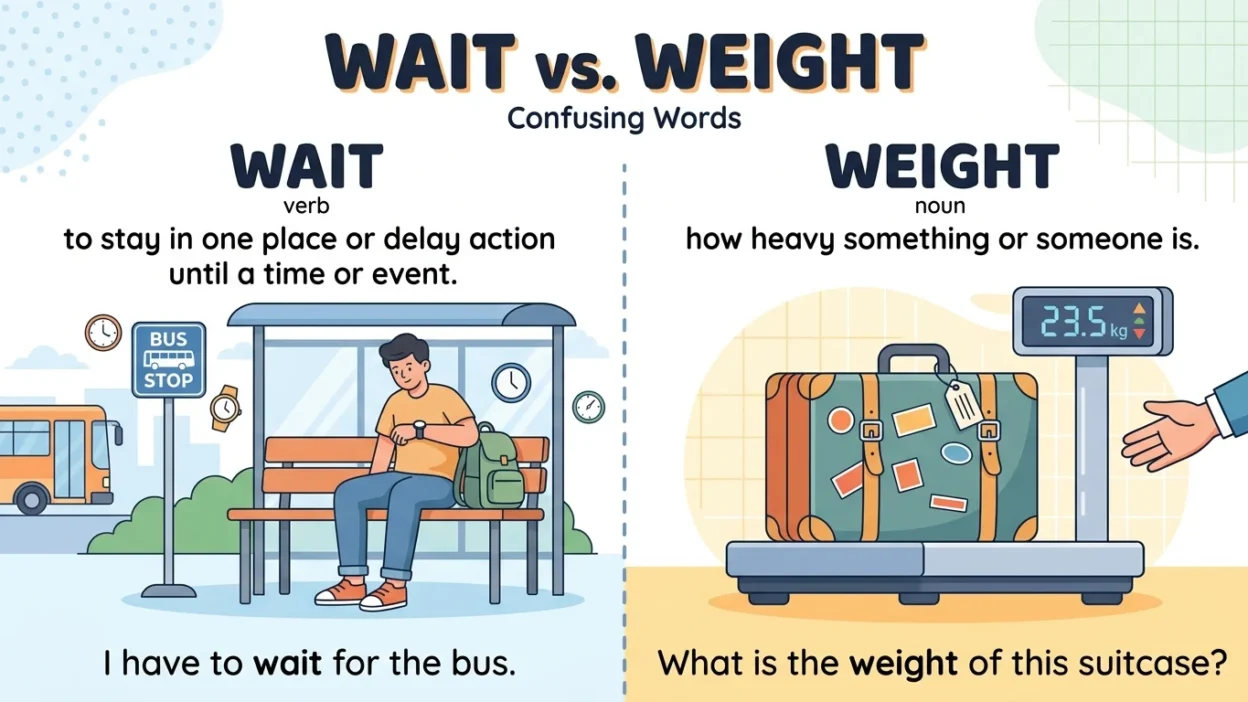
Do you sometimes confuse “wait” and “weight” when writing in English? These two words sound exactly alike in most varieties of English, but they have completely different meanings. One relates to time, while the other relates to heaviness or how heavy something is.
“Wait” is a verb that means to stay in one place or delay an action until something happens. For example, “Please wait for me outside the school.” It can also be used as a noun, as in “We had a long wait at the airport.”
“Weight” is usually a noun that refers to how heavy a person or object is. For example, “The weight of the suitcase surprised me.” It can also describe a burden or an important influence, as in “She felt the weight of her responsibilities.”
Because the words are pronounced alike, they are easy to mix up in emails, text messages, school assignments, and everyday writing. Learning their meanings, grammatical roles, and common sentence patterns will help you choose the correct word every time.
Quick Answer
Wait means to stay until something happens or someone arrives. Weight means how heavy a person or object is, or the heaviness or burden of something. The words are homophones because they usually sound alike but have different spellings and meanings. Example: “Wait for me while I check the weight of the package.”
Why Do People Confuse Wait and Weight?
People often confuse these words because they share the same pronunciation in standard English. When speaking, listeners usually understand the intended meaning from the context, but spelling the words correctly requires knowing what each one means.
Compare these sentences:
- Please wait here for five minutes.
- The box has a heavy weight.
In the first sentence, “wait” describes an action. In the second, “weight” refers to heaviness.
The spelling difference is important because using the wrong word can change the meaning of your sentence or make it grammatically incorrect.
What Does “Wait” Mean?
Wait means to remain in a place, delay an action, or allow time to pass until something happens.
It is commonly used as a verb, although it can also be a noun.
Wait as a Verb
When “wait” is a verb, it describes the action of staying until someone or something is ready or available.
Examples:
- Please wait for me outside.
- We waited for the bus for twenty minutes.
- I cannot wait to see you.
- You should wait until the traffic clears.
- She is waiting for an important phone call.
Common patterns include:
- Wait for someone or something.
- Wait until something happens.
- Wait to do something.
- Wait patiently.
Wait as a Noun
“Wait” can also refer to a period of waiting.
Examples:
- There was a long wait at the hospital.
- The wait for the results felt endless.
- We had a short wait before the meeting began.
What Does “Weight” Mean?
Weight is a noun that usually refers to how heavy a person or object is. It can also refer to a physical load, a burden, or the importance of something.
Weight as Physical Heaviness
Examples:
- The weight of the suitcase was too much for me.
- The package has a weight of five kilograms.
- She checked the weight of her luggage before the flight.
- The table can support the weight of several books.
- The weight of the baby was recorded at birth.
Weight as a Burden or Responsibility
“Weight” can also describe something that feels emotionally or mentally difficult to carry.
Examples:
- He felt the weight of his responsibilities.
- She carried the weight of the decision on her shoulders.
- The news added weight to their concerns.
Weight as Importance or Influence
The word can also mean significance or influence.
Examples:
- Her opinion carries a lot of weight.
- The evidence gave weight to his argument.
- The judge considered the weight of the testimony.
Wait vs Weight: Key Differences
| Feature | Wait | Weight |
|---|---|---|
| Main meaning | Stay until something happens | How heavy something is |
| Part of speech | Verb and noun | Mainly a noun |
| Pronunciation | /weɪt/ | /weɪt/ |
| Example | Wait for your turn. | The bag has a lot of weight. |
| Related words | Waiting, waited | Weighty, weightless |
| Common phrase | Wait for me | Lose weight |
Remember: “Wait” relates mainly to time, while “weight” relates mainly to heaviness, burden, or importance.
Wait vs Weight: Example Sentences
Here are 15 examples to help you understand the difference.
- Please wait until your name is called.
- The weight of the box made it difficult to carry.
- I had to wait for an hour at the doctor’s office.
- The luggage exceeded the airline’s weight limit.
- We should wait until everyone arrives before starting dinner.
- The weight of the evidence supported the claim.
- She told me to wait outside the classroom.
- The machine measures the weight of each package.
- I cannot wait to visit my grandparents.
- The athlete lifted a weight heavier than the previous record.
- Please wait while I check your reservation.
- The bridge must support the weight of the vehicles.
- They waited patiently for the rain to stop.
- He is trying to maintain a healthy body weight.
- Her words carried considerable weight during the discussion.
Common Expressions With “Wait” and “Weight”
These expressions will help you recognize each word in everyday English.
| Expression | Meaning | Example |
|---|---|---|
| Wait a minute | Pause briefly | Wait a minute; I forgot my keys. |
| Wait and see | Be patient until the outcome is known | We will wait and see what happens. |
| Can’t wait | Be very excited about something | I can’t wait to start my new job. |
| Wait for your turn | Remain until it is your turn | Please wait for your turn. |
| Lose weight | Become lighter in body weight | He wants to lose weight gradually. |
| Gain weight | Become heavier | Some people gain weight during the holidays. |
| Lift weights | Exercise by lifting weighted objects | She lifts weights three times a week. |
| Carry weight | Have importance or influence | His recommendation carries weight. |
How to Remember the Difference Between Wait and Weight
A simple memory trick can help you choose the correct spelling.
Wait = time.
Think about waiting for a bus, a friend, or an answer.
Weight = heaviness.
Think about weighing a suitcase, measuring a package, or lifting a heavy object.
You can also connect “weight” with the related word “weigh,” as in “weigh the bag.” Both words relate to heaviness.
Common Mistakes to Avoid
1. Writing “Weight” When You Mean “Wait”
Incorrect: “Please weight for me.”
Correct: “Please wait for me.”
You are asking someone to stay until you arrive, so the correct word is “wait.”
2. Writing “Wait” When You Mean “Weight”
Incorrect: “What is your wait?”
Correct: “What is your weight?”
The second sentence asks how heavy someone is.
3. Confusing “Wait” With “Waiting”
Use “wait” as the base form and “waiting” for continuous actions or as a noun-like form.
Examples:
- I will wait here.
- I am waiting here.
- Waiting can be difficult.
4. Confusing “Weight” With “Weigh”
“Weight” is generally a noun, while “weigh” is a verb that means to measure or have a particular heaviness.
Examples:
- The weight of the parcel is ten kilograms.
- The parcel weighs ten kilograms.
Both sentences communicate the same basic information, but the grammar is different.
Is Wait vs Weight Different in American and British English?
No significant difference exists in the meanings of “wait” and “weight” between American and British English. Both words are pronounced alike in the standard accents of both varieties.
Examples in American English:
- Please wait for me outside.
- The weight of the package is ten pounds.
Examples in British English:
- Please wait for me outside.
- The weight of the parcel is five kilograms.
The main difference in these examples is the preferred vocabulary for certain objects and the units of measurement, not the meanings of “wait” and “weight.”
Similar Words to Wait and Weight
Here are related words that can help expand your vocabulary.
Words Related to Wait
- Await: To wait for something to happen or arrive.
- Delay: To make something happen later than planned.
- Pause: To stop briefly before continuing.
- Remain: To stay in a place or condition.
- Postpone: To arrange for something to happen at a later time.
Words Related to Weight
- Weigh: To measure how heavy something is.
- Heavy: Having a lot of weight.
- Lightweight: Not heavy.
- Weightless: Having no apparent weight, especially in a scientific context.
- Weighty: Heavy or important, depending on context.
Frequently Asked Questions
1. Is it “wait” or “weight” for waiting for someone?
Use wait. For example, “I will wait for you outside the building.” It describes staying until someone arrives.
2. Is “weight” a homophone of “wait”?
Yes. In standard English pronunciation, “weight” and “wait” sound alike but have different spellings and meanings.
3. What is the difference between “wait” and “weigh”?
“Wait” means to stay until something happens. “Weigh” means to measure how heavy something is or to have a particular weight. For example, “Wait here while I weigh the parcel.”
4. Can “wait” be used as a noun?
Yes. “Wait” can refer to a period spent waiting. For example, “There was a long wait at the clinic.”
5. Is “weight” always about body weight?
No. “Weight” can refer to the heaviness of any object, a physical load, emotional responsibility, or the importance of an argument or opinion.
6. What does “carry weight” mean?
“Carry weight” means to have importance, influence, or credibility. For example, “Her recommendation carries weight with the hiring manager.”
7. How do I remember the spelling of wait and weight?
Remember that “wait” is related to time, while “weight” is related to heaviness. You can connect “weight” with “weigh,” which means to measure how heavy something is.
Remember This
Wait means to stay until something happens or someone arrives. Weight refers to heaviness, a burden, or importance.
For example, “Wait while I check the weight of your suitcase” uses both words correctly. Remember that they sound alike, but their meanings and spellings are different.
Conclusion
The difference between “wait” and “weight” is simple once you understand their meanings. “Wait” describes staying or delaying an action, while “weight” refers to how heavy something is or how much importance it carries. Both words are common in everyday English, and knowing the difference helps you avoid spelling mistakes.
Whenever you are unsure, consider what your sentence is about. If it relates to time, patience, or delaying an action, use “wait.” If it relates to heaviness, measuring an object, or importance, use “weight.” With a little practice, you will be able to use both words naturally and accurately.

Ashley Anna is the Administrator of SimileHive, dedicated to creating clear, engaging, and accurate content about similes, idioms, metaphors, and figures of speech. She helps readers improve English skills through practical examples and easy-to-understand explanations.