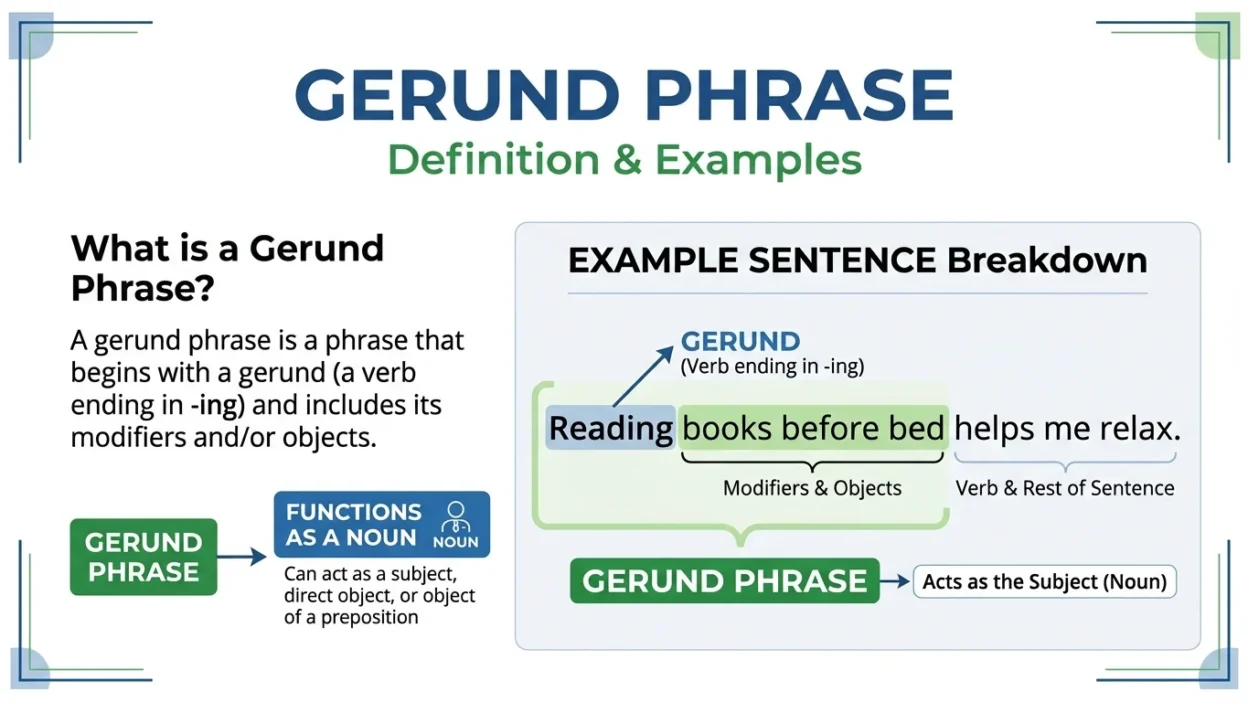
What is a gerund phrase, and how can you identify one in a sentence? A gerund phrase is a group of words that begins with a gerund, which is a verb ending in -ing that functions as a noun. It includes the gerund and any words that complete or describe its meaning.
For example, in the sentence “Swimming in the ocean is refreshing,” the phrase swimming in the ocean is a gerund phrase. The word swimming comes from the verb swim, but the entire phrase acts as the subject of the sentence.
Gerund phrases are common in everyday English, academic writing, and formal communication. They allow you to express activities, habits, interests, and actions as ideas or things. Learning how they work can help you build clearer sentences and avoid common grammar mistakes. In this guide, you will learn the definition of a gerund phrase, how to identify one, its different functions, and plenty of examples.
Quick Answer: What Is a Gerund Phrase?
A gerund phrase is a group of words that begins with a gerund, an -ing form of a verb used as a noun. It includes the gerund and its related words. For example, “Reading books before bed” is a gerund phrase in the sentence “Reading books before bed helps me relax.”
What Is a Gerund?
A gerund is a verb form ending in -ing that functions as a noun.
Examples:
- Swimming is enjoyable.
- I love reading.
- Cooking takes patience.
- She enjoys painting.
In these sentences, swimming, reading, cooking, and painting name activities. They function as nouns, even though they come from verbs.
A gerund can appear by itself or as part of a longer gerund phrase.
Compare these examples:
- Reading helps me relax.
Reading is a gerund. - Reading mystery novels helps me relax.
Reading mystery novels is a gerund phrase.
The second example contains the gerund reading and the words mystery novels, which complete its meaning.
What Is a Gerund Phrase?
A gerund phrase contains a gerund along with its objects, modifiers, or other related words.
Examples:
- Walking in the park improves my mood.
- She enjoys playing the piano.
- Learning a new language takes time.
- He is interested in collecting old coins.
- Eating too much sugar can affect your health.
In each example, the entire bold phrase functions as a noun within the sentence.
A gerund phrase can include:
- A gerund, such as reading or running
- An object, such as books or a marathon
- Modifiers, such as quickly, carefully, or every morning
- Prepositional phrases, such as in the park or before breakfast
How to Identify a Gerund Phrase
Use these simple steps to identify a gerund phrase in a sentence.
- Find the -ing word. Look for a word such as reading, swimming, writing, or dancing.
- Check its function. Ask whether the word or phrase is acting as a noun.
- Find the related words. Identify any objects, modifiers, or other words that belong to the gerund.
- Read the whole phrase. Check whether the complete phrase acts as a subject, object, or another noun-like element.
Example:
“Playing football after school keeps the children active.”
- Gerund: Playing
- Related words: football after school
- Gerund phrase: Playing football after school
- Function: Subject of the sentence
Remember that not every -ing word is a gerund. In “The children are playing football,” playing is part of the verb phrase are playing, not a gerund.
Gerund Phrase Examples With Explanations
Here are 15 examples that show how gerund phrases work in sentences.
| Sentence | Gerund phrase | Function |
|---|---|---|
| Reading every night improves vocabulary. | Reading every night | Subject |
| I enjoy listening to music. | Listening to music | Direct object |
| She is good at solving puzzles. | Solving puzzles | Object of a preposition |
| Cooking for my family makes me happy. | Cooking for my family | Subject |
| He loves playing video games. | Playing video games | Direct object |
| They talked about moving to Canada. | Moving to Canada | Object of a preposition |
| Exercising regularly improves health. | Exercising regularly | Subject |
| We finished cleaning the kitchen. | Cleaning the kitchen | Direct object |
| She apologized for arriving late. | Arriving late | Object of a preposition |
| Writing short stories develops creativity. | Writing short stories | Subject |
| I dislike waiting in long lines. | Waiting in long lines | Direct object |
| He succeeded by working hard. | Working hard | Object of a preposition |
| Traveling around the world is exciting. | Traveling around the world | Subject |
| They considered buying a new car. | Buying a new car | Direct object |
| Learning English takes practice. | Learning English | Subject |
These examples show that a gerund phrase can appear in different parts of a sentence while functioning as a noun.
What Are the Functions of a Gerund Phrase?
A gerund phrase can perform several grammatical functions.
1. Gerund Phrase as a Subject
A gerund phrase can act as the subject of a sentence. It tells you what the sentence is about.
Examples:
- Walking every morning keeps me healthy.
- Studying before an exam improves preparation.
- Helping others brings satisfaction.
- Eating a balanced diet supports good health.
- Traveling with friends creates lasting memories.
In each sentence, the gerund phrase performs the action or names the activity being discussed.
2. Gerund Phrase as a Direct Object
A gerund phrase can act as the direct object of a verb. It tells you what someone enjoys, dislikes, finishes, considers, or avoids.
Examples:
- I enjoy reading historical novels.
- She finished writing her assignment.
- They considered moving to another city.
- He avoids driving during rush hour.
- We practice speaking English every day.
The gerund phrase answers the question “What?” after the main verb.
3. Gerund Phrase as the Object of a Preposition
A gerund phrase can follow a preposition such as at, by, for, about, without, or after.
Examples:
- She is interested in learning French.
- He left without saying goodbye.
- They succeeded by working together.
- I am tired of waiting for the bus.
- After finishing the project, we went home.
In these examples, the gerund phrase follows a preposition and acts as its object.
4. Gerund Phrase as a Subject Complement
A gerund phrase can follow a linking verb and identify or describe the subject.
Examples:
- My favorite activity is reading science fiction.
- Her biggest challenge was learning to drive.
- His main responsibility is training new employees.
- Their hobby is collecting rare books.
Here, each gerund phrase identifies the activity or responsibility being discussed.
Gerund Phrase vs Gerund: What Is the Difference?
A gerund is a single -ing form functioning as a noun. A gerund phrase includes the gerund and its related words.
| Gerund | Gerund phrase | Example |
|---|---|---|
| Reading | Reading interesting books | Reading interesting books improves vocabulary. |
| Swimming | Swimming in cold water | Swimming in cold water can be challenging. |
| Cooking | Cooking dinner for everyone | Cooking dinner for everyone takes time. |
| Dancing | Dancing gracefully on stage | Dancing gracefully on stage requires practice. |
| Writing | Writing a detailed report | Writing a detailed report takes concentration. |
The gerund is the central word, while the gerund phrase includes the additional words that complete the idea.
Gerund Phrase vs Infinitive Phrase
Gerund phrases and infinitive phrases can sometimes perform similar functions, but they have different forms.
A gerund phrase begins with an -ing form used as a noun. An infinitive phrase usually begins with to followed by the base form of a verb.
| Feature | Gerund phrase | Infinitive phrase |
|---|---|---|
| Form | Verb + -ing and related words | To + base verb and related words |
| Example | Reading before bed | To read before bed |
| Sentence | Reading before bed relaxes me. | To read before bed is relaxing. |
| Common function | Subject, object, or object of a preposition | Subject, object, or purpose |
| Meaning | Often names an activity | Often expresses an action, goal, or purpose |
Some verbs can take either a gerund or an infinitive, while others require a particular form. The choice may also change the meaning in some sentences.
Gerund Phrase vs Participial Phrase
Both gerunds and participles can end in -ing, but they serve different grammatical functions.
A gerund phrase functions as a noun. A participial phrase functions as an adjective and describes a noun or pronoun.
Compare these sentences:
- Running along the beach is relaxing.
Running along the beach is a gerund phrase acting as the subject. - The girl, running along the beach, waved at us.
Running along the beach is a participial phrase describing the girl.
Another comparison:
- Baking cakes for friends is enjoyable.
The phrase acts as a noun. - The woman baking cakes for friends is my aunt.
The phrase describes the woman.
The best way to distinguish them is to look at their function, not just the -ing ending.
Common Mistakes With Gerund Phrases
Mistake 1: Assuming Every -ing Word Is a Gerund
Incorrect explanation: Every word ending in -ing is a gerund.
Correct explanation: An -ing word may be a gerund, a participle, or part of a progressive verb phrase.
Examples:
- Swimming is my favorite activity. Gerund.
- The swimming children laughed. Participle.
- The children are swimming. Part of a verb phrase.
Mistake 2: Confusing the Gerund With the Entire Phrase
In “Reading books before bed helps me sleep,” the gerund is reading, but the full gerund phrase is reading books before bed.
Recognizing the complete phrase helps you understand the sentence structure.
Mistake 3: Using an Infinitive After a Preposition
Incorrect: She is interested in to learn Spanish.
Correct: She is interested in learning Spanish.
When a verb follows a preposition, the gerund form is normally used.
Mistake 4: Confusing a Gerund Phrase With a Participial Phrase
Compare:
- Walking through the garden is peaceful. Gerund phrase.
- The man walking through the garden waved. Participial phrase.
The first phrase acts as a noun. The second describes a person.
A Simple Memory Trick
Remember this rule:
A gerund phrase names an activity.
Ask yourself whether the phrase can be understood as the name of an activity or action.
For example:
- Reading books is enjoyable.
- I enjoy reading books.
- She is interested in reading books.
In all three sentences, reading books names an activity and functions as a noun-like unit.
Frequently Asked Questions
1. What is a gerund phrase in simple words?
A gerund phrase is a group of words that begins with an -ing verb form used as a noun. For example, “Playing football after school” is a gerund phrase in “Playing football after school is fun.”
2. What is an example of a gerund phrase?
“Learning a new language takes patience” contains the gerund phrase learning a new language. The phrase acts as the subject of the sentence.
3. Can a gerund phrase be the subject of a sentence?
Yes. For example, “Eating breakfast before school gives me energy.” The phrase eating breakfast before school is the subject.
4. Can a gerund phrase be an object?
Yes. In “I enjoy watching movies,” the phrase watching movies is the direct object of enjoy.
5. What is the difference between a gerund and a gerund phrase?
A gerund is the -ing verb form used as a noun, such as reading. A gerund phrase includes the gerund and related words, such as reading an interesting book.
6. How can I identify a gerund phrase?
Find an -ing form, check whether it functions as a noun, and identify the words connected to it. For example, in “Running in the morning helps me focus,” the gerund phrase is running in the morning.
7. What is the difference between a gerund phrase and a participial phrase?
A gerund phrase functions as a noun, while a participial phrase describes a noun or pronoun. In “Swimming is fun,” swimming is a gerund. In “The swimming child smiled,” swimming is a participle describing child.
8. Do gerund phrases always begin with an -ing word?
Yes, a gerund phrase is built around a gerund, which is an -ing form of a verb functioning as a noun. However, not every phrase beginning with an -ing word is a gerund phrase because the word may function as a participle or part of a verb phrase.
Remember This
- A gerund is an -ing form of a verb that functions as a noun.
- A gerund phrase contains the gerund and its related words.
- Gerund phrases can act as subjects, objects, objects of prepositions, and subject complements.
- Not every -ing word is a gerund.
- A gerund phrase names an activity, while a participial phrase describes a noun or pronoun.
Conclusion
A gerund phrase is an important part of English grammar because it allows an action to function as a noun. It begins with a gerund and includes related words that complete its meaning. For example, writing clear sentences, playing the piano, and walking in the park are all gerund phrases when they function as nouns in their sentences.
To identify a gerund phrase, look for an -ing form, examine its grammatical role, and include the words that belong to it. With practice, you will be able to distinguish gerund phrases from infinitive phrases and participial phrases, helping you write clearer and more accurate English.

Lucas Luke is a passionate language writer and content creator at SimileHive, specializing in similes, idioms, metaphors, and figurative language. He enjoys making complex English expressions simple, engaging, and easy to understand for students, writers, and language enthusiasts through well-researched, practical content.