Writing the time correctly in English is an important skill for students, English learners, and anyone who wants to communicate clearly. Whether you are writing a formal email, completing a school assignment, making an appointment, or sending a text message, knowing how to write the time helps you avoid confusion.
English uses several common formats, including the 12-hour clock with AM and PM and the 24-hour clock. You can also write time in words, such as “half past three” or “a quarter to six.”
The correct format often depends on the situation. In everyday writing, you might write “7:30 AM,” while a formal schedule may use “07:30” or “0730 hours.” Punctuation, capitalization, spacing, and regional preferences can also affect how time is written. In this guide, you will learn the main rules for writing the time, explore practical examples, understand common mistakes, and discover when to use each format.
Quick Answer: How Do You Write the Time in English?
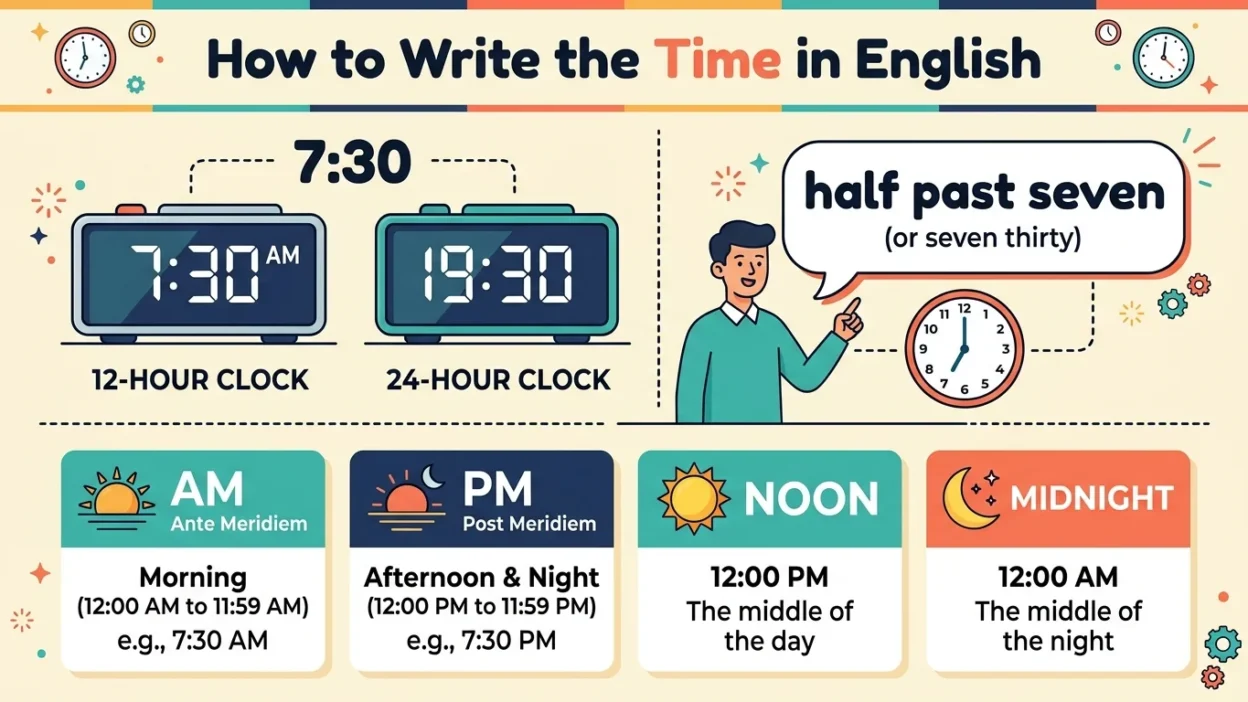
You can write the time using numbers, words, or both. In the 12-hour format, write 7:30 AM or 7:30 PM to distinguish morning from evening. In the 24-hour format, write 07:30 or 19:30. In words, you can write “half past seven.” Choose the format that suits your audience and context.
Why Is Writing the Time Sometimes Confusing?
Time can be written in different ways, and more than one format may be correct. For example, 6:00 PM, 18:00, and six o’clock in the evening all communicate the same time.
People often become confused about:
- Whether to use AM and PM.
- Whether to write a leading zero, as in 07:05.
- Whether to use a colon or a full stop.
- Whether to write time in numbers or words.
- How to write noon and midnight.
- Whether to use a space before AM or PM.
The best choice depends on the purpose of your writing. A casual message, an academic paper, a timetable, and a formal invitation may follow different style conventions.
1. How to Write Time Using the 12-Hour Clock
The 12-hour clock divides the day into two periods: before noon and after noon. It uses the numbers 1 through 12, along with AM or PM when clarification is needed.
What Do AM and PM Mean?
- AM refers to the period from midnight up to, but not including, noon.
- PM refers to the period from noon up to, but not including, midnight.
Examples:
| Time | Meaning |
|---|---|
| 6:00 AM | Six in the morning |
| 9:15 AM | Nine fifteen in the morning |
| 12:00 PM | Noon |
| 3:30 PM | Half past three in the afternoon |
| 7:45 PM | Seven forty-five in the evening |
| 11:00 PM | Eleven at night |
You can write AM and PM in uppercase or lowercase, depending on the style you follow. Common alternatives include “a.m.” and “p.m.”
Examples:
- The class begins at 8:00 AM.
- The shop closes at 9:30 p.m.
- Our meeting is scheduled for 2:15 PM.
For consistency, choose one style and use it throughout the same document.
2. How to Write Time Using the 24-Hour Clock
The 24-hour clock counts the hours from 00 to 23. It is common in transport schedules, military contexts, healthcare settings, and many official timetables.
In this format, you do not need AM or PM.
| 12-Hour Format | 24-Hour Format |
|---|---|
| 12:00 AM | 00:00 |
| 5:00 AM | 05:00 |
| 8:30 AM | 08:30 |
| 12:00 PM | 12:00 |
| 2:45 PM | 14:45 |
| 6:00 PM | 18:00 |
| 9:30 PM | 21:30 |
| 11:59 PM | 23:59 |
Rules for Writing the 24-Hour Time
- Use two digits for the hour when following the standard
HH:MMformat. - Use a leading zero for hours before 10, such as 07:15.
- Do not add AM or PM.
- Remember that 12:00 is noon and 00:00 is midnight in the usual 24-hour convention.
Examples:
- The train leaves at 06:45.
- The appointment is at 13:30.
- The flight arrives at 22:10.
Some style guides and digital systems omit the leading zero in certain contexts, but two-digit hours are common in formal 24-hour schedules.
3. How to Write Time in Words
You can also write the time using words, particularly in conversation, stories, informal messages, and some types of formal prose.
Here are common expressions:
| Digital Time | Time in Words |
|---|---|
| 2:00 | Two o’clock |
| 2:15 | A quarter past two |
| 2:30 | Half past two |
| 2:45 | A quarter to three |
| 3:10 | Ten past three |
| 3:50 | Ten to four |
| 4:20 | Twenty past four |
| 5:40 | Twenty to six |
These expressions are especially common in British English. American English speakers also use them, although expressions such as “two fifteen” and “two forty-five” are common in everyday speech.
Examples in sentences:
- The meeting starts at half past nine.
- We reached the station at a quarter to six.
- Dinner will be served at seven o’clock.
- The bus arrives at ten past eight.
You can write “o’clock” only for exact hours, such as “five o’clock.” Do not write “five thirty o’clock.”
4. Should You Write the Time in Numbers or Words?
Both formats are correct, but each works better in different situations.
| Situation | Recommended Format | Example |
|---|---|---|
| Text messages | Numbers | See you at 6:30. |
| Business emails | Numbers | The meeting starts at 10:00 AM. |
| Stories and creative writing | Often words in narrative prose | It was half past midnight. |
| Timetables | Numbers | Departure: 14:25 |
| Invitations | Either, depending on style | Seven o’clock in the evening |
| Technical schedules | Often 24-hour time | Start time: 16:00 |
In general, numbers make schedules and precise instructions easy to scan. Words can make ordinary prose sound more natural, especially when time is part of a story.
5. How to Write Noon and Midnight
Noon and midnight are special cases because they mark the transition between AM and PM.
- Noon means 12:00 in the middle of the day.
- Midnight means 12:00 at the beginning of a new day.
You may see noon written as 12:00 PM and midnight as 12:00 AM, but these expressions can be confusing to some readers. In important schedules, writing “noon” or “midnight” is often clearer.
Examples:
- The event begins at noon.
- The train departs at midnight.
- Lunch is served at 12 noon.
- The deadline is midnight on Friday.
If a deadline falls at midnight, specify the date clearly. For example, “midnight at the end of Friday” is less ambiguous than simply writing “midnight Friday.”
6. Punctuation and Spacing Rules for Writing Time
Use a Colon Between Hours and Minutes
In standard English writing, a colon is commonly used to separate hours and minutes.
Correct:
- 8:30 AM
- 11:45 PM
- 16:20
A full stop is used in some regional styles, including certain British contexts, but the colon is widely understood internationally.
Leave a Space Before AM or PM
A common format is to place a space between the time and AM or PM.
Preferred in many styles:
- 9:00 AM
- 4:30 PM
Some publications use compact forms such as 9AM. Follow the style guide or format required for your document.
Use Minutes When Needed
If the time is an exact hour, you can write “7 AM” or “7:00 AM.” Both are widely understood. In a formal timetable, including minutes can improve consistency.
Examples:
- The office opens at 9 AM.
- The interview begins at 9:00 AM.
Avoid Mixing Formats
Do not combine the 24-hour clock with AM or PM.
Incorrect: 18:30 PM
Correct: 18:30
Also correct: 6:30 PM
7. Common Mistakes When Writing the Time
Mistake 1: Confusing AM and PM
Incorrect for an evening meeting: The meeting starts at 7:00 AM.
Correct: The meeting starts at 7:00 PM.
AM and PM identify different periods of the day, so check that the label matches your intended time.
Mistake 2: Writing 12 AM When You Mean Noon
If you mean the middle of the day, use “noon” or “12:00 PM.”
If you mean the middle of the night, use “midnight” or “12:00 AM.”
Mistake 3: Adding AM or PM to the 24-Hour Clock
Incorrect: The train leaves at 21:00 PM.
Correct: The train leaves at 21:00.
Mistake 4: Using “O’Clock” With Minutes
Incorrect: It is six thirty o’clock.
Correct: It is six thirty.
Also correct: It is half past six.
Mistake 5: Forgetting to Clarify the Time Period
The sentence “The appointment is at 8:00” may be unclear if the reader does not know whether you mean morning or evening.
Clearer: The appointment is at 8:00 AM.
If the context already makes the time clear, AM or PM may not be necessary.
8. Examples of Writing the Time in Sentences
Here are practical examples of how to write time in different contexts.
- My school starts at 8:00 AM.
- The doctor will see you at 10:30 AM.
- We usually have dinner at 7 PM.
- The train departs at 18:45.
- Please arrive by 9:15 in the morning.
- The movie begins at half past eight.
- The store closes at midnight.
- The meeting will finish at 4:00 PM.
- Our flight is scheduled to depart at 06:20.
- I went to bed at eleven o’clock last night.
- The library opens at 9 AM and closes at 5 PM.
- The presentation is scheduled for 14:00.
Notice that each sentence uses a format suited to its context. You do not need to spell out every time in words, and you do not always need to include minutes for exact hours.
9. American English vs British English: Writing the Time
American and British English use many of the same time formats, but style preferences can differ.
| Feature | American English | British English |
|---|---|---|
| Numeric time | 3:30 PM | 3:30 pm or 3.30 pm in some styles |
| Spoken time | Three thirty | Half past three or three thirty |
| AM/PM punctuation | AM/PM or a.m./p.m. | am/pm or a.m./p.m. |
| 24-hour clock | Common in specific settings | Common in transport and official schedules |
These are tendencies, not strict rules. Both varieties use the 12-hour and 24-hour clocks. When writing for an organization, use its preferred style consistently.
10. How to Choose the Best Time Format
Ask yourself three questions:
- Who will read it? A casual message may use “6 PM,” while a transport timetable may use “18:00.”
- Could the time be misunderstood? Include AM or PM, or use the 24-hour clock, when clarity matters.
- Is there a required style? Follow the instructions for a school assignment, workplace document, or publication.
For everyday writing, formats such as “7:30 AM” and “7:30 PM” are clear and familiar. For official schedules, “07:30” and “19:30” can prevent confusion.
Frequently Asked Questions
1. Is it correct to write 7 AM or 7:00 AM?
Yes. Both are correct in ordinary writing. “7 AM” is concise, while “7:00 AM” includes the minutes and may fit better in a schedule where all times use the same format.
2. How do you write 12 noon correctly?
You can write “noon” or “12:00 PM.” Writing “noon” is often clearer because it avoids confusion about AM and PM.
3. How do you write midnight correctly?
You can write “midnight” or “12:00 AM.” For deadlines and travel schedules, adding the date or saying “midnight at the start of Monday” can prevent misunderstandings.
4. Should AM and PM be capitalized?
AM and PM are common forms. A.M. and P.M., as well as am and pm, are also used in different style guides. Choose one convention and use it consistently.
5. Do you put a space between the time and AM or PM?
Many style guides prefer a space, as in “8:30 AM.” Some styles omit the space. Follow the relevant style guide and avoid switching formats within the same document.
6. Is 18:00 the same as 6 PM?
Yes. In the 24-hour clock, 18:00 is equivalent to 6:00 PM in the 12-hour clock.
7. Should time be written in words or numbers?
Both are correct. Numbers are usually easier to read in schedules, appointments, and instructions. Words often work well in stories and narrative writing. The best choice depends on context and consistency.
Remember This
- Use AM for times before noon and PM for times from noon until before midnight.
- Use 07:30 or 19:30 for the 24-hour clock.
- Write half past seven or a quarter to eight when expressing time in words.
- Use a colon between hours and minutes in the common numeric format.
- Write noon and midnight when you want to avoid ambiguity.
- Keep your formatting consistent throughout the document.
Conclusion
Writing the time correctly in English is straightforward once you understand the common formats. You can use the 12-hour clock with AM and PM, the 24-hour clock for schedules, or words such as “half past six” in ordinary prose. Each format serves a useful purpose.
The most important rule is to make your meaning clear. Choose a format that suits your audience, follow any relevant style guide, and use it consistently. With these simple habits, you can write the time accurately in messages, schoolwork, professional documents, and everyday communication.

Adam Aaron is a language enthusiast and content writer at SimileHive, creating clear, engaging guides on similes, idioms, metaphors, and figurative language to help readers improve English confidently every day.