Have you ever wondered whether to use awaiting or waiting in a sentence? Both words describe situations in which someone expects something to happen or someone to arrive. However, they are not always used in the same way. Understanding the difference between awaiting and waiting can help you write more naturally, communicate clearly, and avoid common grammar mistakes.
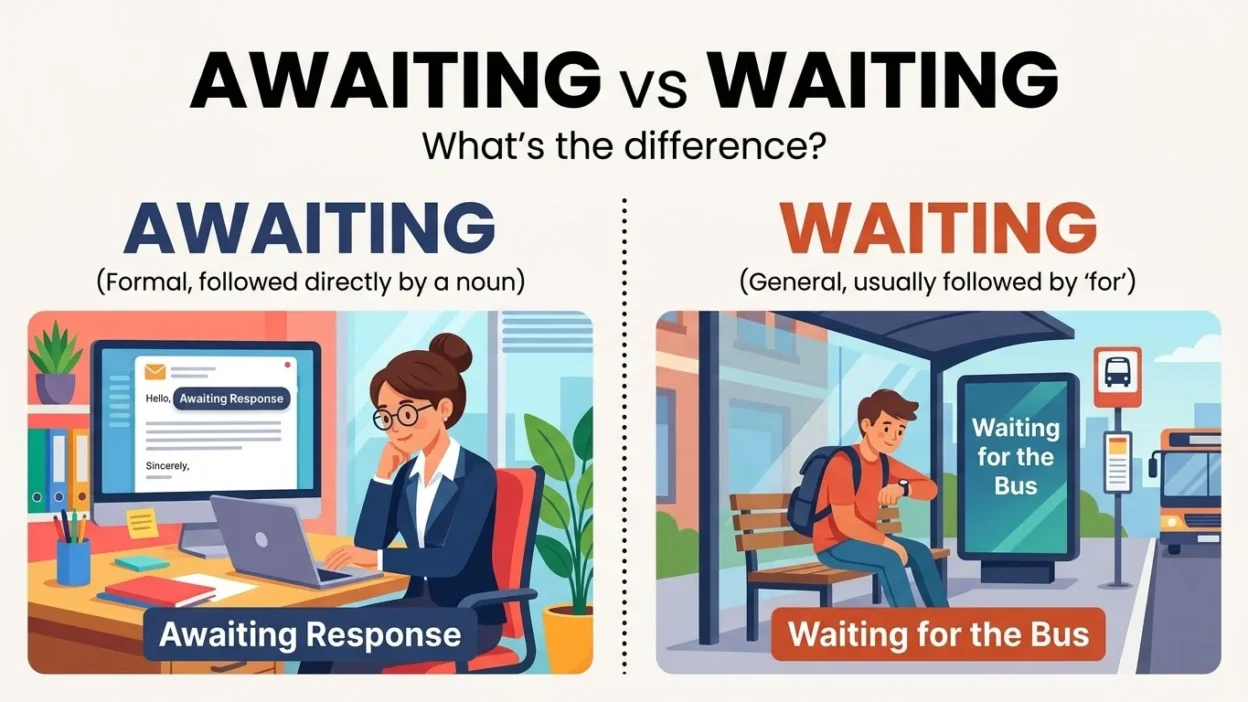
The main difference is that awaiting usually takes a direct object, while waiting often uses the preposition “for” before the person or thing expected. For example, you can say “I am awaiting your response” or “I am waiting for your response.” Both sentences are correct, but they have slightly different tones. “Awaiting” sounds more formal, while “waiting for” is more common in everyday conversation.
In this guide, you will learn the meanings of awaiting and waiting, how to use each word correctly, and how their grammar differs. You will also find practical examples, common mistakes, a comparison table, and answers to frequently asked questions.
Quick Answer: What Is the Difference Between Awaiting and Waiting?
Awaiting means expecting or anticipating something, usually with a direct object and without “for.” Waiting means staying in a place or delaying action until someone or something arrives or happens. It commonly appears as “waiting for.” For example, “I am awaiting your reply” and “I am waiting for your reply” are both correct.
Why Do People Confuse Awaiting and Waiting?
People confuse these words because they often communicate the same basic idea: expecting someone or something.
For example:
- I am awaiting the results.
- I am waiting for the results.
Both sentences mean that the speaker expects the results. The difference lies mainly in grammar and tone.
There are three important distinctions to remember:
- Grammar: Awaiting generally takes a direct object, while waiting commonly uses “for” to introduce the expected person or thing.
- Tone: Awaiting often sounds more formal or professional. Waiting is more common in casual speech.
- Meaning: Waiting can describe staying somewhere, delaying an action, or expecting something. Awaiting focuses more directly on what is expected.
What Does Awaiting Mean?
Awaiting is the present participle of the verb await. It means expecting or waiting for something to happen or for someone or something to arrive.
It is often used in formal writing, business communication, official notices, and professional messages.
Examples of Awaiting in Sentences
- I am awaiting your response to my email.
- The students are awaiting their examination results.
- We are awaiting approval from the manager.
- She is awaiting a decision from the court.
- The patient is awaiting the doctor’s examination.
- Our team is awaiting further instructions.
- The company is awaiting payment from its client.
- He is awaiting confirmation of his booking.
- The applicants are awaiting the final selection list.
- We are awaiting news about the project.
Grammar Rule for Awaiting
In standard English, await normally takes a direct object. This means you generally place the expected person, event, or thing directly after the verb.
Correct examples:
- We are awaiting your reply.
- She is awaiting the results.
- They are awaiting a decision.
Avoid adding “for” after await when it introduces the expected thing.
Incorrect in standard English: We are awaiting for your reply.
Correct: We are awaiting your reply.
What Does Waiting Mean?
Waiting is the present participle of the verb wait. It means remaining in a place, delaying an action, or expecting someone or something to arrive or happen.
In everyday English, it commonly appears in the expression “waiting for.”
Examples of Waiting in Sentences
- I am waiting for the bus.
- She is waiting for her friend outside the school.
- We are waiting for the food to arrive.
- He is waiting for his examination results.
- They are waiting for the manager to make a decision.
- The children are waiting for their parents.
- I have been waiting for your call all morning.
- Please wait for me near the entrance.
- The passengers are waiting for the train.
- She is waiting for an opportunity to prove herself.
Grammar Rule for Waiting
When you mention the person or thing you expect, wait commonly takes the preposition “for.”
Correct examples:
- I am waiting for you.
- She is waiting for the results.
- We are waiting for the meeting to begin.
However, wait does not always require “for.”
Examples:
- Please wait here.
- We waited patiently.
- I cannot wait to see you.
In the last sentence, “cannot wait to” expresses eagerness rather than simply describing a delay.
Awaiting vs Waiting: Key Differences
| Feature | Awaiting | Waiting |
|---|---|---|
| Base verb | Await | Wait |
| Main meaning | Expecting something to happen or arrive | Staying, delaying, or expecting |
| Common structure | Awaiting + direct object | Waiting + for + object |
| Tone | Often formal | Neutral and conversational |
| Everyday use | Common in professional writing | Very common in speech and writing |
| Example | We are awaiting approval. | We are waiting for approval. |
When Should You Use Awaiting?
Use awaiting when you want to express that someone expects a response, decision, result, approval, or other event. It is especially useful in formal and professional contexts.
1. In Business Emails
- We are awaiting your confirmation.
- I am awaiting your feedback on the proposal.
- The finance department is awaiting payment.
2. In Official or Formal Writing
- The court is awaiting further evidence.
- The applicants are awaiting the final decision.
- The department is awaiting an official report.
3. When You Want a Concise Sentence
- Awaiting your response.
- Awaiting further instructions.
- Awaiting approval.
These short expressions are common in notes, subject lines, and brief professional messages. In a complete sentence, you could write, “I am awaiting your response.”
When Should You Use Waiting?
Use waiting in everyday conversations and whenever you want to describe remaining somewhere, delaying an action, or expecting someone or something.
1. In Everyday Conversation
- I am waiting for my friend.
- We are waiting for the bus.
- Are you waiting for someone?
2. When Describing a Delay
- I have been waiting for an hour.
- We are waiting for the rain to stop.
- The customers are waiting outside.
3. When Talking About Future Events
- I am waiting for the right moment.
- She is waiting for an opportunity.
- We are waiting for the results.
Waiting is usually the more natural choice when speaking casually with friends, family, or colleagues.
Awaiting vs Waiting: Examples Side by Side
The following examples show how both words can express a similar idea.
| With Awaiting | With Waiting |
|---|---|
| I am awaiting your reply. | I am waiting for your reply. |
| She is awaiting the results. | She is waiting for the results. |
| We are awaiting approval. | We are waiting for approval. |
| They are awaiting further instructions. | They are waiting for further instructions. |
| He is awaiting a decision. | He is waiting for a decision. |
| The team is awaiting confirmation. | The team is waiting for confirmation. |
Both versions are grammatically correct. The awaiting versions often sound more formal, while the waiting versions tend to sound more conversational.
Common Mistakes with Awaiting and Waiting
Mistake 1: Using “For” After Awaiting
Incorrect in standard English: I am awaiting for your email.
Correct: I am awaiting your email.
Also correct: I am waiting for your email.
Mistake 2: Forgetting “For” After Waiting
Awkward in standard English when referring to an expected person or thing: I am waiting you.
Correct: I am waiting for you.
Remember that wait commonly uses “for” before the person or thing expected.
Mistake 3: Thinking Awaiting Is Always Better
Some writers use awaiting because they think it sounds more professional. However, waiting for is also correct in formal communication.
For example:
- We are awaiting your decision.
- We are waiting for your decision.
Both are suitable for a professional email. Choose the wording that sounds most natural for your context.
Mistake 4: Confusing Waiting with Waiting for
The word waiting can stand alone when the context is clear.
Examples:
- I am waiting.
- Please keep waiting.
- We waited for two hours.
Use “for” when you need to identify the person or thing expected, as in “I am waiting for the doctor.”
Memory Trick: How to Remember the Difference
Use this simple trick:
Awaiting + something
Waiting + for + something
Examples:
- I am awaiting a reply.
- I am waiting for a reply.
Think of awaiting as a more formal, direct way to express expectation. Think of waiting for as the everyday expression you are likely to use in conversation.
Remember that “waiting” can also stand alone, as in “I am waiting here.”
Are Awaiting and Waiting the Same in American and British English?
Yes. The basic meanings and grammar of awaiting and waiting are the same in American and British English.
Both varieties use expressions such as:
- We are awaiting your response.
- We are waiting for the train.
- She is awaiting the results.
- He is waiting for his friend.
The main difference is not regional. It is the level of formality and the grammatical structure of the sentence. In both American and British English, awaiting often sounds more formal, while waiting for is common in everyday communication.
Similar Words and Expressions
Here are some related words and expressions that can help you communicate more precisely.
| Word or Expression | Meaning | Example |
|---|---|---|
| Expecting | Believing something will happen or arrive | I am expecting a call. |
| Anticipating | Looking forward to or expecting something | We are anticipating a busy day. |
| Looking forward to | Feeling pleased or excited about something expected | I am looking forward to meeting you. |
| Pending | Awaiting a decision or completion | The application is pending approval. |
| On hold | Temporarily delayed or paused | The project is on hold. |
| Waiting for | Expecting someone or something | She is waiting for the doctor. |
These expressions are related, but they are not always interchangeable. For example, looking forward to usually suggests a positive feeling, while awaiting does not necessarily express excitement.
Frequently Asked Questions
1. Is awaiting or waiting correct?
Both are correct. Use awaiting when you want to express expectation, often in a formal tone. Use waiting for general situations, especially in everyday conversation. For example, “I am awaiting a reply” and “I am waiting for a reply” are both correct.
2. Is it awaiting or waiting for?
Use awaiting something or waiting for something.
Correct: I am awaiting your response.
Correct: I am waiting for your response.
In standard English, do not normally write “I am awaiting for your response.”
3. Can I say “I am awaiting your response”?
Yes. “I am awaiting your response” is grammatically correct and common in professional communication. It means that you expect the other person to reply.
4. Can I say “I am waiting your response”?
In standard English, this is generally incorrect when you mean that you expect someone to respond. Say “I am waiting for your response” or “I am awaiting your response.”
5. Is awaiting more formal than waiting?
Usually, yes. Awaiting often sounds more formal or businesslike. Waiting for is more common in everyday speech. However, both can be appropriate in professional writing.
6. Is “awaiting approval” correct?
Yes. “Awaiting approval” is a correct and widely used expression. It means that a person, request, or process is waiting for someone to approve it.
Example: “The application is awaiting approval.”
7. Can awaiting and waiting be used in the same sentence?
Yes, if they describe different things or actions.
Example: “We are awaiting the final decision while waiting for the manager to return.”
Here, awaiting the final decision describes what is expected, while waiting for the manager to return describes the other expected event.
Remember This
The easiest way to remember the difference is that awaiting usually takes a direct object, while waiting commonly uses “for” before the person or thing expected.
- Awaiting your reply.
- Waiting for your reply.
- Awaiting approval.
- Waiting for approval.
Both forms can be correct, and the choice often depends on tone and context.
Conclusion
Awaiting and waiting have similar meanings, but their grammar and tone differ. Awaiting is often used in formal writing and generally takes a direct object without “for.” Waiting is more common in everyday English and usually takes “for” when you identify the person or thing expected.
Choose the expression that best suits your sentence. In a professional email, “I am awaiting your response” is concise and formal. In a casual conversation, “I am waiting for your response” sounds natural and clear. Understanding this small difference will help you use both expressions confidently.

Lucas Luke is a passionate language writer and content creator at SimileHive, specializing in similes, idioms, metaphors, and figurative language. He enjoys making complex English expressions simple, engaging, and easy to understand for students, writers, and language enthusiasts through well-researched, practical content.