Have you ever wondered whether to use presume or assume in a sentence? These two words are often used interchangeably because both describe accepting something as true without having complete proof. However, there is a subtle difference between them. Understanding this difference can help you choose the right word in conversations, professional emails, academic writing, and everyday situations.
The main difference is that assume usually means accepting something as true without checking whether it is true, while presume often suggests that you have some reason, evidence, or expectation to believe it is true. For example, “I assumed you were busy” means you believed the person was busy without confirming it. “I presumed you were busy” can suggest that you had some reason to reach that conclusion.
The distinction is not absolute, and the two words sometimes have the same meaning. In this guide, you will learn what presume and assume mean, how to use them correctly, and how their meanings differ through practical examples, comparison tables, common mistakes, and frequently asked questions.
Quick Answer: What Is the Difference Between Presume and Assume?
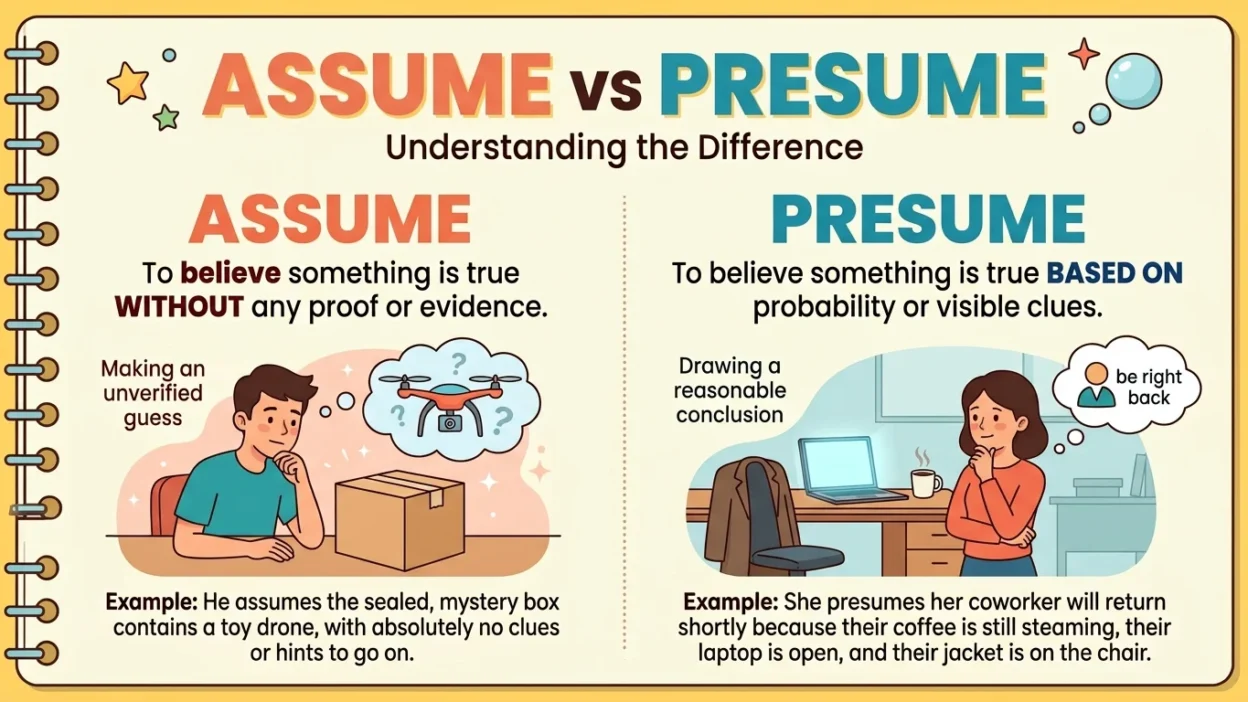
Assume means to accept something as true without proof or confirmation. Presume also means to accept something as true, but it can suggest that the belief is based on reasonable grounds, prior knowledge, or an expectation. For example, “I assumed he was at home” expresses an unverified belief, while “I presumed he was at home because his car was outside” suggests a reason for that belief.
Why Do People Confuse Presume and Assume?
People confuse these words because they share a central meaning: believing something to be true without knowing it with certainty.
Consider these examples:
- I assume she knows the answer.
- I presume she knows the answer.
Both sentences are grammatically correct. They communicate that the speaker believes the woman knows the answer, but the second sentence may sound more formal or suggest a reasonable basis for the belief.
The difference depends on context. Assume often highlights an unverified belief, while presume can highlight an inference or expectation. However, presume does not always require evidence, and assume does not always mean making a careless guess.
What Does Assume Mean?
Assume means to accept something as true without checking or proving it first. You may make an assumption based on a guess, an expectation, past experience, or incomplete information.
It is common in everyday conversation, workplace communication, academic writing, and logical reasoning.
Examples of Assume in Sentences
- I assumed you were already at home.
- She assumed that the meeting had been canceled.
- Don’t assume that everyone agrees with you.
- He assumed I knew how to use the software.
- We assumed the road would be clear.
- I mistakenly assumed that the shop was open.
- You should not assume anything without checking the facts.
- They assumed the project would be completed on time.
- I assumed you had received my email.
- The teacher assumed that all the students understood the lesson.
When Should You Use Assume?
Use assume when you want to describe accepting something as true without confirming it.
For example:
- I assumed you were joking.
- She assumed the package had arrived.
- We should not assume that the information is accurate.
You can also use assume in formal contexts to describe a condition taken as true for the purpose of reasoning.
Example: “Let us assume that the population remains constant.”
Here, the speaker is using a hypothetical condition rather than claiming that the condition is definitely true.
What Does Presume Mean?
Presume means to believe something is true based on reasonable grounds, an expectation, previous knowledge, or a convention. It can also mean to take something for granted without asking.
Presume is common in formal writing, legal contexts, professional communication, and situations where a belief is presented as a reasonable inference.
Examples of Presume in Sentences
- I presume you have already read the report.
- We presumed that the event would begin on time.
- I presume you are familiar with the new policy.
- The law may presume a person innocent until proven guilty, depending on the applicable legal system.
- She presumed that her invitation included a guest.
- I presume you have a reason for being late.
- They presumed that the road was safe to travel.
- I would presume that the manager has approved the request.
- He presumed that everyone had been informed.
- We presumed the information was correct because it came from an official source.
When Should You Use Presume?
Use presume when a belief is presented as a reasonable expectation or conclusion, especially when the context is formal.
For example:
- I presume you are ready to begin.
- We presume that the information provided is accurate.
- I presumed she had received the invitation because she replied to my message.
In these examples, the speaker expects something to be true or has a reason to believe it.
However, remember that presume does not guarantee that the belief is correct or that strong evidence exists.
Presume vs Assume: Key Differences
| Feature | Assume | Presume |
|---|---|---|
| Main meaning | Accept something as true without confirmation | Believe something is true, often based on grounds or expectation |
| Common basis | Guess, expectation, or incomplete information | Inference, prior knowledge, convention, or expectation |
| Tone | Neutral and common in everyday speech | Often somewhat more formal |
| Evidence | May or may not involve evidence | Often suggests some basis for the belief |
| Common expression | Don’t assume anything. | I presume you know. |
| Example | I assumed he was busy. | I presumed he was busy because he did not answer. |
These are general tendencies rather than strict rules. In many situations, presume and assume can be used with little difference in meaning.
Presume vs Assume: Examples Side by Side
Comparing similar sentences is one of the easiest ways to understand the difference.
| With Assume | With Presume |
|---|---|
| I assumed you were tired. | I presumed you were tired because you looked exhausted. |
| She assumed the meeting was over. | She presumed the meeting was over after everyone left. |
| I assume you have received the email. | I presume you have received the email. |
| We assumed the shop was closed. | We presumed the shop was closed because the lights were off. |
| He assumed she understood the instructions. | He presumed she understood the instructions because she had completed similar tasks before. |
The sentences with presume often provide or imply a reason for the belief. However, the words are not restricted to these patterns.
Is Presume More Formal Than Assume?
Generally, yes. Presume can sound more formal, polished, or cautious than assume. It is common in official statements, business communication, legal writing, and polite conversation.
Examples:
- I assume you have the documents.
- I presume you have the documents.
Both sentences are correct. The second may sound more formal or like a polite expectation.
In everyday conversation, however, assume is often the more natural choice.
Example: “I assumed you were coming with us.”
You could also say, “I presumed you were coming with us,” but it may sound slightly more formal depending on the context.
When Should You Use Assume?
1. When You Have Not Checked the Facts
Use assume when you accept something as true without confirmation.
Example: I assumed the restaurant was open, but it was closed.
2. When Describing a Mistaken Belief
Example: She assumed that I had ignored her message.
This sentence explains what she believed, even though her belief may have been incorrect.
3. When Making a Hypothesis
Example: Assume that the train travels at 60 kilometers per hour.
In mathematics, science, and reasoning, assume introduces a condition used to work through a problem.
4. When Giving Advice
Example: Never assume that a task is easy before you try it.
Here, assume describes accepting an idea without checking whether it is true.
When Should You Use Presume?
1. When You Have a Reason to Believe Something
Example: I presumed he was home because his car was parked outside.
The car provides a reason for the belief, although it does not prove that he was home.
2. When Expressing a Polite Expectation
Example: I presume you have received the invitation.
This is a formal way to say that you expect the invitation has arrived.
3. In Legal or Official Contexts
Example: The legal system may presume a person innocent until proven guilty.
This refers to a legal principle, but the precise wording and application depend on the jurisdiction.
4. When Taking Something for Granted
Example: He presumed that he could enter the room without asking permission.
Here, presumed describes acting as though something were permitted or accepted without confirming it.
Common Expressions With Assume and Presume
Both verbs appear in useful everyday expressions.
| Expression | Meaning | Example |
|---|---|---|
| Assume the worst | Expect the most negative outcome | Don’t assume the worst before you know the facts. |
| Assume responsibility | Accept responsibility for something | She assumed responsibility for the mistake. |
| Let’s assume | Treat something as true for discussion | Let’s assume the plan succeeds. |
| Presumably | Probably, based on what is known | Presumably, they have already left. |
| I presume so | I believe that is probably true | “Is he joining us?” “I presume so.” |
| Presume innocence | Treat someone as innocent unless guilt is established under the applicable legal standard | The principle is central to many legal systems. |
Notice that assume responsibility has a different meaning from assuming that something is true. In this expression, assume means to take on a duty or obligation.
Common Mistakes to Avoid
Mistake 1: Thinking Presume Always Means You Have Proof
Presume can suggest a reason for a belief, but it does not mean that the belief has been proven.
Example: I presumed he was at work, but he was actually at home.
The word describes the belief, not whether the belief is correct.
Mistake 2: Thinking Assume Always Means Guessing Without Any Reason
An assumption can be based on previous experience or available information. It simply means that something is accepted as true without being confirmed.
Example: I assumed the office would be open because it usually opens at nine.
Mistake 3: Using Presume Just to Sound More Intelligent
Although presume can sound more formal, it is not automatically better than assume. Choose the word that fits the situation and sounds natural.
Natural: I assumed you were busy.
Also natural: I presumed you were busy because you had several deadlines.
Mistake 4: Confusing Presume With Presumptuous
Presume means to believe something or take something for granted. Presumptuous describes behavior that is too bold, intrusive, or confident without proper justification.
Examples:
- I presume you are available tomorrow.
- It was presumptuous of him to invite himself to the meeting.
The words are related, but their meanings differ.
Memory Trick: How to Remember the Difference
Use this simple guide:
Assume = accept as true without checking.
Presume = believe something is true, often with a reason or expectation.
For example:
- I assumed she was ill. I accepted the idea without checking.
- I presumed she was ill because she had told me she was feeling unwell.
Remember that the distinction is not absolute. Both words can describe beliefs that turn out to be wrong.
Presume vs Assume in American and British English
The basic meanings of presume and assume are similar in American and British English. Both varieties use the words in everyday conversation and formal writing.
Examples:
- American English: I assume you know the rules.
- British English: I presume you know the rules.
These examples illustrate possible preferences, not fixed regional rules. Speakers in both countries use both verbs, and the choice often depends more on context, tone, and personal style than nationality.
Similar Words: Infer, Suppose, Expect, and Presume
Several other words are related to assume and presume, but each has its own meaning.
| Word | Meaning | Example |
|---|---|---|
| Infer | Reach a conclusion from evidence or clues | I inferred that she was upset from her tone. |
| Suppose | Think something is probably true or imagine a possibility | I suppose he is at home. |
| Expect | Believe something is likely to happen | I expect the package to arrive tomorrow. |
| Guess | Form an opinion without being certain | I guess the answer is correct. |
| Presume | Accept something as true, often based on grounds or expectation | I presume the meeting is still scheduled. |
| Assume | Accept something as true without confirmation | I assumed the meeting was canceled. |
One useful distinction is that infer focuses on reaching a conclusion from information, while assume and presume focus on accepting something as true.
Frequently Asked Questions
1. Are presume and assume the same?
They have similar meanings, and they can sometimes be used interchangeably. However, assume often emphasizes accepting something as true without confirmation, while presume can suggest a reasonable basis or expectation.
2. Is presume stronger than assume?
Not necessarily. Presume may suggest that a belief has some basis, but it does not always indicate greater certainty. The strength of the belief depends on the context.
3. Which is more formal, presume or assume?
Presume often sounds more formal than assume. However, both are appropriate in formal writing. For example, “We assume that the information is correct” is perfectly acceptable in a report.
4. Can I say “I presume so”?
Yes. “I presume so” means that you believe something is probably true. It is often used as a polite or somewhat formal response.
Example:
“Will the meeting begin at ten?”
“I presume so.”
5. What is the difference between assume and suppose?
Both can express an uncertain belief. Assume often means accepting something as true for a particular purpose or without confirmation. Suppose can express a tentative belief or introduce an imagined situation.
Examples:
- I assumed he was home.
- I suppose he is home.
The second may sound more tentative, depending on the context.
6. What does “presumed innocent” mean?
“Presumed innocent” refers to the principle that a person accused of a crime is treated as innocent unless guilt is established according to the applicable legal standard. The exact legal rules depend on the jurisdiction.
7. Can an assumption be wrong?
Yes. An assumption can be correct or incorrect because it is accepted without complete confirmation.
Example: I assumed the store closed at eight, but it actually closed at seven.
Likewise, a presumption can also be mistaken.
Remember This
The key difference between presume and assume is the way a belief is presented. Assume commonly describes accepting something as true without checking it. Presume often suggests that the belief follows from a reason, prior knowledge, or expectation.
However, the meanings overlap, so context matters more than a rigid rule. When you simply want to describe an unconfirmed belief, assume is often a natural choice. When you want to express a reasonable expectation or a more formal inference, presume may fit better.
Conclusion
Presume and assume are closely related verbs that help us describe beliefs, expectations, and conclusions. Although both can refer to accepting something as true without complete proof, assume often emphasizes an unverified belief, while presume can suggest a reason or expectation behind that belief.
The best way to choose between them is to consider the context. Use assume for everyday beliefs, hypotheses, and unconfirmed ideas. Use presume when you want to express a reasonable expectation or adopt a somewhat more formal tone. Remember that the distinction is flexible, and both words can be correct in the same situation.

Adam Aaron is a language enthusiast and content writer at SimileHive, creating clear, engaging guides on similes, idioms, metaphors, and figurative language to help readers improve English confidently every day.