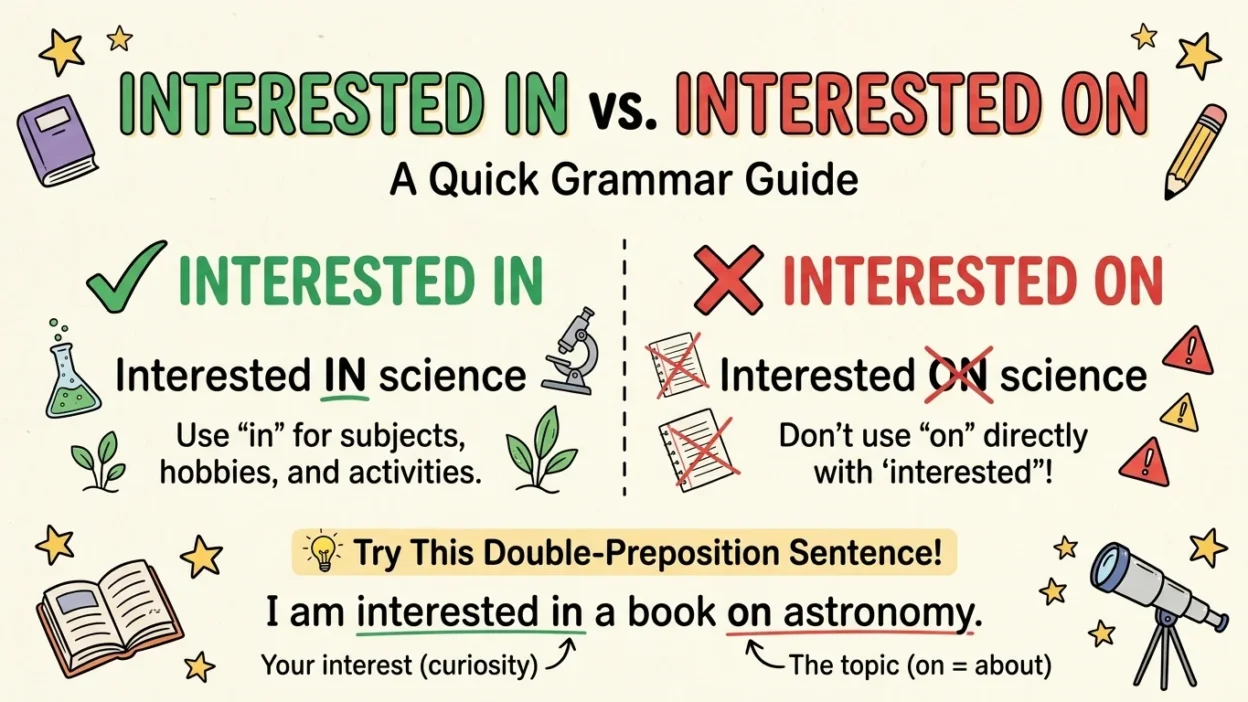
Should you say interested in or interested on? If you want to express curiosity, enthusiasm, or a desire to learn more about something, “interested in” is the correct and standard expression in English. For example, you should say, “I am interested in learning English,” not “I am interested on learning English.”
The confusion occurs because English uses different prepositions after different adjectives. Although on is correct in phrases such as “focused on” and “keen on,” it is not normally used after interested to introduce the subject of someone’s interest.
However, the word on can appear later in a sentence containing interested in when it belongs to another expression. For example, “I am interested in a book on grammar.” Here, in follows interested, while on describes the book’s subject.
In this guide, you will learn the difference between interested in and interested on, explore practical examples, and discover how to use the correct preposition in everyday conversations, emails, and academic writing.
Quick Answer: Interested In vs Interested On
Use “interested in” when talking about something that attracts your attention or curiosity. For example, “She is interested in science.” The expression “interested on” is generally incorrect when introducing the subject of someone’s interest. Say “interested in a topic,” not “interested on a topic.”
Why Do People Confuse Interested In and Interested On?
People often confuse these expressions because English prepositions can be difficult to predict. Some adjectives take in, while others take on, at, for, or about.
For example:
- Interested in music
- Focused on work
- Good at mathematics
- Responsible for a project
- Excited about a trip
Since on is correct after several other expressions, some learners mistakenly use it after interested.
The best way to avoid this mistake is to learn the standard combination: interested in.
What Does Interested In Mean?
The expression interested in means having curiosity, attention, enthusiasm, or a desire to learn more about someone or something.
It can describe interests in subjects, hobbies, careers, activities, people, and experiences.
Examples of Interested In
- Interested in science
- Interested in sports
- Interested in reading
- Interested in a new job
- Interested in learning English
- Interested in business
- Interested in history
- Interested in someone romantically
Example Sentences With Interested In
- I am interested in learning new languages.
- She is interested in science and technology.
- They are interested in buying a new house.
- He has always been interested in history.
- My brother is interested in playing football.
- We are interested in your proposal.
- The students are interested in environmental protection.
- She became interested in photography last year.
- Are you interested in joining our team?
- He is interested in learning how computers work.
In each example, in correctly connects the adjective interested to the subject, activity, or person that attracts someone’s attention.
What Does Interested On Mean?
“Interested on” is not the standard expression when you want to describe curiosity or enthusiasm about a subject.
For example:
Incorrect: I am interested on science.
Correct: I am interested in science.
Incorrect: She is interested on learning French.
Correct: She is interested in learning French.
However, on can appear in the same sentence when it belongs to a different phrase.
For example:
- I am interested in a book on astronomy.
- She is interested in a documentary on climate change.
- He is interested in a course on business management.
In these sentences, in follows interested. The word on introduces the subject of the book, documentary, or course.
Interested In vs Interested On: Key Differences
| Feature | Interested In | Interested On |
|---|---|---|
| Standard usage | Correct | Generally incorrect for introducing an interest |
| Meaning | Having curiosity or enthusiasm about something | No standard meaning in this construction |
| Grammar pattern | Interested in + noun or -ing verb | Usually avoid interested on + topic |
| Formal writing | Recommended | Not recommended for this meaning |
| Example | I am interested in art. | I am interested on art. |
| Correct alternative | Interested in art | Interested in art |
When Should You Use Interested In or Interested On?
Use Interested In for Subjects and Activities
Use interested in when describing something you like, want to explore, or want to know more about.
Examples:
- I am interested in psychology.
- She is interested in learning Spanish.
- We are interested in your business idea.
- He is interested in becoming a doctor.
- They are interested in modern architecture.
Use On When It Belongs to Another Expression
Do not replace in with on after interested. Instead, use on where the sentence requires it for another purpose.
Examples:
- I am interested in a book on photography.
- She is interested in a lecture on climate change.
- He is interested in a report on education.
- We are interested in attending a seminar on marketing.
- They are interested in a podcast on personal finance.
These examples show that both prepositions can occur in one sentence, but they perform different grammatical roles.
Interested In vs Interested On: More Example Sentences
| Incorrect | Correct |
|---|---|
| I am interested on music. | I am interested in music. |
| She is interested on science. | She is interested in science. |
| He is interested on football. | He is interested in football. |
| They are interested on traveling. | They are interested in traveling. |
| We are interested on your offer. | We are interested in your offer. |
| I am interested on learning English. | I am interested in learning English. |
| She is interested on art. | She is interested in art. |
| He is interested on business. | He is interested in business. |
| Are you interested on this job? | Are you interested in this job? |
| They became interested on history. | They became interested in history. |
Common Mistakes to Avoid
1. Using On After Interested
Incorrect: I am interested on photography.
Correct: I am interested in photography.
Remember that interested normally takes in when introducing the subject of interest.
2. Using the Wrong Form of the Verb
After interested in, you can use a noun or an -ing verb.
Correct:
- I am interested in music.
- I am interested in learning music.
Incorrect:
- I am interested in learn music.
3. Confusing Interested In With Interested About
Interested in is the usual expression for a subject or activity.
For example: “She is interested in history.”
The phrase interested about is possible in some contexts, especially when discussing someone’s reaction to information, but it is less common and often less natural than interested in or curious about.
For example:
- Natural: I am interested in the results.
- Natural: I am curious about the results.
4. Thinking On Is Always Incorrect
The word on is not wrong in every sentence containing interested. It can introduce the subject of a book, report, lecture, or other item.
Example: “I am interested in a book on astronomy.”
The key is to use in immediately after interested when expressing someone’s interest.
Memory Trick: How to Remember the Difference
Use this simple rule:
Interested in = Interest in something.
Remember these examples:
- Interested in music
- Interested in sports
- Interested in learning
- Interested in a new job
- Interested in science
If you want to use on, remember that it often describes the subject of a resource or event:
- A book on science
- A lecture on history
- A report on education
Try this sentence:
“I am interested in a book on astronomy.”
Here, in follows interested, while on tells you what the book is about.
American vs British English
There is no meaningful difference between American and British English in this rule. Both varieties use interested in to describe curiosity, enthusiasm, or attention toward a subject.
Examples:
- American English: I am interested in studying biology.
- British English: I am interested in studying biology.
The expression interested on is generally nonstandard for this meaning in both varieties.
Interested In vs Interested On: Similar Expressions
| Expression | Meaning | Example |
|---|---|---|
| Interested in | Curious about or attracted to something | She is interested in painting. |
| Curious about | Wanting to know more about something | I am curious about the results. |
| Keen on | Enthusiastic about something | He is keen on tennis. |
| Focused on | Giving attention to something | She is focused on her studies. |
| Excited about | Feeling enthusiasm about something | We are excited about the trip. |
| Passionate about | Having a strong interest in something | He is passionate about music. |
| Concerned about | Worried about something | They are concerned about the delay. |
Frequently Asked Questions
1. Is it interested in or interested on?
Interested in is the standard expression when describing curiosity or enthusiasm about something. For example, “I am interested in science.”
2. Can I say “I am interested on this topic”?
In standard English, say “I am interested in this topic.” The preposition in is the correct choice.
3. Is “interested on learning” correct?
No, not in standard English. Say “interested in learning.” For example, “She is interested in learning French.”
4. Can interested in be followed by a verb?
Yes. Use the -ing form of the verb after interested in.
Examples:
- I am interested in reading.
- She is interested in traveling.
- They are interested in studying abroad.
5. Is “interested about” correct?
Interested about is less common and often less natural when naming a topic of interest. In most cases, use interested in or curious about, depending on the intended meaning.
6. Can I use interested in for people?
Yes. You can say that you are interested in someone, including in a romantic sense.
Example: “He is interested in her.”
7. Why do we say “a book on science” but “interested in science”?
The prepositions serve different grammatical purposes. On can introduce the subject covered by a book, while in follows interested to identify the subject attracting someone’s attention.
8. Is interested in formal or informal?
Interested in is appropriate in both formal and informal English. You can use it in conversations, emails, academic writing, job applications, and professional communication.
Remember This
Always use “interested in” when describing curiosity or enthusiasm about a subject, activity, person, or opportunity.
Say “interested in science,” “interested in learning,” or “interested in the job.” Do not use interested on to introduce the thing that interests you.
Conclusion
The difference between interested in and interested on is mainly a matter of standard English grammar. When you want to express curiosity, enthusiasm, or a desire to learn more about something, use interested in.
Although on can appear later in a sentence, as in “a book on history,” it does not normally replace in after interested. Learning this simple pattern will help you write more naturally and avoid a common preposition mistake.

Adam Aaron is a language enthusiast and content writer at SimileHive, creating clear, engaging guides on similes, idioms, metaphors, and figurative language to help readers improve English confidently every day.