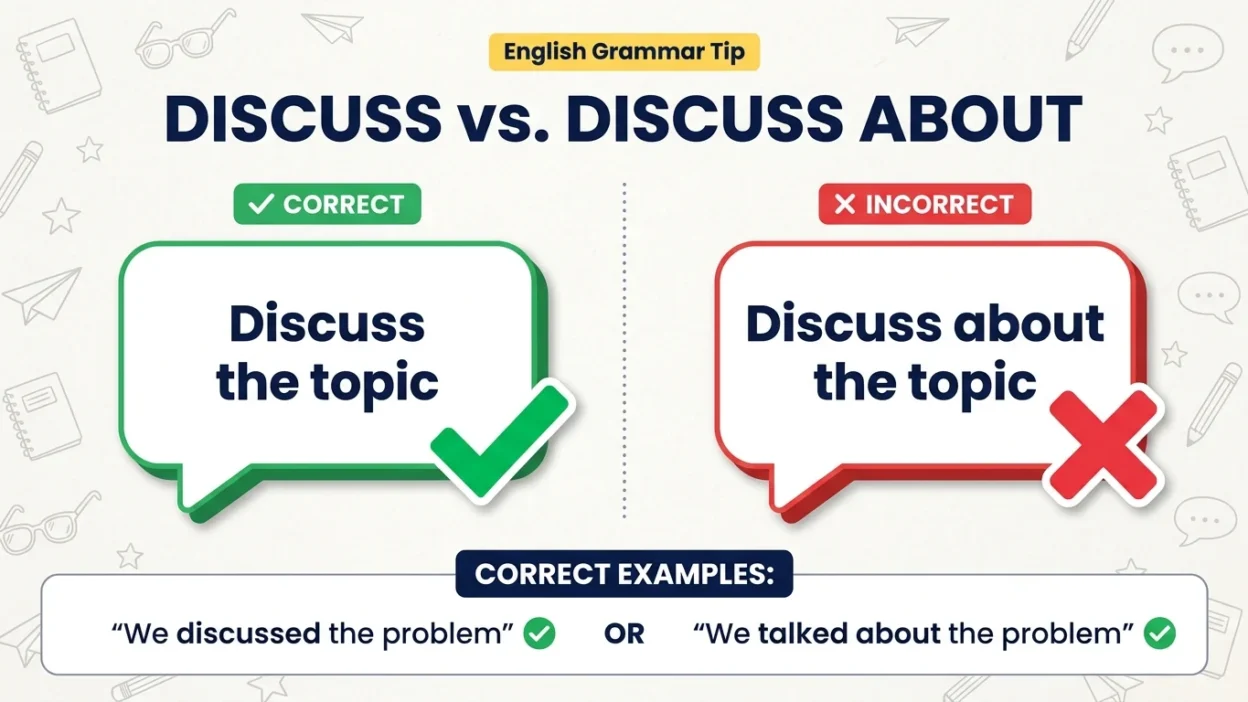
Is it correct to say discuss about or should you simply use discuss? In standard English, “discuss about” is generally incorrect when you mean to talk about a topic. The verb discuss already means to talk about something, so you do not need the extra preposition about.
For example, you should say, “We discussed the problem,” rather than “We discussed about the problem.” Similarly, “The students discussed the new lesson” is more natural and grammatically standard than “The students discussed about the new lesson.”
This mistake is common among English learners because many similar verbs, such as talk, speak, and think, can be followed by about. However, discuss works differently. Understanding this simple grammar rule can help you write more naturally in emails, academic assignments, business conversations, and everyday English.
In this article, you will learn why discuss about is usually incorrect, how to use discuss properly, and when you can use talk about instead.
Quick Answer: Discuss About vs Discuss
Use “discuss something,” not “discuss about something,” when you mean to talk about a topic. For example, say “We discussed the issue” instead of “We discussed about the issue.” If you want to use about, say “We talked about the issue.” Both discuss the issue and talk about the issue are correct.
Why Do People Say Discuss About?
People often say discuss about because they apply the grammar pattern of other common verbs to discuss.
For example:
- We talked about the problem.
- We spoke about the problem.
- We discussed the problem.
The first two examples use about, but the third does not need it.
Another reason is that some languages use a preposition equivalent to about after their verbs for discussion. Speakers may carry that pattern into English.
Although you may hear discuss about in everyday conversations, especially among English learners and in some regional varieties, “discuss something” is the standard construction in formal and general English.
What Does Discuss Mean?
The verb discuss means to talk about a subject with another person or group, usually to share ideas, exchange information, or consider a problem.
It is a transitive verb in this meaning, which means it normally takes a direct object without a preposition.
Examples of Discuss
- Discuss a problem
- Discuss a topic
- Discuss the results
- Discuss a proposal
- Discuss an important issue
- Discuss future plans
- Discuss the advantages and disadvantages
Example Sentences With Discuss
- We need to discuss the problem before making a decision.
- The teacher discussed the new topic in class.
- They discussed their plans for the weekend.
- The committee will discuss the proposal tomorrow.
- My colleagues discussed the results of the meeting.
- Let us discuss your ideas in more detail.
- The manager discussed the company’s future plans.
- The students discussed the advantages and disadvantages of online learning.
- We discussed the matter with our supervisor.
- The team is discussing ways to improve its performance.
Notice that discuss is followed directly by the topic. No about is needed.
What Does Discuss About Mean?
The expression discuss about is generally considered nonstandard when about simply introduces the topic being discussed.
For example:
Incorrect: We discussed about the new policy.
Correct: We discussed the new policy.
However, the word about can appear later in a sentence containing discuss when it belongs to another grammatical structure.
For example:
- We discussed the concerns about the new policy.
- They discussed the information about the project.
- The students discussed what the article was about.
In the first two examples, about belongs to the noun phrase that follows it. In the third, about appears at the end of a clause and is not directly following discuss as a required preposition.
Discuss About vs Discuss: Key Differences
| Feature | Discuss | Discuss About |
|---|---|---|
| Standard usage | Correct | Generally nonstandard for introducing a topic |
| Grammar pattern | Discuss + topic | Discuss about + topic is usually avoided |
| Formal writing | Recommended | Usually considered an error |
| Example | We discussed the issue. | We discussed about the issue. |
| Better alternative | Discuss the issue | Talk about the issue |
When Should You Use Discuss or Talk About?
Both expressions can be correct, but they follow different grammatical patterns.
Use Discuss + Topic
Use discuss when you want to describe a conversation about a subject, issue, or idea.
Examples:
- We discussed the budget.
- They discussed the problem with their manager.
- The class discussed climate change.
- I would like to discuss your application.
- The board discussed the proposed changes.
Use Talk About + Topic
Use talk about when you want to say that someone is speaking about a subject.
Examples:
- We talked about the budget.
- They talked about the problem with their manager.
- The class talked about climate change.
- I would like to talk about your application.
- The board talked about the proposed changes.
The meanings often overlap, but discuss can sound more focused or formal, especially in professional and academic settings.
Discuss vs Talk About: Comparison Table
| Sentence | Correct? | Explanation |
|---|---|---|
| We discussed the issue. | Yes | Discuss takes a direct object. |
| We discussed about the issue. | Generally no | Remove about. |
| We talked about the issue. | Yes | Talk commonly takes about before a topic. |
| We spoke about the issue. | Yes | Speak about is a standard construction. |
| We discussed the issue with our teacher. | Yes | With introduces the person involved in the discussion. |
| We discussed about the issue with our teacher. | Generally no | Say “discussed the issue with our teacher.” |
Discuss About: 15 Common Mistakes and Corrections
Here are common examples to help you use discuss correctly.
| Incorrect | Correct |
|---|---|
| We discussed about the problem. | We discussed the problem. |
| Let’s discuss about your plans. | Let’s discuss your plans. |
| The teacher discussed about grammar. | The teacher discussed grammar. |
| They discussed about the meeting. | They discussed the meeting. |
| I want to discuss about this matter. | I want to discuss this matter. |
| We discussed about the new rules. | We discussed the new rules. |
| She discussed about her future. | She discussed her future. |
| The team discussed about the project. | The team discussed the project. |
| They are discussing about the issue. | They are discussing the issue. |
| We will discuss about the results. | We will discuss the results. |
| He discussed about his concerns. | He discussed his concerns. |
| The students discussed about the book. | The students discussed the book. |
| Can we discuss about this later? | Can we discuss this later? |
| The manager discussed about the changes. | The manager discussed the changes. |
| We need to discuss about our options. | We need to discuss our options. |
Common Mistakes to Avoid
1. Adding About After Discuss
Incorrect: I want to discuss about my future.
Correct: I want to discuss my future.
Remember that discuss already includes the idea of talking about a subject.
2. Confusing Discuss With Talk
Incorrect: We discussed about the exam.
Correct: We discussed the exam.
Also correct: We talked about the exam.
The important point is to use the correct pattern for each verb.
3. Thinking About Is Always Wrong Near Discuss
Incorrect: We discussed about the problem.
Correct: We discussed the problem.
Also correct: We discussed the concerns about the problem.
The word about can appear in a sentence with discuss. It simply should not be added directly after discuss to introduce its topic in standard usage.
4. Using Discuss About in Formal Writing
In essays, reports, emails, and academic assignments, use discuss the topic rather than discuss about the topic.
For example:
Incorrect: This essay will discuss about the causes of pollution.
Correct: This essay will discuss the causes of pollution.
Memory Trick: How to Remember the Difference
Use this simple rule:
- Discuss + topic
- Talk about + topic
Think of these examples:
- Discuss the movie.
- Talk about the movie.
- Discuss the meeting.
- Talk about the meeting.
Whenever you want to use about, ask yourself whether you can replace discuss about with talk about. If you can, you can usually also use discuss directly with the topic.
American vs British English
There is no meaningful difference between American and British English in this rule.
Both varieties generally use discuss something rather than discuss about something when introducing the subject of a discussion.
Examples:
- American English: We discussed the proposal.
- British English: We discussed the proposal.
You may encounter discuss about in regional or informal usage, but discuss the proposal is the safer choice in standard writing.
Discuss vs Talk About: Similar Expressions
| Expression | Correct Example |
|---|---|
| Discuss | We discussed the issue. |
| Talk about | We talked about the issue. |
| Speak about | She spoke about her experience. |
| Debate | They debated the proposal. |
| Consider | We considered the available options. |
| Review | The team reviewed the results. |
| Go over | Let’s go over the instructions. |
| Have a discussion about | We had a discussion about the issue. |
Notice that have a discussion about is correct because about follows the noun discussion, not the verb discuss.
Frequently Asked Questions
1. Is “discuss about” grammatically correct?
In standard English, discuss about is generally considered incorrect when about directly introduces the topic. Say “discuss the topic” instead.
2. Should I say “discuss this” or “discuss about this”?
Say “discuss this.” For example, “We need to discuss this matter.” You can also say, “We need to talk about this matter.”
3. Is “discuss about” acceptable in spoken English?
You may hear it in conversation, particularly among learners or in some regional varieties. However, discuss something is the standard form and is recommended for clear, formal English.
4. What is the difference between discuss and talk about?
Both can describe talking about a subject. Discuss is often more direct or formal, while talk about is common in everyday conversation. Their grammatical patterns differ: discuss a topic but talk about a topic.
5. Can I say “discuss with someone”?
Yes. You can say “discuss something with someone.”
Example: “I discussed the issue with my teacher.”
Do not add about before the topic.
6. Is “discuss the matter about” correct?
It depends on what follows. “Discuss the matter about the new policy” can sound awkward or unclear. A more natural sentence is “Discuss the matter concerning the new policy” or “Discuss the new policy.”
7. Is “have a discussion about” correct?
Yes. Have a discussion about something is grammatically correct because about introduces the topic of the noun discussion.
Example: “We had a discussion about our future plans.”
8. Can I write “This essay discusses about climate change”?
It is better to write “This essay discusses climate change.” The verb discusses takes the topic directly, without about.
Remember This
Say “discuss the topic,” not “discuss about the topic.”
Use discuss directly with the subject, but use about with verbs and expressions such as talk about, speak about, and have a discussion about.
Conclusion
The difference between discuss about and discuss is a simple but important grammar rule. In stahttps://dictionary.cambridge.org/dictionary/english/betweenndard English, discuss takes a direct object, so you should say “discuss the problem,” “discuss the meeting,” or “discuss your plans.”
If you prefer to use about, choose a construction such as “talk about the problem” or “have a discussion about the problem.” Following this rule will make your English clearer, more natural, and more appropriate for both formal writing and everyday conversation.

Charles Kevin is a passionate language writer and researcher at SimileHive, creating clear, engaging content about similes, idioms, metaphors, and figurative language to help readers improve English communication confidently every day.