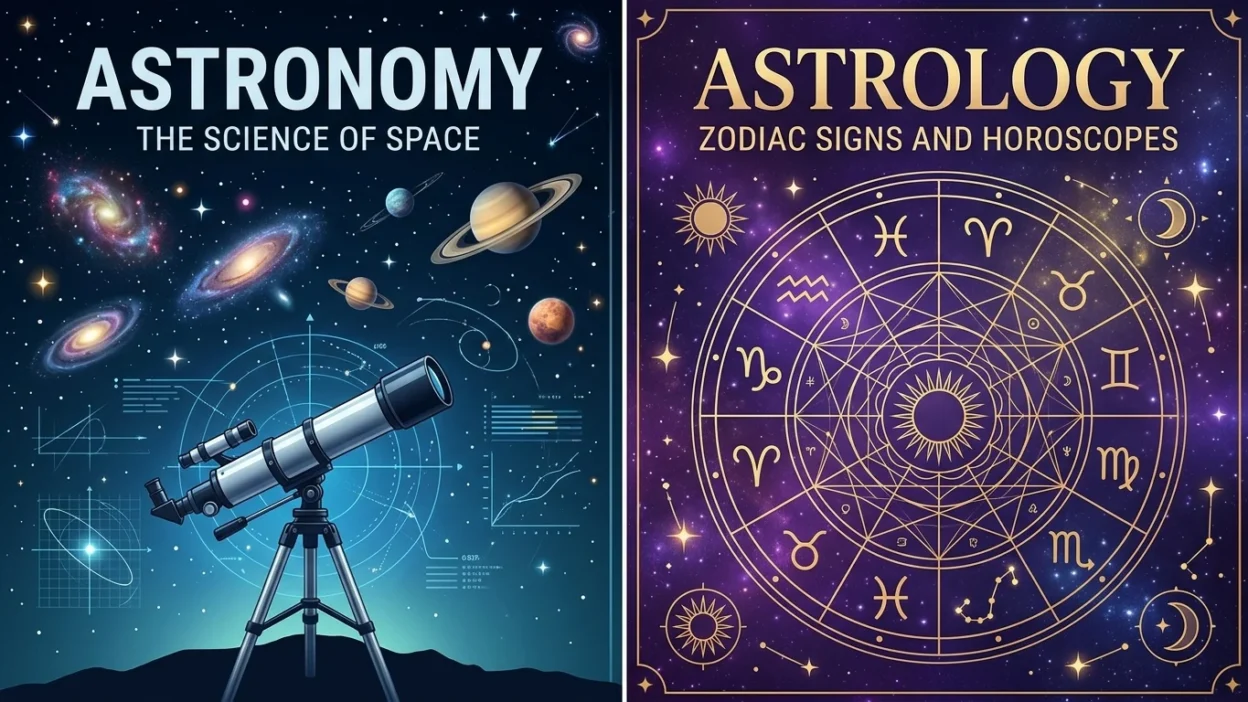
Astronomy and astrology may sound similar, but they are two very different subjects. Both involve celestial objects such as stars, planets, the Moon, and other objects in space. However, they differ in their purposes, methods, and scientific foundations.
Astronomy is the scientific study of the universe, while astrology is the belief that the positions and movements of celestial bodies are connected to human personalities and events.
People often confuse these words because they share the same Greek root related to stars and have similar spellings. Yet, choosing the correct word matters, especially when writing about science, horoscopes, space exploration, or zodiac signs.
Astronomy uses observation, mathematics, and scientific evidence to understand the universe. Astrology interprets the positions of celestial bodies to make claims about personality traits or possible future events.
In this guide, you will learn the meaning of astronomy and astrology, discover their main differences, and explore practical examples. You will also find simple memory tricks to help you remember which word to use.
Quick Answer: Astronomy vs Astrology
Astronomy is a natural science that studies stars, planets, galaxies, and the universe using scientific methods. Astrology is a belief system that interprets the positions of celestial bodies as meaningful for human personality, relationships, or future events. Astronomy is supported by scientific evidence, while astrology is not scientifically established as a reliable way to predict human affairs.
Why Do People Confuse Astronomy and Astrology?
People confuse astronomy and astrology for three main reasons.
- Similar spelling: Both words begin with “astro,” which relates to stars or celestial objects.
- Shared subject matter: Both discuss planets, stars, and other objects in the sky.
- Historical connection: Astronomy and astrology were closely connected in some ancient cultures. Over time, astronomy developed into a modern scientific discipline, while astrology continued as a system of symbolic interpretation and prediction.
Although the words look alike, they describe different ways of understanding the sky.
What Is Astronomy?
Astronomy is the scientific study of celestial objects, space, and the universe as a whole. Astronomers investigate how stars form, how planets move, what galaxies contain, and how the universe changes over time.
Astronomy relies on observations, mathematical models, experiments where possible, and evidence that can be tested and evaluated.
Examples of Astronomy
- Studying the planets in our solar system.
- Observing distant galaxies through telescopes.
- Investigating black holes and neutron stars.
- Measuring the distance between celestial objects.
- Researching how the universe began and evolved.
- Studying whether other planets might have conditions suitable for life.
Example Sentences With Astronomy
- My sister wants to study astronomy at university.
- The astronomy club uses a telescope to observe the Moon.
- Astronomy helps scientists understand how stars are formed.
- We watched a documentary about astronomy and distant galaxies.
- Modern astronomy uses powerful telescopes to explore space.
What Is Astrology?
Astrology is a belief system that interprets the positions and movements of celestial bodies as having connections with human personality, relationships, and events.
Astrologers often use birth charts, zodiac signs, and planetary positions to offer interpretations or predictions. These practices vary across astrological traditions.
Unlike astronomy, astrology is not recognized as a scientific method for reliably determining personality or predicting individual events. Scientific studies have not established that astrological readings provide reliable predictive information beyond chance or general statements.
Examples of Astrology
- Reading a daily horoscope based on a zodiac sign.
- Creating a birth chart using a person’s birth date, time, and place.
- Comparing zodiac signs for romantic compatibility.
- Interpreting planetary positions as symbols of life changes.
- Consulting an astrologer for a personal reading.
Example Sentences With Astrology
- My friend reads her horoscope because she enjoys astrology.
- Astrology often uses zodiac signs to interpret personality traits.
- He consulted an astrologer to learn about his birth chart.
- The magazine publishes a weekly astrology column.
- Some people use astrology when thinking about relationships or major decisions.
Astronomy vs Astrology: Key Differences
| Feature | Astronomy | Astrology |
|---|---|---|
| Meaning | Scientific study of the universe | Interpretation of celestial positions in relation to human affairs |
| Main purpose | To understand space and celestial objects | To interpret personality traits or possible events |
| Method | Observation, mathematics, and scientific testing | Birth charts, zodiac signs, and symbolic interpretations |
| Scientific status | Established natural science | Not scientifically established as a reliable predictive system |
| Practitioners | Astronomers and astrophysicists | Astrologers |
| Common tools | Telescopes, satellites, and scientific instruments | Birth charts, astrological tables, and zodiac systems |
| Typical question | How do stars form? | What might my zodiac sign say about me? |
| Example | Studying a distant planet | Reading a horoscope |
When Should You Use Astronomy or Astrology?
Choose the word according to what you are discussing.
Use Astronomy When Talking About Science and Space
Use astronomy when the subject involves scientific research into the universe.
Examples:
- She enjoys reading books about astronomy.
- The school organized an astronomy night to observe Saturn.
- Scientists use astronomy to investigate distant galaxies.
- He hopes to become an astronomer and study black holes.
Use Astrology When Talking About Horoscopes and Zodiac Signs
Use astrology when discussing a system of beliefs involving celestial positions and human life.
Examples:
- She follows astrology and reads her daily horoscope.
- The astrologer explained the meaning of his birth chart.
- Astrology often connects zodiac signs with personality traits.
- They discussed astrology and relationship compatibility.
Astronomy vs Astrology: More Example Sentences
Here are additional examples to make the difference easier to understand.
| Astronomy | Astrology |
|---|---|
| Astronomy helps us understand the life cycle of stars. | Astrology associates zodiac signs with personality traits. |
| Our class watched a film about astronomy. | My cousin enjoys reading about astrology. |
| The astronomer studied the planet using a telescope. | The astrologer interpreted the planetary positions in a birth chart. |
| Astronomy examines the physical properties of galaxies. | Astrology interprets celestial positions symbolically. |
| She chose astronomy because she loves scientific research. | He became interested in astrology after reading horoscopes. |
| The observatory offers astronomy lessons to students. | The website offers astrology readings for different zodiac signs. |
| Astronomy can help scientists discover planets outside our solar system. | Astrology may be used by some people as a tool for personal reflection. |
| The professor explained how astronomy has advanced over time. | The article described the history of astrology. |
| Astronomy uses evidence to develop and test explanations. | Astrology uses traditional systems to interpret celestial patterns. |
| The documentary explored astronomy and the structure of the universe. | The podcast discussed astrology and zodiac compatibility. |
Is Astronomy a Science, and Is Astrology a Science?
Astronomy is a science. It uses systematic observation, mathematical reasoning, and testable explanations to study the universe. Astronomical theories are evaluated against evidence and revised when new findings require it.
Astrology is not considered a science. Although it uses astronomical information, such as the apparent positions of planets and the Sun, its claims about personality and future events have not gained reliable scientific support.
The key distinction is that astronomy investigates physical processes using scientific methods, while astrology assigns interpretations to celestial patterns based on traditional belief systems.
Are Astronomy and Astrology Related?
Historically, astronomy and astrology were connected. Ancient civilizations observed celestial movements for practical purposes, such as tracking seasons and creating calendars, while also interpreting those movements as signs related to earthly events.
As scientific methods developed, astronomy became a distinct field focused on evidence-based explanations of the universe. Astrology continued as a separate tradition involving horoscopes, birth charts, and symbolic interpretations.
Today, the two subjects share some vocabulary and celestial references, but their methods and goals are different.
Common Mistakes to Avoid
1. Using Astronomy When You Mean Astrology
Incorrect: I read my astronomy forecast to find out what my zodiac sign says.
Correct: I read my astrology forecast to find out what my zodiac sign says.
2. Using Astrology When You Mean Astronomy
Incorrect: The scientist uses astrology to study distant galaxies.
Correct: The scientist uses astronomy to study distant galaxies.
3. Assuming Both Are Scientific Fields
Astronomy is a scientific discipline. Astrology is a belief system that has not been scientifically validated as a reliable way to predict personality or future events.
4. Confusing an Astronomer With an Astrologer
An astronomer studies the universe scientifically. An astrologer interprets celestial positions according to astrological traditions.
5. Assuming Similar Words Have Similar Purposes
Astronomy and astrology share a historical connection and similar roots, but their meanings are not interchangeable.
Memory Trick: How to Remember the Difference
Use this simple trick:
- Astronomy = Astronauts and space science. Think of telescopes, planets, stars, and galaxies.
- Astrology = Astrology charts and zodiac signs. Think of horoscopes, birth charts, and symbolic predictions.
Remember this example:
“I study astronomy to understand the planets, but I read astrology to learn what my horoscope says.”
The first sentence is about science. The second is about a belief system.
Astronomy vs Astrology: Similar Words
| Word | Meaning |
|---|---|
| Astronomer | A scientist who studies celestial objects and the universe |
| Astrologer | A person who practices or interprets astrology |
| Astronomical | Related to astronomy or celestial objects; also used informally to mean extremely large |
| Astrological | Related to astrology, horoscopes, or zodiac interpretations |
| Horoscope | An astrological forecast or chart based on celestial positions |
| Zodiac | A belt of the sky used in astronomy and divided into signs in astrology |
| Astrophysics | The branch of astronomy that applies physics to understand celestial objects and cosmic phenomena |
| Cosmology | The scientific study of the universe’s origin, structure, and evolution |
Frequently Asked Questions
1. What is the main difference between astronomy and astrology?
Astronomy is the scientific study of the universe and celestial objects. Astrology interprets the positions of celestial bodies as connected to human personality and events.
2. Which is correct, astronomy or astrology?
Both words are correct, but they have different meanings. Use astronomy for scientific studies of space and astrology for horoscopes, zodiac signs, and related belief systems.
3. Is astrology based on astronomy?
Astrology uses information about celestial positions, but its interpretations and predictions about human affairs are not scientifically established. Astronomy studies celestial objects through scientific methods.
4. What is a person who studies astronomy called?
A person who studies astronomy scientifically is called an astronomer. An astronomer may specialize in areas such as planetary science, stars, galaxies, or cosmology.
5. What is a person who studies astrology called?
A person who practices or studies astrology is called an astrologer. Astrologers interpret celestial positions using astrological traditions and systems.
6. Why do astronomy and astrology have similar names?
Both words share a Greek-derived root associated with stars or celestial objects. They also have a historical connection because ancient sky observation often combined practical observation with astrological interpretation.
7. Can astrology predict the future accurately?
Astrology is used by some people to make predictions, but scientific evidence has not established it as a reliable method for predicting individual events or outcomes.
8. Is astronomy harder than astrology?
Astronomy usually requires substantial study of mathematics, physics, data analysis, and scientific methods. Astrology involves learning its own traditions and interpretive systems, but it does not follow the same scientific standards as astronomy.
Remember This
Astronomy studies the universe through science, while astrology interprets celestial positions in relation to human life.
Use astronomy when discussing stars, planets, galaxies, telescopes, and scientific discoveries. Use astrology when discussing horoscopes, birth charts, zodiac signs, and astrological predictions.
Conclusion
Astronomy and astrology may sound alike, but they represent two different approaches to celestial objects. Astronomy is an established science that investigates the universe through observation, mathematics, and evidence. Astrology is a belief system that interprets the positions of celestial bodies in connection with personality and possible life events.
The easiest way to remember the difference is to connect astronomy with space science and astrology with horoscopes. Once you understand this distinction, you can use both words accurately in conversations, schoolwork, and writing.

Lucas Luke is a passionate language writer and content creator at SimileHive, specializing in similes, idioms, metaphors, and figurative language. He enjoys making complex English expressions simple, engaging, and easy to understand for students, writers, and language enthusiasts through well-researched, practical content.