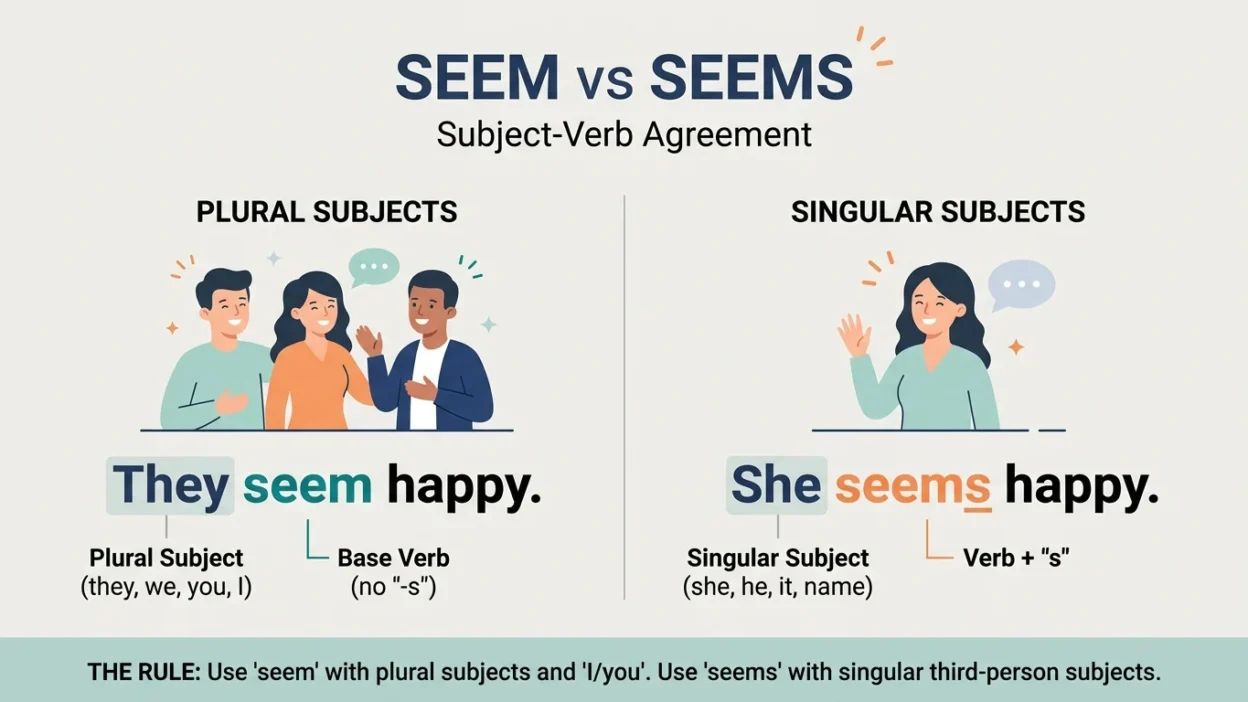
“Seem” and “seems” are both correct forms of the same verb, but they are used with different subjects. Use “seem” with I, you, we, they, and plural nouns. Use “seems” with he, she, it, and singular third person nouns. Both forms mean to appear to be a certain way or give a particular impression.
For example, you should say “They seem happy” but “She seems happy.” Similarly, “The answers seem correct” is right because “answers” is plural, while “The answer seems correct” is right because “answer” is singular.
This difference is important in everyday conversation, professional emails, essays, and formal writing. Although the rule is simple, people sometimes confuse these forms when a sentence contains a long subject or when they are unsure whether the subject is singular or plural.
In this guide, you will learn the meaning of “seem” and “seems,” the grammar rules for choosing between them, common mistakes to avoid, and practical examples that will help you use both forms correctly.
Quick Answer
“Seem” is used with I, you, we, they, and plural subjects. “Seems” is used with he, she, it, and singular third person subjects. For example, say “You seem tired” but “He seems tired.” Both forms mean to appear or give a particular impression.
Why Do People Confuse “Seem” and “Seems”?
People confuse “seem” and “seems” because both forms express the same basic meaning. The difference is grammatical, not a difference in meaning.
In the simple present tense, most English verbs take an -s ending when the subject is he, she, it, or a singular noun. The verb “seem” follows this rule.
Compare these examples:
- I seem busy.
- You seem busy.
- We seem busy.
- They seem busy.
- He seems busy.
- She seems busy.
- The teacher seems busy.
The key is to identify the subject before choosing the verb.
1. What Does “Seem” Mean?
“Seem” means to appear to be something or give the impression that something is true. It is often used when you describe how something looks, feels, or appears based on the information available.
Examples of “Seem”
- You seem happy today.
- They seem ready for the meeting.
- We seem to have enough time.
- I seem to remember this place.
- The students seem excited about the trip.
- These instructions seem confusing.
- You seem very confident.
- My friends seem worried about the results.
- The answers seem correct.
- The children seem tired after the game.
When Should You Use “Seem”?
Use “seem” with:
- I: I seem nervous.
- You: You seem upset.
- We: We seem prepared.
- They: They seem interested.
- Plural nouns: The books seem expensive.
You can also use “seem” with plural subjects followed by an adjective, a noun phrase, or an infinitive.
Examples:
- They seem friendly.
- The plans seem like a good idea.
- The children seem to understand the lesson.
2. What Does “Seems” Mean?
“Seems” is the third person singular form of the verb “seem” in the simple present tense. It has the same meaning as “seem,” but it is used with a singular third person subject.
Examples of “Seems”
- He seems happy today.
- She seems worried about the exam.
- It seems difficult at first.
- The teacher seems pleased with the results.
- My brother seems tired.
- The weather seems pleasant.
- This idea seems interesting.
- The answer seems correct.
- Your friend seems very polite.
- The situation seems complicated.
When Should You Use “Seems”?
Use “seems” with:
- He: He seems busy.
- She: She seems happy.
- It: It seems possible.
- Singular nouns: The dog seems hungry.
- Singular indefinite pronouns: Everyone seems ready.
Examples:
- The movie seems interesting.
- My phone seems broken.
- Everyone seems excited about the event.
Remember that words such as “everyone,” “someone,” and “nobody” are grammatically singular, even though they can refer to multiple people.
Comparison Table 1: Seem vs Seems
| Feature | Seem | Seems |
|---|---|---|
| Verb form | Base form | Third person singular |
| Subject | I, you, we, they | He, she, it |
| Plural nouns | Yes | No, not in standard subject agreement |
| Singular nouns | Generally no | Yes |
| Example | They seem happy. | She seems happy. |
| Meaning | To appear or give an impression | To appear or give an impression |
The main difference is subject agreement. Both forms have the same meaning.
3. What Is the Main Grammar Rule for “Seem” and “Seems”?
The rule is based on the subject of the sentence.
Use “Seem” with Plural Subjects
When the subject refers to more than one person or thing, use “seem.”
Examples:
- The flowers seem fresh.
- My parents seem pleased.
- These questions seem difficult.
- The players seem confident.
Use “seem” with “I,” “you,” “we,” and “they,” even when “you” refers to just one person.
Example: “You seem tired.”
Use “Seems” with Singular Third Person Subjects
When the subject is one person or thing referred to as he, she, or it, use “seems.”
Examples:
- The flower seems fresh.
- My father seems pleased.
- This question seems difficult.
- The player seems confident.
What About “Everyone” and “Each”?
Words such as “everyone,” “everybody,” “someone,” “anyone,” “each,” and “nobody” usually take a singular verb.
Correct:
- Everyone seems ready.
- Each student seems confident.
- Nobody seems interested.
Incorrect in standard English:
- Everyone seem ready.
- Each student seem confident.
- Nobody seem interested.
Comparison Table 2: Correct and Incorrect Sentences
| Sentence | Correct or Incorrect? |
|---|---|
| They seem happy. | Correct |
| They seems happy. | Incorrect |
| He seems tired. | Correct |
| He seem tired. | Incorrect |
| The books seem interesting. | Correct |
| The book seems interesting. | Correct |
| Everyone seems ready. | Correct |
| Everyone seem ready. | Incorrect in standard English |
4. How Do You Use “Seem” and “Seems” in Different Sentence Structures?
The verb “seem” can be followed by an adjective, a noun phrase, “like,” or an infinitive. The subject determines whether you use “seem” or “seems.”
Seem or Seems + Adjective
- The children seem happy.
- The child seems happy.
- You seem nervous.
- She seems nervous.
Seem or Seems + Like
- These shoes seem like a good choice.
- This shoe seems like a good choice.
- They seem like nice people.
- He seems like a nice person.
Seem or Seems + To + Verb
- They seem to understand the instructions.
- She seems to understand the instructions.
- We seem to have a problem.
- He seems to have a problem.
Seem or Seems + To Be
- The answers seem to be correct.
- The answer seems to be correct.
- You seem to be busy.
- He seems to be busy.
The subject determines the verb form in all these patterns.
5. More Examples of “Seem” and “Seems”
Here are 16 additional examples to help you understand the difference.
Examples with “Seem”
- These shoes seem too small.
- You seem familiar with this topic.
- We seem to be going in the wrong direction.
- The neighbors seem friendly.
- The instructions seem easy to follow.
- They seem to know each other.
- My cousins seem excited about the wedding.
- The prices seem reasonable.
Examples with “Seems”
- This shoe seems too small.
- He seems familiar with this topic.
- The car seems to be making a strange noise.
- Our neighbor seems friendly.
- The instruction seems easy to follow.
- She seems to know the answer.
- My cousin seems excited about the wedding.
- The price seems reasonable.
Notice how the verb changes when the subject changes from plural to singular.
6. Common Mistakes to Avoid
Mistake 1: Using “Seems” with “They”
Incorrect: They seems happy.
Correct: They seem happy.
“They” takes the base form of the verb in the simple present tense.
Mistake 2: Using “Seem” with “He” or “She”
Incorrect: She seem tired.
Correct: She seems tired.
Use “seems” with a singular third person subject.
Mistake 3: Forgetting That “Everyone” Is Singular
Incorrect: Everyone seem excited.
Correct: Everyone seems excited.
Although “everyone” refers to people in general, it takes a singular verb.
Mistake 4: Looking at the Nearest Noun Instead of the Subject
Incorrect: The list of items seem long.
Correct: The list of items seems long.
The subject is “list,” which is singular. The plural noun “items” is part of a phrase describing the list and does not control the verb.
Mistake 5: Changing the Verb After “Does”
When you use “does” in a question or negative sentence, the main verb returns to its base form.
Correct:
- Does she seem upset?
- He does not seem worried.
- Does the plan seem reasonable?
Incorrect:
- Does she seems upset?
- He does not seems worried.
7. A Simple Memory Trick
Remember this easy rule:
He, she, it = seems.
I, you, we, they = seem.
You can also remember that a singular noun usually takes “seems,” while a plural noun usually takes “seem.”
Examples:
- The cat seems hungry.
- The cats seem hungry.
- My friend seems tired.
- My friends seem tired.
When you are unsure, identify the subject first. Then choose the verb that agrees with it.
8. American vs British English
“Seem” and “seems” follow the same subject agreement rules in both American and British English.
There is no meaningful regional difference in the standard use of these forms.
American English:
- The team seems ready.
- The players seem ready.
British English:
- The team seems ready.
- The players seem ready.
In both varieties, collective nouns such as “team” can sometimes take plural agreement in British English when the members are being considered individually. However, “the team seems ready” is correct in both varieties, and “the team seem ready” can also occur in British usage depending on context.
9. Similar Words and Expressions
| Word | Example |
|---|---|
| Appear / Appears | They appear happy. / She appears happy. |
| Look / Looks | You look tired. / He looks tired. |
| Sound / Sounds | They sound excited. / It sounds exciting. |
| Feel / Feels | I feel nervous. / She feels nervous. |
| Become / Becomes | They become quiet. / He becomes quiet. |
| Remain / Remains | The doors remain open. / The door remains open. |
These verbs follow similar subject agreement patterns in the simple present tense.
10. Frequently Asked Questions
Is “Seem” or “Seems” Correct?
Both are correct. Use “seem” with I, you, we, they, and plural subjects. Use “seems” with he, she, it, and singular third person subjects.
Should I Say “It Seem” or “It Seems”?
Say “it seems.” The pronoun “it” is singular and takes “seems” in the simple present tense.
Example: “It seems like a good idea.”
Is It “You Seem” or “You Seems”?
“You seem” is correct. The verb “seem” is used with “you,” whether you are speaking to one person or several people.
Is It “Everyone Seem” or “Everyone Seems”?
“Everyone seems” is correct in standard English because “everyone” is grammatically singular.
Is “Does It Seem” or “Does It Seems” Correct?
“Does it seem” is correct. After “does,” use the base form “seem,” not “seems.”
Can “Seem” Be Used in the Past Tense?
Yes. The past tense is “seemed” for all subjects.
Examples:
- She seemed tired.
- They seemed happy.
- It seemed impossible.
What Is the Difference Between “Seem” and “Look”?
“Seem” describes a general impression or appearance, while “look” often refers more directly to visual appearance. For example, “He seems upset” expresses an impression, while “He looks upset” often suggests that his appearance gives that impression.
Remember This
Use “seem” with I, you, we, they, and plural nouns. Use “seems” with he, she, it, and singular third person nouns.
Both words mean “appear” or “give an impression.” The only difference is the subject they agree with.
Conclusion
The difference between “seem” and “seems” is simple once you understand subject verb agreement. “Seem” is used with I, you, we, they, and plural nouns, while “seems” is used with he, she, it, and singular third person nouns.
For example, “They seem happy” and “She seems happy” are both correct. Always identify the subject before choosing the verb, and remember to use the base form after “does.” With these rules and examples, you can use “seem” and “seems” confidently in everyday speech and writing.

Adam Aaron is a language enthusiast and content writer at SimileHive, creating clear, engaging guides on similes, idioms, metaphors, and figurative language to help readers improve English confidently every day.