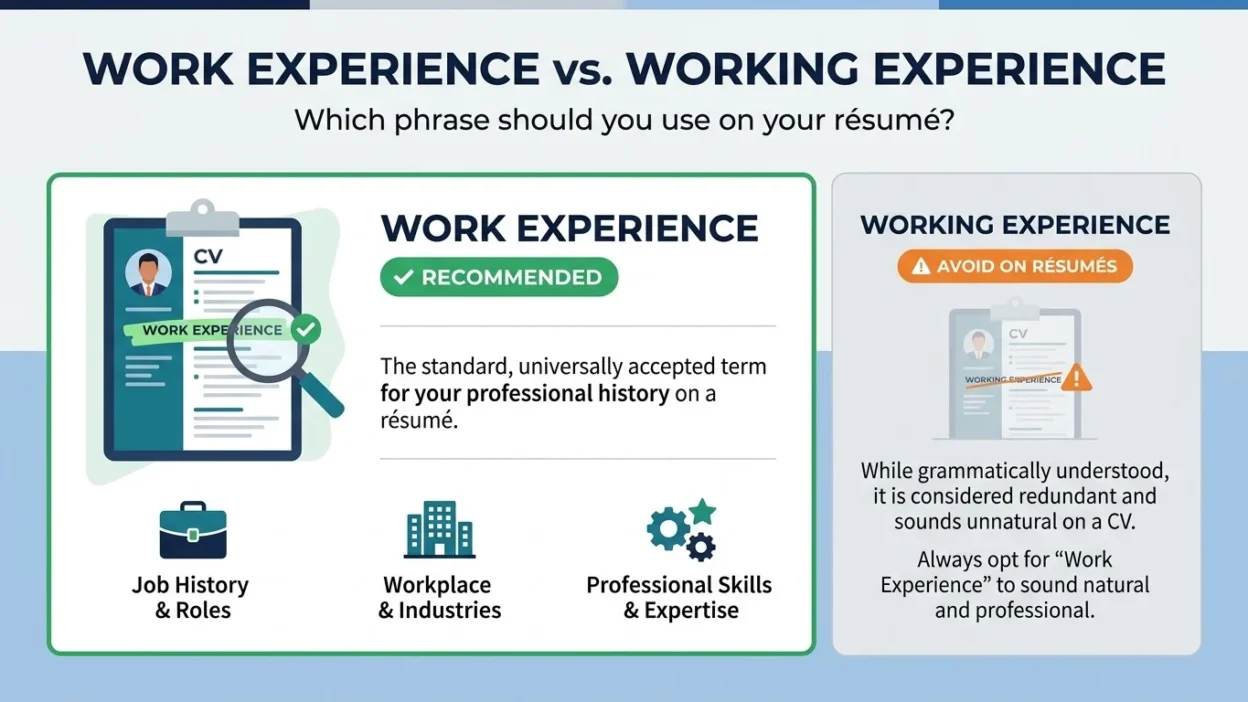
“Work experience” and “working experience” may seem interchangeable, but they are used differently in standard English. “Work experience” is the usual and preferred expression when talking about a person’s employment history, professional background, or practical knowledge gained through a job. For example, “I have five years of work experience” is a natural way to describe your professional background.
“Working experience” is also used in some contexts, particularly in certain regional varieties of English, but it is less common when describing employment history in international professional writing. In other sentences, “working” can function as an adjective, such as “a working experience” in some specialized contexts, although this wording is often less natural than alternatives such as “a practical experience” or “a hands-on experience.”
Choosing the right phrase matters when writing a résumé, preparing a CV, applying for a job, or describing your qualifications in an interview. In this guide, you will learn the meanings, differences, grammar rules, and practical examples of both expressions so you can use the most natural wording.
Quick Answer
“Work experience” is the standard expression for describing employment history, job skills, and professional experience. For example, “She has three years of work experience.” “Working experience” appears in some varieties of English, but it is less common in this meaning. For CVs, résumés, job applications, and professional communication, use “work experience.”
Why Do People Confuse “Work Experience” and “Working Experience”?
People confuse these expressions because work and working are both related to employment and activity.
In English, however, adding -ing can change how a word functions in a sentence. “Work experience” is an established phrase in which work describes the type of experience. “Working” can describe an activity or function as a participle or adjective, but that does not mean it can replace work in every expression.
For example:
- Work experience: I have two years of work experience.
- Working experience: This wording is used by some speakers, but “work experience” is more standard for describing employment history.
- Working environment: The conditions in which people work.
- Working hours: The hours during which someone works.
The key is to learn the natural expression for the meaning you want to communicate.
1. What Does “Work Experience” Mean?
“Work experience” refers to the knowledge, skills, and practical understanding a person gains through employment, internships, volunteering, or other work-related activities.
It can also refer to a person’s history of working in particular jobs or industries.
The expression is widely used in job applications, CVs, résumés, interviews, and career discussions.
Examples of “Work Experience”
- I have three years of work experience in customer service.
- The company requires candidates with relevant work experience.
- She gained valuable work experience during her internship.
- My work experience includes teaching and administration.
- Employers often look for candidates with practical work experience.
- He has extensive work experience in the technology industry.
- You should include your work experience on your résumé.
- The position is suitable for applicants with little work experience.
- Her previous work experience helped her secure the job.
- I am looking for an opportunity to gain work experience.
- The internship gave me useful work experience in marketing.
- Although he has limited work experience, he has strong technical skills.
When Should You Use “Work Experience”?
Use “work experience” when discussing:
- Employment history
- Professional skills and knowledge
- Previous jobs and responsibilities
- Internships and workplace training
- Experience relevant to a job application
For example:
“I have five years of work experience in accounting.”
This is natural, clear, and suitable for a CV, résumé, or interview.
2. What Does “Working Experience” Mean?
“Working experience” is a phrase used by some English speakers, especially in certain regional varieties, to refer to experience gained through employment. However, “work experience” is generally more idiomatic and widely preferred for this meaning.
The word working is more commonly used in expressions that describe an activity, condition, or function.
Examples include:
- working conditions
- working hours
- working environment
- working knowledge
- working relationship
In some contexts, “working experience” may also refer to the experience of working in a particular situation, but the intended meaning can be unclear. Often, a more specific expression will communicate the idea better.
Examples and Better Alternatives
| Less Preferred or Context Dependent | More Natural Alternative |
|---|---|
| I have five years of working experience. | I have five years of work experience. |
| She has working experience in finance. | She has work experience in finance. |
| We need candidates with working experience. | We need candidates with relevant work experience. |
| He gained working experience at the company. | He gained practical experience at the company. |
| It was a good working experience. | It was a valuable work experience or a valuable experience working there. |
The best alternative depends on the intended meaning. If you are describing your employment background, use “work experience.” If you are describing what it felt like to work somewhere, phrases such as “my experience working there” may be clearer.
Comparison Table 1: Work Experience vs Working Experience
| Feature | Work Experience | Working Experience |
|---|---|---|
| General usage | Standard and widely accepted | Less common in the employment-history sense |
| Meaning | Skills, knowledge, or history gained through work | Often intended to mean the same thing |
| CVs and résumés | Recommended | Generally avoid |
| Job interviews | Natural and professional | May sound less idiomatic |
| International English | Widely understood and preferred | Usage varies by region |
| Best choice | Most employment-related contexts | Use only when the wording fits a specific context |
3. What Is the Main Difference Between “Work Experience” and “Working Experience”?
The main difference is conventional usage and naturalness.
“Work Experience” Is the Standard Phrase
Use it when describing your employment history or the skills you have gained through work.
Examples:
- I have two years of work experience.
- The employer prefers candidates with relevant work experience.
- My work experience includes customer service and sales.
“Working Experience” Is Less Common for Employment History
Although people may understand “working experience,” it is not usually the first choice in standard professional English.
Instead of writing:
“I have considerable working experience in management.”
Write:
“I have considerable work experience in management.”
The second sentence is more natural and appropriate for a professional document.
Is “Working Experience” Always Wrong?
No. It is found in some regional usage, and working is correct in many other expressions. However, when you mean a person’s employment background, “work experience” is the safer and more widely accepted option.
Comparison Table 2: Correct Phrases for Different Situations
| Situation | Recommended Expression |
|---|---|
| Describing your employment history | Work experience |
| Applying for a job | Relevant work experience |
| Describing internship experience | Internship experience or work experience |
| Talking about experience gained at a workplace | Experience working at the company |
| Describing a job’s conditions | Working conditions |
| Talking about your schedule | Working hours |
| Describing familiarity with a subject | Working knowledge |
| Describing cooperation between colleagues | Working relationship |
4. When Should You Use “Work Experience”?
In a CV or Résumé
Use “Work Experience” as a section heading listing your previous jobs, employers, dates, and responsibilities.
Example:
Work Experience
- Marketing Assistant, ABC Company, 2023–2025
- Sales Representative, XYZ Ltd., 2021–2023
In a Job Application
Example:
“The position requires at least two years of relevant work experience.”
This wording is standard and professional.
In an Interview
Example:
“My work experience has helped me develop strong communication and problem-solving skills.”
In Education and Training
Work experience does not always mean paid employment. It can include internships, placements, volunteering, and other practical activities, depending on the context.
Example:
“My university internship gave me valuable work experience in software development.”
5. More Examples of “Work Experience” in Sentences
Here are additional examples showing how the phrase is used naturally.
Professional Examples
- The employer values relevant work experience.
- My work experience has prepared me for this position.
- She gained work experience in human resources.
- The role offers an opportunity to develop professional work experience.
- His work experience includes managing a team of ten employees.
Education and Career Examples
- Students can gain work experience through internships.
- The program helps graduates build practical work experience.
- Volunteering can provide useful work experience.
- My first job gave me valuable work experience.
- The applicant has limited work experience but excellent qualifications.
Everyday Examples
- I want to gain more work experience before applying for a senior role.
- Her work experience helped her adapt to the new position.
- You do not always need years of work experience to demonstrate your skills.
- The course combines classroom learning with work experience.
- His previous work experience made the transition easier.
6. Common Mistakes to Avoid
Mistake 1: Writing “Working Experience” on a CV
Less preferred: “Working Experience”
Recommended: “Work Experience”
Use “Work Experience” as the heading for your employment history.
Mistake 2: Assuming “Working” Can Replace “Work” Everywhere
English expressions have established word patterns.
For example:
- work experience
- working conditions
- working hours
- work permit
- working knowledge
The correct form depends on the expression.
Mistake 3: Confusing “Work Experience” with “Experience of Working”
These phrases are related but can have different emphasis.
- “I have work experience in retail” describes your professional background.
- “My experience of working in retail was rewarding” describes what it was like to work in retail.
The second construction focuses more on the experience of doing the activity.
Mistake 4: Using “Work Experiences” Without a Reason
“Work experience” is usually uncountable when it refers to a person’s overall professional background.
Natural: “She has extensive work experience.”
The plural “work experiences” can be used when referring to separate or distinct experiences, but it is less common in ordinary CV language.
7. A Simple Memory Trick
Remember this rule:
Work experience = your professional background and skills gained through work.
Use “working” when it naturally describes a noun or activity, as in “working hours” or “working conditions.”
Examples:
- I have five years of work experience.
- I have a working knowledge of Spanish.
- The company offers flexible working hours.
If you are writing a CV, résumé, cover letter, or job application, choose “work experience.”
8. American vs British English
“Work experience” is standard in both American and British English.
There is no major difference between the two varieties that requires American speakers to use “work experience” and British speakers to use “working experience.” The shorter phrase is widely accepted in both.
In British English, “work experience” can also refer to a short placement intended to help students learn about a workplace or career. In American English, people may use terms such as “internship,” “job shadowing,” or “work experience,” depending on the situation.
For international professional writing, “work experience” is the clearest general choice.
9. Similar Words and Expressions
| Expression | Meaning |
|---|---|
| Professional experience | Experience gained in a profession or career |
| Employment history | A record of previous jobs |
| Relevant experience | Experience that relates to a particular role |
| Practical experience | Knowledge gained through doing something |
| Hands-on experience | Direct involvement in a task or activity |
| Industry experience | Experience in a particular business sector |
| Job experience | Experience gained through a job |
| Working knowledge | Practical familiarity with a subject or skill |
These expressions overlap, but they are not identical. For example, employment history focuses on the jobs you have held, while practical experience emphasizes skills gained by doing rather than simply studying.
10. Frequently Asked Questions
Is “Work Experience” or “Working Experience” Correct?
Both expressions occur in English, but “work experience” is the standard and generally preferred phrase for employment history and professional skills.
Can I Write “Working Experience” on My CV?
It is better to write “Work Experience” on your CV or résumé. This is the conventional heading used for previous jobs, internships, and professional responsibilities.
Is “Working Experience” Grammatically Wrong?
Not necessarily. It is used in some regional varieties of English, but it is less common in standard international professional writing when referring to employment history.
Is “Work Experience” Countable or Uncountable?
It is usually uncountable when referring to professional background.
Example: “She has extensive work experience.”
When referring to separate events or activities, “experiences” may be appropriate, but the wording depends on the intended meaning.
What Is the Difference Between “Work Experience” and “Professional Experience”?
They are very similar. “Professional experience” often emphasizes experience in a career or profession, while “work experience” is broader and can include jobs, internships, placements, and other work-related activities.
Can Students Have Work Experience?
Yes. Students can gain work experience through internships, volunteering, part-time jobs, placements, and other practical activities. Paid employment is not the only possible source.
Is “Working Knowledge” Correct?
Yes. “Working knowledge” is a standard expression meaning practical familiarity with a subject, tool, or skill.
Example: “She has a working knowledge of Excel.”
Remember This
Use “work experience” when talking about employment history, professional skills, and experience gained through work. It is the standard choice for CVs, résumés, interviews, and job applications.
“Working experience” occurs in some contexts, but it is generally less natural for this meaning. When in doubt, write “work experience.”
Conclusion
The difference between “work experience” and “working experience” is mainly a matter of established usage. Although both expressions can be encountered in English, “work experience” is the more natural and widely accepted phrase for describing employment history, professional skills, and practical knowledge gained through work.
If you are preparing a CV, applying for a job, or describing your career background in an interview, “work experience” is the recommended choice. Remember that “working” is correct in expressions such as “working conditions,” “working hours,” and “working knowledge,” but it does not replace “work” in every phrase.

Charles Kevin is a passionate language writer and researcher at SimileHive, creating clear, engaging content about similes, idioms, metaphors, and figurative language to help readers improve English communication confidently every day.