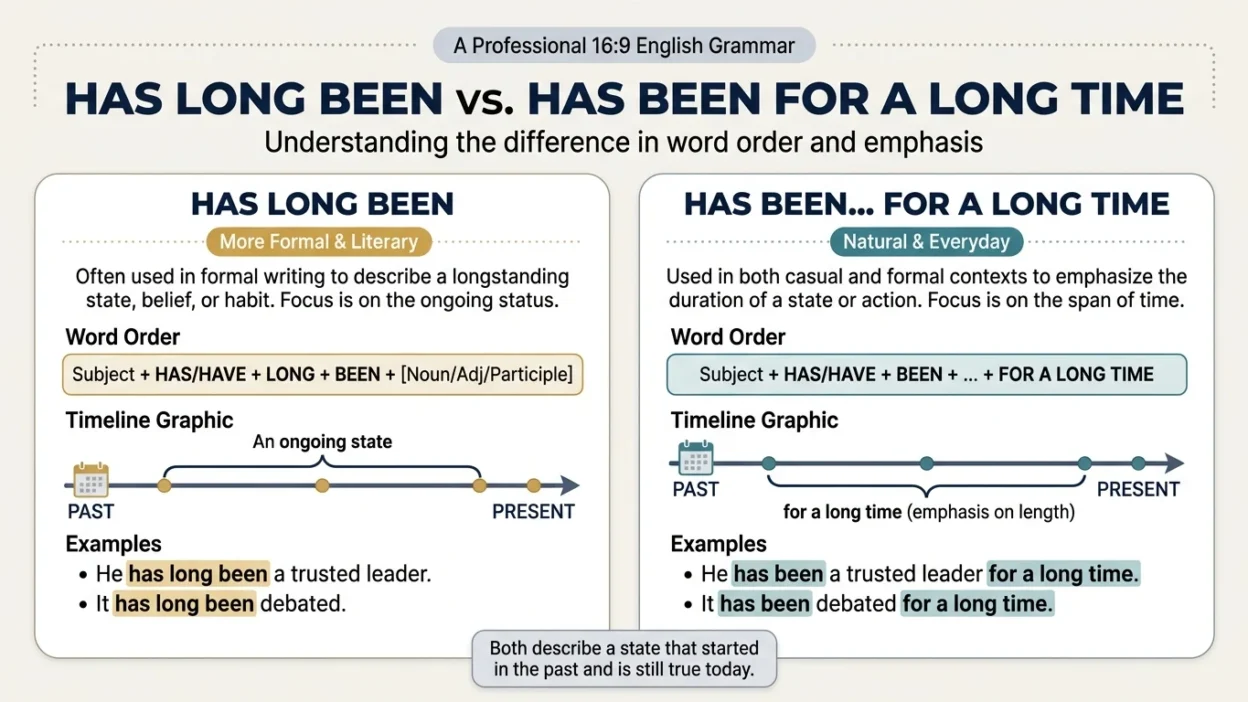
“Has long been” and “has been for a long time” are both correct English expressions. They describe something that started in the past and remains true in the present, or a condition that has continued over an extended period. The main difference is their style. “Has long been” is more concise and often sounds more formal, while “has been for a long time” is more conversational and explicit about duration.
For example, you can say, “She has long been a trusted friend” or “She has been a trusted friend for a long time.” Both sentences communicate that the friendship has lasted for many years or an extended period.
These expressions are useful in everyday conversations, academic writing, professional communication, and articles. However, their sentence structures are slightly different, and some verbs work more naturally with one construction than another. Understanding these patterns will help you choose the right expression and avoid awkward sentences.
In this guide, you will learn the meanings, grammar rules, differences, and correct usage of both expressions, along with practical examples to help you use them confidently.
Quick Answer
“Has long been” and “has been for a long time” are both correct. They often express the same idea: something began in the past and has continued to be true. “Has long been” is concise and often more formal, while “has been for a long time” emphasizes duration more explicitly and is common in everyday English.
Why Do People Confuse These Expressions?
People confuse these expressions because they can communicate the same meaning in many sentences.
For example:
- The city has long been a popular tourist destination.
- The city has been a popular tourist destination for a long time.
Both sentences describe a condition that has existed over an extended period.
The difference is mainly in wording and emphasis. The first sentence uses “long” before “been,” while the second uses the phrase “for a long time” to describe duration.
One important point is that these expressions are not interchangeable in every sentence. The verb and the structure of the sentence affect which version sounds natural.
1. What Does “Has Long Been” Mean?
“Has long been” means that something has been true, existed, or continued for an extended period.
It is formed using:
Subject + has + long + been + complement
Examples:
- She has long been a respected teacher.
- This building has long been a symbol of the city.
- He has long been interested in history.
The expression is particularly common in formal writing, news articles, academic discussions, and professional communication. However, it is not limited to formal contexts.
10 Examples of “Has Long Been”
- She has long been a trusted member of our team.
- Education has long been an important part of the community.
- This town has long been famous for its traditional crafts.
- He has long been interested in learning new languages.
- The river has long been a source of water for local farmers.
- Reading has long been one of her favorite activities.
- The company has long been a leader in its industry.
- This issue has long been a subject of public debate.
- The university has long been known for its research.
- My grandfather has long been a source of inspiration to me.
When Should You Use “Has Long Been”?
Use “has long been” when you want to express an established or continuing condition in a concise way.
For example:
“The region has long been known for its beautiful landscapes.”
This sentence sounds natural in an article, report, or descriptive passage.
2. What Does “Has Been for a Long Time” Mean?
“Has been for a long time” expresses that a condition or state has continued over an extended period.
Its basic structure is:
Subject + has been + complement + for a long time
Examples:
- She has been a teacher for a long time.
- This building has been a landmark for a long time.
- He has been interested in history for a long time.
The phrase “for a long time” explicitly tells the reader or listener that the condition has lasted for an extended period. It is natural in everyday conversations as well as many forms of writing.
10 Examples of “Has Been for a Long Time”
- She has been a trusted member of our team for a long time.
- Education has been an important part of the community for a long time.
- This town has been famous for its traditional crafts for a long time.
- He has been interested in learning new languages for a long time.
- The river has been a source of water for local farmers for a long time.
- Reading has been one of her favorite activities for a long time.
- The company has been a leader in its industry for a long time.
- This issue has been a subject of public debate for a long time.
- The university has been known for its research for a long time.
- My grandfather has been a source of inspiration to me for a long time.
When Should You Use “Has Been for a Long Time”?
Use this expression when you want to state the duration clearly, particularly in conversation.
For example:
“I have been interested in photography for a long time.”
This sounds natural when explaining a personal interest that began in the past and continues now.
Comparison Table 1: Has Long Been vs Has Been for a Long Time
| Feature | Has Long Been | Has Been for a Long Time |
|---|---|---|
| Meaning | A condition has existed for an extended period | A condition has existed for an extended period |
| Grammar | Has + long + been | Has been + complement + for a long time |
| Style | Often concise and formal | Often conversational and explicit |
| Emphasis | Highlights an established condition | Highlights how long the condition has lasted |
| Common contexts | Articles, reports, academic writing | Everyday speech and general writing |
| Correctness | Correct | Correct |
The two expressions often mean the same thing, but the best choice depends on the sentence and the tone you want.
3. What Is the Main Difference Between These Expressions?
The main difference is their placement of “long” and how they express duration.
“Has Long Been” Is More Concise
The word “long” appears between “has” and “been.”
Example:
“Technology has long been an important part of modern life.”
This wording is compact and often suits formal or descriptive writing.
“Has Been for a Long Time” States Duration More Explicitly
The phrase “for a long time” appears after the main description.
Example:
“Technology has been an important part of modern life for a long time.”
This sentence communicates essentially the same idea but spells out the duration more explicitly.
Are They Always Interchangeable?
No. They are interchangeable in many sentences, but not in every context.
For example:
- “She has long been working here” is possible, but it sounds less natural to many speakers than “She has been working here for a long time.”
- “She has long been a manager” sounds natural because “been a manager” describes a continuing state.
For an action that is still in progress, the present perfect continuous often works best:
“She has been working here for a long time.”
Comparison Table 2: Examples in Different Contexts
| Context | With “Has Long Been” | With “Has Been for a Long Time” |
|---|---|---|
| Education | Education has long been a priority. | Education has been a priority for a long time. |
| Friendship | He has long been my closest friend. | He has been my closest friend for a long time. |
| Business | The firm has long been successful. | The firm has been successful for a long time. |
| Public debate | The topic has long been controversial. | The topic has been controversial for a long time. |
| Personal interest | She has long been interested in art. | She has been interested in art for a long time. |
Both forms work naturally in these examples.
4. How Do You Use These Expressions Correctly?
To choose the correct expression, consider the verb, the type of condition, and the tone of your sentence.
Use “Has Long Been” with Nouns and Adjectives
This construction is particularly natural when describing a role, identity, quality, or established condition.
Examples:
- He has long been a supporter of the project.
- The area has long been popular with tourists.
- The subject has long been controversial.
- She has long been a reliable colleague.
Use “Has Been for a Long Time” to Emphasize Duration
This construction is especially natural in everyday explanations.
Examples:
- He has been a supporter of the project for a long time.
- The area has been popular with tourists for a long time.
- The subject has been controversial for a long time.
- She has been a reliable colleague for a long time.
Use the Present Perfect Continuous for Ongoing Actions
When describing an action that started in the past and continues now, the present perfect continuous is often the natural choice.
Examples:
- She has been studying English for a long time.
- He has been working at the company for a long time.
- They have been waiting for a long time.
You could also say, “She has long been studying English,” but that wording is more formal and less common in everyday conversation.
5. More Examples in Everyday English
Here are additional examples showing how the expressions work in different situations.
Professional and Academic Examples
- This organization has long been committed to helping local families.
- This organization has been committed to helping local families for a long time.
- The theory has long been accepted by many researchers.
- The theory has been accepted by many researchers for a long time.
- The school has long been known for its excellent teaching.
- The school has been known for its excellent teaching for a long time.
Personal and Social Examples
- She has long been one of my closest friends.
- She has been one of my closest friends for a long time.
- He has long been passionate about music.
- He has been passionate about music for a long time.
- They have long been supporters of the local team.
- They have been supporters of the local team for a long time.
General Descriptive Examples
- The mountain has long been a symbol of strength.
- The mountain has been a symbol of strength for a long time.
- The tradition has long been part of local culture.
- The tradition has been part of local culture for a long time.
- This road has long been an important trade route.
- This road has been an important trade route for a long time.
6. Common Mistakes to Avoid
Mistake 1: Assuming One Expression Is Incorrect
Incorrect assumption: “Has long been” is grammatically wrong because “long” should come after “been.”
Correction: “Has long been” is a standard and correct construction.
Mistake 2: Placing “For a Long Time” Awkwardly
Less natural: “She has for a long time been a teacher.”
More natural in ordinary writing: “She has been a teacher for a long time.”
The first sentence is grammatically possible, but the second is generally more natural for everyday communication.
Mistake 3: Using “Has” with a Plural Subject
Incorrect: “They has long been friends.”
Correct: “They have long been friends.”
Use “has” with he, she, it, and singular third-person subjects. Use “have” with I, you, we, and they.
Mistake 4: Confusing States with Ongoing Actions
For an ongoing activity, the present perfect continuous is often more natural.
Less natural in everyday conversation: “He has long been working here.”
More natural: “He has been working here for a long time.”
However, the first sentence is possible in more formal contexts.
7. A Simple Memory Trick
Remember these patterns:
- Has long been + description: concise and often formal.
- Has been + description + for a long time: explicit and conversational.
- Has been + verb-ing + for a long time: emphasizes an ongoing action.
Examples:
- She has long been a good friend.
- She has been a good friend for a long time.
- She has been helping me for a long time.
If you are unsure which to choose in everyday conversation, “has been for a long time” is often a straightforward option, provided you place it correctly in the sentence.
8. American vs British English
Both “has long been” and “has been for a long time” are used in American and British English.
There is no strict regional rule requiring one form in American English and the other in British English. The choice is primarily about sentence structure, emphasis, and style.
“Has long been” often appears in formal writing, journalism, and academic prose in both varieties. “Has been for a long time” is common in conversation and general writing in both varieties.
For an international audience, either form is appropriate when the sentence is constructed naturally.
9. Similar Expressions
These expressions can also describe something that started in the past and continues or remains true.
| Expression | Example |
|---|---|
| Has always been | She has always been kind to me. |
| Has been for years | He has been a teacher for years. |
| Has been for ages | We have been friends for ages. |
| Has been for quite some time | The issue has been discussed for quite some time. |
| Has existed for a long time | The tradition has existed for a long time. |
| Has remained | The building has remained popular. |
| Has continued to be | The place has continued to be a favorite destination. |
These alternatives have slightly different meanings. For example, “has always been” suggests continuity throughout the relevant period, while “has been for years” emphasizes duration without necessarily suggesting that the condition existed from the very beginning.
10. Frequently Asked Questions
Is “Has Long Been” Grammatically Correct?
Yes. “Has long been” is a correct English construction used to describe a condition or fact that has existed for an extended period.
Example: “She has long been a respected leader.”
Is “Has Been for a Long Time” Correct?
Yes. It is a correct and common expression.
Example: “She has been a respected leader for a long time.”
Which Is More Formal: “Has Long Been” or “Has Been for a Long Time”?
“Has long been” often sounds more concise and formal, especially in academic writing, journalism, and professional articles. However, “has been for a long time” is also suitable for formal writing when it fits the sentence.
Can I Use “Has Long Been” in Everyday Conversation?
Yes. It is grammatically correct in conversation, although it may sound more formal than “has been for a long time” in some situations.
Do These Expressions Have Exactly the Same Meaning?
They often have the same meaning when describing an ongoing state or condition. However, they are not interchangeable in every construction. The type of verb and the intended meaning affect which expression sounds natural.
Can I Say “Has Long Been Working”?
Yes, this construction is possible, particularly in formal or literary writing. In ordinary conversation, “has been working for a long time” is usually more natural.
What Is the Difference Between “Has Long Been” and “Has Always Been”?
“Has long been” means something has been true for an extended period. “Has always been” often suggests that it has been true throughout the relevant period, perhaps for as long as the speaker can remember.
For example, “He has long been interested in history” does not necessarily mean he has been interested in it his entire life.
Remember This
“Has long been” and “has been for a long time” are both correct, and they often express the same idea.
Use “has long been” for a concise expression that often suits formal writing. Use “has been for a long time” when you want to state the duration more explicitly. For ongoing actions, “has been doing something for a long time” is usually the more natural choice.
Conclusion
The difference between “has long been” and “has been for a long time” is mainly a matter of style and sentence structure. Both expressions can describe a condition that started in the past and continues to be true. The shorter form is often more concise and formal, while the longer form makes the duration more explicit.
When choosing between them, consider whether you are describing a state, such as being a teacher, or an ongoing action, such as working or studying. Both forms can be correct, but the most natural choice depends on the verb and context.

Lucas Luke is a passionate language writer and content creator at SimileHive, specializing in similes, idioms, metaphors, and figurative language. He enjoys making complex English expressions simple, engaging, and easy to understand for students, writers, and language enthusiasts through well-researched, practical content.