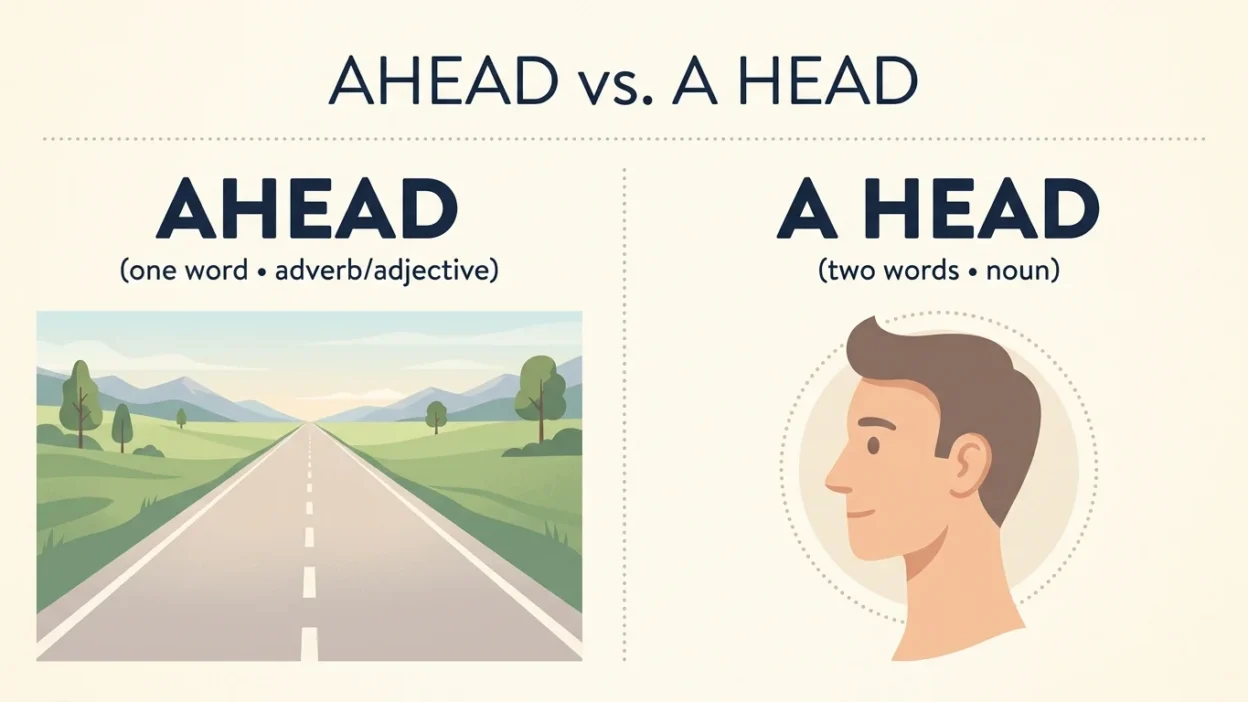
Ahead and a head sound exactly the same, but they have completely different meanings and grammatical functions. Ahead is usually an adverb meaning “in front,” “forward,” or “in the future.” A head is simply the article a followed by the noun head, meaning one person’s or animal’s head.
For example, “There is a long road ahead” uses ahead to talk about what is in front or in the future. In contrast, “The doctor examined a head in the medical illustration” uses a head as two separate words. Knowing whether you mean a position, direction, future time, or the physical body part will help you choose the correct form.
Quick Answer
Ahead is one word and usually means in front, forward, or in the future. A head is two words: a is an article and head is a noun. For example, “We have a long journey ahead” and “The statue has a head.”
Why Do People Confuse Ahead and A Head?
The main reason is pronunciation.
Ahead and a head are normally pronounced the same way:
ahead → uh-HEAD
a head → uh HEAD
Because they sound alike, it can be difficult to know which spelling is correct when writing.
The solution is to look at the meaning and grammar of the sentence.
| Form | Meaning | Example |
|---|---|---|
| ahead | In front, forward, or in the future | We have a difficult task ahead. |
| a head | One physical head | The statue has a head. |
Ahead: Meaning and Usage
Ahead is usually an adverb. It can describe position, direction, progress, or future time.
It can mean:
- In front
- Forward
- Further along
- In the lead
- In the future
- Before someone or something else
Ahead Meaning “In Front”
The car ahead is moving slowly.
Here, ahead means “in front of us.”
Another example:
There is a bridge ahead.
The bridge is in front of the speaker or traveler.
Ahead Meaning “In the Future”
We have a busy week ahead.
Here, ahead refers to future time.
Another example:
There are many challenges ahead.
The challenges have not happened yet but are expected in the future.
Ahead Meaning “Further Forward”
She walked ahead of the group.
She moved forward and was in front of the others.
Examples of Ahead
- There is a gas station just ahead.
- The road ahead looks dangerous.
- We have a long journey ahead.
- He walked ahead of us.
- The team is two points ahead.
- She is far ahead in her studies.
- Think ahead before making a decision.
- There are better opportunities ahead.
- The car ahead suddenly stopped.
- We need to plan ahead.
- The finish line is just ahead.
- He looked ahead and saw a large crowd.
- The company is moving ahead with the project.
- Keep moving ahead and do not give up.
- We have an exciting year ahead.
A Head: Meaning and Usage
A head is not a special expression like ahead. It is simply the article a followed by the noun head.
Here, head can refer to:
- The body part containing the brain, eyes, ears, nose, and mouth
- The head of an animal
- A person or animal considered as one individual
- The top or front part of something, depending on context
Examples of “A Head”
The child drew a head on the figure.
Here, “a head” means one head.
The doll has a head but no arms.
Again, “a” describes one head.
Examples of A Head
- The statue has a large head.
- The artist painted a head on the figure.
- The animal has a small head.
- I saw a head above the crowd.
- The doctor examined a head injury.
- The toy has a removable head.
- The drawing needs a head.
- The character has a round head.
- The sculpture has a human head.
- The costume includes a head and mask.
Notice that a head is normally part of a larger grammatical structure. You can often replace it with one head:
The statue has a head.
The statue has one head.
This helps you recognize the two-word form.
Ahead vs A Head: The Main Difference
The easiest rule is:
Ahead = one word meaning “in front,” “forward,” or “in the future.”
A head = two words meaning “one head.”
| Ahead | A Head |
|---|---|
| One word | Two words |
| Usually an adverb | Article + noun |
| Means in front, forward, or in the future | Means one head |
| “The road ahead is long.” | “The statue has a head.” |
| “We have work ahead.” | “The character has a head.” |
How to Know Which One to Use
Ask yourself what you mean.
Do you mean “in front” or “in the future”?
Use ahead.
There is a difficult decision ahead.
The car ahead is slowing down.
Do you mean “one head”?
Use a head.
The drawing has a head.
The statue has a head.
This simple question will solve most ahead vs a head problems.
Common Expressions With Ahead
Ahead of
Ahead of means in front of someone or something, or earlier than something.
She arrived ahead of schedule.
The runner is ahead of the others.
Go Ahead
Go ahead can mean to proceed or continue.
Go ahead and start without me.
Plan Ahead
Plan ahead means to prepare for the future.
It is always useful to plan ahead.
Look Ahead
Look ahead means to think about or consider the future.
We need to look ahead and prepare for next year.
Think Ahead
Think ahead means to consider what may happen in the future.
Good leaders think ahead.
Common Expressions With A Head
Because a head is simply an article plus a noun, it does not have the same fixed expressions as ahead.
However, you may see phrases such as:
a head injury
a head of hair
a head of lettuce
a head of cabbage
a head of cattle
The exact meaning of head changes according to the context.
For example:
I bought a head of lettuce.
Here, “a head” refers to one whole lettuce plant or compact cluster.
Compare These Sentences
These sentences show the difference clearly.
Example 1
There is a mountain ahead.
Meaning: The mountain is in front of us.
The statue has a head.
Meaning: The statue has one head.
Example 2
We have a difficult exam ahead.
Meaning: The exam is in the future.
The drawing needs a head.
Meaning: The drawing needs one head.
Example 3
The car ahead is red.
Meaning: The car in front is red.
The toy has a red head.
Meaning: The toy’s head is red.
Common Mistakes
1. Writing “a head” When You Mean “in Front”
Incorrect:
The road a head is blocked.
Correct:
The road ahead is blocked.
Here, you mean the road in front, so ahead is one word.
2. Writing “ahead” When You Mean One Head
Incorrect:
The statue has ahead.
Correct:
The statue has a head.
You mean one physical head, so the words must be separate.
3. Confusing “Ahead of” With “A Head Of”
Compare:
She arrived ahead of me.
This means she arrived before me or was in front of me.
But:
He ate a head of lettuce.
This means he ate one whole head of lettuce.
The spelling changes the meaning completely.
4. Forgetting That “Ahead” Can Refer to the Future
“Ahead” does not only mean physically in front.
We have a busy month ahead.
Here, it means a busy month is coming in the future.
When to Use Ahead
Use ahead when talking about:
- Position
- Direction
- Progress
- Future time
- Being in front
- Moving forward
- Planning for the future
Examples:
Look ahead.
The road ahead is narrow.
We have difficult days ahead.
She is ahead of the class.
When to Use A Head
Use a head when head is a noun and you mean one head.
Examples:
The animal has a head.
He drew a head on the character.
The statue has a large head.
We bought a head of cabbage.
American vs British English
There is no meaningful difference between American and British English in the spelling distinction between ahead and a head.
Both varieties use:
ahead for the adverb meaning “in front” or “in the future.”
a head for the article plus noun combination.
The pronunciation is also generally the same in both varieties, which is why context is so important.
Similar Words
| Word or Phrase | Meaning |
|---|---|
| Ahead | In front, forward, or in the future |
| A head | One head |
| In front | Located before or ahead of something |
| Forward | Toward the front or future |
| Before | Earlier than something |
| In advance | Before an event or expected time |
| Head | The body part or top/front part of something |
Frequently Asked Questions
What is the difference between ahead and a head?
Ahead is one word meaning “in front,” “forward,” or “in the future.” A head is two words meaning one physical head or another noun use of “head.”
Is “ahead” one word or two?
Ahead is one word.
The road ahead is clear.
Is “a head” always two words?
When you mean the article a plus the noun head, yes.
The animal has a head.
Is “ahead of” one word?
Yes. Ahead of is written with “ahead” as one word.
She arrived ahead of schedule.
What does “a head” mean?
“A head” usually means one head, but “head” can have many meanings depending on context. For example, “a head of lettuce” refers to one whole lettuce plant or compact cluster.
Is “ahead” a preposition?
“Ahead” is most commonly used as an adverb, although it can appear in the compound preposition ahead of.
What does “ahead of schedule” mean?
“Ahead of schedule” means earlier or faster than planned.
The project is ahead of schedule.
What does “a head of cabbage” mean?
“A head of cabbage” means one whole cabbage, referring to the compact leafy structure.
Remember This
Use this simple memory trick:
Ahead = forward or future
A head = one head
Think:
The road ahead = the road in front.
A head = one physical head.
If you can replace the word with “in front” or “in the future,” use ahead.
If you can replace it with “one head,” use a head.
Final Verdict
Ahead and a head sound the same, but they have completely different meanings.
Use ahead when you mean in front, forward, further along, or in the future:
We have a lot of work ahead.
Use a head when you mean one head:
The statue has a head.
The easiest way to remember the difference is ahead = forward/future, a head = one head.
Conclusion
The difference between ahead and a head is simple once you focus on meaning. Ahead is one word that commonly describes position, direction, progress, or future time. A head is two words consisting of the article “a” and the noun “head.”
Because the two forms sound alike, spelling can be confusing. When writing, ask yourself whether you mean “in front or in the future” or “one head.” If you mean the first idea, choose ahead. If you mean the second, write a head.

Lucas Luke is a passionate language writer and content creator at SimileHive, specializing in similes, idioms, metaphors, and figurative language. He enjoys making complex English expressions simple, engaging, and easy to understand for students, writers, and language enthusiasts through well-researched, practical content.