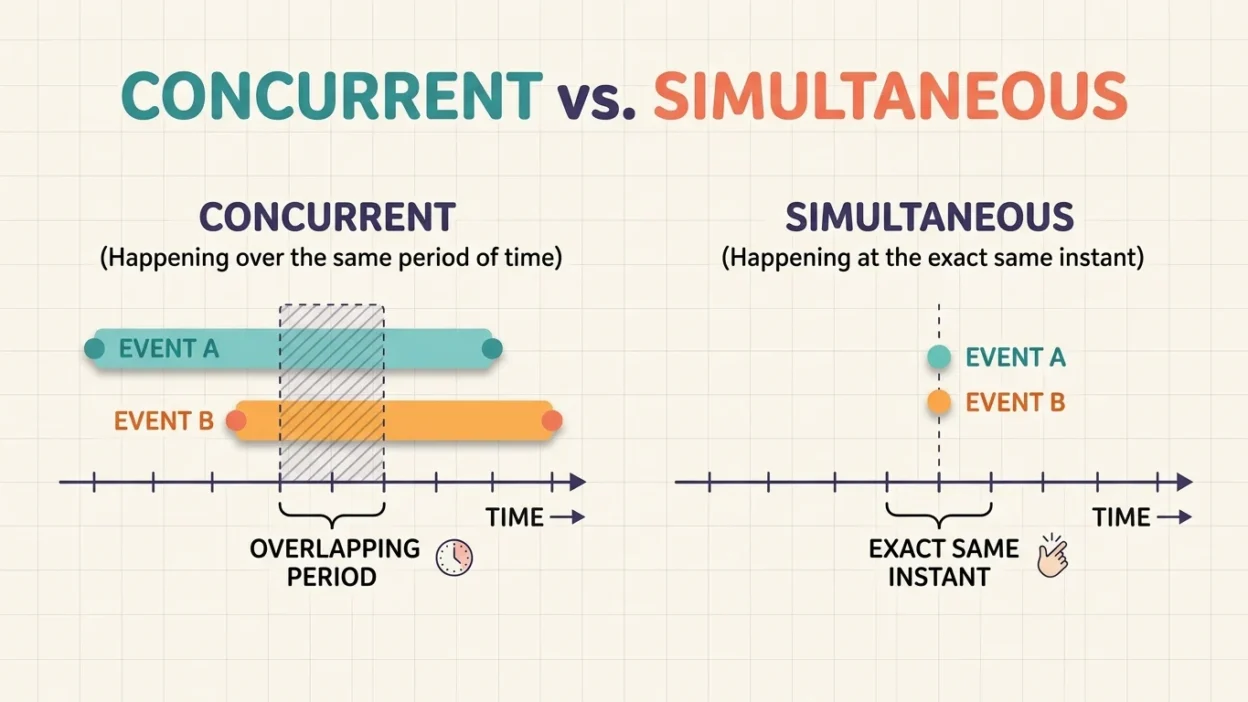
Concurrent and simultaneous both describe things that happen at the same time, so it is easy to confuse them. However, the two words focus on slightly different ideas. Concurrent usually means that two or more events, activities, periods, or processes overlap in time, while simultaneous means that things happen at exactly or nearly exactly the same time.
For example, if two employees work on separate projects during the same week, their work is concurrent because the periods overlap. If two alarms ring at exactly 8:00, they are simultaneous. The distinction becomes especially useful in business, science, technology, law, education, and everyday English. Understanding the difference will help you choose the more precise word when describing events, actions, processes, or periods that occur together.
Quick Answer
Concurrent means happening or existing during the same period, usually with some overlap. Simultaneous means happening at the same time, often at exactly the same moment. So, concurrent events can overlap without starting or ending together, while simultaneous events occur together at the same time.
Why Do People Confuse Concurrent and Simultaneous?
Both words are connected with time and can sometimes be translated as “happening at the same time.”
The important difference is the degree of timing involved.
Imagine two meetings:
- Meeting A runs from 9:00 to 10:00.
- Meeting B runs from 9:30 to 10:30.
The meetings are concurrent because they overlap.
But they are not necessarily simultaneous, because they did not start at the same time.
Now imagine two phones ringing at exactly 9:30.
Those calls are simultaneous because they happen at the same moment.
| Word | Main Idea | Example |
|---|---|---|
| Concurrent | Occurring during the same period or overlapping | Two projects were concurrent. |
| Simultaneous | Occurring at the same time or moment | Both alarms rang simultaneously. |
Concurrent: Meaning and Usage
Concurrent is an adjective meaning happening, existing, or continuing during the same period of time.
It often emphasizes overlap or coexistence, rather than an exact moment.
Examples
She is taking two concurrent courses this semester.
The courses take place during the same period.
The company is working on several concurrent projects.
The projects are happening during the same period, although they may have different starting and ending dates.
Common contexts for “concurrent”
You will often see concurrent used with:
- Projects
- Events
- Activities
- Processes
- Courses
- Sessions
- Responsibilities
- Systems
- Conditions
- Terms
Example Sentences
- The company is managing several concurrent projects.
- She completed two concurrent training programs.
- The conference has three concurrent sessions.
- The two investigations were conducted concurrently.
- He had several concurrent responsibilities at work.
- The software can process multiple concurrent requests.
- The students were enrolled in concurrent courses.
- Several concurrent events took place across the city.
- The researchers studied three concurrent processes.
- The two projects ran concurrently for several months.
Simultaneous: Meaning and Usage
Simultaneous means happening at the same time, especially at exactly or almost exactly the same moment.
It focuses more strongly on timing at a particular moment.
Examples
The two doors opened simultaneously.
This suggests that both doors opened at essentially the same time.
The audience gave a simultaneous cheer.
The people cheered together at the same moment.
Common contexts for “simultaneous”
You will often see simultaneous used with:
- Actions
- Events
- Movements
- Sounds
- Reactions
- Announcements
- Releases
- Attacks
- Translations
- Occurrences
Example Sentences
- The two lights turned on simultaneously.
- Both players moved simultaneously.
- The bells rang simultaneously.
- The announcement was broadcast simultaneously in several countries.
- They gave simultaneous answers.
- The two explosions occurred simultaneously.
- The children raised their hands simultaneously.
- The two systems failed simultaneously.
- The singers began simultaneously.
- Both teams scored almost simultaneously.
Concurrent vs Simultaneous: The Main Difference
The easiest distinction is:
Concurrent = overlapping in time
Simultaneous = happening at the same time
Consider these examples:
The two courses were concurrent.
They took place during the same period.
The two bells rang simultaneously.
They rang at the same moment.
| Feature | Concurrent | Simultaneous |
|---|---|---|
| Basic meaning | Happening during the same period | Happening at the same time |
| Main focus | Overlap | Same moment |
| Exact timing required? | No | Usually yes or nearly so |
| Can events have different start times? | Yes | Usually no |
| Common use | Projects, courses, processes, periods | Actions, sounds, reactions, events |
| Example | Concurrent projects | Simultaneous explosions |
Can Concurrent Mean Simultaneous?
Sometimes, yes.
If two events happen at exactly the same time, they are concurrent in the broader sense that they occur during the same period.
However, concurrent does not necessarily mean simultaneous.
This is the most important point.
For example:
The two projects were concurrent.
This does not tell us that they started or finished on the same day. It only tells us that their periods overlapped.
But:
The two events were simultaneous.
strongly suggests that they occurred at the same time.
Therefore, simultaneous is usually more precise when you mean “at the same moment.”
Concurrent vs Simultaneous in Everyday English
In everyday conversation, at the same time is often more natural than either word.
For example:
They arrived at the same time.
This is simple and natural.
You could say:
They arrived simultaneously.
This is grammatically correct but sounds more formal.
You could also say:
Their activities were concurrent.
But this would suggest that their activities overlapped rather than necessarily beginning at the same moment.
Concurrently vs Simultaneously
The adverbs follow the same basic distinction.
Concurrently means during the same period or with overlapping timing.
The two teams worked concurrently on the project.
Simultaneously means at the same time or moment.
The two machines started simultaneously.
Compare:
The programs ran concurrently.
They operated during overlapping periods.
The programs started simultaneously.
They started at the same moment.
Common Mistakes
1. Treating the Words as Perfect Synonyms
Although they are related, they are not always interchangeable.
The two projects were concurrent.
means their timelines overlapped.
The two projects were simultaneous.
suggests they happened at the same time.
The first sentence is generally more natural when discussing longer activities or periods.
2. Using “Simultaneous” for Any Overlapping Activity
If two activities overlap but start at different times, concurrent is usually more accurate.
For example:
The two courses were concurrent.
Course A: September to December
Course B: October to January
They overlap, but they are not necessarily simultaneous in their entirety.
3. Assuming Concurrent Means Exactly the Same Moment
It does not necessarily mean that.
Two events can be concurrent while occurring at different points within the same period.
4. Overusing “Simultaneously”
In ordinary conversation, “at the same time” is often more natural.
Instead of:
She answered the questions simultaneously.
you might simply say:
She answered the questions at the same time.
When Should You Use Concurrent?
Use concurrent when you want to emphasize that activities, processes, periods, or events overlap or exist during the same timeframe.
Examples:
- concurrent projects
- concurrent sessions
- concurrent courses
- concurrent processes
- concurrent responsibilities
- concurrent investigations
Example:
The company is running three concurrent projects.
The projects are all active during an overlapping period.
When Should You Use Simultaneous?
Use simultaneous when you want to emphasize that two or more actions or events happen at the same moment.
Examples:
- simultaneous movements
- simultaneous announcements
- simultaneous reactions
- simultaneous attacks
- simultaneous releases
Example:
The two alarms went off simultaneously.
They went off at essentially the same moment.
Concurrent vs Simultaneous in Different Fields
Business
The company has several concurrent projects.
The projects are active during overlapping periods.
Technology
The server can handle multiple concurrent connections.
Multiple connections can be active at the same time.
Science
The researchers observed several concurrent processes.
The processes occurred during overlapping periods.
Broadcasting
The event was broadcast simultaneously in several countries.
The broadcasts happened at the same time.
Education
Students can enroll in two concurrent courses.
The courses take place during the same period.
American vs British English
Concurrent and simultaneous are used in both American and British English with essentially the same meanings.
There is no major difference in the basic distinction:
- Concurrent = overlapping or existing during the same period
- Simultaneous = happening at the same time or moment
The words are common in formal, academic, professional, and technical English.
Similar Words
| Word | Meaning |
|---|---|
| Concurrent | Happening during the same period |
| Simultaneous | Happening at the same moment |
| Synchronous | Happening at the same time or in coordination |
| Overlapping | Partly occupying the same period |
| Coinciding | Happening at the same time or matching |
| Parallel | Happening or developing alongside something else |
| Contemporaneous | Existing or occurring during the same period |
These words can overlap in meaning, but their uses are not always identical.
Frequently Asked Questions
What is the difference between concurrent and simultaneous?
Concurrent means occurring during the same period, usually with some overlap. Simultaneous means occurring at the same time, often at exactly the same moment.
Does concurrent mean simultaneous?
Not necessarily. Concurrent events can overlap without occurring at exactly the same moment. Simultaneous events happen at the same time.
Can two events be concurrent but not simultaneous?
Yes. For example, two meetings can overlap for 30 minutes even though one starts before the other. They are concurrent but not simultaneous.
Is concurrent the same as overlapping?
They are very similar. Concurrent often means that two or more things exist or happen during overlapping periods.
Is simultaneous more precise than concurrent?
When you mean exactly at the same time, yes. “Simultaneous” directly emphasizes the same moment, while “concurrent” can refer to a broader period of overlap.
What is the difference between concurrently and simultaneously?
Concurrently means during the same period or with overlapping timing. Simultaneously means at the same time or moment.
Is “at the same time” the same as “simultaneously”?
Usually, yes. “Simultaneously” is a more formal and concise way of saying that two or more things happen at the same time.
Which word is better for projects?
Concurrent is usually better for projects because projects can overlap in their timelines without starting or finishing at exactly the same time.
Remember This
Use this simple memory trick:
Concurrent = overlap
Simultaneous = same moment
Think of two movies:
If they are playing during the same evening but start at different times, they are concurrent.
If they both start at exactly 8:00, they are simultaneous.
So remember:
Concurrent means “during the same period.”
Simultaneous means “at the same time.”
Final Verdict
The difference between concurrent and simultaneous is mainly about how precisely you are describing time.
Use concurrent when two or more things happen or exist during an overlapping period. Use simultaneous when they happen at the same moment.
Concurrent = overlapping time.
Simultaneous = same time.
If you are talking about long-running projects, courses, processes, or responsibilities, concurrent is often the better choice. If you are describing actions, reactions, sounds, or events occurring at exactly the same moment, simultaneous is usually more precise.
Conclusion
Although concurrent and simultaneous are closely related, they are not completely interchangeable. Concurrent describes things that happen during the same general period, so some overlap is enough. Simultaneous describes things that happen at the same time, with the focus on a shared moment.
The easiest way to remember the distinction is concurrent means overlapping, while simultaneous means happening together at the same moment. Once you understand this difference, choosing between the two words becomes much easier in everyday, academic, business, and technical writing.

Adam Aaron is a language enthusiast and content writer at SimileHive, creating clear, engaging guides on similes, idioms, metaphors, and figurative language to help readers improve English confidently every day.